
Cottonbatting Plant (Pseudognaphalium stramineum)
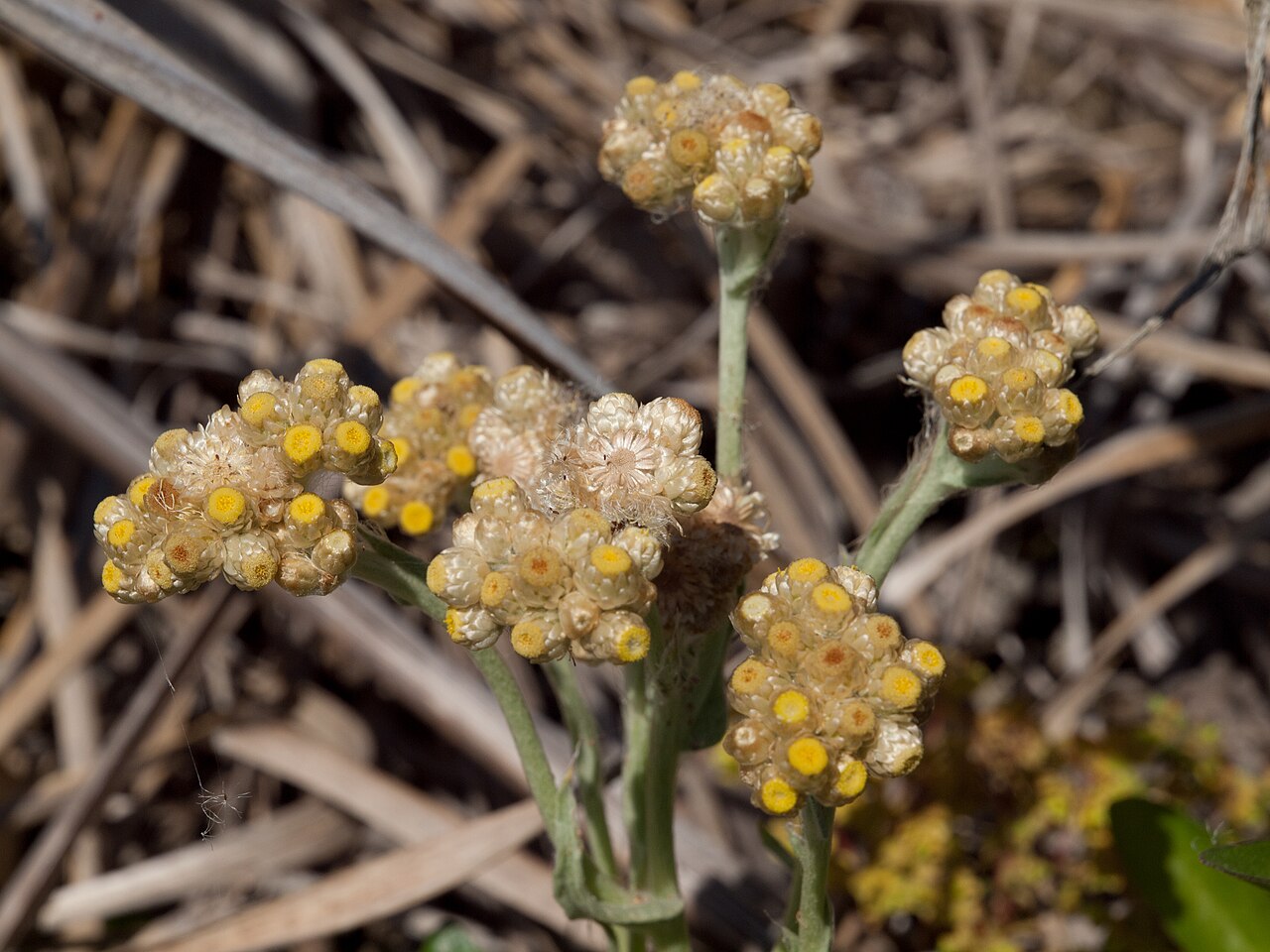
Pseudognaphalium stramineum, known as Cottonbatting Plant (also cotton-batting cudweed, Chilean cudweed or everlasting cudweed), is a woolly annual or biennial cudweed of western North America. It belongs to the aster family (Asteraceae) and was long known as Gnaphalium stramineum or G. chilense. The common name comes from the thick, loose, cottony white hairs that cover its stems and leaves.
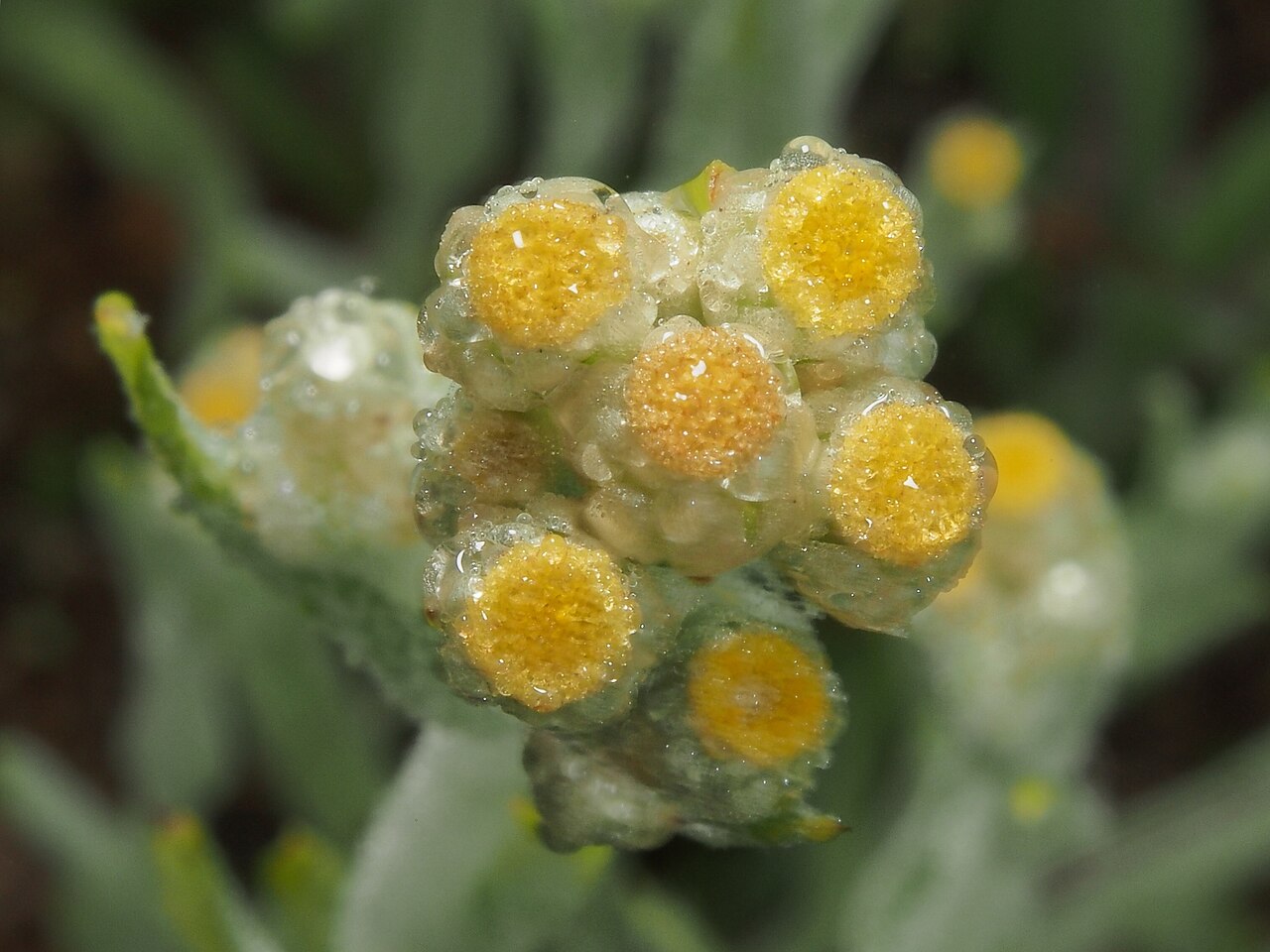
It grows 6 inches to about 2 1/2 feet tall, with upright, densely woolly stems and narrow, gray-green leaves. From spring through fall it carries dense, rounded clusters of small flower heads at the stem tips. Each head is surrounded by papery, straw-colored to pale yellow bracts (stramineum means “straw-colored”), and the heads keep their shape when dry, like other everlastings.
Cottonbatting plant is common in moist sandy or gravelly places, from coastal dunes and streambanks to desert washes and mountain meadows. It is a short-lived plant that often appears on its own after disturbance. In wild gardens it adds soft, silvery texture, feeds small pollinators and serves as a larval host for the American lady butterfly.
Identification
Look for upright, densely woolly, gray-white plants with narrow leaves and tight, rounded clusters of small, straw-colored, papery flower heads at the stem tips, often in sandy, moist ground.
Growth Habit
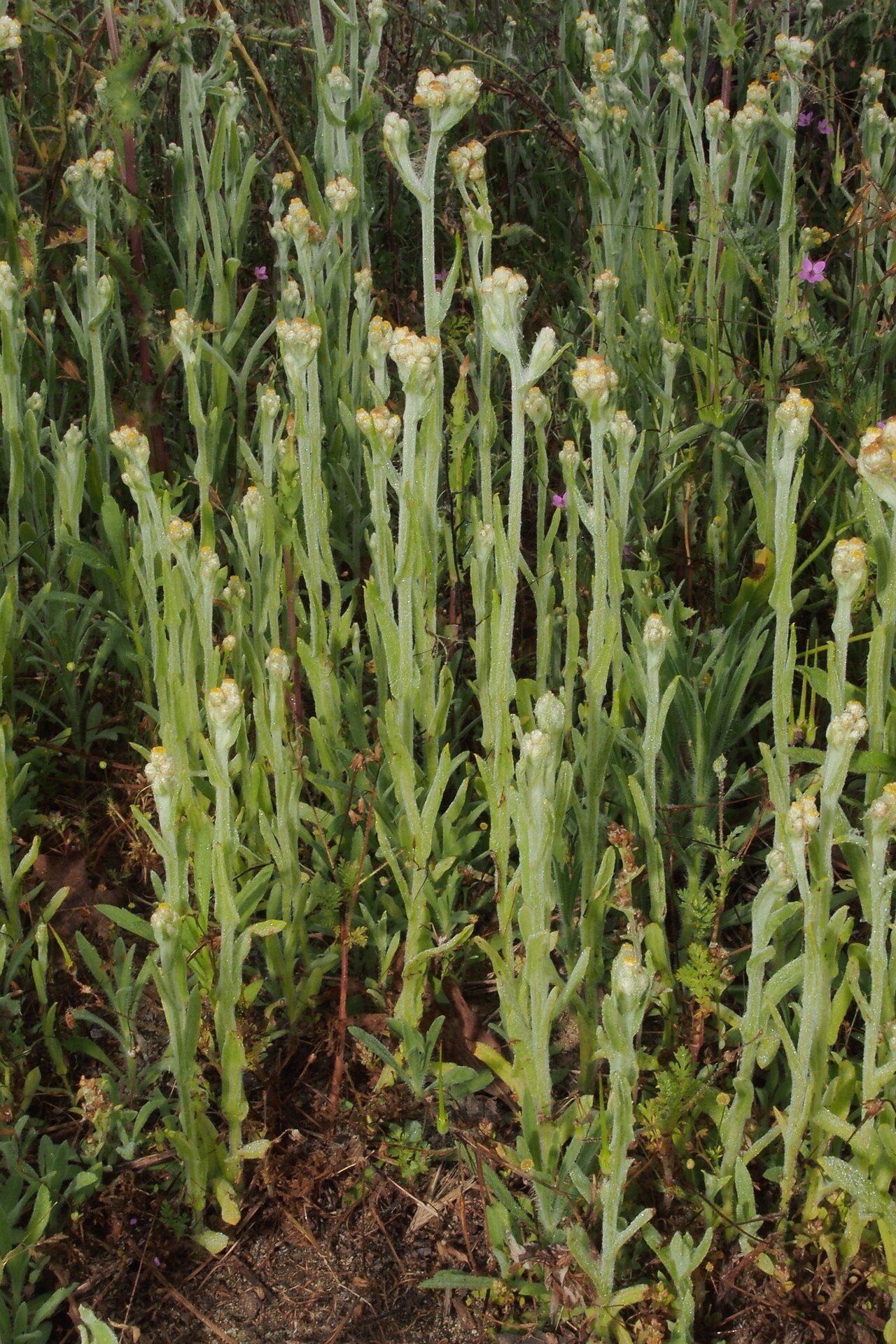
Cottonbatting plant is an annual or biennial (sometimes a short-lived perennial in mild climates) with one to several erect stems 6 to 30 inches tall from a taproot. The stems are covered in thick, loose, cottony white hairs. Plants often grow in dense stands on open, damp ground.
Leaves
The leaves are alternate, narrow (linear to oblanceolate), 1 to 3 1/2 inches long, with smooth edges. Both surfaces are covered in woolly hairs, and the leaf bases extend down the stem slightly (decurrent) or clasp it. The plant has little or no scent, unlike some fragrant cudweeds.
Flowers
Flowers appear from about March to October, depending on climate. The flower heads are small, about 1/4 inch tall, and crowded into dense, rounded clusters at the tips of the stems. Each head has yellowish disk flowers (no rays) surrounded by several rows of shiny, papery bracts that are straw-colored, pale yellow or whitish, sometimes slightly brownish.
Fruit & Seeds
The fruits are tiny, smooth achenes with a ring of fine white bristles (pappus) that carry them on the wind. The papery bracts remain on the plant after the seeds have dispersed.
Look-alikes
California cudweed has green, sticky-glandular leaves and white bracts, and a strong scent. Rabbit tobacco, an eastern species, has fragrant leaves that are green above and woolly below. Pearly everlasting is a perennial with bright white bracts. Jersey cudweed (Helichrysum luteoalbum, also called Pseudognaphalium luteoalbum) is a very similar weedy species from Eurasia; it has more decurrent leaves and smaller, more yellowish heads.
Quick Facts
| Scientific Name | Pseudognaphalium stramineum (syn. Gnaphalium stramineum, G. chilense) |
| Family | Asteraceae (aster family) |
| Plant Type | Annual or biennial herb |
| Mature Height | 0.5–2.5 ft |
| Mature Spread | 6–12 in |
| Growth Rate | Fast |
| Sun Exposure | Full sun |
| Water Needs | Low to medium; often in moist sandy soil |
| Soil Type | Sandy, gravelly or loamy soils; disturbed ground |
| Soil pH | Neutral to alkaline (about 6.5–8.5) |
| Bloom Time | March–October |
| Flower Color | Straw-yellow to whitish bracts with yellow centers |
| Fall Color | Silvery-gray foliage; dried heads persist |
| Fruit | Tiny achene with white bristles |
| Deer Resistant | Yes; woolly foliage seldom browsed |
| USDA Hardiness Zones | Annual/biennial (grows in zones 4–10 climates) |
Native Range
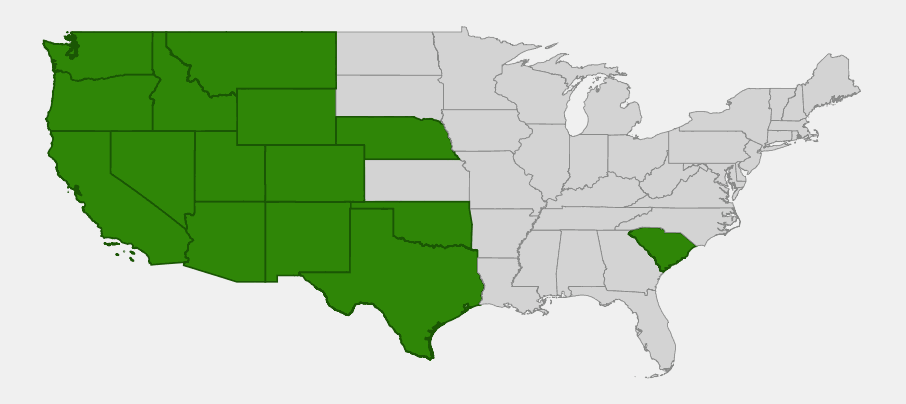
Cottonbatting plant is widespread in western North America, from southern British Columbia south through the western United States and Mexico to Central America. In the United States it grows in every western state from the Pacific coast to the Rocky Mountains, and is especially common in California, Arizona, Oregon and Washington. East of the Rockies it extends into western Nebraska, western Oklahoma and West and South Texas.
USDA PLANTS also records it from several Atlantic Coast states. NatureServe treats the North Carolina and Virginia populations as introduced, so they are not counted as native range on this page. USDA lists South Carolina as part of its native range, but there are very few records there; it is best regarded as an outlying record. It is also sometimes found as an introduced plant in Europe.
It grows in open, often sandy or gravelly sites with some moisture: coastal dunes and bluffs, river and stream banks, sandbars, washes, meadows, roadsides, fields and recently burned or disturbed ground, from sea level to about 9,000 feet in the mountains.
📋 Regional plant lists featuring Cottonbatting Plant: Idaho, Eastern Oregon & Eastern Washington · Montana & Wyoming · Nebraska, Kansas & Eastern Colorado · Utah & Western Colorado · Arizona & New Mexico · North & South Carolina · South & West Texas · Western Oregon & Western Washington · California & Nevada
Growing & Care Guide
Cottonbatting plant is a short-lived, self-sowing plant. It is rarely sold, but it often arrives on its own in sunny, sandy gardens in the West. If you like its silvery texture, let some plants go to seed.
Light
Full sun. It becomes leggy and short-lived in shade.
Soil & Water
It grows best in sandy or gravelly, well-drained soil, and tolerates poor soil. In nature it is often found where there is some moisture, such as stream banks and washes, but established plants tolerate drought. Water occasionally during long dry spells if you want it to keep flowering.
Planting Tips
Scatter seed on bare, sunny soil in fall or early spring and press it in lightly; the seeds need light to germinate. It works well in gravel gardens, along dry streambeds and in meadow plantings with other native wildflowers.
Pruning & Maintenance
No pruning is needed. Pull plants after they finish if you want to limit reseeding, or leave them for seed and the silvery dried heads. Thin seedlings where they become too dense.
Propagation
Grow from seed, which needs no special treatment. Plants usually reseed on their own in open soil.
Landscape Uses
- Butterfly gardens: larval host for the American lady butterfly
- Gravel and dry gardens: soft, silvery foliage and texture
- Stream banks and washes: quickly covers open sandy ground
- Dried flowers: the papery heads keep their form when dried
- Restoration: early colonizer of disturbed, sandy sites
Wildlife & Ecological Value
Cottonbatting plant is a modest-looking plant with a special role: it is one of the native food plants of the American lady butterfly.
For Pollinators
Small bees, flies and wasps visit the flower heads. Cudweeds and everlastings in this group, including cottonbatting plant, are larval host plants for the American lady butterfly (Vanessa virginiensis); the caterpillars build silken nests of leaves and hairs at the stem tips.
For Birds
Small seed-eating birds such as goldfinches and sparrows eat the seeds.
For Mammals
The woolly foliage is rarely eaten by deer or livestock.
Ecosystem Role
As a fast-growing pioneer, it quickly colonizes bare sand and gravel along streams, dunes and burns, helping hold soil until longer-lived plants move in.
Cultural & Historical Uses
The species name stramineum means “straw-colored,” describing the papery bracts of the flower heads. The genus name Pseudognaphalium means “false Gnaphalium“: the plant was described by Carl Sigismund Kunth in 1818 as Gnaphalium stramineum and moved to Pseudognaphalium by Arne Anderberg in 1991.
Cudweeds and everlastings have a long history of folk use in the Americas. Several Pseudognaphalium species have been used in traditional medicine for coughs and colds. Do not use wild plants as a remedy without expert guidance.
The name “cotton-batting” refers to the cotton padding once used in quilts, which the loose, white hairs of the plant resemble.
Frequently Asked Questions
Why is it called cottonbatting plant?
Its stems and leaves are covered with thick, loose, white hairs that look like cotton batting, the padding used in quilts.
Is cottonbatting plant an annual?
It is usually an annual or biennial, though in mild climates some plants live a little longer. It reseeds readily.
Is cottonbatting plant native?
Yes. It is native across the western United States, southern British Columbia, Mexico and Central America. Populations in North Carolina and Virginia are considered introduced.
Does it attract butterflies?
Yes. It is a larval host for the American lady butterfly, and its flowers are visited by small pollinators.
Is cottonbatting plant weedy?
It is a pioneer that colonizes bare, disturbed ground, but it is a native plant and is easy to pull where it is not wanted.

Looking for a nursery that carries Cottonbatting Plant?
Browse our native plant nursery directory: Arizona · California · Colorado · Idaho · Montana · Nebraska, Nevada, New Mexico & Oklahoma · Oregon · South Carolina, Texas & Utah · Washington · Wyoming

