
Desert Milkweed (Asclepias erosa)
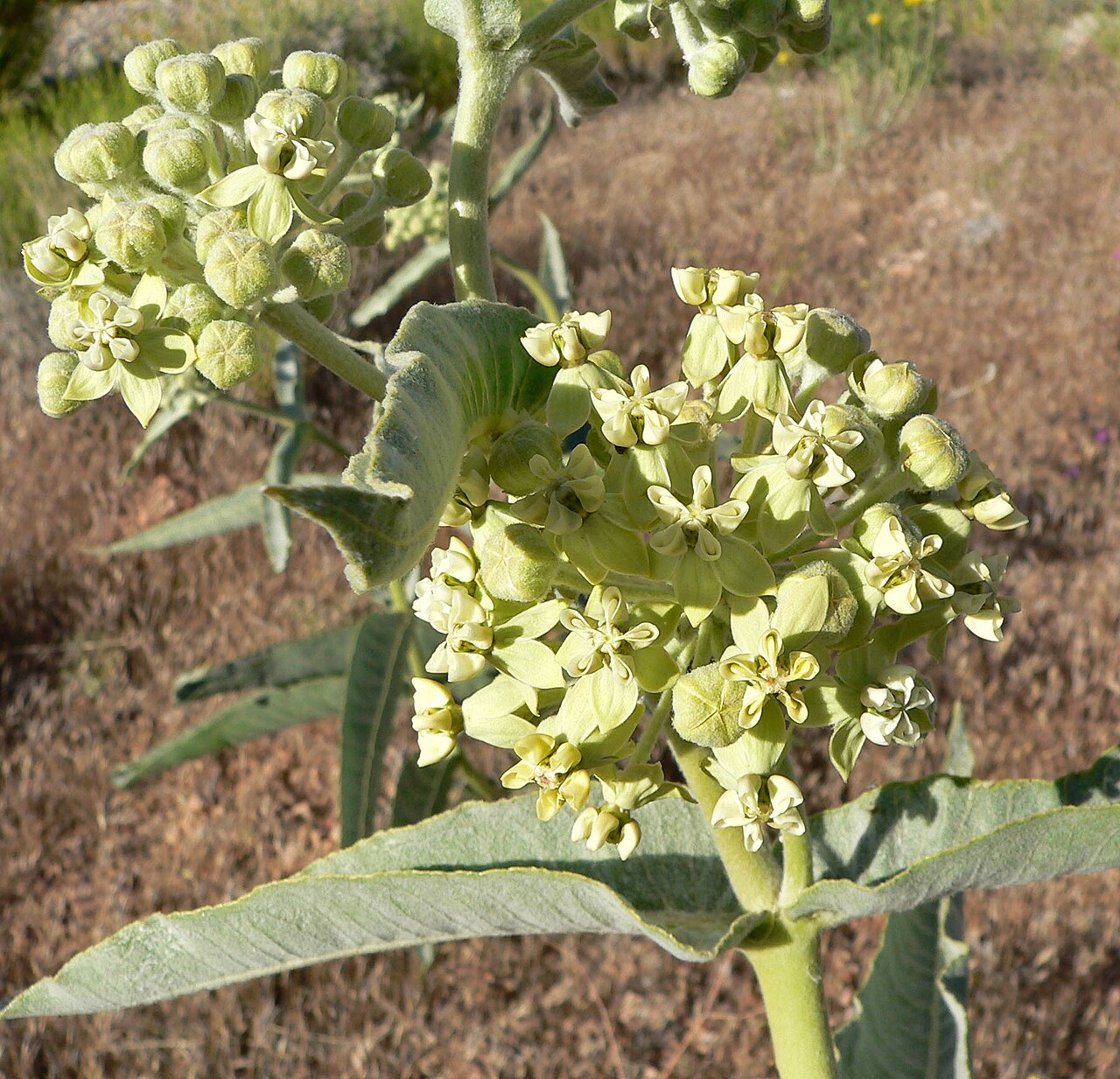
Asclepias erosa, known as Desert Milkweed, is a robust native milkweed of the Mojave and Sonoran Deserts and the dry slopes of southern California. It grows as a clump of stout, upright stems 1 1/2 to 3 feet tall, with broad, pale gray-green to whitish leaves, and from spring into summer it bears rounded clusters of creamy, greenish-white flowers. Its pale foliage makes it one of the most striking plants of desert washes.
It belongs to the dogbane family (Apocynaceae), which now includes the milkweeds once placed in their own family, Asclepiadaceae. The species name erosa means “eroded” or “gnawed”, describing the slightly irregular, wavy leaf edges. Like other milkweeds, it is a larval host plant for the monarch butterfly and an important nectar source for many insects in the desert.
Safety note: like all milkweeds, desert milkweed contains cardiac glycosides, which are toxic if eaten by people, pets or livestock, and its milky sap can irritate skin and eyes. Plant it away from grazing animals, wash your hands after handling it, and do not eat any part of it. This guide covers how to identify it, where it grows, how to grow it and its value to monarchs and other wildlife.
Identification
Desert milkweed is easy to spot in sandy washes and on desert flats: look for clumps of thick, upright stems with large, pale, almost whitish leaves and round clusters of cream to greenish flowers.
Growth Habit
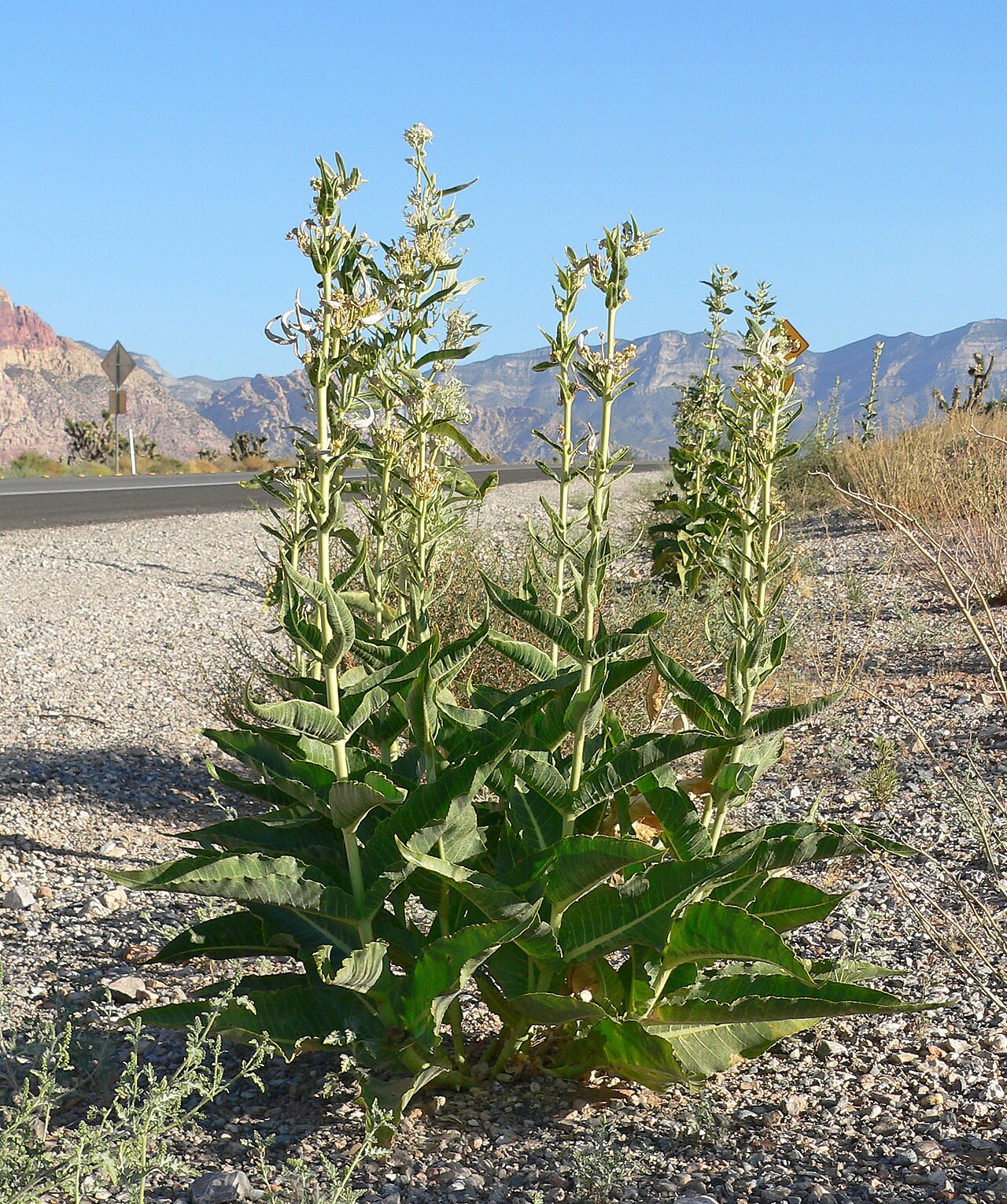
It is a perennial that grows from a deep, woody taproot. Several stout, unbranched or sparingly branched stems rise to about 1 1/2 to 3 feet, occasionally taller. The stems and leaves are covered with fine hairs when young, which give the plant a whitish to gray-green color. It dies back to the root in winter and sprouts again in spring. Like other milkweeds, the stems and leaves contain milky sap.
Leaves
The leaves are opposite, broadly lance-shaped to ovate, 2 to 7 inches long and up to 3 inches wide, often clasping or nearly clasping the stem. They are pale green to whitish, with prominent pale veins and slightly wavy, irregular edges.
Flowers
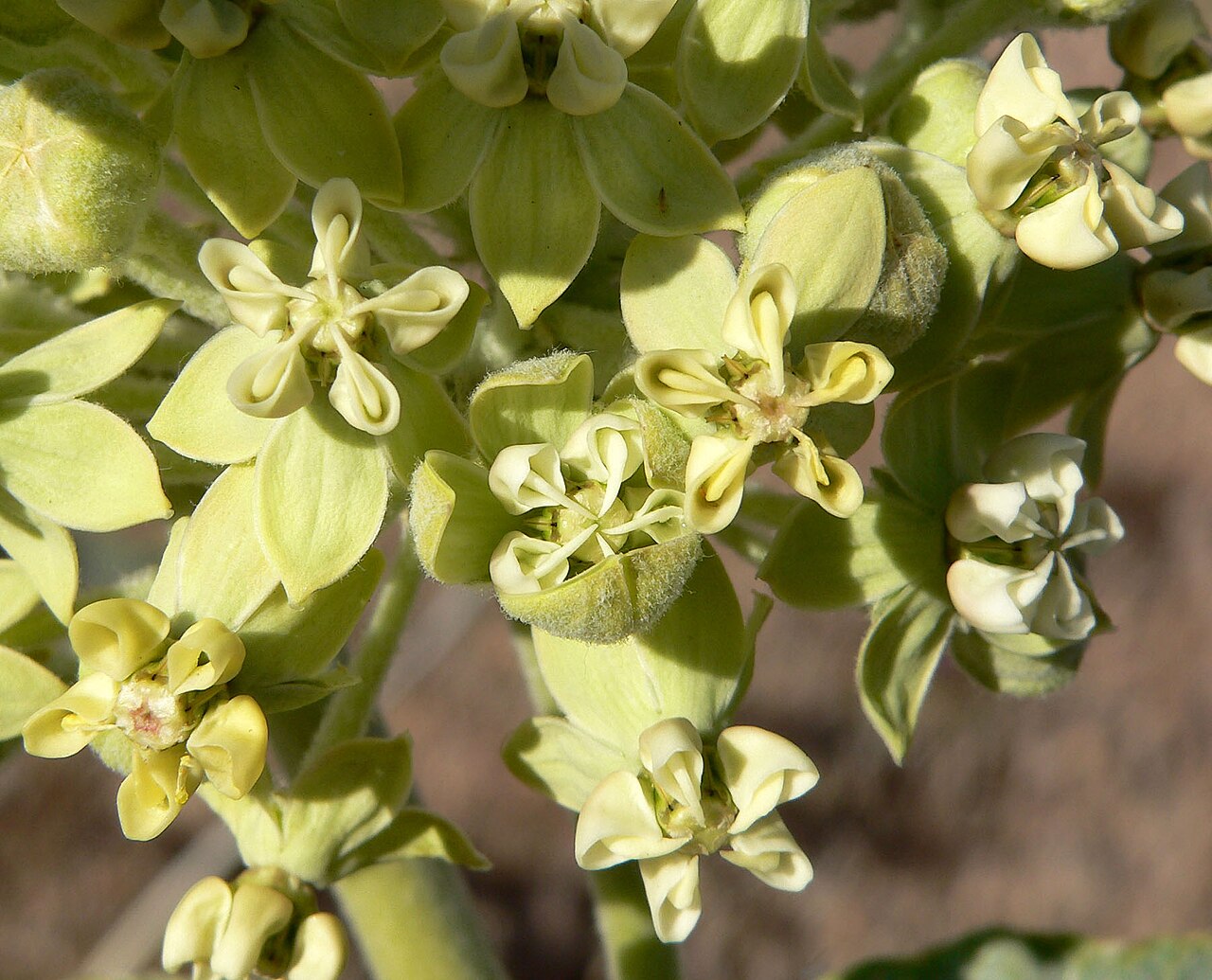
The flowers are borne in dense, rounded clusters (umbels) at the upper leaf axils and stem tips. Each flower is about 1/2 inch across, with five pale greenish-yellow petals that bend back and a central crown of five cream-colored hoods. Bloom time is mainly April to July, with some flowers into September after summer rain.
Fruit & Seeds
The fruit is a smooth, spindle-shaped pod, about 2 to 4 inches long, that splits open in late summer or fall. It releases many flat, brown seeds, each with a tuft of silky white hairs that carries it on the wind.
Look-alikes
Rush milkweed (Asclepias subulata) of the same deserts has nearly leafless, rush-like green stems. Woollypod milkweed (Asclepias eriocarpa) of California foothills has densely woolly leaves and woolly pods. Showy milkweed (Asclepias speciosa) has pink, star-shaped flowers. Desert milkweed is recognized by its large, pale, broad leaves, creamy flower clusters and desert habitat.
Quick Facts
| Scientific Name | Asclepias erosa Torr. |
| Family | Apocynaceae (dogbane family; formerly Asclepiadaceae) |
| Plant Type | Herbaceous perennial |
| Mature Height | 1 1/2–3 ft (occasionally to 4 ft) |
| Mature Spread | 1–3 ft |
| Growth Rate | Moderate |
| Sun Exposure | Full sun |
| Water Needs | Very low; drought tolerant |
| Soil Type | Sandy, gravelly or rocky, well-drained desert soils |
| Soil pH | About 7.0–8.5 |
| Bloom Time | April–July (into September after rain) |
| Flower Color | Cream to pale greenish-yellow |
| Fall Color | None notable; dies back in winter |
| Fruit | Smooth pod with silky-tufted seeds |
| Deer Resistant | Yes; toxic and rarely browsed |
| USDA Hardiness Zones | 7–10 |
Native Range
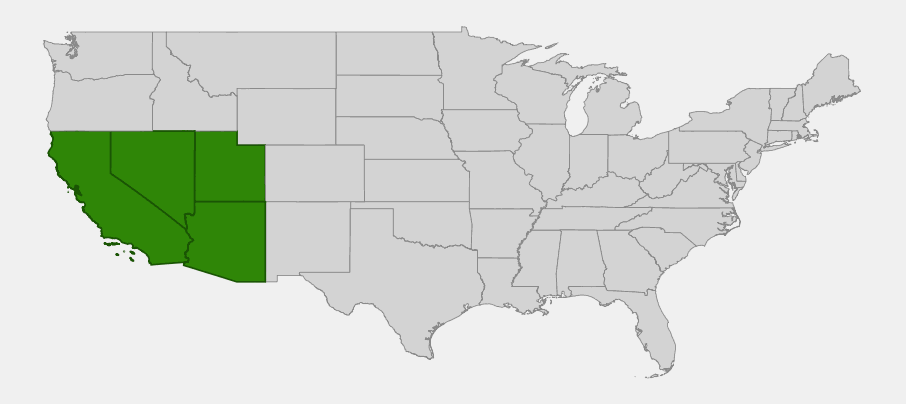
Desert milkweed is native to the southwestern United States and northern Baja California. USDA PLANTS lists it in California, Nevada, Utah and Arizona.
In California it grows in the Mojave and Colorado Deserts and on the desert-facing slopes and interior valleys of the Transverse and Peninsular Ranges, from Inyo and Mono Counties south to Imperial and San Diego Counties, and west into the dry interior of Santa Barbara, San Luis Obispo, Kern and Tulare Counties. In Nevada it is found mainly in the southern Mojave Desert around Las Vegas and Lincoln County, with outlying records farther north in Nye, Lander, Pershing and Humboldt Counties. It reaches Utah in the far southwest, in Washington County, and Arizona in the west, along the lower Colorado River and in the Mohave, La Paz, Yuma and Coconino County areas.
It grows in sandy and gravelly washes, desert flats and bajadas, along roadsides, and in creosote bush scrub, Joshua tree woodland and the edges of chaparral and pinyon-juniper woodland, from near sea level to about 6,000 feet.
📋 Regional plant lists featuring Desert Milkweed: Utah & Western Colorado · Arizona & New Mexico · California & Nevada
Growing & Care Guide
Desert milkweed is an outstanding native milkweed for low-water gardens in the desert Southwest and southern California. Plants and seed are offered by some native nurseries and seed suppliers in the region. It needs heat, sun and sharp drainage, and it rewards patience: plants can take a season or two to settle in.
Light
Plant it in full sun. It needs strong light and heat to grow well and flower.
Soil & Water
Use sandy, gravelly or rocky soil with excellent drainage. It is very drought tolerant once established, and overwatering, especially in winter or in heavy clay, is the most common cause of failure. Give occasional deep water during its first summer, then little or none in desert gardens apart from rain.
Planting Tips
Plant young plants from containers in fall or early spring, since the deep taproot makes established plants nearly impossible to move. Space them about 2 to 3 feet apart. Combine with brittlebush, desert marigold, globemallow and desert willow for a habitat garden. Because it is toxic, keep it away from livestock and areas where pets chew plants.
Pruning & Maintenance
Cut the dead stems to the ground in late winter, wearing gloves to avoid the sap. Leave aphids and caterpillars alone; they rarely harm established plants, and monarch caterpillars are the reason to grow it. Avoid pesticides.
Propagation
Grow it from seed. Collect pods as they begin to split, remove the silky hairs, and sow in spring in deep pots of sandy mix, which suits the long taproot. A period of cold, moist stratification for several weeks can improve germination. Plant out seedlings while still small.
Landscape Uses
- Monarch and butterfly gardens: a larval host plant and nectar source in the desert
- Xeriscapes and desert gardens: striking pale foliage on very little water
- Pollinator gardens: nectar for bees, wasps and butterflies
- Wash and roadside restoration: a native perennial of sandy, disturbed ground
- Wildlife education: watching monarch caterpillars grow on their host plant
Wildlife & Ecological Value
Desert milkweed is one of the most important milkweeds for monarchs and other insects in the deserts of the Southwest.
For Pollinators
It is a larval host plant for the monarch butterfly and for the queen butterfly, a close relative of the monarch found in the Southwest. Monarchs moving through the deserts in spring may lay eggs on its new growth. Its flowers provide nectar for butterflies, native bees, honey bees and many kinds of wasps. The caterpillars that feed on it store its cardiac glycosides, which make them distasteful to predators.
For Birds
Its foliage is toxic and the seeds have little food value for birds, but the abundant insects it supports are food for desert songbirds, and some birds use the silky seed fibers in nests.
For Mammals
The leaves and stems are toxic, and mammals generally avoid them. It is considered poisonous to livestock, which may eat it when other forage is scarce.
Ecosystem Role
Desert milkweed supports a specialized community of insects adapted to milkweed toxins, including monarch and queen caterpillars, milkweed bugs, milkweed beetles and oleander aphids. As monarch populations have declined, native milkweeds such as this one have become a focus of habitat restoration in the West.
Cultural & Historical Uses
Desert milkweed was described in the 1850s by the American botanist John Torrey, from specimens collected during the government surveys of the American West. The genus Asclepias is named for Asclepius, the Greek god of medicine.
Milkweeds were widely used by Indigenous peoples of the Southwest, who made cordage and thread from the strong stem fibers of several species. Because milkweeds are toxic, their use for food or medicine required careful knowledge, and they should not be eaten.
Today desert milkweed is a favorite of monarch conservation programs in Arizona, Nevada and southern California, where native milkweeds are planted in schoolyards, parks and home gardens to support the butterflies.
Frequently Asked Questions
Is desert milkweed poisonous?
Yes. Like all milkweeds, it contains cardiac glycosides that are toxic if eaten by people, pets or livestock, and the milky sap can irritate skin and eyes. Wear gloves and wash your hands after handling it.
Do monarch butterflies use desert milkweed?
Yes. It is a larval host plant for monarchs and queen butterflies, and its flowers provide nectar for many pollinators.
Where does desert milkweed grow?
In the Mojave and Sonoran Deserts and dry southern California valleys, in California, Nevada, Utah, Arizona and northern Baja California.
How much water does desert milkweed need?
Very little. Once established, it survives on natural rainfall in desert gardens. Overwatering and poor drainage are its biggest threats.
Can I transplant desert milkweed?
Not easily. It has a deep taproot, so start with young container plants or seed and plant them where they will stay.

Looking for a nursery that carries Desert Milkweed?
Browse our native plant nursery directory: Arizona · California · Nevada · Utah

