Desert Paintbrush (Castilleja angustifolia)
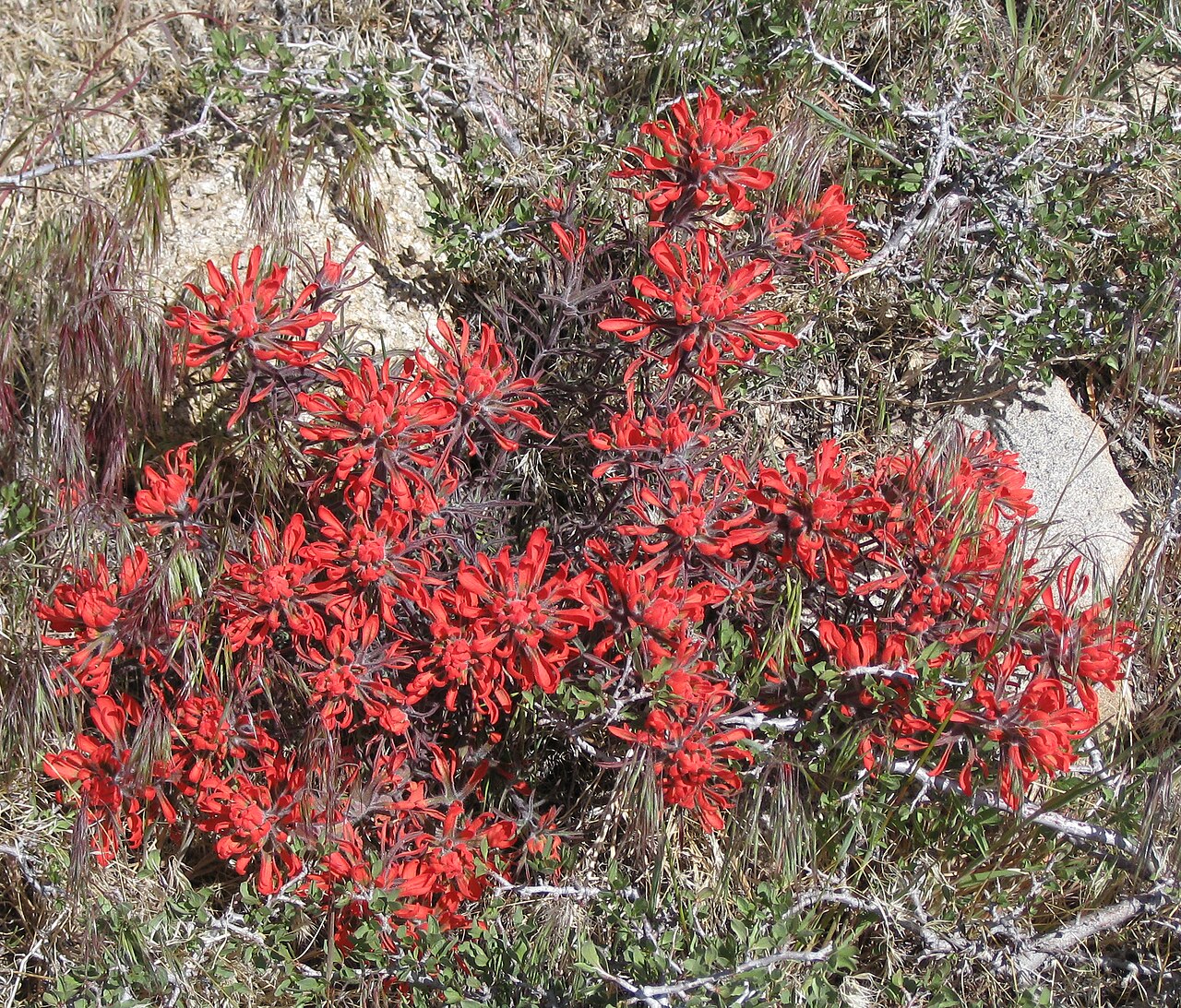
Castilleja angustifolia, commonly called Desert Paintbrush or northwestern Indian paintbrush, is a low, bushy perennial wildflower of the Intermountain West known for its brilliant scarlet to orange-red flower clusters. Much of what gardeners and field guides have long called “desert paintbrush” was formerly treated as a separate species, Castilleja chromosa; current USDA PLANTS taxonomy places that name as a synonym within Castilleja angustifolia (as variety dubia), so this page covers the broader species as currently accepted, using “desert paintbrush” for the plants most field guides and nurseries still sell under that name.
Like all paintbrushes, Desert Paintbrush is a root hemiparasite: it photosynthesizes on its own but also taps into the roots of neighboring plants, especially sagebrush and other shrubs, to draw extra water and nutrients. This single fact explains almost everything gardeners find frustrating about growing paintbrush — it is not a plant that thrives alone in a pot or an isolated garden bed, because it needs a living host root system nearby to reach its full size and vigor.
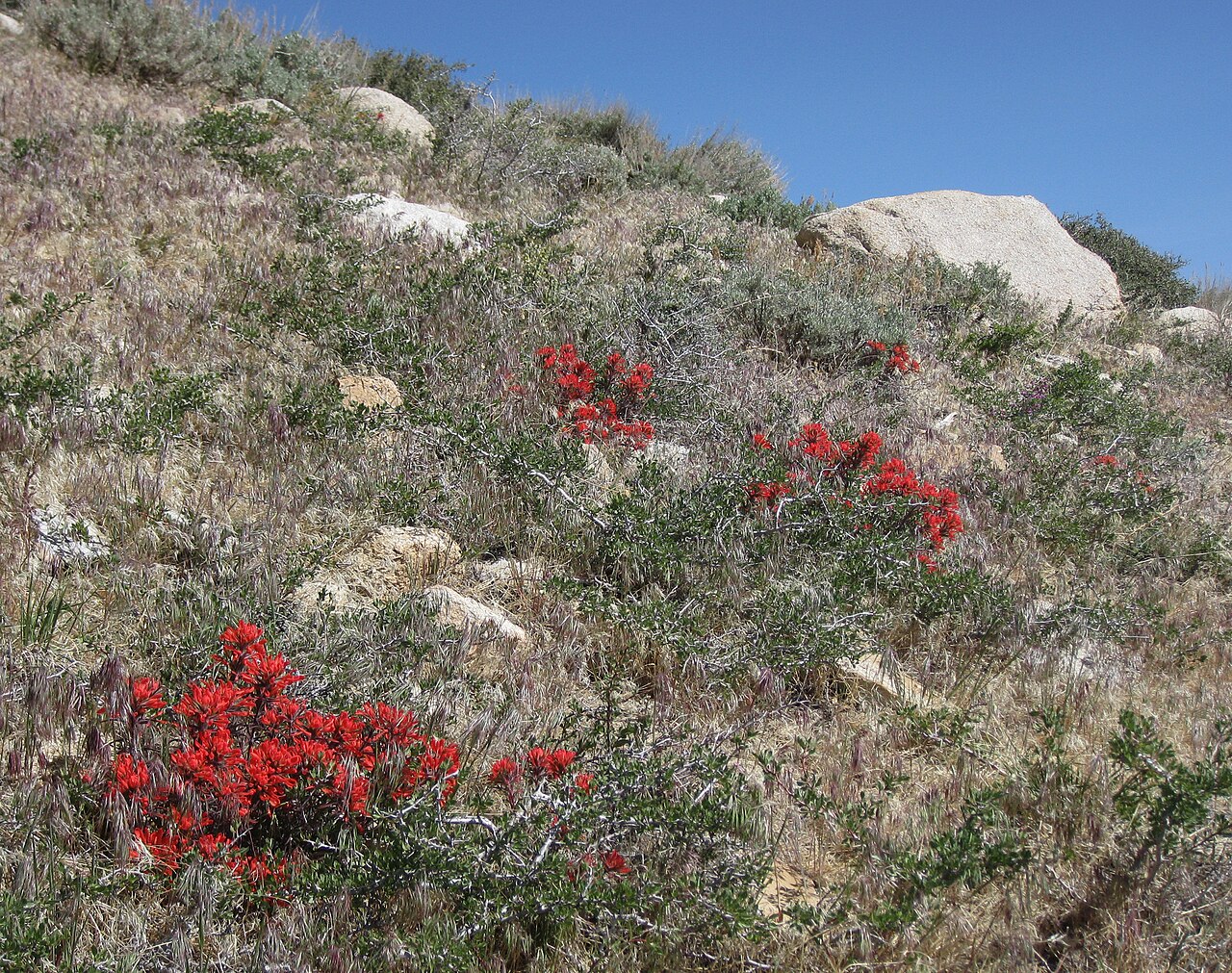
In the wild, Desert Paintbrush forms low, spreading clumps 6 to 16 inches tall across dry, rocky slopes, sagebrush flats, and pinyon-juniper woodlands from the Columbia Basin south through the Great Basin to the Mojave Desert and the Colorado Plateau. It is a classic, reliable splash of red across the spring desert and foothill landscape, and a magnet for hummingbirds migrating north in early spring.
Identification
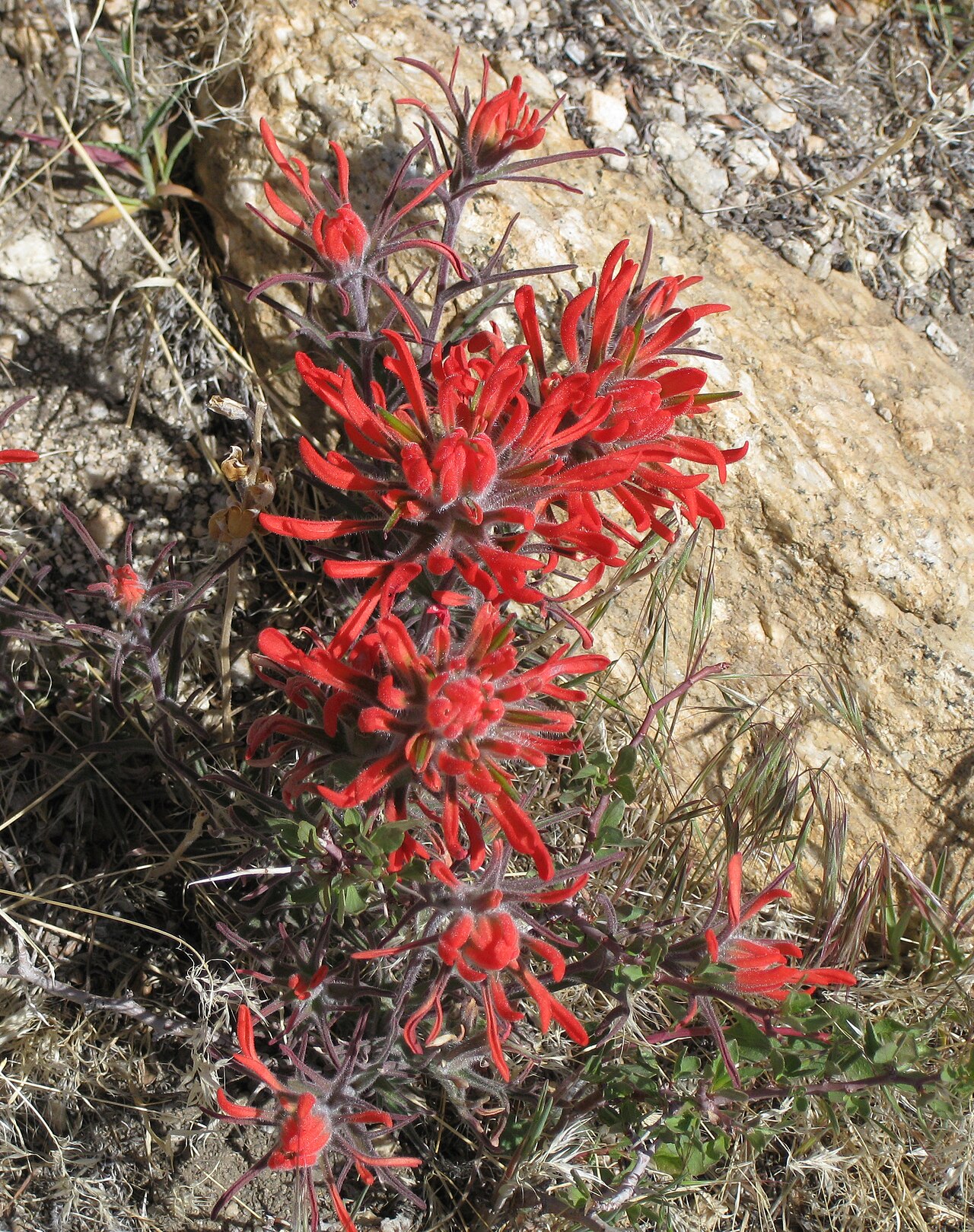
Desert Paintbrush is identified by its low, many-branched habit, narrow gray-green leaves, and dense, brush-like flower clusters where the true flowers are hidden behind showy, brightly colored, petal-like bracts.
Stems & Leaves
Plants form clumps of several to many stems, 6 to 16 inches tall, arising from a woody base. Leaves are narrow, linear to lance-shaped, 1 to 2 inches long, often with a few shallow lobes near the tip, and covered in fine hairs that give the whole plant a soft gray-green cast. The foliage alone is unremarkable and easy to overlook until the plant flowers.
Flowers
The true flowers are small, tubular, and greenish, largely concealed within clusters of showy bracts that do the visual work — these bracts range from bright scarlet-red to orange-red, occasionally yellow, and are deeply cleft into narrow, finger-like lobes that give the flower head its shaggy, brush-like appearance. Flowering typically runs from March to June depending on elevation, with low-desert populations blooming earliest and high-elevation populations well into early summer.
Fruit & Seeds
Fruit is a small, dry, two-chambered capsule that splits open to release numerous tiny seeds. Because paintbrush seedlings must establish a haustorial (parasitic) connection to a host root within their first year or two to survive long-term, seed-grown plants need to germinate in close proximity to a suitable host such as sagebrush, buckwheat, or bunchgrass.
Quick Facts
| Scientific Name | Castilleja angustifolia (syn. Castilleja chromosa) |
| Family | Orobanchaceae (Broomrape) |
| Plant Type | Perennial Wildflower (root hemiparasite) |
| Mature Height | 6–16 in |
| Mature Spread | 8–16 in |
| Growth Rate | Slow (dependent on host establishment) |
| Sun Exposure | Full Sun |
| Water Needs | Low once established |
| Soil Type | Dry, rocky, well-drained; gravelly or sandy loam |
| Soil pH | Neutral to alkaline |
| Bloom Time | March – June |
| Flower Color | Scarlet to orange-red bracts (occasionally yellow) |
| Fall Color | None notable; foliage dies back |
| Fruit | Small dry capsule with numerous tiny seeds |
| Deer Resistant | Mostly |
| USDA Hardiness Zones | 4–8 |
Native Range
Desert Paintbrush is native to the Intermountain West and parts of the Southwest, occurring from eastern Washington, Oregon, and Montana south through Idaho, Nevada, and Utah into California, Arizona, New Mexico, and western Colorado. It favors dry, open habitats: sagebrush steppe, pinyon-juniper woodland, desert scrub, and rocky slopes and washes, typically from valley floors up to mid-elevation foothills and lower mountain slopes.
It is most abundant in the Great Basin and Mojave Desert, where its scarlet clumps are a familiar and reliable sight on dry hillsides in spring, often growing in direct association with the big sagebrush (Artemisia tridentata) and bunchgrasses that serve as its parasitic hosts. It is absent from wetter, forested parts of the Pacific Northwest and from the high plains of the central and eastern states.
Desert Paintbrush shares much of its range with other western paintbrushes, including Wyoming Paintbrush and Wholeleaf Indian Paintbrush; all are easiest to tell apart by close comparison of bract and leaf shape rather than color alone, since flower color varies within every paintbrush species.
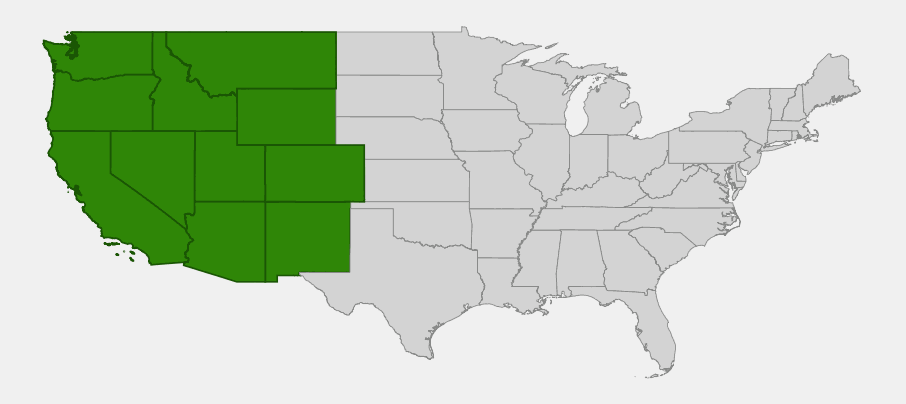
📋 Regional plant lists featuring Desert Paintbrush: Arizona & New Mexico · Utah & Western Colorado · Montana & Wyoming · Idaho, Eastern Oregon & Eastern Washington
Growing & Care Guide
Honest advice first: Desert Paintbrush is one of the harder native wildflowers to establish deliberately, and it should never be dug from the wild — as a root hemiparasite it is already attached to a host plant’s root system, and digging it up severs that connection and almost always kills it while damaging the host and disturbing fragile desert soil. Buy nursery-propagated seed or plugs grown with an established host instead.
Light
Full sun is essential. Desert Paintbrush comes from open, unshaded desert and steppe habitat and will not perform in shaded garden beds.
Soil & Water
Give it dry, rocky, fast-draining soil that mimics its native sagebrush-steppe and desert-scrub habitat. It has low water needs once established and is intolerant of regular garden irrigation or heavy, wet soils, which quickly rot the roots. Avoid rich, amended garden soil; lean, mineral soil is closer to what this species expects.
Planting Tips
Because Desert Paintbrush is a root hemiparasite, it needs to be planted near — ideally touching the root zone of — a compatible host plant to thrive long-term. Big sagebrush, rabbitbrush, native bunchgrasses, and many buckwheats all work as hosts. Sow seed directly around an already-established host plant in fall, so winter moisture and cold stratify the seed naturally; broadcasting seed with no host nearby will produce seedlings that struggle and usually fail within a season or two. Commercially grown plugs are sometimes sold pre-paired with a host plug in the same container — these transplant far more reliably than bare paintbrush seedlings.
Pruning & Maintenance
Little maintenance is needed or wanted. Avoid fertilizing — paintbrush is adapted to lean soils, and excess nutrients benefit weeds and the host plant more than the paintbrush itself. Leave spent flower heads in place to let seed disperse naturally near the host.
Propagation
Propagation is by seed, always sown near a host. Fresh seed benefits from a cold-moist stratification period of 4 to 6 weeks before an expected spring germination, which happens naturally with a fall sowing outdoors. Paintbrush is essentially impossible to propagate reliably from cuttings or division because of its dependence on an intact haustorial connection to a host root.
Landscape Uses
- Dryland and xeriscape gardens planted alongside sagebrush or native bunchgrasses
- Pollinator and hummingbird gardens in arid-region landscapes
- Habitat restoration in sagebrush steppe and desert scrub projects
- Rock gardens with lean, gravelly soil and a nearby host shrub
Wildlife & Ecological Value
Despite its modest size, Desert Paintbrush punches above its weight ecologically in the arid landscapes where it grows.
For Pollinators
The tubular flowers are adapted for long-tongued pollinators and are especially attractive to hummingbirds, which rely on early-blooming paintbrush as a critical nectar source during spring migration through the Great Basin and Southwest. Native bees and some butterflies also visit the flowers.
For Birds
Hummingbirds, especially Black-chinned and Broad-tailed Hummingbirds, time their northward migration to coincide with peak paintbrush bloom in many parts of its range, making it a genuinely important early-season nectar resource rather than just an incidental one.
For Mammals
Mule deer and other browsers occasionally eat the foliage, though it is not a preferred forage species. Small mammals shelter among the dense clumps of paintbrush and its host shrubs.
Ecosystem Role
As a root hemiparasite, Desert Paintbrush interacts directly with the root systems of its neighbors, and some research suggests this parasitism can modestly reduce the dominance of vigorous hosts like sagebrush, helping maintain plant diversity in sagebrush steppe communities. Its presence is also a rough indicator of relatively intact, undisturbed arid rangeland, since it depends on established native shrub and bunchgrass communities to persist.
Cultural & Historical Uses
Various Indigenous peoples of the Great Basin and Intermountain West used paintbrush species, including desert paintbrush, in limited traditional contexts — most notably the flowers and bracts as a source of color for dyes, and in some documented cases as a minor seasoning or garnish. These are recorded historical and ethnobotanical uses, not a basis for foraging today: paintbrush species can take up and concentrate selenium from soils in parts of their range, and should not be eaten.
Desert Paintbrush has long been a celebrated wildflower of the spring desert and steppe, frequently photographed and sought out by wildflower enthusiasts, and it remains a horticultural curiosity more than a mainstream garden plant precisely because of its parasitic habit — a trait that makes it ecologically fascinating but genuinely difficult to cultivate outside specialized native plant nurseries.
Frequently Asked Questions
Is Desert Paintbrush the same plant as Castilleja chromosa?
Largely, yes. Plants long called Castilleja chromosa are now treated by USDA PLANTS as a synonym within Castilleja angustifolia (variety dubia). Older field guides, seed packets, and nursery listings may still use the name C. chromosa for the same plant.
Can I dig up a Desert Paintbrush from the wild and transplant it to my garden?
No — please don’t. As a root hemiparasite, it is physically attached to a host plant’s roots, and digging severs that connection, almost always killing the paintbrush while damaging the host plant and disturbing fragile desert soil. Buy nursery-propagated seed or host-paired plugs instead.
Why won’t my paintbrush seeds grow?
Paintbrush seedlings need to connect to a living host root — typically sagebrush, rabbitbrush, or a native bunchgrass — within their first year or two, or they fail to thrive. Sowing seed with no host plant nearby is the most common reason home gardeners struggle with this genus.
Is Desert Paintbrush poisonous?
It is not considered a significant toxicity concern for people or pets in normal garden contact, but paintbrush species can accumulate selenium from certain soils and should not be eaten. Treat it as an ornamental and wildlife plant, not a food or medicinal herb.
What’s the easiest way to add paintbrush to a native garden?
Start with an established clump of big sagebrush or native bunchgrass, then direct-sow fresh paintbrush seed around its base in fall. Looking for pre-paired host-and-paintbrush plugs from a native plant nursery is usually more reliable than seed alone for a home gardener.

Looking for a nursery that carries Desert Paintbrush?
Browse our native plant nursery directory: Arizona · California · Colorado · Idaho · Montana · Nevada & New Mexico · Oregon · Utah · Washington · Wyoming