Mockernut Hickory (Carya tomentosa)
Carya tomentosa (syn. Carya alba), commonly called Mockernut Hickory, is one of the most widespread and recognizable hickories of the eastern deciduous forest. The name comes from the fruit: a thick, hard shell encloses a comparatively small, sweet kernel, which early settlers felt “mocked” anyone who went to the trouble of cracking it. It is a member of the walnut family (Juglandaceae) and one of the longest-lived hickories, with individual trees routinely passing 200 years and some reaching 500.
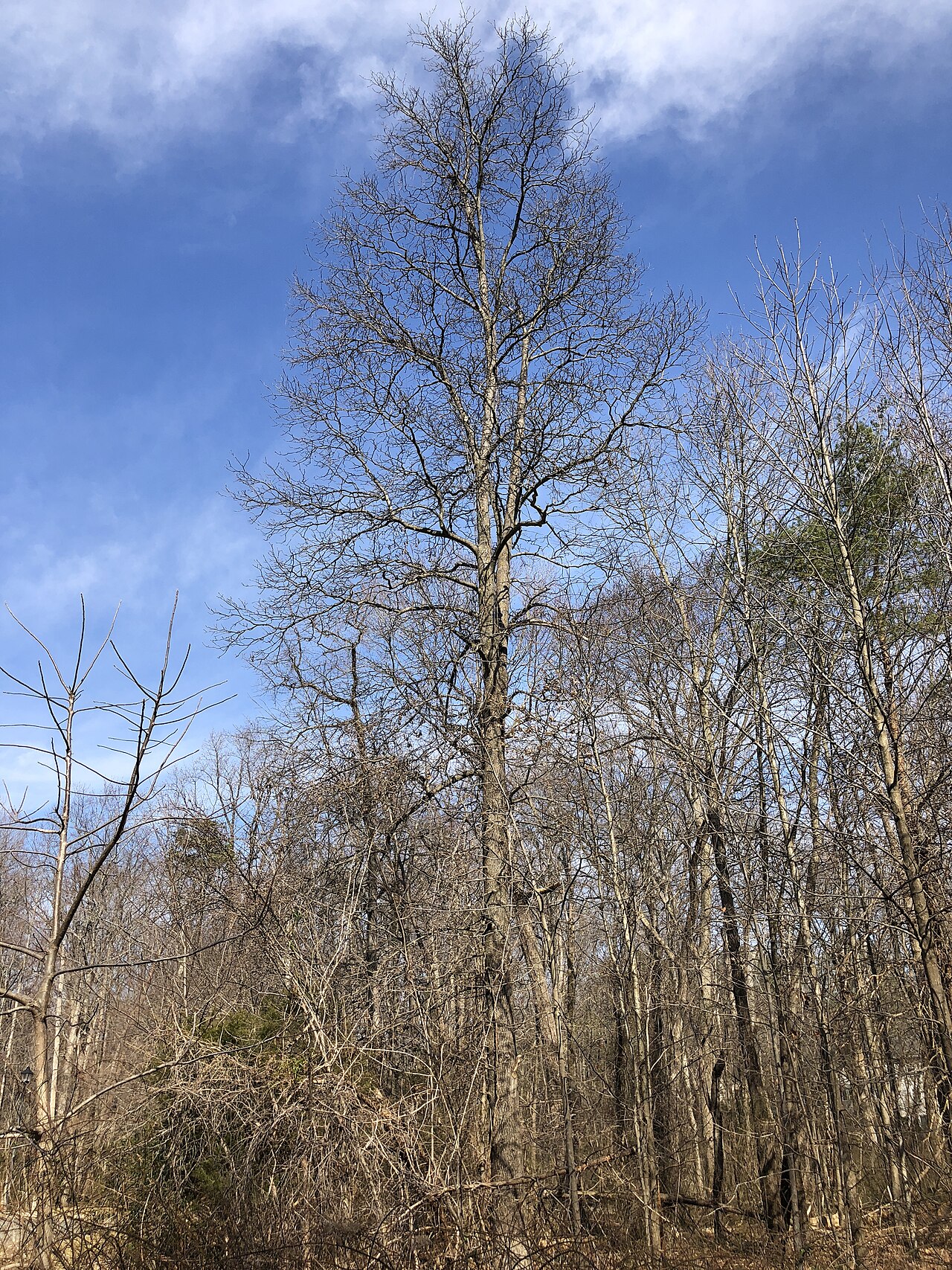
Mockernut Hickory grows as a tall, slow-growing forest tree, usually 50 to 80 feet in height with a narrow, oval crown and a long, clear, arrow-straight trunk. Its compound leaves are the largest of any eastern hickory — often 8 to 15 inches long — and are strongly aromatic when crushed, with a resinous, spicy scent that comes from the dense coat of fine hairs and golden glands covering the leaflets and twigs. That same fuzzy coating is the source of the specific epithet tomentosa, Latin for “covered with down.”
Across its broad range from southern New England and the Ohio Valley to Florida and east Texas, Mockernut Hickory is a defining member of oak-hickory forests, prized for its rock-hard wood, its heavy mast crops that feed dozens of wildlife species, and its value as a long-lived shade tree for large properties. It is not a fast tree and not a small one, so it rewards patience rather than quick results — but few native trees match its combination of toughness, longevity, and wildlife value.
Identification
Mockernut Hickory is identified by the combination of very large, hairy, strongly aromatic compound leaves, tight diamond-furrowed bark (never shaggy), stout orange-brown winter buds, and a thick-shelled nut with a small, sweet, four-angled kernel inside.
Bark & Stems
Bark is light gray and tight, developing a close, interlacing network of diamond-shaped furrows and ridges with age — distinctly different from the loose, peeling plates of Shagbark Hickory. Twigs are stout and reddish-brown, covered in fine rust-colored hairs when young, and tipped with large, egg-shaped terminal buds up to an inch long that are covered in overlapping, hairy, yellowish-brown scales. The buds are a reliable winter identification feature even on bare trees.
Leaves
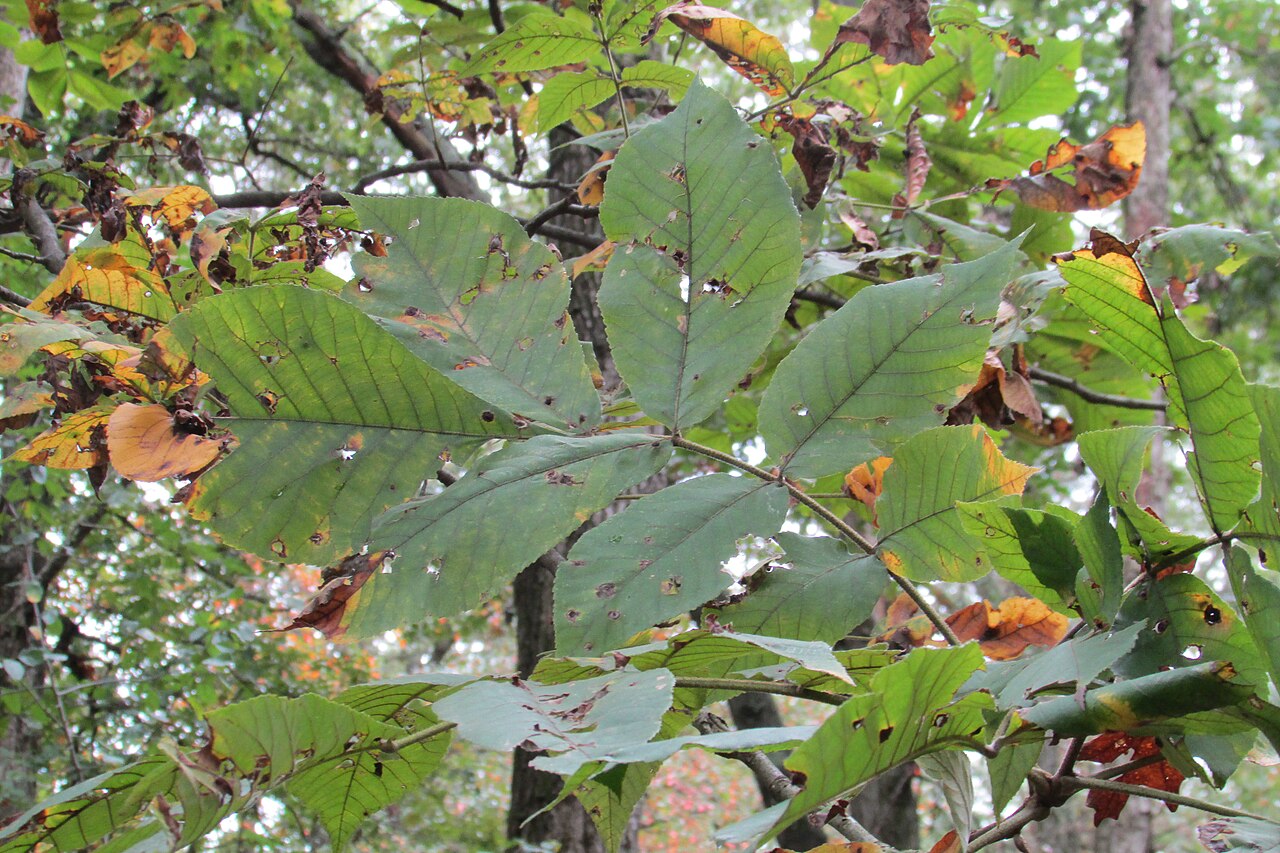
Leaves are alternate, pinnately compound, 8 to 15 inches long, usually with 7 (occasionally 5 or 9) leaflets. The terminal three leaflets are noticeably larger than the lower pairs. Leaflet margins are finely toothed, the upper surface is dark yellow-green and slightly glossy, and the underside is paler and densely hairy with scattered resinous glands that give off a strong, spicy fragrance when crushed — the single most reliable field character for separating this species from other hickories. Fall color is a clear golden yellow.
Flowers
Mockernut Hickory is monoecious, with separate male and female flowers on the same tree, blooming as the leaves emerge in mid-spring. Male flowers hang in slender, yellow-green catkins 4 to 5 inches long in clusters of three; female flowers are small, short spikes at the tips of new growth. Pollination is by wind, and a late frost after bud break can wipe out an entire year’s nut crop.
Fruit & Seeds
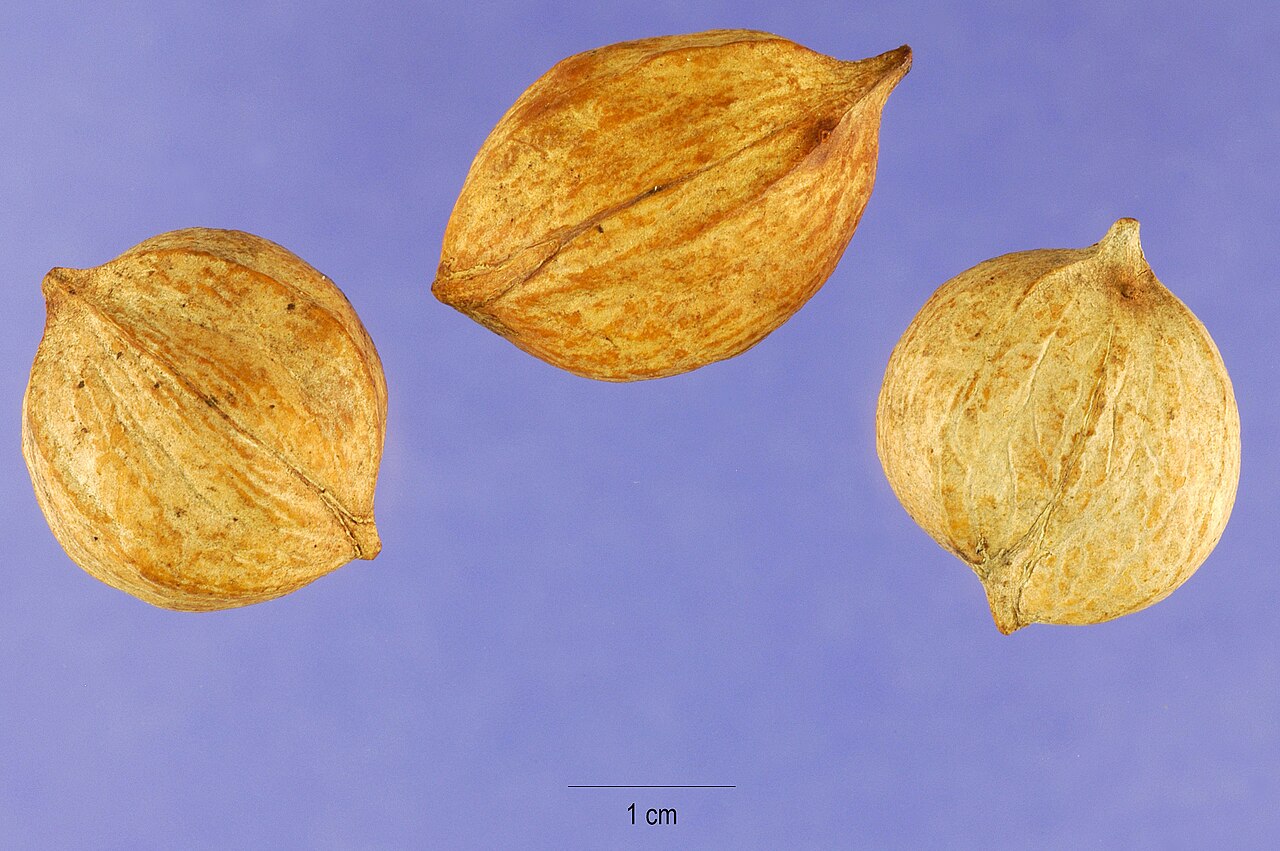
The fruit is a nearly round nut, 1.25 to 2 inches across, enclosed in a thick, hard husk that splits into four sections at maturity in September or October. The shell itself is very thick and hard, enclosing a small but sweet, edible kernel. Good seed crops occur only every 2 to 3 years, and trees typically need 25 to 30 years before bearing their first nuts.
Quick Facts
| Scientific Name | Carya tomentosa (syn. Carya alba) |
| Family | Juglandaceae (Walnut) |
| Plant Type | Deciduous Tree |
| Mature Height | 50–80 ft (exceptional trees to 100 ft) |
| Mature Spread | 30–50 ft |
| Growth Rate | Slow |
| Sun Exposure | Full Sun to Part Shade |
| Water Needs | Average; tolerates brief dry spells once established |
| Soil Type | Well-drained loam or clay loam; tolerates rocky, dry upland soils |
| Soil pH | Adaptable; 5.0–7.5 |
| Bloom Time | April – May |
| Flower Color | Yellow-green (inconspicuous) |
| Fall Color | Golden yellow |
| Fruit | Thick-husked, hard-shelled nut with a small, sweet kernel |
| Deer Resistant | Mostly (seedlings may be browsed) |
| USDA Hardiness Zones | 5–9 |
Native Range
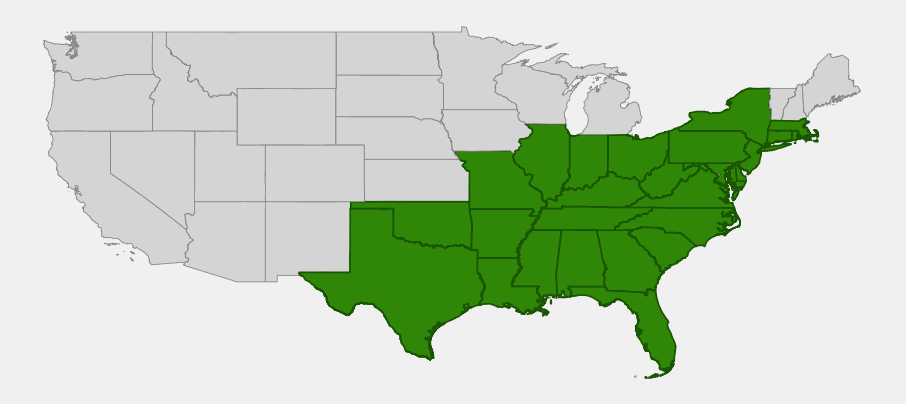
Mockernut Hickory is native to the eastern United States, from southern New England and New York west through the Ohio Valley to southern Illinois and Missouri, and south through the Appalachians and Coastal Plain to Florida and east Texas. It is one of the most common hickories across the Southeast, where it is a dominant or co-dominant species in upland oak-hickory forests.
It grows from sea level up to roughly 3,000 feet in the southern Appalachians, favoring well-drained ridges, upper slopes, and dry-to-mesic uplands over bottomland sites — it is far less tolerant of wet or poorly drained soils than species like Water Hickory or Pecan. It is most often found growing alongside oaks on soils too dry or infertile for more demanding hardwoods, which is part of why oak-hickory forest is named for this genus as much as for oaks.
Mockernut Hickory should not be confused with the many hickories planted well outside this native range as yard or street trees; verify local nursery stock is of regional origin before planting for restoration purposes. Within its native range it regenerates well from seed but is slow to reach canopy height, so young trees are often overtopped by faster-growing species unless openings in the canopy give them room to grow.
📋 Regional plant lists featuring Mockernut Hickory: Connecticut, Massachusetts & Rhode Island · New York, Pennsylvania & Northern New Jersey · Delaware, Southern New Jersey & Long Island · Maryland, Virginia & West Virginia · North Carolina & South Carolina · Georgia, Alabama & Mississippi · Arkansas, Louisiana, Eastern Oklahoma & Eastern Texas · Kentucky & Tennessee · Ohio & Indiana · Illinois, Iowa & Missouri
Growing & Care Guide
Mockernut Hickory is a long-term investment rather than a quick landscape fix. It is slow-growing and difficult to transplant once established in the wild because of its long taproot, so success starts with planting young container or bare-root stock while the root system is still manageable.
Light
Give it full sun to light shade. Seedlings tolerate the dappled shade of a forest understory and can persist there for years, but a tree needs an opening in the canopy to put on real height and begin bearing nuts. In open, sunny sites it develops a fuller, more symmetrical crown.
Soil & Water
Mockernut Hickory is notably tolerant of poor, dry, rocky upland soils where many other hardwoods struggle — this is exactly the niche it fills in oak-hickory forest. It prefers well-drained loam or clay loam and does not tolerate waterlogged or poorly drained sites. Established trees are drought-tolerant thanks to a deep taproot, though young trees benefit from consistent watering during their first two to three summers.
Planting Tips
Plant small container-grown stock (1 to 3 gallon) rather than attempting to move larger trees, which resent root disturbance. Choose the permanent site carefully — Mockernut Hickory develops a deep taproot early and does not transplant well afterward. Give it plenty of room: a mature tree needs 30 to 50 feet of spread and should not be planted close to foundations, driveways, or septic lines, both because of its eventual size and because falling nuts and husks are heavy and persistent in autumn.
Pruning & Maintenance
Prune only to remove dead, damaged, or crossing branches, ideally in late winter. Mockernut Hickory has a strong natural form and rarely needs corrective pruning. It is a slow but very long-lived tree, so plant it where it can remain undisturbed for decades; it is not a species for a yard that will be redeveloped or heavily reshaped in the near future.
Propagation
Propagation is almost always by seed. Nuts should be collected in fall as soon as the husks split, floated to discard hollow or insect-damaged seeds, and cold-stratified in moist sand or peat at 33–41°F for 90 to 120 days before spring sowing. Germination can still be slow and uneven. Grafting is used commercially for named hickory and pecan-hickory hybrids but is not practical for home gardeners.
Landscape Uses
- Large shade tree for parks, campuses, and spacious residential lots
- Restoration plantings in oak-hickory forest and woodland edge projects
- Wildlife plantings where heavy mast production benefits game and songbirds
- Long-term legacy tree for properties where a multi-generation canopy tree is wanted
Wildlife & Ecological Value
Mockernut Hickory is a cornerstone mast producer in the forests where it grows, though its benefits reach well beyond its own nut crop.
For Pollinators
The wind-pollinated catkins provide an early, abundant pollen source for a range of native bees in spring, before most other flowers have opened. The foliage also hosts the larvae of several native moth species, including luna moth and regal moth, which in turn support breeding songbirds.
For Birds
Wild turkey, wood ducks, and a variety of woodpeckers eat the nuts, and cavity-nesting birds use mature hickories — which are prone to heart rot once old — for nest sites. The dense canopy also provides cover and foraging habitat for many forest-interior songbirds.
For Mammals
Squirrels are the primary disseminators of hickory nuts, burying far more than they recover and effectively planting new trees in the process. White-tailed deer, black bears, raccoons, and foxes all feed on the nuts when they fall, and the thick bark of older trees provides good insulation against fire and cold for roosting bats and other wildlife.
Ecosystem Role
As a slow-growing, long-lived canopy tree, Mockernut Hickory helps define the structure and species composition of oak-hickory forest, one of the most widespread forest types in the eastern United States. Its tolerance of poor, dry soils lets it occupy ridges and slopes that many faster-growing hardwoods cannot, adding resilience and species diversity to upland forest communities.
Cultural & Historical Uses
Hickory wood, including Mockernut, was prized by Indigenous peoples and early settlers alike for its exceptional strength, hardness, and shock resistance — qualities unmatched by almost any other North American hardwood. It was historically split for tool handles, wagon wheel spokes, and later for the frames of early golf clubs, as well as burned as firewood prized for its high heat output and long-lasting coals.
Indigenous peoples across the hickory’s range used the nuts as a food source, sometimes pounding whole nuts (shell and all) and boiling them to extract an oily liquid called “hickory milk,” used to enrich cornbread and stews. The thick, hard shell of Mockernut nuts made this pounding-and-boiling method more practical than trying to crack and pick out the small kernels directly.
Hickory wood remains commercially important today for tool handles, flooring, furniture, and smoking meat — hickory smoke is a hallmark of traditional Southern barbecue. These are historical and commercial uses rather than guidance for home foragers; while the kernels are edible, cracking the thick shell for a small amount of meat is, as the tree’s common name suggests, more effort than most people find worthwhile.
Frequently Asked Questions
Why is it called Mockernut Hickory?
The name refers to the nut: a thick, very hard shell protects a comparatively small, sweet kernel, so cracking it open “mocks” the work involved for the modest reward inside.
How can I tell Mockernut Hickory apart from Shagbark Hickory?
Bark is the quickest clue — Shagbark Hickory has loose, curling plates that peel away from the trunk, while Mockernut Hickory bark stays tight with shallow, interlacing diamond-shaped furrows. Mockernut’s leaves are also larger and distinctly hairy and aromatic when crushed.
Are Mockernut Hickory nuts edible?
Yes, the kernel is sweet and edible, but the shell is unusually thick and hard, so the yield of meat per nut is small. Squirrels and other wildlife rely on the crop far more heavily than people typically do.
How long does it take for a Mockernut Hickory to produce nuts?
Trees generally need 25 to 30 years of growth before they begin bearing, and good seed crops occur only every 2 to 3 years. This slow timeline is one reason Mockernut Hickory is better suited to long-term plantings than to a garden wanting quick results.
Can I transplant a wild Mockernut Hickory seedling?
It is difficult. Mockernut Hickory develops a deep taproot early in life, and wild seedlings rarely survive transplanting once that root is established. Start instead with young container-grown nursery stock, or grow your own from stratified seed, and plant it in its permanent location while still small.

Looking for a nursery that carries Mockernut Hickory?
Browse our native plant nursery directory: Connecticut, Delaware, Georgia & Florida · Massachusetts, Maryland, Mississippi, Kentucky, Missouri & Louisiana · Rhode Island, Pennsylvania, Virginia, South Carolina, Tennessee & Texas · New York, New Jersey, North Carolina, Ohio & Oklahoma · West Virginia · Alabama & Arkansas · Indiana & Illinois