Few-flowered Shooting Star (Primula pauciflora)
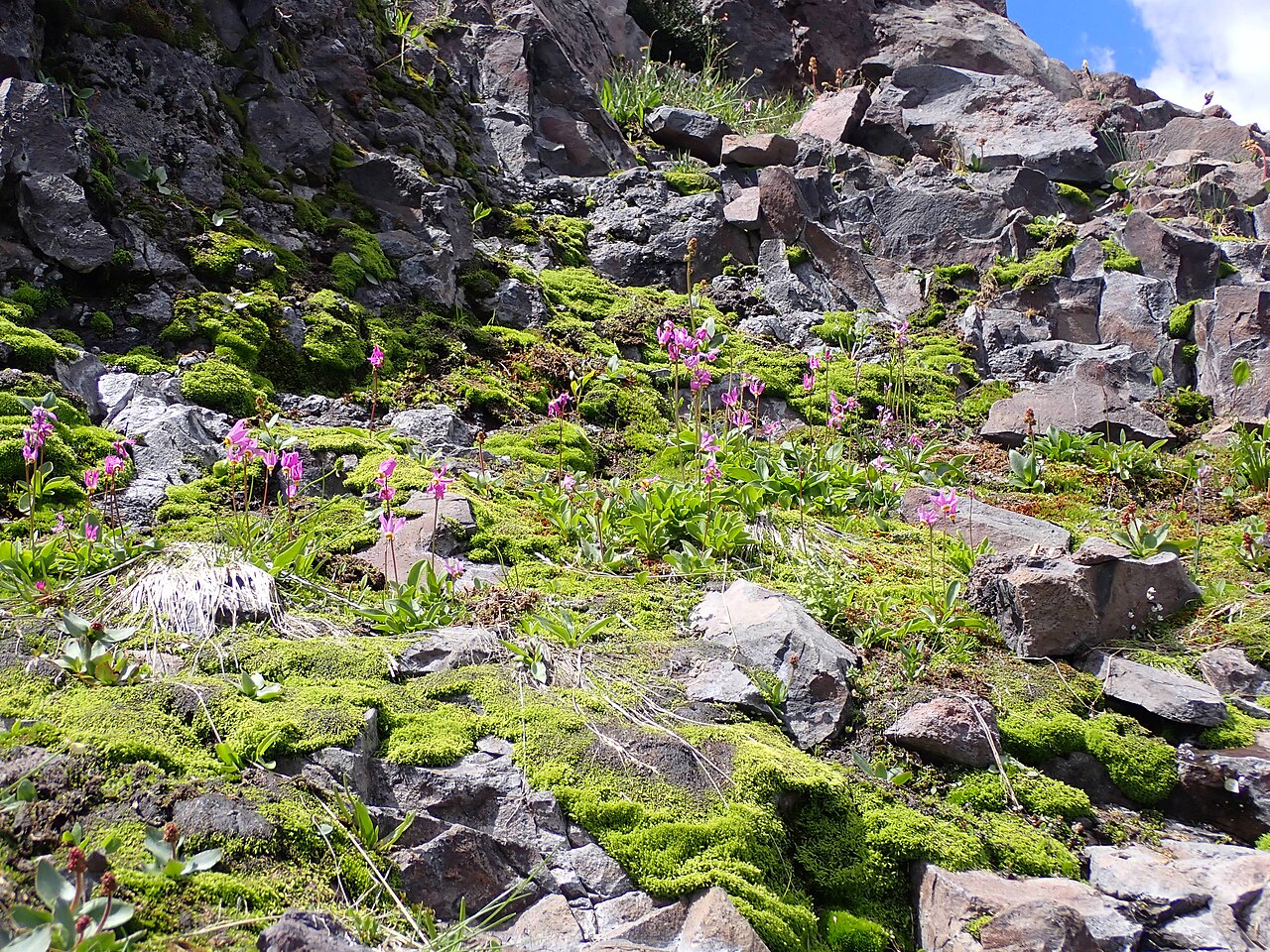
Primula pauciflora (long known as Dodecatheon pulchellum), commonly called the Few-flowered Shooting Star or Darkthroat Shooting Star, is a small perennial wildflower of wet meadows and seeps across the mountain West. Like all shooting stars, its flowers look like tiny badminton birdies hanging from a bare stalk: five petals swept sharply backward, a bright yellow collar, and a dark, pointed cone of fused anthers aimed at the ground. It belongs to the primrose family (Primulaceae), and botanists have moved it back and forth between the old genus Dodecatheon and Primula more than once — most current floras now place it in Primula, but “shooting star” and the species name pulchellum (“pretty”) are still what most gardeners and field guides use.
This is a plant of short, intense seasons. It pushes up a rosette of fleshy leaves and a leafless flowering stalk as snowmelt saturates the soil, blooms for a few weeks while the ground is still wet, sets seed, and then disappears underground for the rest of the year as its habitat dries out. Depending on elevation and latitude, that bloom window can fall anywhere from April at low-elevation sites to July in alpine cirques, which is why the same species can be found flowering in an Arizona canyon in early spring and on a Montana mountainside in midsummer.
Few-flowered shooting star is not a plant for the average perennial border — it wants the kind of ground that is saturated in spring and droughty by late summer, a combination few garden beds offer. But where that niche exists — a streambank, a seasonally wet meadow, a rock garden with a spring seep — it is a striking, easy-care native that disappears tidily after bloom rather than lingering as fading foliage.
Identification
Few-flowered shooting star grows from a short rootstock as a basal rosette with one or more leafless flowering stalks (scapes). There is no stem foliage; everything happens at ground level and on the bare scape.
Leaves
The leaves are entirely basal, forming a loose rosette 2 to 6 inches across. Individual leaves are oblong to spoon-shaped (spatulate), somewhat fleshy, smooth-edged or very shallowly toothed, tapering gradually into a winged leaf stalk. They are bright to medium green, hairless, and noticeably softer and more succulent than most companion wildflowers — an adaptation to the temporarily saturated soils the plant favors.
Flowers
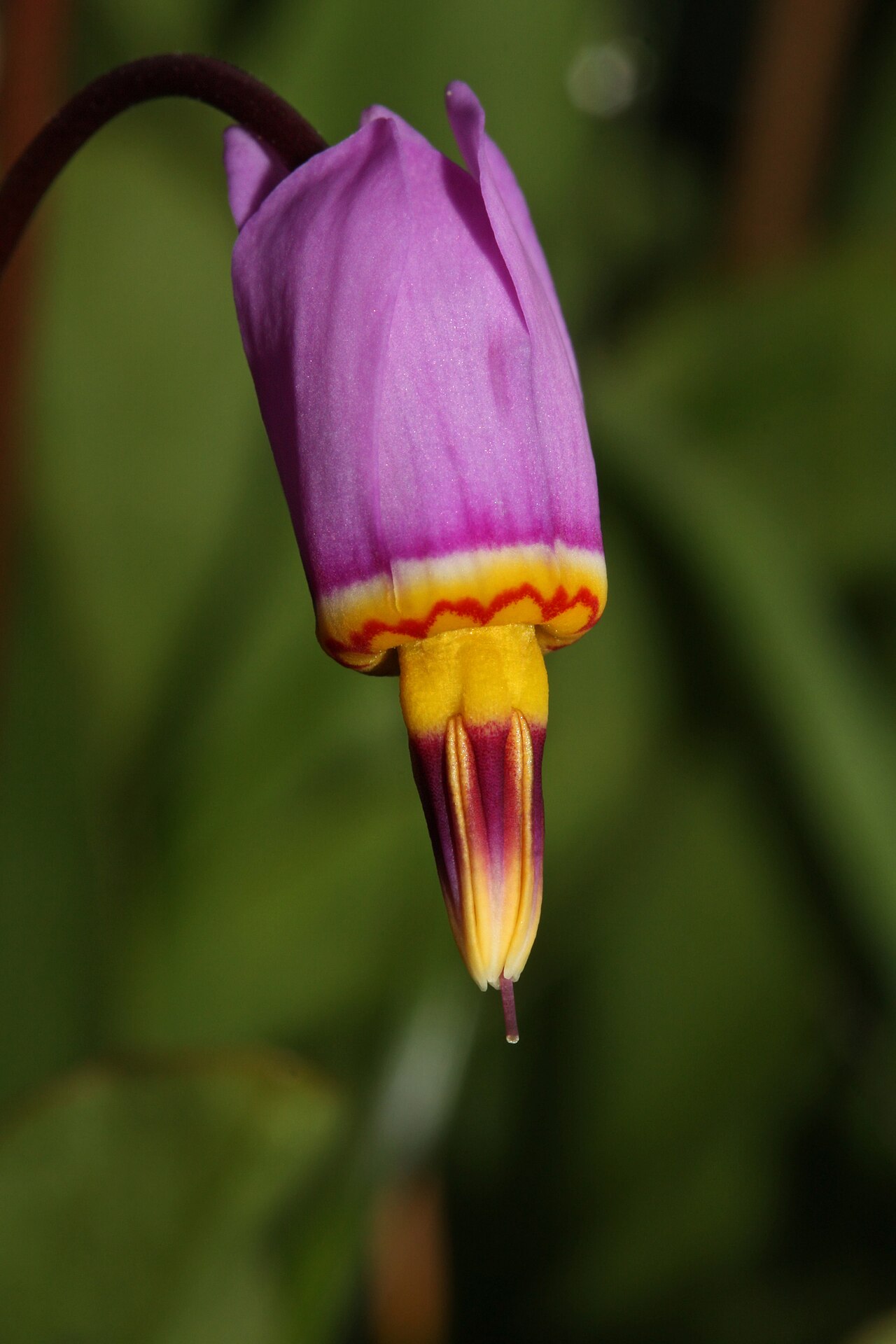
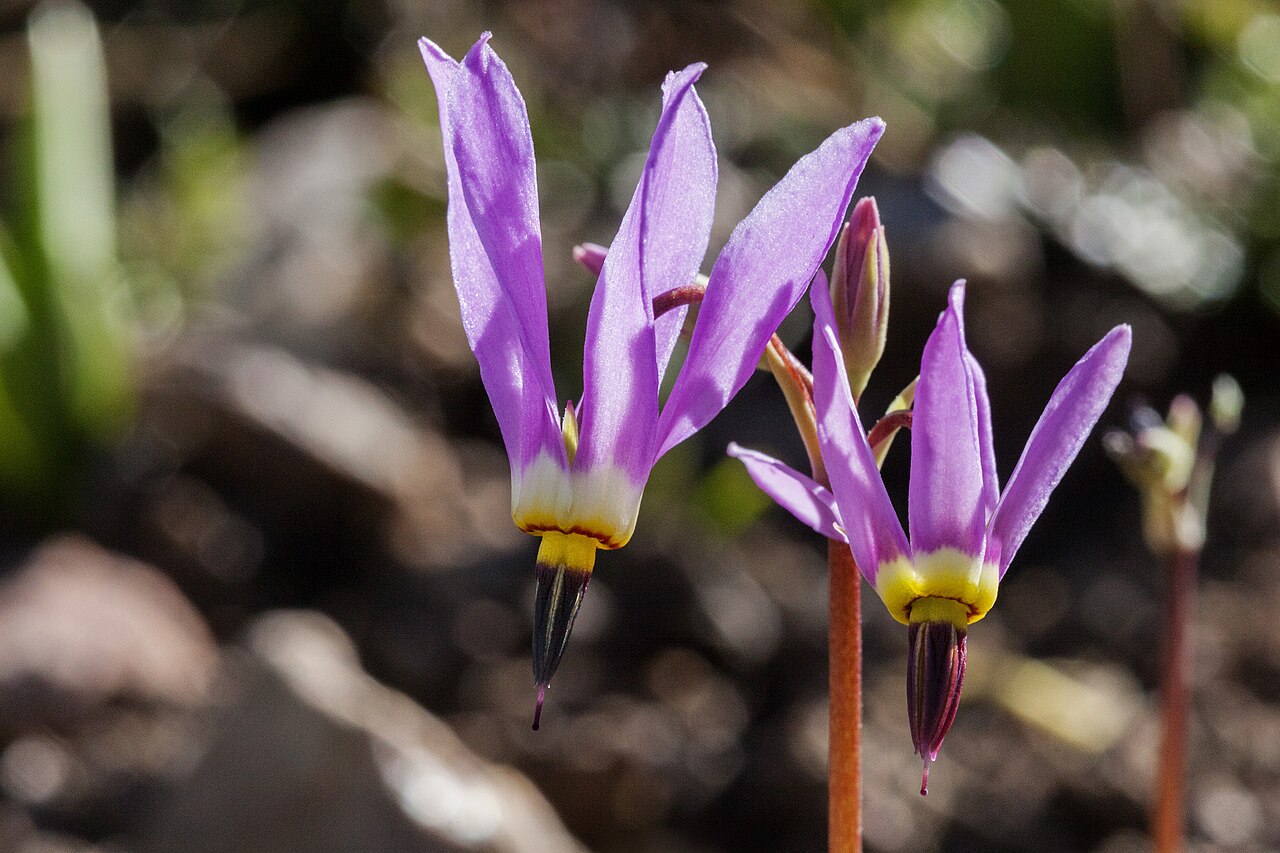
One to several (rarely more than a dozen) nodding flowers are carried in a loose umbel atop a smooth, leafless stalk 4 to 16 inches tall. Each flower hangs upside-down before opening, then as it matures the four or five petals sweep sharply backward and upward, away from the reproductive parts, giving the unmistakable “shooting star” shape. Petals are magenta-pink to lavender (occasionally white), with a short, well-defined yellow band at the base rimmed by a dark maroon to blackish-purple zigzag line — the “darkthroat” that gives the plant one of its common names. The stamens are fused into a narrow, pointed cone of dark purple to black anthers that projects downward like a beak. Bumblebees pollinate the flowers by vibrating this cone (buzz pollination), which releases pollen from pores at the tip.
Fruit & Seeds
After pollination the flower stalk straightens upright and the ovary swells into a small, cylindrical capsule that splits open at the tip to release numerous tiny seeds. By the time the capsules ripen, the surrounding ground is usually drying out, and the whole plant — leaves, stalks and all — withers back to the rootstock for a long summer and fall dormancy.
Quick Facts
| Scientific Name | Primula pauciflora (syn. Dodecatheon pulchellum) |
| Family | Primulaceae (Primrose) |
| Plant Type | Herbaceous perennial wildflower (spring/summer ephemeral) |
| Mature Height | 4–16 in (10–40 cm) in flower |
| Mature Spread | 4–8 in rosette |
| Growth Rate | Slow to moderate; spreads gradually by seed and offsets |
| Sun Exposure | Full Sun to Part Shade |
| Water Needs | Wet to consistently moist in spring; tolerates dry summer dormancy |
| Soil Type | Rich, humusy soil that is saturated in spring, loam or clay-loam |
| Soil pH | Neutral to slightly alkaline (6.5–7.5) |
| Bloom Time | April – July (earlier at low elevation, later in alpine sites) |
| Flower Color | Magenta-pink to lavender with a yellow and dark maroon throat |
| Fall Color | None (plant is dormant by late summer) |
| Fruit | Small upright seed capsule |
| Deer Resistant | Generally yes (low palatability, brief above-ground season) |
| USDA Hardiness Zones | 3–8 |
Native Range
Few-flowered shooting star has one of the broadest ranges of any shooting star, spanning much of western North America from Alaska south through the Pacific Northwest, the Rocky Mountains and the Great Basin to Arizona and New Mexico. It occurs from coastal Alaska meadows near sea level to alpine cirques above 11,000 feet in the Rockies, which is why its bloom time varies so much from place to place — essentially tracking the retreat of snowmelt at each site.
Across this range it is consistently a plant of reliably wet ground: subalpine and alpine meadows fed by snowmelt, streambanks, spring seeps, moist meadow edges, and the margins of vernal pools that are saturated in spring and dry by midsummer. It is often found growing with sedges, mountain bluebells, globeflower, marsh marigold and other moisture-loving montane wildflowers, usually on open or lightly shaded ground rather than deep forest.
Few-flowered shooting star is not considered rare or at risk across its range as a whole, though some local populations in heavily grazed or altered wet meadows have declined, since livestock and off-road use can damage the shallow-rooted rosettes and compact the moist soils the species depends on. It is not native to and should not be planted outside its western mountain range.
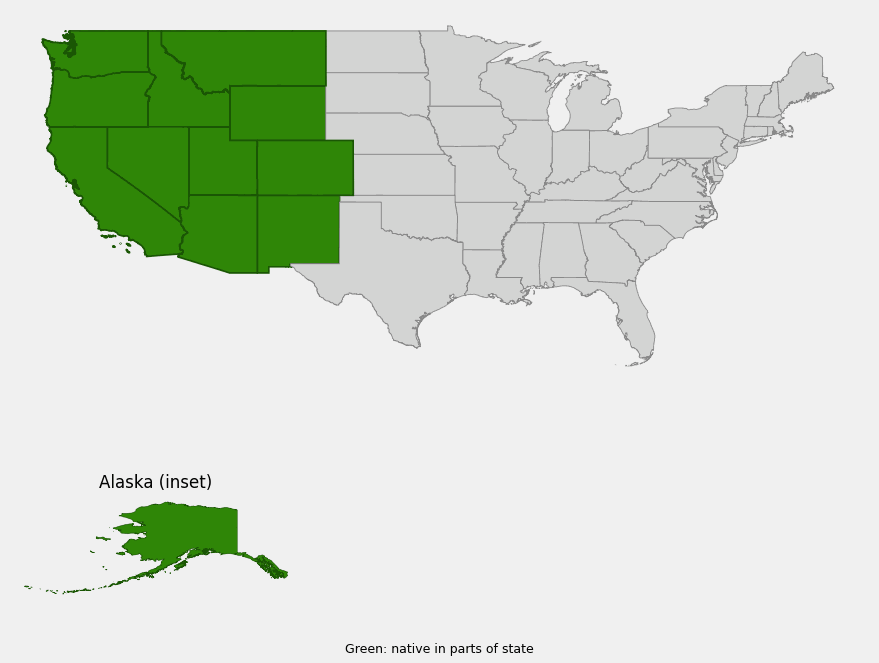
📋 Regional plant lists featuring Few-flowered Shooting Star: Alaska · Idaho, Eastern Oregon & Eastern Washington · Western Oregon & Western Washington · Montana & Wyoming · Utah & Western Colorado · Arizona & New Mexico
Growing & Care Guide
Few-flowered shooting star rewards gardeners who can offer it the one thing it truly needs: reliably wet soil during its spring growing season. Get that right and it is an easy, low-maintenance native that returns reliably every year.
Light
Plants do best in full sun to light part shade. At higher, more open elevations full sun is ideal; in warmer, lower-elevation gardens a little afternoon shade helps keep the rosette and soil from drying out too quickly during bloom.
Soil & Water
This is the critical factor: soil must stay consistently wet to saturated through the spring growing and flowering period. A streambank, pond margin, rain garden low spot, or a bed fed by snowmelt or irrigation in spring works well. Once the plant goes dormant in early-to-mid summer, the same ground can dry out considerably — in fact a dry summer dormancy is normal and even beneficial, mimicking the seasonal wet-then-dry cycle of its native meadows. Rich, humusy loam or clay-loam soil suits it better than sand, which drains too fast.
Planting Tips
Set out nursery-grown plants or sow fresh seed in fall so it can experience a natural cold, moist winter stratification. Plant at the edge of a pond, in a rain garden, or anywhere the soil is reliably wet in spring. Mark the spot, since the entire plant disappears by midsummer and is easy to accidentally dig into or plant over later in the season.
Pruning & Maintenance
None needed. Let the foliage die back naturally after bloom rather than cutting it, since the plant is simply storing energy below ground for next year. Deadheading is optional; leaving a few capsules to ripen lets the colony self-sow into nearby wet spots.
Propagation
Few-flowered shooting star is most reliably propagated from fresh seed sown in fall and left outdoors to stratify over winter, or by carefully dividing the fleshy rootstock in late summer dormancy, when the above-ground growth has already died back.
Landscape Uses
- Pond and stream margins where soil stays wet in spring
- Rain gardens and low spots that collect snowmelt or runoff
- Alpine and rock gardens built around a spring seep
- Native wet-meadow restoration plantings
- Early-season pollinator plantings for native bumblebees
Wildlife & Ecological Value
Despite its short above-ground season, few-flowered shooting star plays a real role in the wet meadow communities where it grows, especially as an early nectar and pollen source in a habitat that is often still cold and sparse in flower.
For Pollinators
The flowers are specialized for buzz pollination: bumblebees grip the dark anther cone and vibrate their flight muscles to shake pollen loose from pores at its tip, a technique few other insects can perform. This makes shooting stars an important early-season resource specifically for native bumblebee queens establishing new colonies, at a time when few other wet-meadow wildflowers are blooming.
For Birds
The plant’s brief, low-growing season offers little direct forage or cover for birds, though the wet meadows it favors generally support insect populations that feed foraging songbirds and shorebirds.
For Mammals
Few-flowered shooting star is not a significant browse species; its low palatability and short growing season mean deer and elk generally pass over it in favor of other wet-meadow vegetation.
Ecosystem Role
As a true spring ephemeral of saturated ground, the species helps fill the narrow window between snowmelt and the full emergence of summer wet-meadow vegetation, and its shallow, fleshy roots help bind the thin soils of seeps and streambanks during the wettest part of the year.
Cultural & Historical Uses
Several Indigenous peoples across the shooting star’s range, including groups in the Rocky Mountain and Great Basin regions, knew the plant and used its flowers or roots in various ways documented in ethnobotanical records, though specific practices varied by nation and are not consistently recorded across its full range. As with many showy spring wildflowers, shooting stars were also simply appreciated and gathered as cut flowers in the short window when wet mountain meadows burst into bloom.
In more recent horticultural history, shooting stars — including this species and its close relatives — have long been grown by rock garden and alpine plant enthusiasts in North America and Europe, prized for their unusual swept-back flower form and their reliable, if brief, annual appearance. Named cultivars have been selected for flower color.
No part of this plant is used medicinally or as food today, and no reliable record supports treating any shooting star as an edible or medicinal plant; admire it in the meadow or garden rather than harvesting it.
Frequently Asked Questions
Is Primula pauciflora the same plant as Dodecatheon pulchellum?
Yes. For decades this species was classified in the genus Dodecatheon as Dodecatheon pulchellum, and that name is still widely used in field guides, nurseries and older references. Current taxonomy places all shooting stars within Primula, making Primula pauciflora the accepted scientific name, but both names refer to the same plant.
Why did my shooting star disappear in midsummer?
That is normal, not a sign of trouble. Few-flowered shooting star is a spring ephemeral: it grows, blooms and sets seed while the soil is wet from snowmelt, then goes fully dormant below ground once the ground dries out in summer. It will reappear the following spring as soon as conditions turn wet again.
Can I grow few-flowered shooting star in a normal flower bed?
Only if that bed stays consistently wet to saturated in spring. Without that, the plant will struggle or fail to establish. It is much better suited to a pond edge, rain garden, or a spot fed by snowmelt or seasonal runoff than to an average well-drained perennial border.
Do bees pollinate shooting star flowers normally?
Not in the usual way. The flowers require “buzz pollination,” in which a bumblebee grips the dark cone of fused anthers and vibrates its wing muscles to shake pollen out through small pores — a technique most other pollinators, including honeybees, cannot perform efficiently.
Is few-flowered shooting star rare or endangered?
No, across its full range from Alaska to New Mexico it is considered secure, though some local wet-meadow populations have been reduced by grazing, trampling or wetland alteration. Planting it in a suitable wet garden spot supports the species without any need to collect from the wild.