Frosted Hawthorn (Crataegus pruinosa)
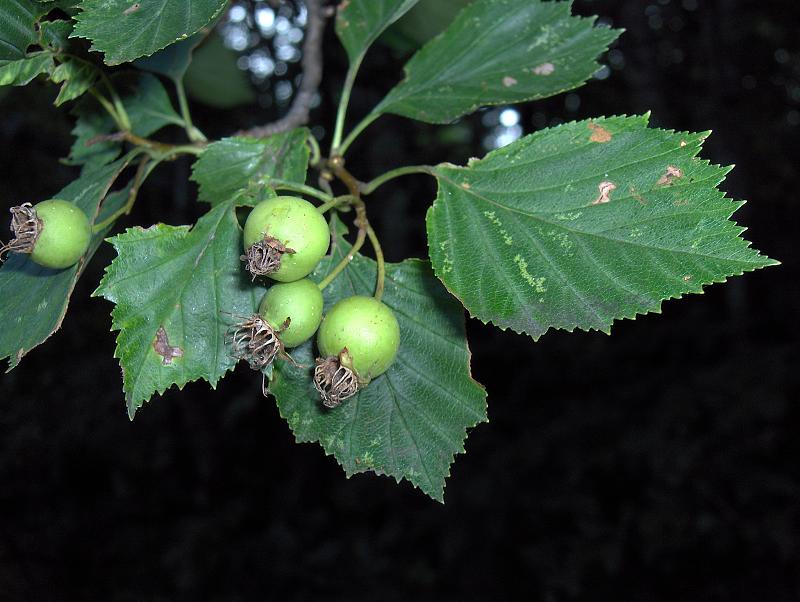
Crataegus pruinosa, commonly called Frosted Hawthorn, is a thorny native shrub or small tree in the rose family (Rosaceae) found scattered through open woods, old fields, and fencerows of the eastern United States. The common name comes from the heavy waxy “bloom,” or pruinescence, that dusts the ripening fruit — rub a thumb across a pome in September and it wipes away like frost, revealing deeper red or crimson skin underneath. It is one of several hundred named hawthorns in a notoriously difficult genus, but it is also one of the more recognizable: a dense, often many-stemmed small tree with stiff purple-black thorns, sharply lobed leaves, and clusters of white spring flowers that ripen into greenish, pink-blushed, frost-coated fruit by early fall.
Frosted hawthorn is not a plant most nurseries market by name, and that is part of its appeal for a serious native-plant gardener. It is a workhorse thicket species — the kind of small tree that anchors a hedgerow, feeds overwintering birds, and asks for almost nothing once established. Left alone in a sunny corner of the yard or along a field edge, it will slowly build into a dense, round-topped specimen that is as useful to wildlife as anything you could plant.
Identification
Frosted hawthorn grows as a shrub or small tree 7 to 23 feet (2–7 m) tall, usually with multiple trunks and a dense, rounded crown. Twigs carry straight to slightly recurved thorns 1 to 2 inches (3–5 cm) long that start reddish-brown, darken to deep purple, and finally shiny black by their second year — a useful identification clue in winter when the leaves are gone.
Leaves
Leaves are broadly ovate to rhombic, 1 to 2½ inches (2–6 cm) long, with 3 or 4 shallow to moderate lobes per side and sharply toothed (serrate) margins. The leaf base is broadly wedge-shaped to nearly straight across, and the upper surface is smooth (glabrous) in most varieties. Leaves emerge with a slight bluish-green cast that deepens to matte green through summer; fall color is an unremarkable yellow-brown.
Flowers
In May, clusters of 5 to 10 white, five-petaled flowers open at the branch tips, each about ¾ to 1 inch (15–25 mm) across. The anthers are usually pale pink to rose, occasionally cream, giving the flower clusters a faint blush when viewed up close. Like most hawthorns, the blossoms have a slightly unpleasant, musky scent that draws flies and small native bees rather than showier pollinators.
Fruit
The defining feature: pomes ⅜ to ¾ inch (10–20 mm) across, greenish with pink or mauve patches ripening toward crimson, and covered in a conspicuous waxy pruinose bloom that rubs off at a touch. Fruits are somewhat angular rather than perfectly round, with hard, mealy flesh and 3 to 5 nutlets (pyrenes) inside. They ripen from September into October and often persist into early winter, shriveling but still providing a late-season food source after softer fruits are gone.
Only one verifiably identified, appropriately licensed photograph of this species was available at time of writing; a second close-up or bark/thorn image will be added as better-documented material becomes available.
Quick Facts
| Scientific Name | Crataegus pruinosa (H.L. Wendl.) K. Koch |
| Family | Rosaceae (Rose) |
| Plant Type | Deciduous shrub / small tree |
| Mature Height | 7–23 ft (2–7 m) |
| Growth Rate | Slow to moderate |
| Sun Exposure | Full sun to part shade |
| Water Needs | Low to moderate once established |
| Soil Type | Adaptable; dry to mesic, well-drained loam or clay-loam |
| Soil pH | Adaptable, neutral preferred |
| Bloom Time | May |
| Flower Color | White |
| Fruit | Greenish-pink to crimson pomes with waxy bloom, Sep–Oct |
| Thorns | Yes, 1–2 in, purple-black on older wood |
| USDA Hardiness Zones | 4–8 |
Native Range
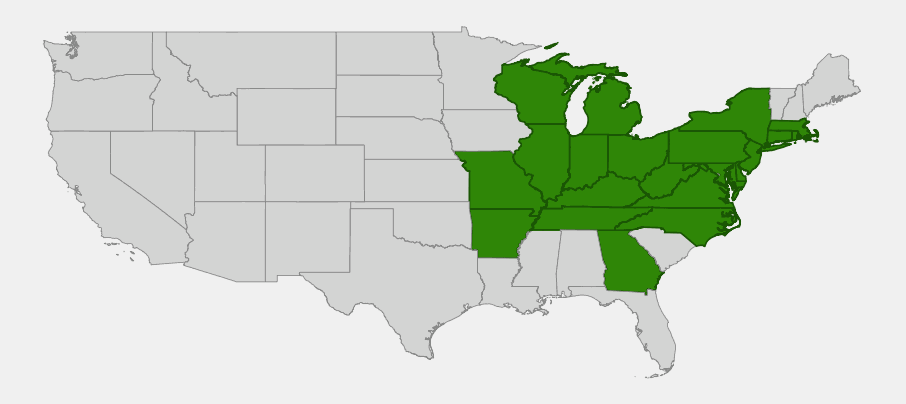
Frosted hawthorn is native to a broad swath of the eastern United States, from the southern Great Lakes and Ozarks east through the Mid-Atlantic and into southern New England, with its southern limit running along the Appalachians into northern Georgia. It grows in open, successional habitats: old fields, fencerows, forest edges, thin upland woods, and pastures that are not too heavily grazed. In the northern part of its range it stays mostly shrubby, colonizing abandoned fields; farther south it more often develops into a small single- or few-stemmed tree in open or thinly wooded sites.
Like most hawthorns, C. pruinosa is a taxonomically complicated species — botanists recognize six varieties across its range that differ mainly in leaf shape and hairiness, and it is known to hybridize and intergrade with relatives such as Kansas hawthorn (C. coccinioides) toward the southwestern edge of its range. The USDA PLANTS Database lists it as symbol CRPR2, native to the Lower 48 and adjacent Canada.
📋 Regional plant lists featuring Frosted Hawthorn: Connecticut, Massachusetts & Rhode Island · New York, Pennsylvania & Northern New Jersey · Delaware, Southern New Jersey & Long Island · Maryland, Virginia & West Virginia · North Carolina & South Carolina · Georgia, Alabama & Mississippi · Arkansas, Louisiana & East Texas/Oklahoma · Kentucky & Tennessee · Ohio & Indiana · Illinois, Iowa & Missouri · Michigan, Wisconsin & Eastern Minnesota
Growing & Care Guide
Frosted hawthorn is an undemanding, tough small tree once it is in the ground. It tolerates poor, compacted, or clay soils far better than most ornamental trees, making it a good choice for difficult sites where little else native will establish.
Light & Water
Give it full sun to light part shade — it flowers and fruits most heavily in open sites, and will become leggy and sparse-flowering in heavy shade. It is drought tolerant once established and does not need supplemental watering outside of the first year or two, though it also tolerates occasional wet spells and heavier soils better than many upland trees.
Soil & Planting
Adaptable to a wide range of soils, including clay-loam, rocky or gravelly ground, and disturbed sites, provided drainage is reasonable. Plant young container stock in fall or early spring, and give it room to form its natural dense, multi-stemmed shape — pruning to a single leader is possible but works against the tree’s instinct to sucker and branch low.
Pruning & Maintenance
Minimal pruning is needed beyond removing dead or crossing wood in late winter. Because of the stout thorns, site it away from walkways and play areas, and wear heavy gloves and eye protection for any pruning work. The species is generally free of serious pest or disease problems, though like all hawthorns it can show cedar-hawthorn rust on leaves where eastern redcedar grows nearby — usually cosmetic rather than life-threatening.
Landscape Uses
- Wildlife hedgerows and thorny thicket plantings for nesting cover
- Field-edge and fence-line plantings on marginal or compacted soil
- Naturalized meadow or old-field restoration plantings
- Barrier or security plantings, using the dense thorny growth to discourage foot traffic
- Specimen small tree for a sunny yard corner with minimal care
Wildlife & Ecological Value
Frosted hawthorn earns its keep as a wildlife plant. The persistent, pruinose fruit hangs on well into winter, when it becomes an important food source for American robins, cedar waxwings, northern cardinals, ruffed grouse, and other fruit-eating birds after softer berries have already been stripped from the landscape. Small mammals including foxes and raccoons also eat the fallen fruit.
The dense, thorny branching provides excellent nesting cover for songbirds such as northern mockingbirds, gray catbirds, and brown thrashers, which favor the protection thorns provide against predators. In spring, the flowers — though not especially showy up close — draw flies, small native bees, and other generalist pollinators. As a larval host, hawthorns in general support a number of moth and butterfly species, including several hairstreaks and the spring azure.
Frequently Asked Questions
Is frosted hawthorn fruit edible?
The pomes are not toxic, and like most hawthorn fruit they have historically been nibbled or used in jellies, but the flesh is mealy, dry, and mildly astringent — most people find them unpalatable fresh. They are best left for wildlife, which rely on them far more than people do.
How do I tell frosted hawthorn from other eastern hawthorns?
Hawthorn species are notoriously difficult to separate with confidence, and Crataegus pruinosa is no exception. The clearest field mark is the heavy waxy bloom on the ripening fruit, which rubs off at a touch — more pronounced here than on most relatives. Leaf shape, thorn color, and anther color are all useful but variable characters best checked in combination.
Is this a good choice for a small yard?
Its compact, shrubby habit makes it workable in moderate-sized spaces, but the stout thorns mean it is best kept away from paths, play areas, and property lines where neighbors or passersby might brush against it.
Does it need a pollinator partner to fruit?
No. Like most hawthorns it sets fruit readily from its own flowers and does not require a second plant nearby, though fruit set is heavier with good pollinator activity during the brief May bloom window.

Looking for a nursery that carries Frosted Hawthorn?
Browse our native plant nursery directory: AL–AR · CO–HI · ID–KS · KY–MT · NE–OK · PA–VA · WV–WY
More hawthorns to explore: Downy Hawthorn · Dotted Hawthorn. Related reading: Hawthorn Trees: Plant, Grow & Care, Planting Native Trees for Wildlife, and Attracting Songbirds with Native Plants.