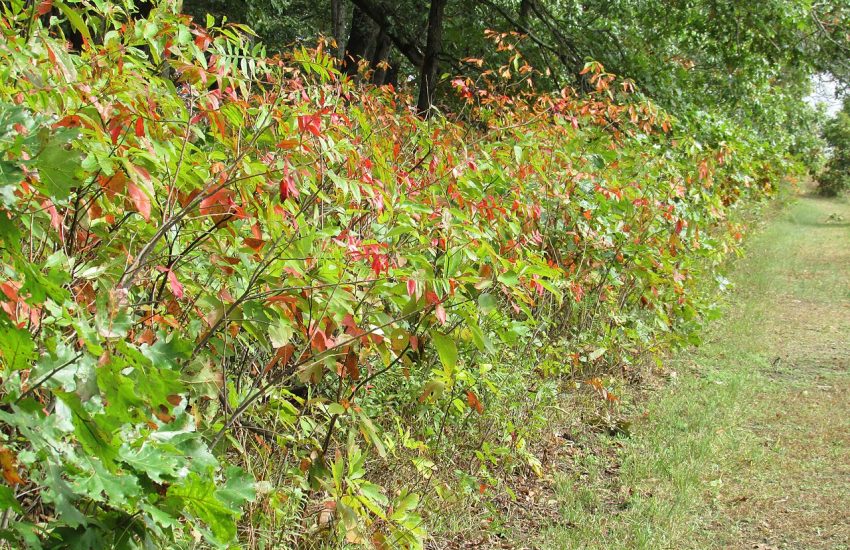
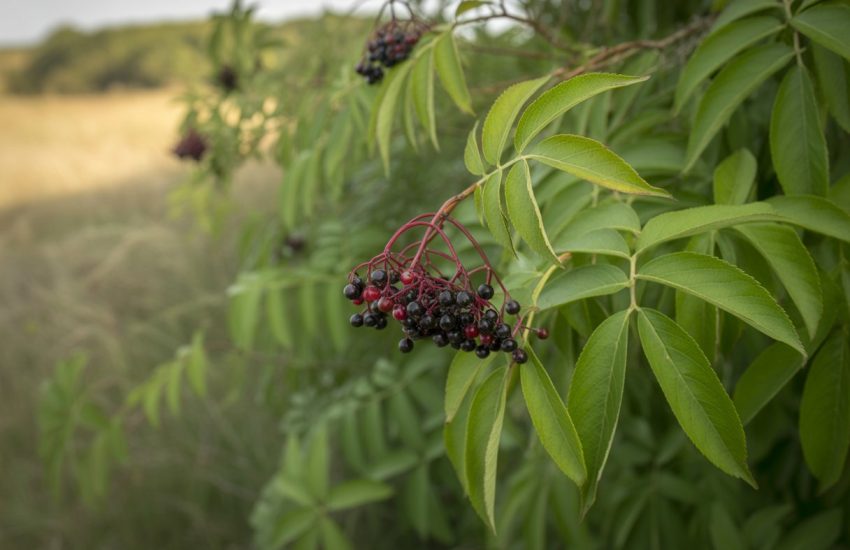
Kansas Hawthorn (Crataegus coccinioides)
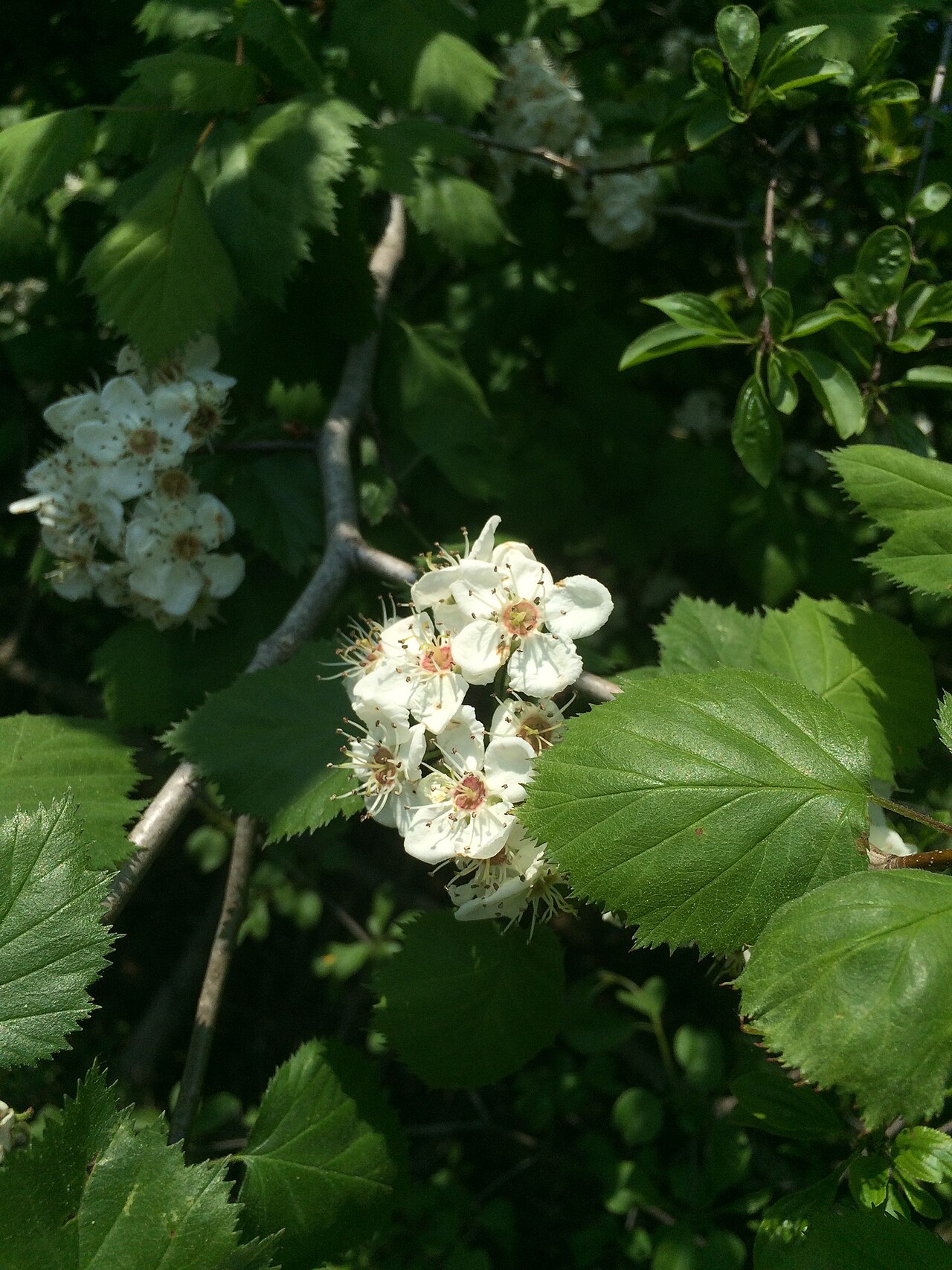
Crataegus coccinioides, commonly called Kansas Hawthorn or large-flowered cockspurthorn, is a native shrub or small tree in the rose family (Rosaceae) found in a band running from the southwestern Midwest to southern New England and southern Quebec. Despite its common name, the species is not confined to Kansas — it ranges much more broadly through the Ohio and lower Missouri valleys, the Appalachian foothills, and New England.
Like most hawthorns, Kansas hawthorn is part of a genus notorious for its fine-grained taxonomic complexity, built on dozens of locally named, closely related forms. Some current floras treat it as a synonym of the more broadly circumscribed Crataegus dilatata, but the USDA PLANTS Database and many regional checklists continue to recognize C. coccinioides as a distinct species, and that is the treatment used on this page. Typical plants have large, showy flowers, rounded leaves, and fruit that ripens to an unusual pink-crimson rather than the pure scarlet of many related species.
Identification
Kansas hawthorn is a shrub or small tree 13 to 23 feet (4–7 m) tall. New twig growth is somewhat reddish, glabrous or sparsely hairy, aging to shiny dark brown and then gray. Thorns are numerous, usually somewhat recurved, and shiny blackish on second-year wood, typically 1¼ to 2½ inches (3–6 cm) long.
Leaves
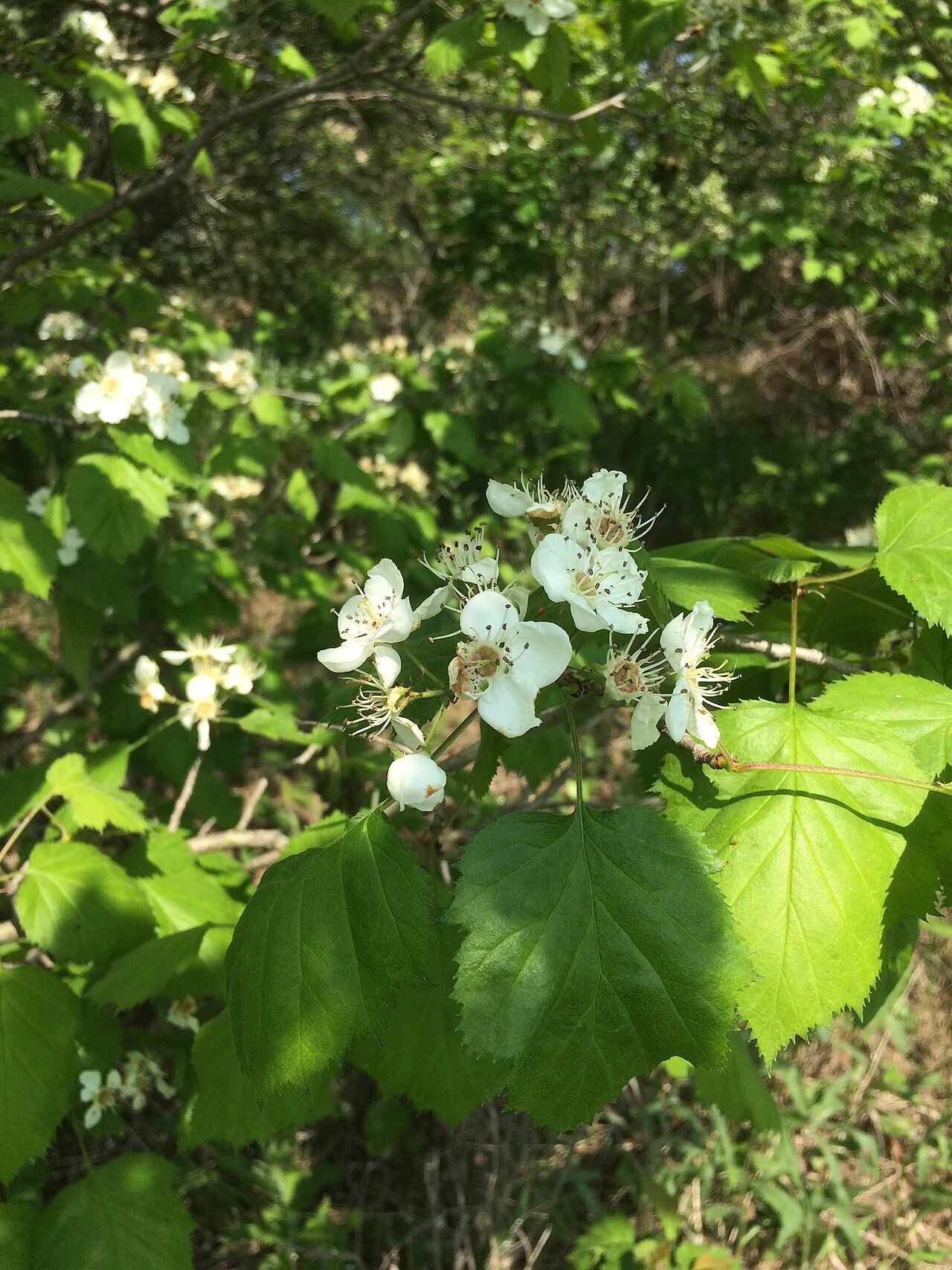
Leaves are usually ovate, sometimes very broadly ovate to ovate-deltate, 1½ to 3½ (occasionally to 4½) inches (4–11 cm) long — among the larger leaves in the genus. The base is broadly wedge-shaped, flattened, or slightly heart-shaped on broader leaves, with 3 to 5 shallowly sinused, sharply pointed lobes per side and sharply serrate margins.
Flowers
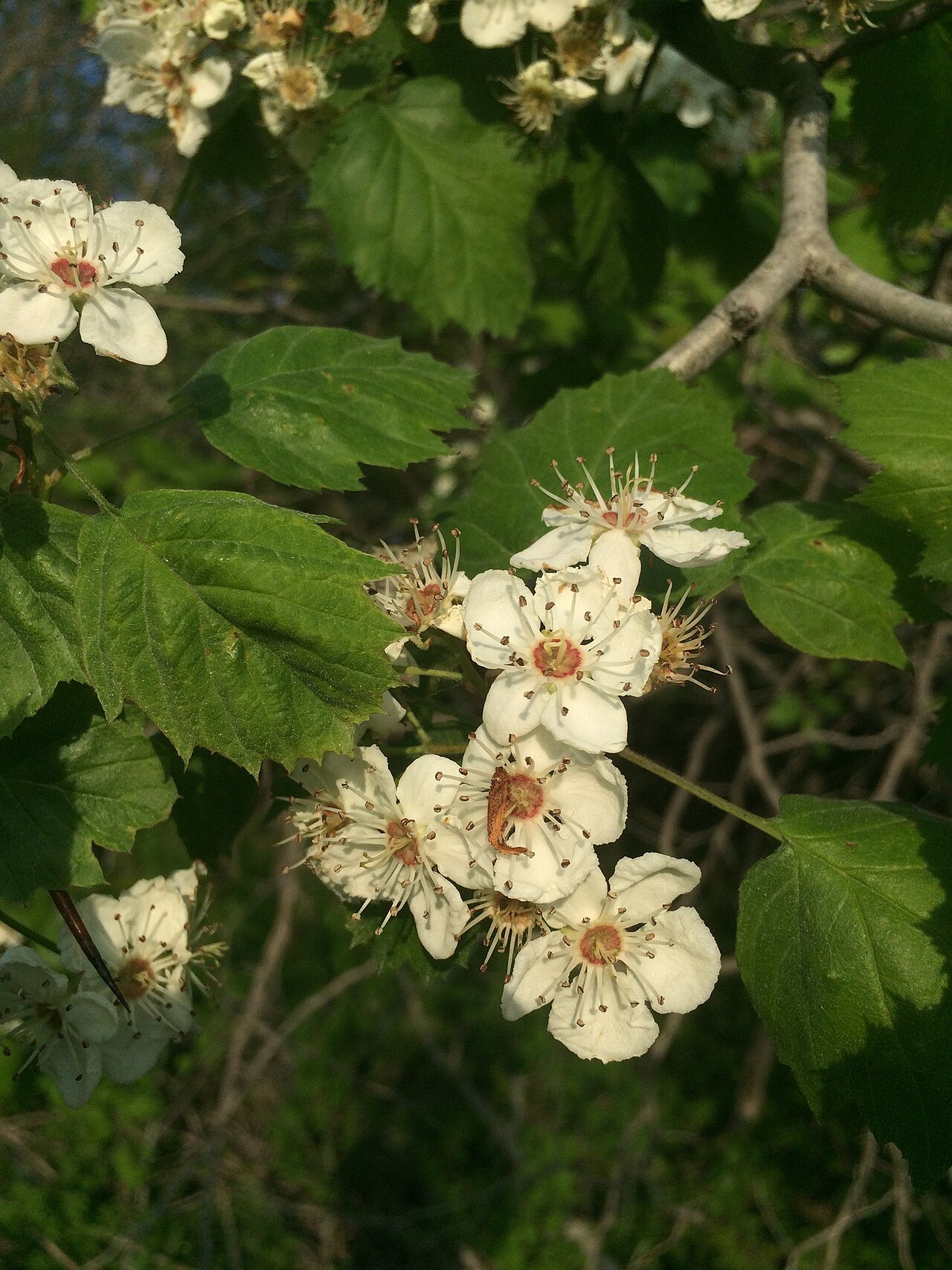
Flowers are unusually large for the genus, ¾ to 1 inch (20–25 mm) across, opening in clusters of 5 to 12 in April and May. Typical plants have 20 rose-colored stamens and mostly smooth floral parts, though white-anthered and densely hairy forms also occur within the species’ variation.
Fruit
Pomes are bright pink to crimson — paler and pinker than the scarlet fruit of close relatives — roundish, ⅜ to ¾ (occasionally 1) inch (10–25 mm) across, and often lightly pruinose (waxy-coated), ripening September into October. The pink-crimson color combined with the waxy bloom is a useful field mark separating it from the deeper scarlet or red fruit of most other hawthorns in ser. Coccineae.
Quick Facts
| Scientific Name | Crataegus coccinioides Ashe |
| Family | Rosaceae (Rose) |
| Plant Type | Deciduous shrub / small tree |
| Mature Height | 13–23 ft (4–7 m) |
| Growth Rate | Slow to moderate |
| Sun Exposure | Full sun to part shade |
| Water Needs | Low to moderate once established |
| Soil Type | Adaptable, well-drained preferred |
| Bloom Time | April–May |
| Flower Color | White (unusually large blooms) |
| Fruit | Pink to crimson, lightly waxy pomes, Sep–Oct |
| Thorns | Yes, 1.25–2.5 in, recurved, blackish |
| USDA Hardiness Zones | 4–7 |
Native Range
Kansas hawthorn occurs from the southwestern Midwest — including Kansas, Missouri, and Arkansas — east through Illinois, Indiana, Kentucky, and Ohio to New York, Pennsylvania, and Massachusetts, with disjunct populations reported in southern Ontario and Quebec. It grows in brush, successional fields, pastures, and woodland margins at low elevations. The Flora of North America notes that records from Vermont and Oklahoma are unconfirmed, and this page excludes those states from the regional-list recommendations below pending better documentation.
Within its range, C. coccinioides shows considerable variation in hairiness and anther color — some botanists have named separate species (C. declivitatis, C. conspecta, C. dilatata, among others) for white-anthered or densely hairy extremes, while others, including some current online floras, lump all of these together, sometimes under the name C. dilatata. The USDA PLANTS Database continues to list C. coccinioides as an independently accepted species under symbol CRCO2, which this page follows.
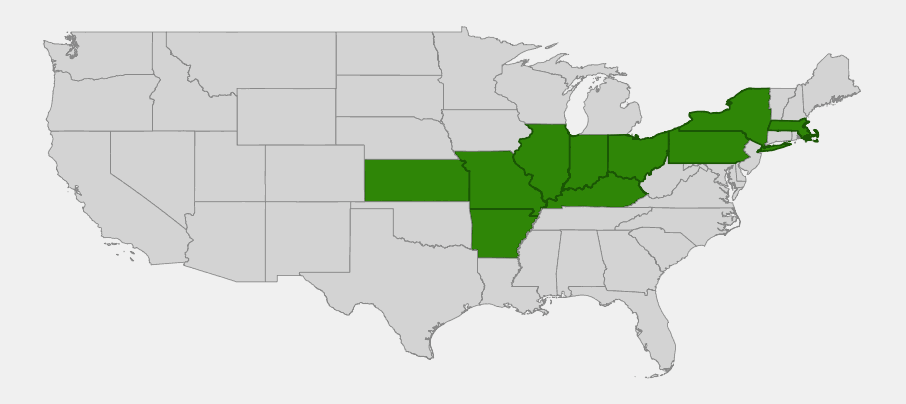
📋 Regional plant lists featuring Kansas Hawthorn: Connecticut, Massachusetts & Rhode Island · New York, Pennsylvania & Northern New Jersey · Kentucky & Tennessee · Ohio & Indiana · Illinois, Iowa & Missouri · Arkansas, Louisiana & East Texas/Oklahoma · Nebraska, Kansas & Eastern Colorado
Growing & Care Guide
Kansas hawthorn makes an attractive small specimen tree, valued especially for its unusually large spring flowers.
Light & Water
Plant in full sun to part shade; flowering is heaviest in full sun. Once established it tolerates average garden moisture and short dry spells without special care, though it is not a true drought specialist and benefits from occasional deep watering in extended dry periods, especially the first two seasons after planting.
Soil & Planting
Adaptable to average, well-drained garden soils. Plant container stock in fall or early spring, giving the tree room to develop its natural rounded form — minimal staking or structural pruning is needed.
Pruning & Maintenance
Remove dead or crossing branches in late winter dormancy. The species is generally healthy, with occasional cedar-hawthorn rust where eastern redcedar grows nearby. Handle pruning with heavy gloves given the recurved, blackish thorns.
Landscape Uses
- Flowering specimen tree — among the showiest-flowered native hawthorns
- Wildlife hedgerow or thicket planting
- Naturalized old-field or pasture-edge restoration
- Pollinator garden anchor tree for its large April–May blooms
Wildlife & Ecological Value
The unusually large, showy flowers make Kansas hawthorn a strong early-to-mid-spring resource for native bees and other pollinators searching out one of the biggest hawthorn blooms available to them. Its pink-crimson fruit, ripening in early fall, is eaten by American robins, cedar waxwings, and other fruit-loving birds, as well as small mammals foraging windfall beneath the canopy. As with other hawthorns, the dense thorny branches offer secure nesting cover for shrubland birds such as brown thrashers and gray catbirds, and the foliage supports several native moth and butterfly larvae associated with the broader apple/hawthorn group within Rosaceae.
Because Kansas hawthorn blooms slightly later than the earliest hawthorn species but often alongside crabapples and other spring-flowering trees, it extends the window of nectar and pollen availability for early-season pollinators moving through a native-plant landscape, complementing earlier and later bloomers in a mixed hawthorn or orchard-edge planting.
Frequently Asked Questions
Is Kansas hawthorn only found in Kansas?
No — despite the common name, it is native across a broad swath of the Midwest and Northeast, from Kansas and Missouri east to Massachusetts and south into Arkansas and Kentucky. The name likely reflects where the species was first collected or described rather than the center of its range.
Is Kansas hawthorn the same as Crataegus dilatata?
Botanists disagree. Some current treatments, including some online floras, lump C. coccinioides into the broader, more widely circumscribed C. dilatata. The USDA PLANTS Database and many regional plant lists continue to treat it as a distinct species, which is the approach followed here; gardeners researching the species in other sources may encounter either name.
Is the fruit edible?
The pomes are not toxic and have the typical mealy hawthorn texture; they are better left as a food source for birds than harvested for the table.
Does it need a specific climate?
It is hardy roughly in USDA zones 4–7 and does not require anything beyond the average well-drained garden conditions common across its native range in the Midwest and Northeast.

Looking for a nursery that carries Kansas Hawthorn?
Browse our native plant nursery directory: AL–AR · ID–KS · KY–MT · NE–OK · PA–VA
More hawthorns to explore: Downy Hawthorn · Dotted Hawthorn. Related reading: Hawthorn Trees: Plant, Grow & Care and Attracting Songbirds with Native Plants.