
Green Pitcher Plant (Sarracenia oreophila)
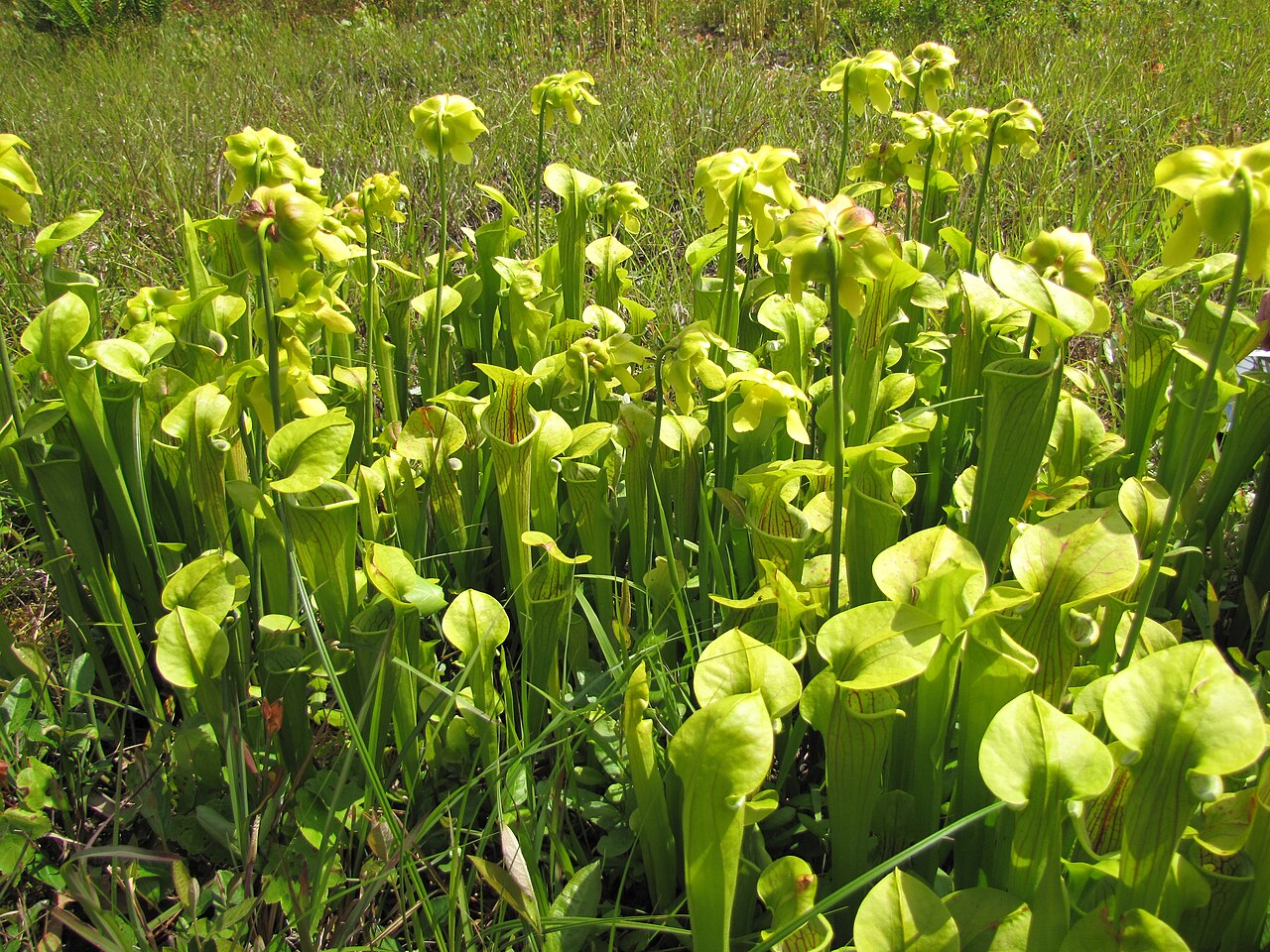
Sarracenia oreophila, the Green Pitcher Plant, is a carnivorous plant of the southern Appalachian region and one of the rarest pitcher plants in North America. In spring it sends up tall, trumpet-shaped, yellow-green leaves that trap insects, along with nodding yellow flowers. Its species name means “mountain-loving” (Greek oros, mountain, and philos, loving). Unlike most of its relatives, which live on the Coastal Plain, it grows in seepage bogs, wet meadows and sandy stream banks on the plateaus and mountains of northeastern Alabama, north Georgia and far southwestern North Carolina.
The green pitcher plant is federally listed as endangered under the U.S. Endangered Species Act, and it has been since 1979. Most of its remaining wild populations are on Sand Mountain and Lookout Mountain and nearby areas of northeastern Alabama, with only a few sites in Georgia and North Carolina. It was historically recorded in Tennessee as well. It is also listed in Appendix I of CITES, the international treaty on trade in endangered species. Never dig or collect green pitcher plants from the wild. Under the Endangered Species Act it is illegal to remove listed plants from federal land, or from any land in violation of state law, and poaching is one of the threats that pushed the species onto the endangered list.
Fortunately, green pitcher plant is easy to propagate, and nursery-propagated plants, often raised from seed or tissue culture, are grown by carnivorous plant enthusiasts around the world. This guide covers how to identify it, where it grows, why it is endangered, and how to grow it responsibly from legally propagated plants in a bog garden.
Identification
Green pitcher plant looks a lot like the more widespread Yellow Pitcher Plant, and botanists once treated it as a variety of that species. Its mountain habitat, its broader hood and its curved, sword-like summer leaves are the best ways to tell them apart.
Pitchers
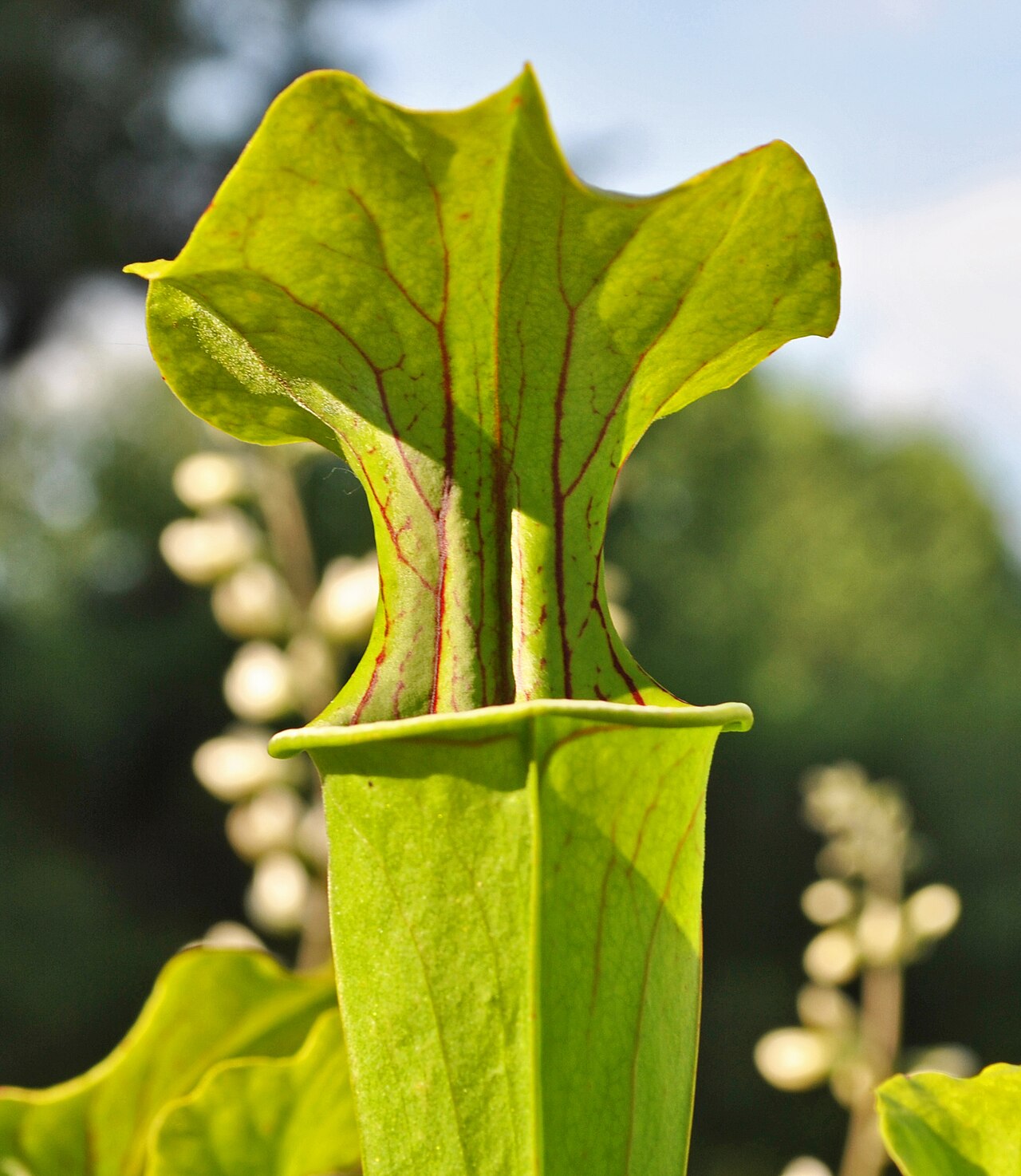
The pitchers (modified leaves) are upright, slender trumpets usually 8 to 30 inches tall, widening gradually to an open mouth. They are yellow-green to green, sometimes with faint red veins inside the throat or a reddish blush on the hood. The hood, or lid, is broad, rounded and held upright over the mouth, and it is often wider relative to the pitcher than in yellow pitcher plant. The inner surface is lined with downward-pointing hairs and a slippery waxy zone that keep insects from climbing out.
Summer Leaves (Phyllodia)
Green pitcher plant’s pitchers usually wither by mid- to late summer. As they fade, the plant produces flat, curved, sickle-shaped leaves called phyllodia, which do not trap insects. These blade-like leaves are a good identification clue in late summer and fall, when the pitchers are gone. Yellow pitcher plant keeps its pitchers longer and makes few or no phyllodia.
Flowers
The flowers appear in April and May, often just before or with the first pitchers. Each nods at the top of a leafless stalk that is usually a little shorter than the pitchers. The five long, drooping petals are yellow, and they hang over an umbrella-shaped style disk. The flowers have a sweet, slightly musty fragrance.
Rhizome & Fruit
The plant grows from a thick, creeping rhizome just below the soil surface, and it slowly forms clumps. After pollination, the flower develops a rounded capsule that splits in fall to release many small seeds. Seedlings take several years to reach flowering size.
Quick Facts
| Scientific Name | Sarracenia oreophila (Kearney) Wherry |
| Family | Sarraceniaceae (pitcher plant family) |
| Plant Type | Carnivorous herbaceous perennial from a rhizome |
| Mature Height | 8–30 in |
| Mature Spread | 1–2 ft; slowly forms clumps |
| Growth Rate | Slow to moderate |
| Sun Exposure | Full sun |
| Water Needs | High; moist to wet in the growing season, damp in winter |
| Soil Type | Acidic, nutrient-poor sand, sandy loam or peat |
| Soil pH | About 4.5–6.0 |
| Bloom Time | April–May |
| Flower Color | Yellow |
| Fall Color | Pitchers wither in summer; flat green phyllodia persist into fall |
| Fruit | Rounded capsule with many small seeds |
| Deer Resistant | Yes; rarely browsed |
| USDA Hardiness Zones | 6–8 |
Native Range
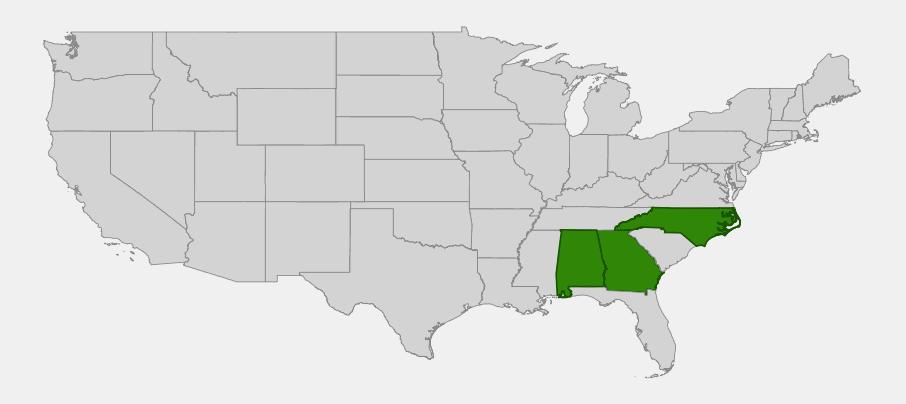
Green pitcher plant has one of the smallest ranges of any North American pitcher plant. USDA PLANTS records it from Alabama, Georgia and North Carolina. Most populations are in northeastern Alabama, on the Cumberland Plateau (Sand Mountain and Lookout Mountain) and in the nearby Ridge and Valley. A small number of sites are in north Georgia and in the mountains of far southwestern North Carolina. The U.S. Fish and Wildlife Service also lists Tennessee in its historical range.
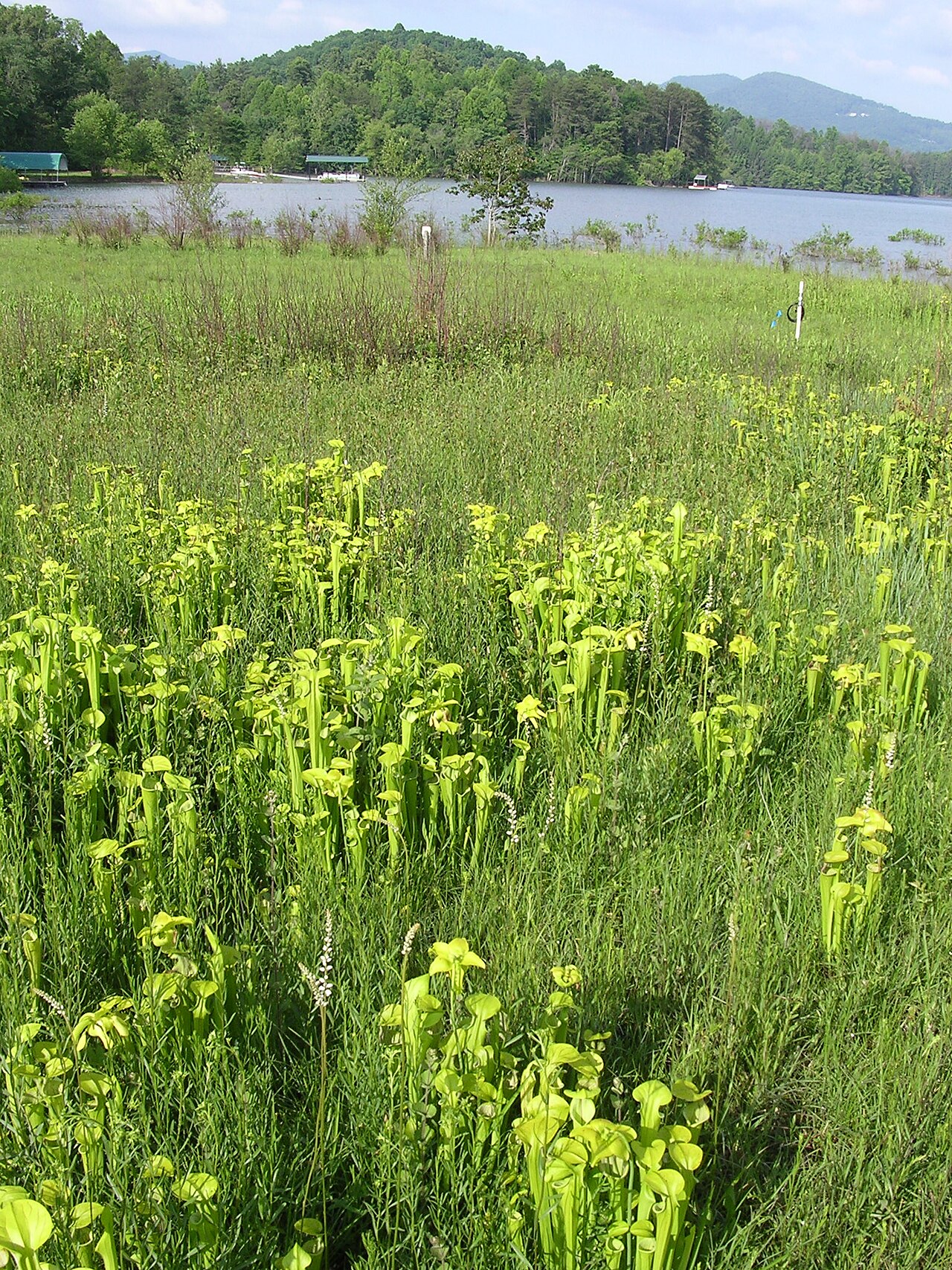
The species grows in three main habitats: seepage bogs and wet meadows on plateaus and mountain slopes, sandy and gravelly banks and bars along streams, and moist oak-pine flatwoods with open canopies. All of these sites are sunny and kept open by fire, flooding or other disturbance. When shrubs and trees close in, the plants stop flowering and slowly disappear.
Habitat loss is the main reason the species is endangered. Many sites have been drained, flooded by reservoirs, converted to farmland or pasture, or lost to development. Fire suppression lets woody plants shade out pitcher plants, and poachers have dug plants from wild populations. Recovery efforts include protecting sites, controlling woody growth, prescribed burning and reintroducing propagated plants.
📋 Regional plant lists featuring Green Pitcher Plant: Alabama, Georgia & Mississippi · North & South Carolina
Growing & Care Guide
Green pitcher plant is one of the easier and hardier Sarracenia to grow outdoors, as long as you start with nursery-propagated plants. Buy only from nurseries that sell legally propagated stock. Because it is federally endangered, selling plants across state lines requires a federal permit, and reputable carnivorous plant nurseries hold one or sell only within their state. Never buy plants that might have been dug from the wild.
Light
Give it full sun, at least 6 hours of direct light a day. With less light the pitchers become floppy and pale, and the plant rarely flowers. It does poorly as an indoor plant unless grown under strong grow lights.
Soil & Water
Plant in a nutrient-poor, acidic mix such as one part sphagnum peat to one part coarse silica sand or perlite. Keep the medium moist to wet during the growing season. In a bog garden or a pot standing in a tray, keep the water level an inch or two below the crown. Use rainwater, distilled water or reverse-osmosis water, because tap water with dissolved minerals slowly harms carnivorous plants. Never fertilize the soil. Green pitcher plant tolerates slightly drier conditions than many Coastal Plain species, but it should never dry out completely.
Planting Tips
Plant in spring with the rhizome lying horizontally just at or below the surface, growing tip pointing up. A lined bog garden, a large container without drainage holes, or a mini-bog in a half-barrel all work well. Group it with other carnivorous and bog plants that need the same conditions.
Pruning & Maintenance
Green pitcher plant needs a winter dormancy of about three to four months with cool temperatures. Outdoors in zones 6 to 8 it stays outside year-round; mulch the crowns with pine needles in colder areas. Cut away the dead pitchers in late winter or early spring, leaving the green phyllodia until new growth begins. Divide crowded clumps every few years in early spring.
Propagation
Propagate by dividing rhizomes in early spring, cutting a section with its own growing point and roots. It can also be grown from seed, which needs about four to eight weeks of cold, moist stratification and then light to germinate. Seedlings take three to five years to reach flowering size. Collecting seed or plants from wild populations is not permitted.
Landscape Uses
- Bog gardens: a hardy, early-flowering pitcher plant for sunny bog gardens in zones 6–8
- Carnivorous plant collections: one of the easier Sarracenia for beginners in temperate climates
- Container bogs: a large pot or half-barrel kept wet with rainwater makes a good display
- Conservation and education: a living example of an endangered southern Appalachian species
- Restoration: used in recovery work by agencies and partners, with propagated plants and under permits
Wildlife & Ecological Value
Pitcher plants are carnivores, but they also support a surprising web of other life in their bogs and seeps.
For Pollinators
The nodding yellow flowers are pollinated mainly by bumblebees and other large bees, which push past the petals to reach pollen and nectar under the umbrella-like style. Because the flowers appear in spring before the pitchers are fully developed, there is little risk that the plant will trap its own pollinators.
For Birds
Birds occasionally pick insects from open pitchers, and wrens and other small birds forage in bog vegetation. Pitcher plants are not an important food plant for birds.
For Mammals
Mammals rarely eat pitcher plants. Deer and other herbivores mostly avoid the leaves.
Ecosystem Role
Each pitcher is a small ecosystem. Nectar and color lure ants, wasps, bees, flies and beetles, which slip into the pitcher and drown, and digestive enzymes and bacteria break them down for nitrogen and phosphorus. Specialized insects live inside or on pitcher plants, including pitcher plant moths, whose caterpillars feed on the pitchers, and flesh flies whose larvae feed on trapped prey. Green pitcher plant is also an indicator of open, fire-maintained seepage habitats that support other rare bog plants.
Cultural & Historical Uses
The genus Sarracenia is named for Michel Sarrazin, a French physician and naturalist in Quebec who sent pitcher plants to European botanists in the late 1600s and early 1700s. Green pitcher plant was first described in the early 20th century as a variety of yellow pitcher plant, and it was later raised to full species rank by Edgar Wherry, a specialist in Appalachian plants.
Its listing as endangered in 1979 made it one of the earlier plants protected under the Endangered Species Act. Since then, the U.S. Fish and Wildlife Service, state agencies, land trusts and botanical gardens have worked to protect remaining sites, restore habitat with fire and brush clearing, and bank seed and propagated plants. Some sites are on lands owned or managed by conservation organizations and public agencies.
Among carnivorous plant growers, green pitcher plant is valued for its hardiness and its early flowers, and it is a parent of many hybrids. Its popularity in cultivation makes it easy to find legally propagated plants, which helps reduce the incentive for poaching wild populations.
Frequently Asked Questions
Is the green pitcher plant endangered?
Yes. Sarracenia oreophila is listed as endangered under the U.S. Endangered Species Act, and it is in CITES Appendix I. Only a limited number of wild populations remain, mostly in northeastern Alabama. Never collect plants or seed from the wild.
Is it legal to grow green pitcher plant?
Yes, it is legal to grow nursery-propagated plants. Selling endangered plants across state lines requires a federal permit, so buy from reputable carnivorous plant nurseries that propagate their own stock and sell legally.
How is green pitcher plant different from yellow pitcher plant?
Green pitcher plant grows in the mountains and plateaus of Alabama, Georgia and North Carolina, while yellow pitcher plant is a Coastal Plain species. Green pitcher plant usually has a broader, rounder hood, its pitchers die back in midsummer, and it then produces flat, curved, non-trapping leaves (phyllodia).
Why do the pitchers die in summer?
It is normal. Green pitcher plant puts most of its effort into spring pitchers, which trap insects early in the season. By mid- to late summer they wither and are replaced by flat phyllodia, which carry on photosynthesis until winter.
Does green pitcher plant need a winter dormancy?
Yes. It needs about three to four months of cool winter rest. Plants kept warm all year weaken and eventually die. Outdoors within zones 6 to 8, normal winters provide the dormancy it needs.

Looking for a nursery that carries Green Pitcher Plant?
Browse our native plant nursery directory: Alabama · Georgia · North Carolina

