
Western False Asphodel (Triantha occidentalis)
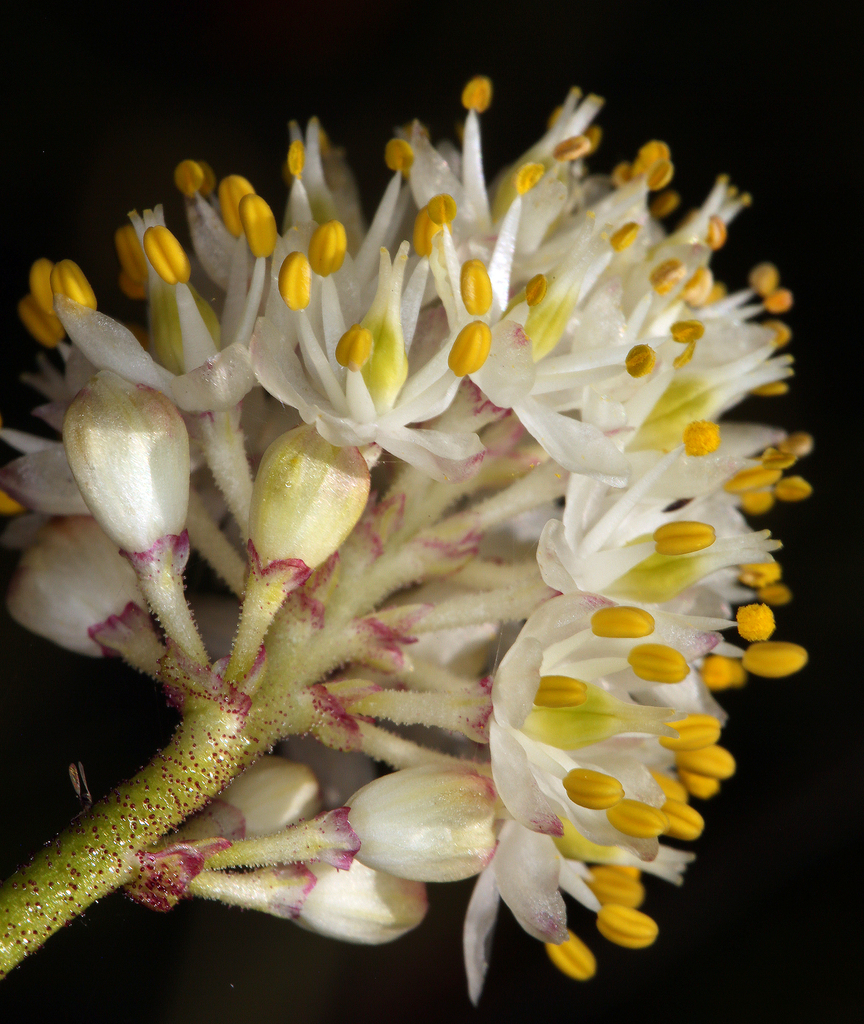
Triantha occidentalis, known as Western False Asphodel or sticky false asphodel, is a slender perennial wildflower of bogs, fens, seeps and wet mountain meadows in western North America. It is also listed under the older name Tofieldia glutinosa ssp. occidentalis. From a tuft of flat, grass-like leaves it sends up a single leafless stem, 4 to 30 inches tall, topped in summer by a rounded head of small white flowers with yellow anthers. It belongs to the small false asphodel family (Tofieldiaceae).
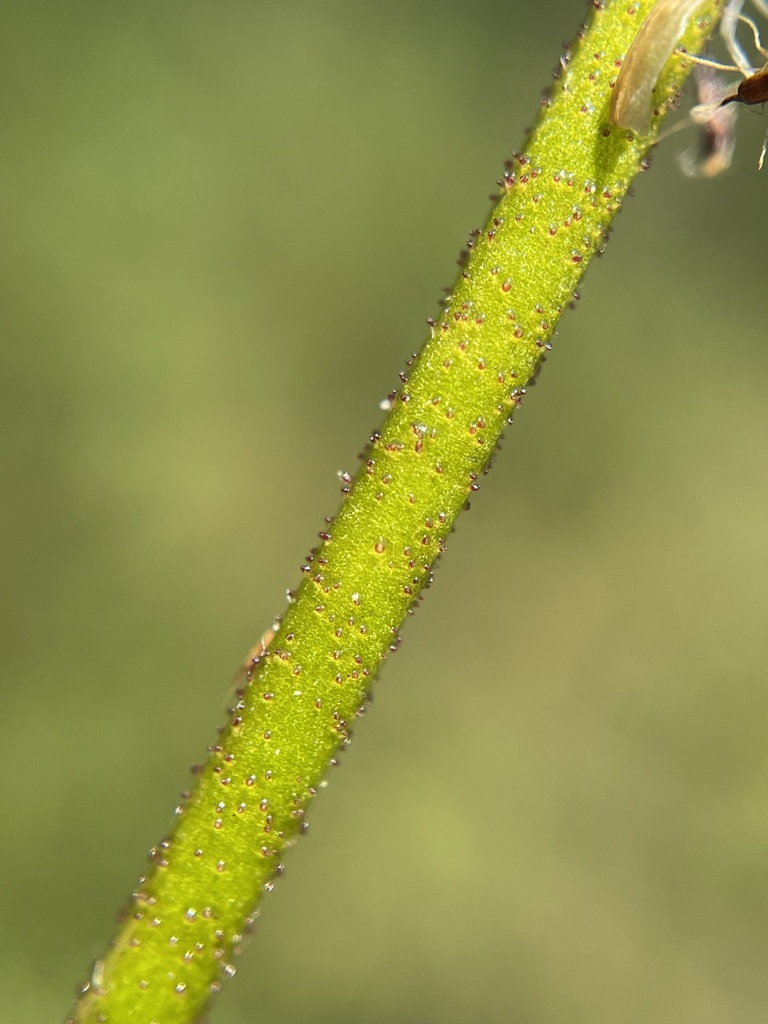
In 2021, researchers at the University of Wisconsin-Madison and the University of British Columbia reported in the Proceedings of the National Academy of Sciences that western false asphodel is carnivorous. Small insects, mostly midges and other tiny flies, become stuck to the glandular hairs on its upper stem, and the plant secretes digestive enzymes and absorbs nitrogen from them. Labeling experiments found that it can obtain more than half of its nitrogen this way, making it the first carnivorous plant identified in this family.
Unlike most carnivorous plants, it traps insects with its flowering stem rather than its leaves, close to the flowers that need pollinators, which are mostly bees and larger flies too big to get stuck. This guide covers how to identify it, where it grows, how it might be grown, and its role in western wetlands.
Identification
Western false asphodel looks like a small lily of wet places. Its sticky stem, white flowers in a compact head, and iris-like leaves are distinctive.
Leaves & Growth Habit
A clump-forming perennial from a short rhizome. The leaves are mostly basal, 2 to 8 inches long, narrow and flat, and arranged in a fan like those of an iris, each leaf folded at the base around the next. The flowering stem usually has one small leaf near its base and is otherwise leafless.
Stem
The stem is 4 to 30 inches tall, slender and upright. Its upper part, just below the flowers, is densely covered with short, sticky glandular hairs, which often hold small trapped insects. The stickiness is the source of the older species name glutinosa, meaning “gluey.”
Flowers
Flowers open from June to September, depending on elevation, in a dense, rounded or short cylindrical head ½ to 2 inches long. They are arranged in small clusters of three, which gives the genus its name: Triantha means “three flowers.” Each flower is about ¼ inch across, with six white to cream tepals and six stamens with yellow anthers.
Fruit & Look-alikes
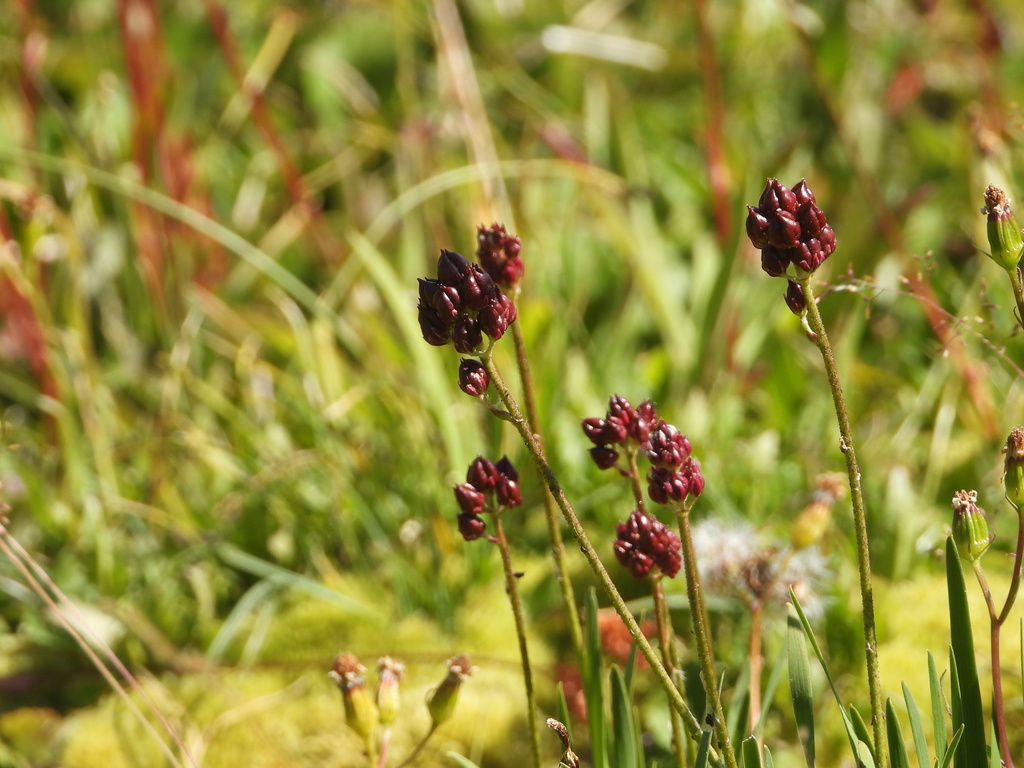
The fruit is an upright capsule that turns reddish-purple to brown, containing seeds with tail-like appendages at each end. Tofieldia species such as Pursh’s false asphodel lack sticky hairs on the stem. Western false asphodel can be mistaken for White Bog Orchid in the same wet meadows, but the orchid has spurred flowers in a taller spike and leafy stems. Grass-of-Parnassus has single, larger, veined white flowers.
Quick Facts
| Scientific Name | Triantha occidentalis (syn. Tofieldia glutinosa ssp. occidentalis, Tofieldia occidentalis) |
| Family | Tofieldiaceae (false asphodel family) |
| Plant Type | Herbaceous perennial wildflower; carnivorous |
| Mature Height | 4–30 in |
| Mature Spread | 3–8 in |
| Growth Rate | Slow |
| Sun Exposure | Full sun to light shade |
| Water Needs | Wet; constantly moist to saturated soil |
| Soil Type | Peat, wet mineral soil, gravel seeps; often on serpentine in California |
| Soil pH | Acidic to neutral |
| Bloom Time | June–September |
| Flower Color | White to cream with yellow anthers |
| Fall Color | Fruit turns reddish-purple |
| Fruit | Upright capsule with appendaged seeds |
| Deer Resistant | Not well documented; seldom browsed in its wet habitat |
| USDA Hardiness Zones | About 3–8 |
Native Range
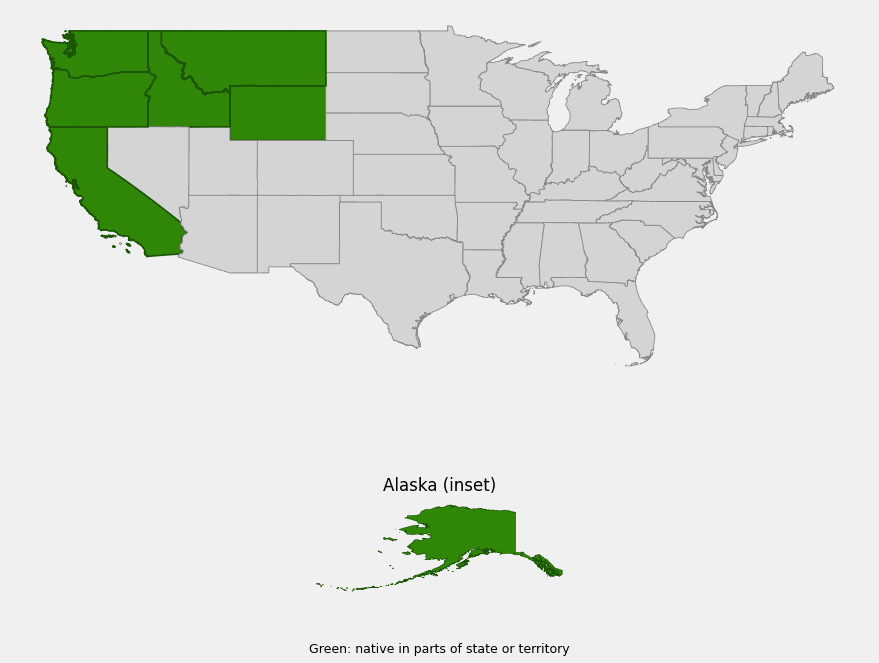
Western false asphodel is native to western North America. USDA PLANTS lists it in Alaska, Washington, Oregon, California, Idaho, Montana and Wyoming, and in Canada in British Columbia and Alberta. In Alaska it grows in the southeast and along the southern coast. In the lower 48 it follows the mountains: the Cascades and Olympic Mountains, the Coast Ranges and Klamath Mountains, the northern Sierra Nevada, and the northern Rockies of Idaho, Montana and northwestern Wyoming.
It grows on both sides of the Cascades in Washington and Oregon, from coastal bogs near sea level to subalpine meadows, and in California it is frequent in the Klamath region, where it often grows in seeps and fens on serpentine soils alongside the California Pitcher Plant.
Its habitats are bogs, fens, seeps, wet meadows, stream banks and wet, mossy rock faces, generally where the soil stays saturated through the growing season and competition from taller plants is limited. Three subspecies are recognized (ssp. occidentalis, ssp. brevistyla and ssp. montana), differing mainly in the length of the flower’s style and in their geographic ranges.
📋 Regional plant lists featuring Western False Asphodel: Alaska · Western Oregon & Western Washington · Idaho, Eastern Oregon & Eastern Washington · California & Nevada · Montana & Wyoming
Growing & Care Guide
Western false asphodel is rarely offered by nurseries, but carnivorous-plant and native bog gardeners in the West may find seed or plants from specialist growers. Never dig it from the wild: its bog and fen habitats are fragile and easily damaged. If you can grow sundews and butterworts outdoors, you can likely grow this plant in the same conditions.
Light
Full sun to light shade. In nature it grows in open bogs and meadows; in deep shade it flowers poorly.
Soil & Water
It needs constantly wet, low-nutrient soil. A bog garden or large container of peat and sand (or peat and perlite), kept saturated with rainwater or other low-mineral water, suits it. Do not fertilize: like other carnivorous plants, it is adapted to soils very low in nitrogen and phosphorus.
Planting Tips
Plant in spring in a bog garden or a sunken, undrained container within its native region and climate. It needs a cold winter dormancy and is best suited to the Pacific Northwest, Alaska and mountain regions of the West.
Pruning & Maintenance
Cut back the old stems and dead leaves in late fall or early spring. Keep taller grasses and sedges from crowding it, and never let the soil dry out.
Propagation
Grow it from seed sown on the surface of moist peat and sand in fall, so that it receives a natural winter chill, or after several weeks of cold, moist stratification. Established clumps can be carefully divided in spring.
Landscape Uses
- Bog gardens: with sundews, butterworts and pitcher plants in western climates
- Native wetland restoration: in bogs, fens and seeps within its range
- Carnivorous plant collections: a recently discovered carnivore with an unusual trapping strategy
- Wildflower viewing: summer blooms in mountain meadows and coastal bogs
Wildlife & Ecological Value
Western false asphodel has a dual relationship with insects: it feeds on tiny ones and depends on larger ones for pollination.
For Pollinators
Its white flowers are visited by bees, butterflies and larger flies, which are too big and strong to be caught by the sticky stem. The sticky zone lies below the flowers, and researchers suggest this arrangement lets the plant trap tiny midges while sparing its pollinators.
For Birds
It offers little direct food for birds, but the bogs and wet meadows where it grows support many insects that birds such as swallows, flycatchers and warblers feed on.
For Mammals
It has no recognized importance as food for mammals and is rarely browsed.
Ecosystem Role
As a carnivorous plant it captures small flies, mostly midges, and absorbs their nitrogen using phosphatase enzymes secreted by the stem’s glandular hairs. This helps it survive in bogs and fens where soil nutrients are scarce. It is part of the specialized plant community of western wetlands, often growing with other carnivorous plants.
Cultural & Historical Uses
Sereno Watson described the plant in the late 1800s as Tofieldia occidentalis, and it was later moved to the genus Triantha, named for its flowers in groups of three. For much of the 20th century it was treated as a subspecies of the eastern Tofieldia glutinosa, now Triantha glutinosa, sticky false asphodel. The name “false asphodel” refers to its resemblance to the Old World asphodels.
Its carnivory was discovered in 2021 by a team led by Qianshi Lin and Sean Graham at the University of British Columbia and Thomas Givnish at the University of Wisconsin-Madison. Their interest was sparked by genome studies showing that the plant had lost a set of plastid genes that is also missing in many other carnivorous plants. They then fed wild plants fruit flies labeled with a heavy nitrogen isotope and traced the nitrogen into the plant.
The discovery showed that carnivorous plants may still be hiding in plain sight, even among well-studied wildflowers in heavily botanized regions. Because the sticky hairs are on the flowering stem, the plant is carnivorous only during the part of the year when it is in bloom.
Frequently Asked Questions
Is western false asphodel really carnivorous?
Yes. A 2021 study published in the Proceedings of the National Academy of Sciences showed that it traps small insects on the sticky hairs of its flowering stem, digests them with enzymes, and absorbs their nitrogen, in some cases getting more than half of its nitrogen from prey.
What does it catch?
Mostly tiny insects such as midges and other small flies. Larger insects, including the bees and flies that pollinate its flowers, are strong enough to avoid getting stuck.
Is it the same as Tofieldia glutinosa?
It was once treated as a western subspecies of Tofieldia glutinosa. Botanists now treat it as a separate species, Triantha occidentalis, while the eastern sticky false asphodel is Triantha glutinosa.
Where does it grow?
In bogs, fens, seeps and wet meadows from southern Alaska and British Columbia south through Washington, Oregon and northern California, and east to Idaho, Montana, Wyoming and Alberta.
Can I grow it in a bog garden?
Yes, in cool climates, in constantly wet, nutrient-poor soil such as peat and sand, watered with rainwater. Use seed or plants from specialist growers and never collect from the wild.

Looking for a nursery that carries Western False Asphodel?
Browse our native plant nursery directory: Alaska · California · Idaho · Montana · Oregon · Washington · Wyoming

