
Harbinger of Spring (Erigenia bulbosa)
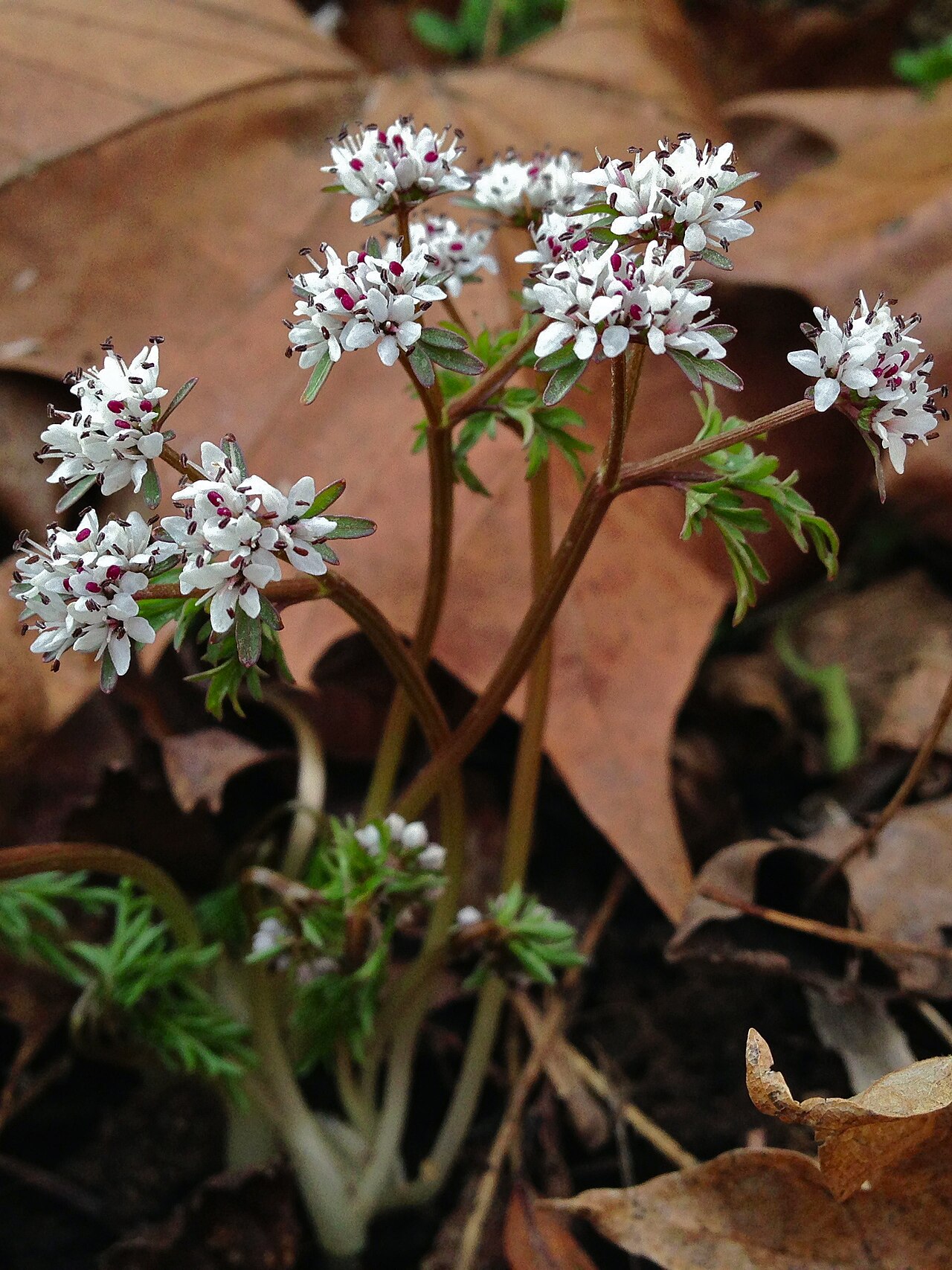
Erigenia bulbosa, known as Harbinger of Spring or pepper and salt, is one of the very first wildflowers to bloom in the deciduous forests of eastern North America. In late winter or the first warm days of spring, often while snow can still fall, it pushes up tiny clusters of white flowers with dark maroon anthers, only a few inches above the fallen leaves. It belongs to the carrot family (Apiaceae) and is the only species in its genus.
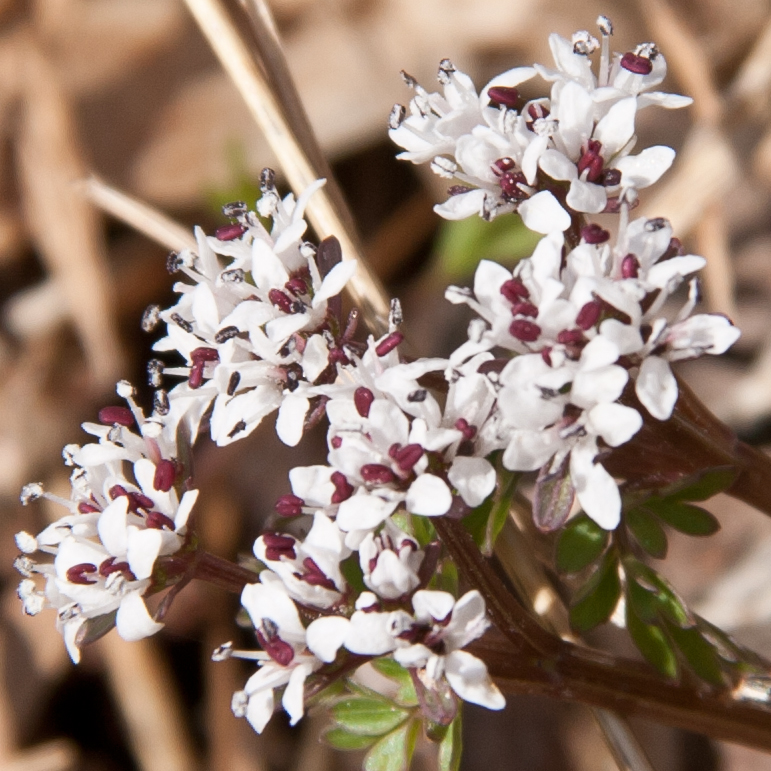
The plant is small and easy to miss. A whole flowering plant is often only 2 to 6 inches tall, and each flower is about an eighth of an inch across. Seen up close, though, the contrast of white petals and dark red-brown anthers is striking, and it is the source of the common name pepper and salt. The genus name comes from the Greek for “born early,” and the species name refers to the round, bulb-like tuber that it grows from.
Harbinger of spring is a true spring ephemeral: it emerges, flowers, sets seed and disappears back underground within a few weeks, before the trees leaf out. This guide covers how to recognize it, where it grows, how to care for it in a woodland garden, and why early-blooming plants like it matter to the first insects of the year.
Identification
When it first emerges, harbinger of spring can look like a sprig of parsley pushing through the leaf litter. Its very early bloom time, tiny white flowers with dark anthers and finely divided leaves make it distinctive once you know to look for it.
Tuber & Stem
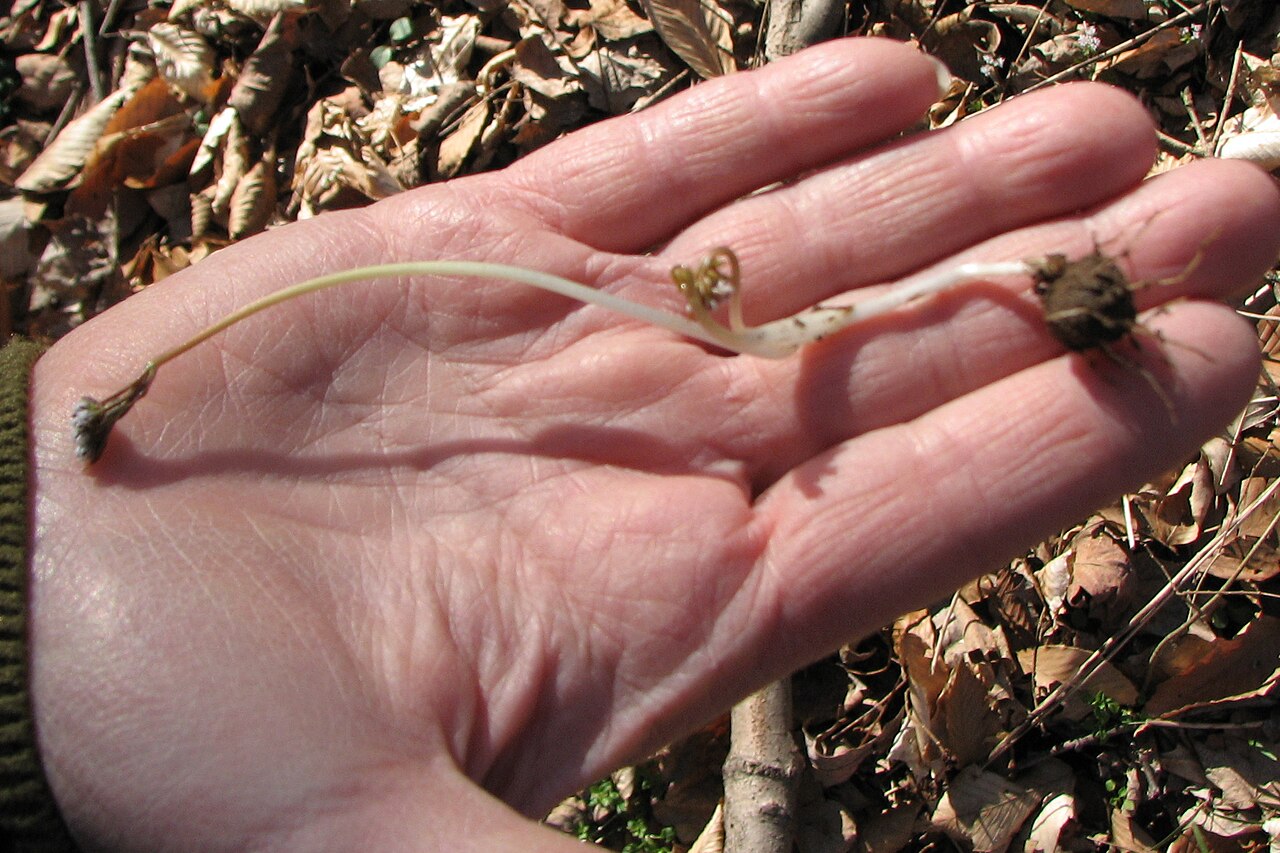
Each plant grows from a small, rounded tuber about a quarter to half an inch across, buried a few inches deep in rich forest soil. A single slender, often reddish or purplish stem rises from the tuber. The underground part of the stem can be several inches long, while the part above the leaf litter is usually only a few inches tall at flowering. The stem lengthens a little as the fruit develops.
Leaves
There is usually a single main leaf near the base of the stem, with one or two smaller leaves just below the flower cluster. The leaves are divided into three parts, and each part is divided again into narrow, rounded lobes, giving a delicate, parsley-like or fern-like look. When first emerging they are often tinged purple, turning green as they expand. The whole plant is hairless.
Flowers
The flowers are borne in small, compound umbels typical of the carrot family, usually with a few rays each carrying several tiny flowers. Each flower is about an eighth of an inch across, with five white petals and five stamens. The anthers are dark reddish-brown to maroon before they open, which creates the speckled “pepper and salt” effect. As the anthers shed pollen they fade and turn yellowish. Flowering takes place from about February to April, starting earliest in the South.
Fruit & Seeds
After flowering, the fruits form quickly. They are small, flattened and kidney-shaped to nearly round, about an eighth of an inch wide, and they split into two halves, each holding one seed. By late spring the leaves and stems turn yellow and wither, and the plant remains dormant underground until the next late winter.
Quick Facts
| Scientific Name | Erigenia bulbosa |
| Family | Apiaceae (carrot family) |
| Plant Type | Spring ephemeral perennial from a tuber |
| Mature Height | 2–6 in in flower (to about 9 in in fruit) |
| Mature Spread | 2–4 in |
| Growth Rate | Slow to establish; spreads slowly by seed |
| Sun Exposure | Part shade to shade (full sun in early spring before trees leaf out) |
| Water Needs | Moderate; moist soil in spring, tolerates drier soil in summer dormancy |
| Soil Type | Rich, loamy forest soil high in organic matter |
| Soil pH | About 6.0–7.5; often on limestone-derived soils |
| Bloom Time | February–April |
| Flower Color | White with maroon to red-brown anthers |
| Fall Color | None; dormant from late spring |
| Fruit | Small flattened fruit splitting into two one-seeded halves |
| Deer Resistant | Usually; too small and too early to attract much browsing |
| USDA Hardiness Zones | 5–8 |
Native Range
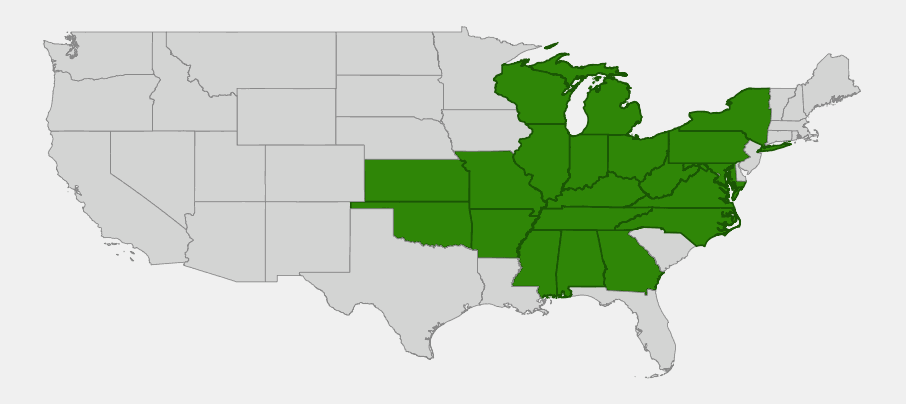
Harbinger of spring is a plant of the eastern and central United States and southern Ontario. USDA PLANTS records it from 20 states and the District of Columbia: from New York, Pennsylvania, Michigan and Wisconsin south through the Ohio River Valley and the Appalachians to Alabama, Georgia and Mississippi, and west to Missouri, Arkansas, eastern Kansas and eastern Oklahoma. In Canada it is found only in the far south of Ontario.
It is most common in the Ohio and middle Mississippi River valleys, in states such as Ohio, Indiana, Illinois, Kentucky, Tennessee and Missouri, where it can carpet rich floodplain forests in early spring. Toward the edges of its range, including New York, Pennsylvania, Wisconsin, Michigan, Kansas, the Carolinas, Georgia and Ontario, it is local or rare and is tracked as a species of conservation concern in several of those places. Records in Kansas and the Atlantic states are outlying, at the margins of its main range.
It grows in rich, moist deciduous forests, especially on floodplains, stream terraces, the lower slopes of ravines and wooded bluffs. It is often found on soils derived from limestone or other base-rich rock, under trees such as sugar maple, beech, buckeye, sycamore and pawpaw.
📋 Regional plant lists featuring Harbinger of Spring: New York, Pennsylvania & Northern New Jersey · Ohio & Indiana · Michigan, Wisconsin & Eastern Minnesota · Kentucky & Tennessee · Nebraska, Kansas & Eastern Colorado · Maryland, Virginia & West Virginia · Illinois, Iowa & Missouri · Alabama, Georgia & Mississippi · North & South Carolina · Arkansas, Louisiana, Eastern Oklahoma & Eastern Texas
Growing & Care Guide
Harbinger of spring is rarely sold, but it can be grown in a shady woodland garden in its native range, where it is a delight for anyone watching for the first signs of spring. Buy only nursery-propagated plants or grow it from responsibly collected seed. Never dig plants from the wild: the tubers are small and easily damaged, and the species is rare in several states.
Light
Plant under deciduous trees and shrubs. Like other spring ephemerals, it needs the bright light of early spring, before the canopy closes, and then accepts deep shade in summer while it is dormant.
Soil & Water
Provide rich, loose, moist soil with plenty of leaf mold, like a forest floor. Neutral to slightly alkaline soils suit it best. The soil should stay moist while the plant is in growth from late winter to late spring. In summer, when the plant is dormant, it tolerates the natural drying of woodland soil. Leave fallen leaves in place as a natural mulch.
Planting Tips
Plant small groups of nursery-grown tubers or potted plants close together, so that the tiny flowers make an impact. Choose a spot along a path or near a window where you can see them in late winter. Avoid areas that will be dug or heavily planted later in the season, since the dormant tubers are easy to damage.
Pruning & Maintenance
No pruning is needed. Let the foliage yellow and wither on its own so the tuber can store energy for next year. Keep aggressive groundcovers, such as invasive garlic mustard, lesser celandine and English ivy, out of the planting. These weeds are among the biggest threats to spring ephemerals in the wild as well.
Propagation
Harbinger of spring is propagated mainly from seed. Sow fresh seed outdoors in late spring or early summer, as soon as it ripens, and do not let it dry out. Germination usually occurs the following spring or later, and seedlings may take a few years to reach flowering size. In a suitable woodland garden, established plants will slowly self-sow.
Landscape Uses
- Woodland gardens: an early accent among other spring ephemerals under deciduous trees
- Shade gardens: combined with ferns and summer-green woodland plants that fill the space after it goes dormant
- Early-season pollinator plantings: one of the first flowers of the year for small native bees and flies
- Floodplain and woodland restoration: within its native range, using nursery-propagated stock
- Nature study: a classic first-flower-of-spring plant for wildflower walks
Wildlife & Ecological Value
A plant only a few inches tall may seem unimportant, but early-blooming spring ephemerals like harbinger of spring are vital to the insects that become active on the first warm days of the year.
For Pollinators
The tiny flowers provide nectar and pollen when very few other flowers are open. They are visited mainly by small early bees, such as mining bees and small sweat bees, and by flies, including hover flies, that are active on mild late-winter and early-spring days. Because it blooms so early, harbinger of spring helps sustain these insects until the larger wave of spring flowers begins.
For Birds
Harbinger of spring is not an important food plant for birds, but it grows in rich deciduous forests that support a great variety of woodland birds, including warblers, thrushes and woodpeckers.
For Mammals
Its small size and early season mean it is rarely browsed. Small mammals may eat the tubers and seeds. Rich floodplain and slope forests where it grows are important habitat for many mammals.
Ecosystem Role
Spring ephemerals like harbinger of spring grow and absorb nutrients in early spring, when the forest floor gets sunlight but the trees have not yet leafed out. Research on spring ephemerals suggests that they help keep nutrients released by thawing soil in the forest instead of letting them wash away, then return them to the soil when they die back. A healthy population of harbinger of spring is also a sign of an old, relatively undisturbed forest floor.
Cultural & Historical Uses
The name Erigenia comes from the Greek for “early born,” a fitting name for one of the earliest wildflowers of eastern forests. The plant was first described in 1803 as Sison bulbosum by the French botanist André Michaux, from material collected in North America. Thomas Nuttall moved it to its own genus, Erigenia, in 1818.
Ethnobotanical records report that the Cherokee chewed the plant to ease toothache. The tubers are small and the plant is uncommon in many places, so it has never been an important food or medicine. Like many members of the carrot family, its relatives include both edible and highly poisonous plants, so it should not be eaten.
For many naturalists in the Midwest and the Ohio Valley, finding the first harbinger of spring of the year is an annual ritual. The tiny flowers, often blooming in February or early March among dead leaves, mark the start of the spring wildflower season long before the larger trilliums, bluebells and phlox appear.
Frequently Asked Questions
Why is it called harbinger of spring?
It is one of the earliest wildflowers to bloom in eastern deciduous forests, often in February or early March, so its flowers announce that spring is coming. Its other name, pepper and salt, comes from the white petals and dark maroon anthers.
How big is harbinger of spring?
It is tiny. A flowering plant is often only 2 to 6 inches tall, and each flower is about an eighth of an inch across. You usually need to get down on your knees to appreciate it.
Can I dig harbinger of spring from the woods?
No. The tubers are easily damaged and transplanted plants rarely survive. The species is rare and protected or tracked in several states. Buy nursery-propagated plants or grow it from seed.
Is harbinger of spring edible?
It should not be eaten. Although it is not known as a poisonous plant, it is small and uncommon, and its family includes deadly species such as poison hemlock and water hemlock, which makes misidentification dangerous.
What happens to it in summer?
Like other spring ephemerals, it dies back by late spring after setting seed and spends the rest of the year dormant as an underground tuber. Plan companion plants, such as ferns, to fill the space in summer.

Looking for a nursery that carries Harbinger of Spring?
Browse our native plant nursery directory: Alabama & Arkansas · Georgia · Illinois, Indiana & Kansas · Kentucky, Maryland, Michigan, Mississippi & Missouri · New York, North Carolina, Ohio & Oklahoma · Pennsylvania, Tennessee & Virginia · West Virginia & Wisconsin