
Rosepink (Sabatia angularis)
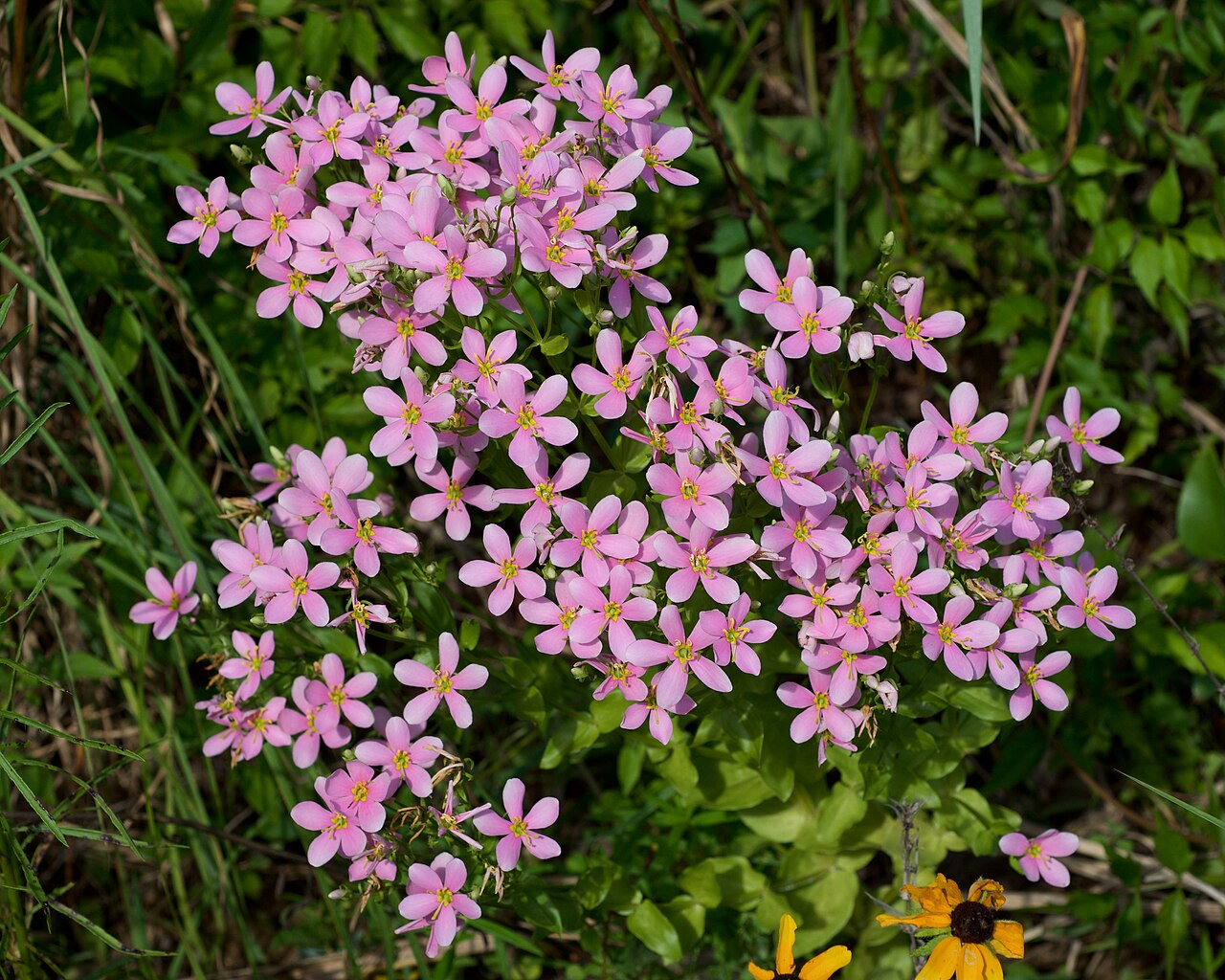
Sabatia angularis, known as Rosepink, rose pink, square-stem rose gentian or bitterbloom, is a native biennial wildflower in the gentian family (Gentianaceae). In its second summer it sends up a branched, candelabra-like stem 1 to 3 feet tall that can carry dozens of fragrant, star-shaped pink flowers about an inch across. Each flower has a yellow-green star at its center, edged with a thin red line.
Rosepink grows in open, sunny or lightly shaded places across the eastern and south-central United States: old fields, prairies and glades, open woods and woodland edges, thickets, meadows and roadsides, on soils from damp sand and peat to dry, rocky ground. The species name angularis refers to its square, sharp-angled stems, which carry thin wings along each corner.
Because it is a biennial that depends on seed, rosepink is less common in gardens than it deserves to be. Where it finds the right spot it can reseed for years, and a patch in midsummer bloom is one of the prettiest sights in a native meadow. This guide covers how to identify it, where it grows and how to grow it from seed.
Identification
Rosepink is one of several pink-flowered Sabatia species in the East. Its square, winged stems, opposite branching and broad, clasping leaves separate it from most relatives.
Habit & Stems
In its first year the plant is a low rosette of leaves. In the second year one to several stems rise from the rosette to 1 to 3 feet. The stems are smooth, sharply four-angled and narrowly winged on the corners. They are mostly unbranched below and branch freely in pairs above, giving the plant a rounded, many-flowered crown.
Leaves
The stem leaves are opposite, stalkless and often clasp the stem at their base. They are ovate to broadly lance-shaped, smooth-edged and hairless, up to about 1½ inches long and 1 inch wide, becoming smaller and narrower toward the top. The basal rosette leaves usually wither by flowering time.
Flowers
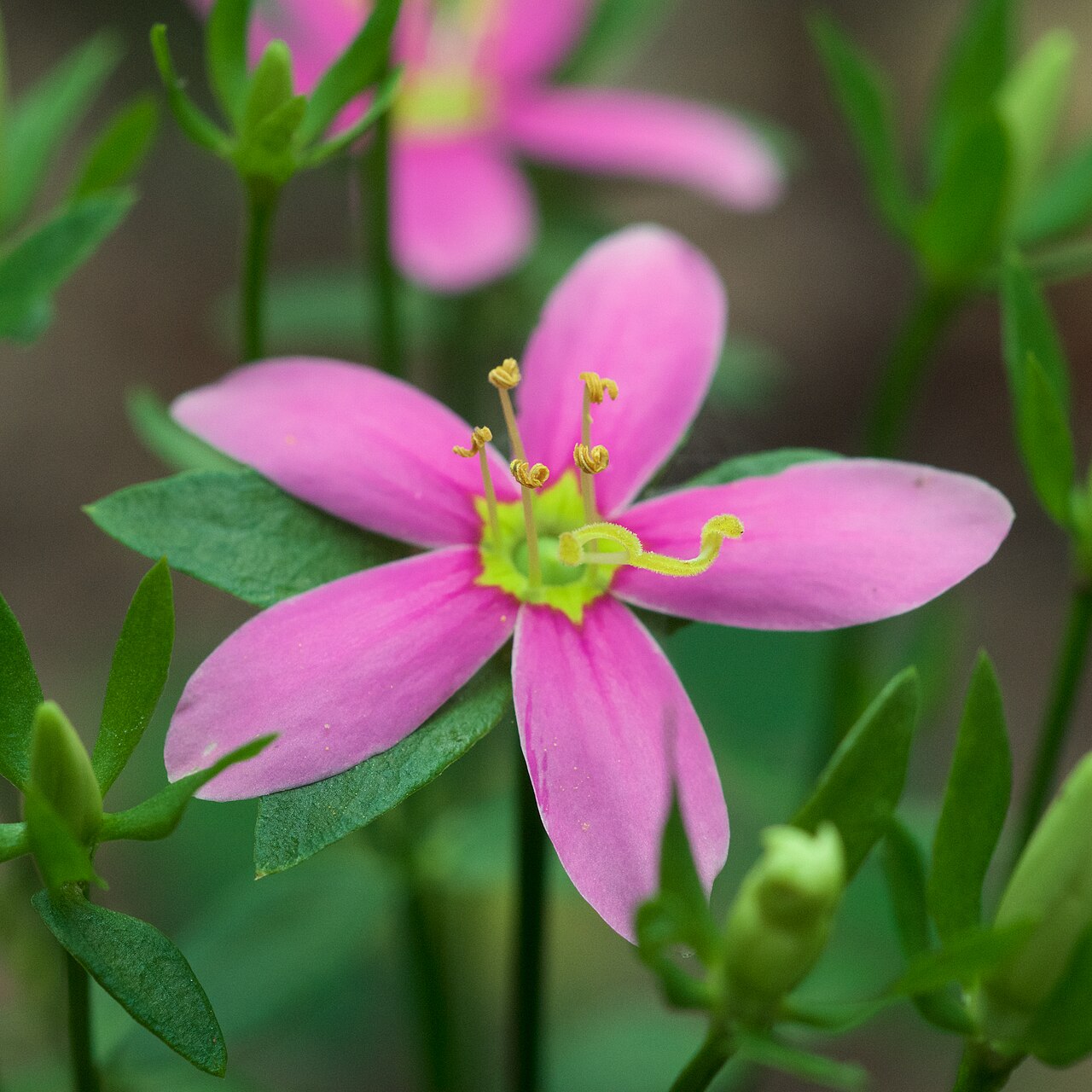
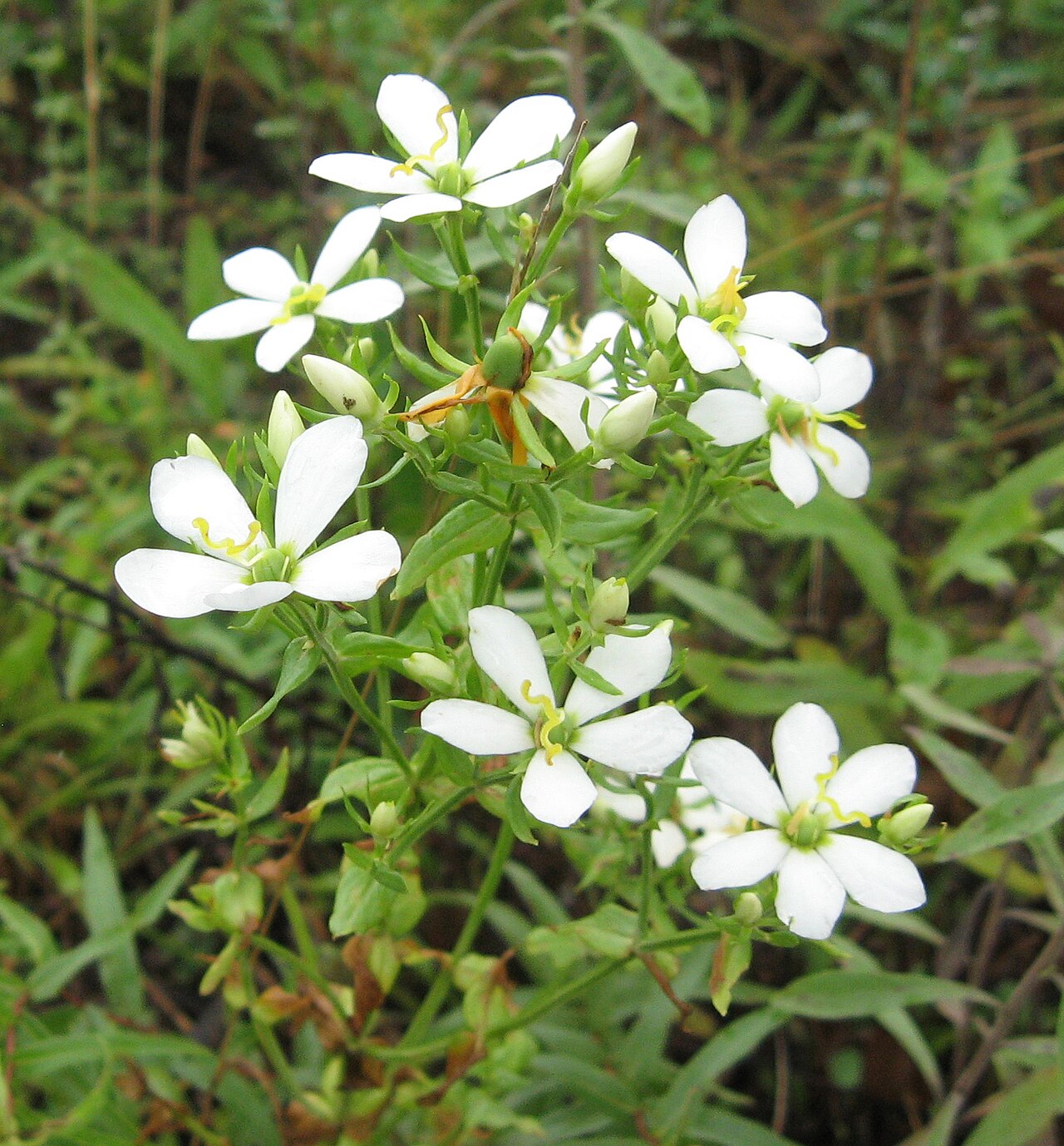
Each branch ends in a single flower about an inch across, with five spreading, rounded pink lobes. They are occasionally pale pink or white. At the base of the lobes is a yellow to greenish star outlined in red. The yellow stamens curve around a style that splits into two twisted stigma branches. The flowers are fragrant, and bloom runs mostly from late June through August, into September in the South.
Fruit & Seeds
The fruit is a small, oval capsule that splits open in late summer or fall to release many tiny seeds. The plant dies after setting seed, and new rosettes come from seed that falls nearby.
Quick Facts
| Scientific Name | Sabatia angularis (basionym Chironia angularis) |
| Family | Gentianaceae (gentian family) |
| Plant Type | Biennial wildflower (rosette the first year, flowering the second) |
| Mature Height | 1–3 ft in flower |
| Mature Spread | 1–2 ft |
| Growth Rate | Moderate |
| Sun Exposure | Full sun to part shade |
| Water Needs | Medium; tolerates both damp and fairly dry soils |
| Soil Type | Sand, loam, peat, and thin rocky or limestone glade soils |
| Soil pH | About 5.5–7.5 |
| Bloom Time | Late June–August (into September in the South) |
| Flower Color | Pink with a yellow-green, red-edged star; rarely white |
| Fall Color | None; plants die after flowering |
| Fruit | Small capsule with many tiny seeds |
| Deer Resistant | Yes; the plant is very bitter and rarely browsed |
| USDA Hardiness Zones | 5–9 |
Native Range
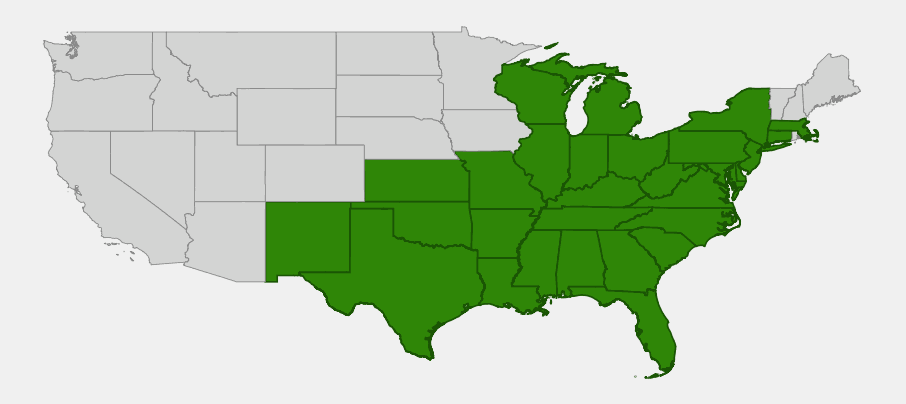
USDA PLANTS records rosepink as native in 29 states and the District of Columbia, from Massachusetts, New York, Michigan and Wisconsin south to Florida and west to Kansas, Oklahoma and Texas, with an outlying record in New Mexico. In Canada it was historically known from southern Ontario, where it is now believed to be extirpated.
It is most common in the Southeast and the Ozark and Ouachita regions, where it grows in glades, open oak and pine woods, prairie remnants, old fields and roadsides. Farther north it becomes scarce and local. Michigan, Wisconsin, New York and New England are at the northern edge of its range, and the Wisconsin and New Mexico records are outlying.
Rosepink grows on many soils, from moist sandy or peaty ground near the coast to thin, dry soil over limestone in the interior. What it needs most is light and open soil where its seeds can germinate, so it thrives where fire, mowing or grazing keeps vegetation open.
📋 Regional plant lists featuring Rosepink: Alabama, Georgia & Mississippi · North & South Florida · North & South Carolina · Maryland, Virginia & West Virginia · Kentucky & Tennessee · Arkansas, Louisiana, Eastern Oklahoma & Eastern Texas · Illinois, Iowa & Missouri · Ohio & Indiana · Nebraska, Kansas & Eastern Colorado · Michigan, Wisconsin & Eastern Minnesota · New York, Pennsylvania & Northern New Jersey · Delaware, Southern New Jersey & Long Island · Connecticut, Massachusetts & Rhode Island · New Hampshire, Maine & Vermont
Growing & Care Guide
Rosepink is grown from seed, and its biennial habit means a little patience: the plants form rosettes the first year and flower the second. Once a colony is going, it maintains itself by reseeding wherever it has open, sunny soil. Seed is available from some native seed suppliers, and plants are occasionally sold by native nurseries.
Light
Full sun to part shade. It flowers best in sun but tolerates light shade at woodland edges, where it often grows in the wild.
Soil & Water
Rosepink adapts to sandy, loamy, peaty or rocky soils and to both moist and fairly dry sites, as long as the soil is not soggy all year. Lean soils are best, since rich soil favors bigger competitors. No fertilizer is needed.
Planting Tips
Sow the tiny seeds on the surface of bare or lightly disturbed soil in fall, and do not cover them; they need light to germinate. Sowing two years in a row gives flowering plants every year, because each sowing will bloom in its second summer. Container-grown rosettes can be planted in spring.
Pruning & Maintenance
Do not deadhead if you want the colony to continue: the plants must drop seed to come back. Keep taller, aggressive plants from shading out the rosettes, and leave a few patches of open soil for seedlings. In meadows, mowing in late fall or early spring, after seed drop, helps keep conditions open.
Propagation
Grow it from seed only. Collect capsules as they turn brown in late summer or fall and shake out the dust-fine seeds. Surface-sow outdoors in fall, or give seed a few weeks of cold, moist stratification before sowing it on the surface of a fine mix in spring.
Landscape Uses
- Meadows and prairies: midsummer pink color among native grasses and wildflowers
- Pollinator gardens: fragrant flowers visited by bees
- Woodland edges: a light-shade-tolerant wildflower for open woods and clearings
- Glade and barrens restoration: a characteristic wildflower of open, rocky sites in the Ozarks and Interior Highlands
- Naturalized areas: a self-sowing biennial for informal plantings with some open soil
Wildlife & Ecological Value
Rosepink is a small plant with a big summer show, and its open flowers feed many bees in midsummer.
For Pollinators
The flowers are visited mainly by bees, including bumble bees, sweat bees and other small native bees, which collect pollen. Like many gentians, the flowers shed pollen before the stigma is receptive, which favors cross-pollination by insects moving between plants.
For Birds
Rosepink has little direct food value for birds; its seeds are tiny. It is part of the open meadow, glade and prairie communities that support grassland birds.
For Mammals
The foliage is intensely bitter, and deer and rabbits usually leave it alone. This also makes it a useful wildflower where browsing is heavy.
Ecosystem Role
As a short-lived biennial, rosepink depends on open soil and periodic disturbance. It is typical of fire- and grazing-maintained glades, prairies and open woods, and it declines where these become overgrown. Like other gentians, it forms associations with soil fungi that help the seedlings establish.
Cultural & Historical Uses
Linnaeus named the plant Chironia angularis in 1753, and Frederick Pursh moved it to Sabatia in 1814. The genus honors the eighteenth-century Italian botanist Liberato Sabbati.
In the nineteenth century rosepink was a well-known bitter herb, sometimes called American centaury. Jacob Bigelow illustrated it in American Medical Botany (1817–1820), and William P. C. Barton included it in his Vegetable Materia Medica of the United States, where it was described as a bitter tonic used in home remedies for fevers and digestion. These historical uses are not a recommendation, and the plant should not be used as a medicine without professional advice.
Today it is valued as a wildflower and a sign of healthy open habitats. Many naturalists in the Midwest and the Southeast look for rosepink in midsummer, and a white-flowered form occasionally appears among the pink plants.
Frequently Asked Questions
Is rosepink an annual or perennial?
It is a biennial. Plants form a rosette of leaves in the first year, then flower, set seed and die in the second. Colonies last by reseeding.
Why are there no flowers in the first year?
First-year plants put their energy into a basal rosette. Flowering stems appear the next summer. If you sow seed two years in a row, you will have flowers each year.
How do I tell rosepink from other rose gentians?
Rosepink has square, winged stems, opposite branching and broad, clasping leaves up to about an inch wide. Many other Sabatia species have round stems, narrower leaves or alternate branching.
Is rosepink deer resistant?
Yes. The plant is very bitter, which is why it was once used as a bitter tonic, and deer and rabbits rarely eat it.
Where can I buy rosepink?
Look for seed from native seed companies and plants from native plant nurseries within its range. Grow it from seed rather than digging wild plants, which seldom survive transplanting.

Looking for a nursery that carries Rosepink?
Browse our native plant nursery directory: Alabama & Arkansas · Connecticut, Delaware, Florida & Georgia · Illinois, Indiana & Kansas · Kentucky, Louisiana, Maryland, Massachusetts, Michigan, Mississippi & Missouri · New Jersey, New Mexico, New York, North Carolina, Ohio & Oklahoma · Pennsylvania, South Carolina, Tennessee, Texas & Virginia · West Virginia & Wisconsin