
Mesquite Mistletoe (Phoradendron californicum)
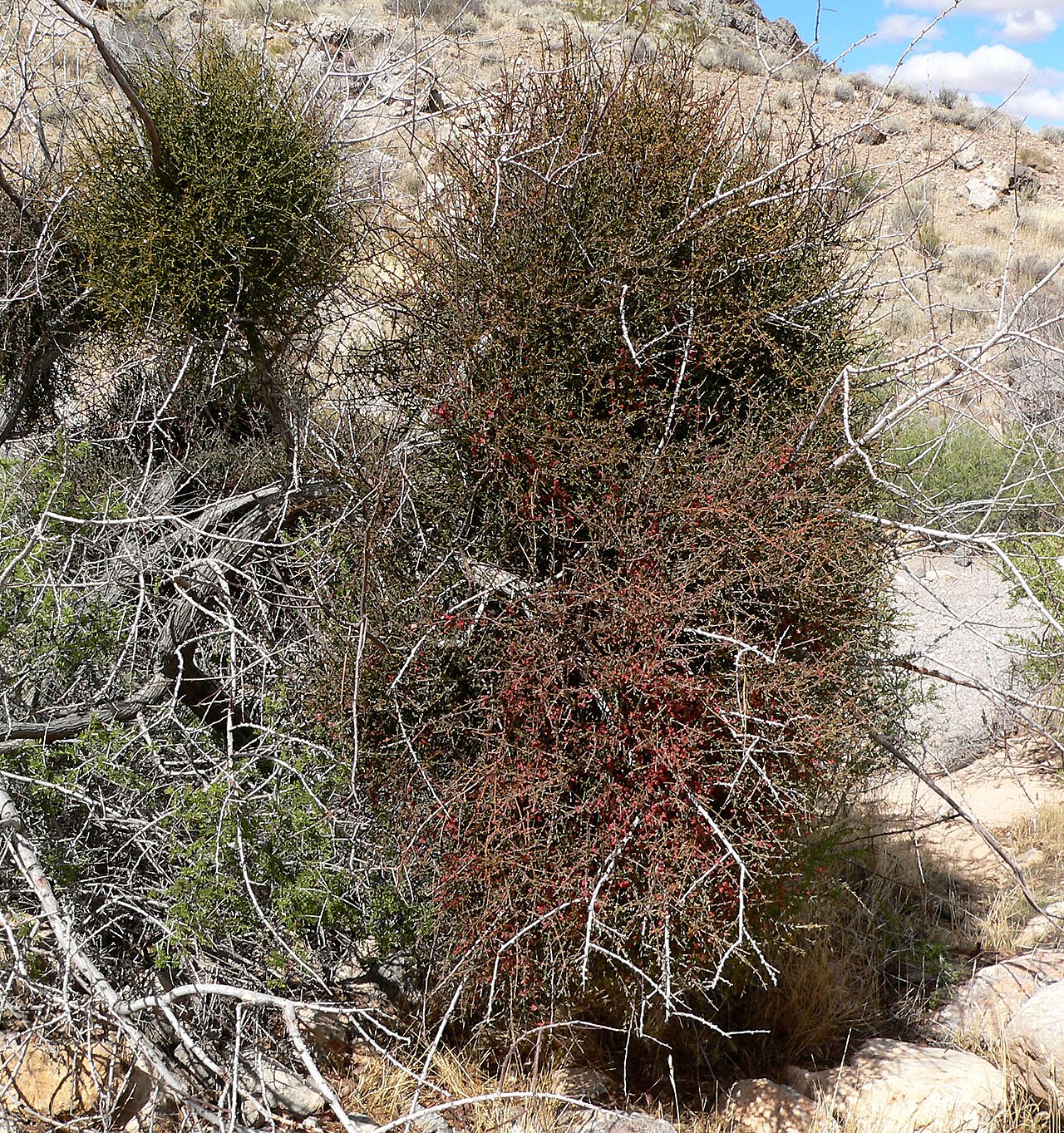
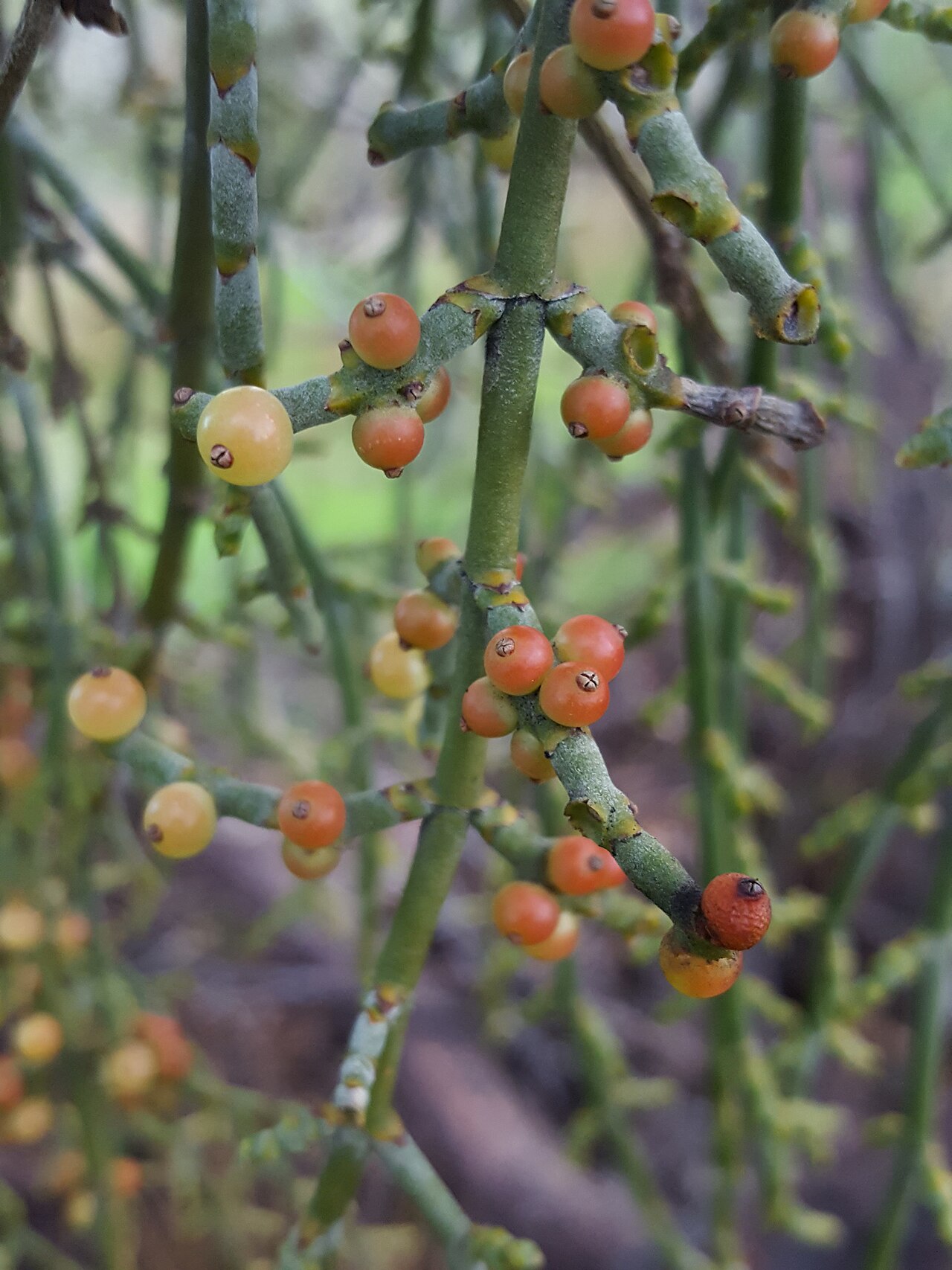
Phoradendron californicum, known as Mesquite Mistletoe or desert mistletoe, is a native parasitic shrub of the Mojave and Sonoran deserts. It grows on the branches of mesquite, palo verde, catclaw acacia, ironwood and other desert trees and shrubs, forming tangled clumps of jointed, nearly leafless stems that can hang 3 feet or more from a branch. The stems are gray-green to reddish, and in winter female plants are dotted with small, translucent, coral-pink to red berries.
Mesquite mistletoe is a hemiparasite. It has green stems and makes some of its own food through photosynthesis, but it has no roots in the ground. Instead it sends specialized tissue (a haustorium) into the host branch and draws water and minerals from it. Its leaves are reduced to tiny scales, which helps it save water in one of the hottest, driest regions of North America.
Because it is a parasite, mesquite mistletoe cannot be bought from a nursery or planted in a garden, and this page is a guide to identifying and appreciating it in the wild. It is also poisonous: the berries and stems are toxic to people and pets and should never be eaten. At the same time it is one of the most important wildlife plants in the low desert, feeding phainopeplas and many other birds through the winter.
Identification
Mesquite mistletoe is easy to recognize: clumps of leafless, jointed green or reddish stems hanging from the branches of desert legume trees. The only similar plants in its range are other mistletoes, which have obvious leaves or grow on different hosts.
Stems & Growth Form
Plants form dense, rounded to hanging clumps, usually 1 to 3 feet across and sometimes trailing 3 to 5 feet below the host branch. The stems are slender, round, jointed and repeatedly branched. They are gray-green in shade and often turn reddish or orange-brown in full sun or drought. The surface is smooth to finely hairy. Old, heavy infections can turn whole sections of a host tree into a mass of mistletoe.
Leaves
The leaves are reduced to tiny, paired scales about 1 to 2 mm long at the stem joints, so the plant looks leafless. This is the most important difference from the region’s other mistletoes, such as big-leaf mistletoe (Phoradendron macrophyllum), which has broad, green leaves and grows mainly on cottonwoods, sycamores, ashes and walnuts along streams.
Flowers
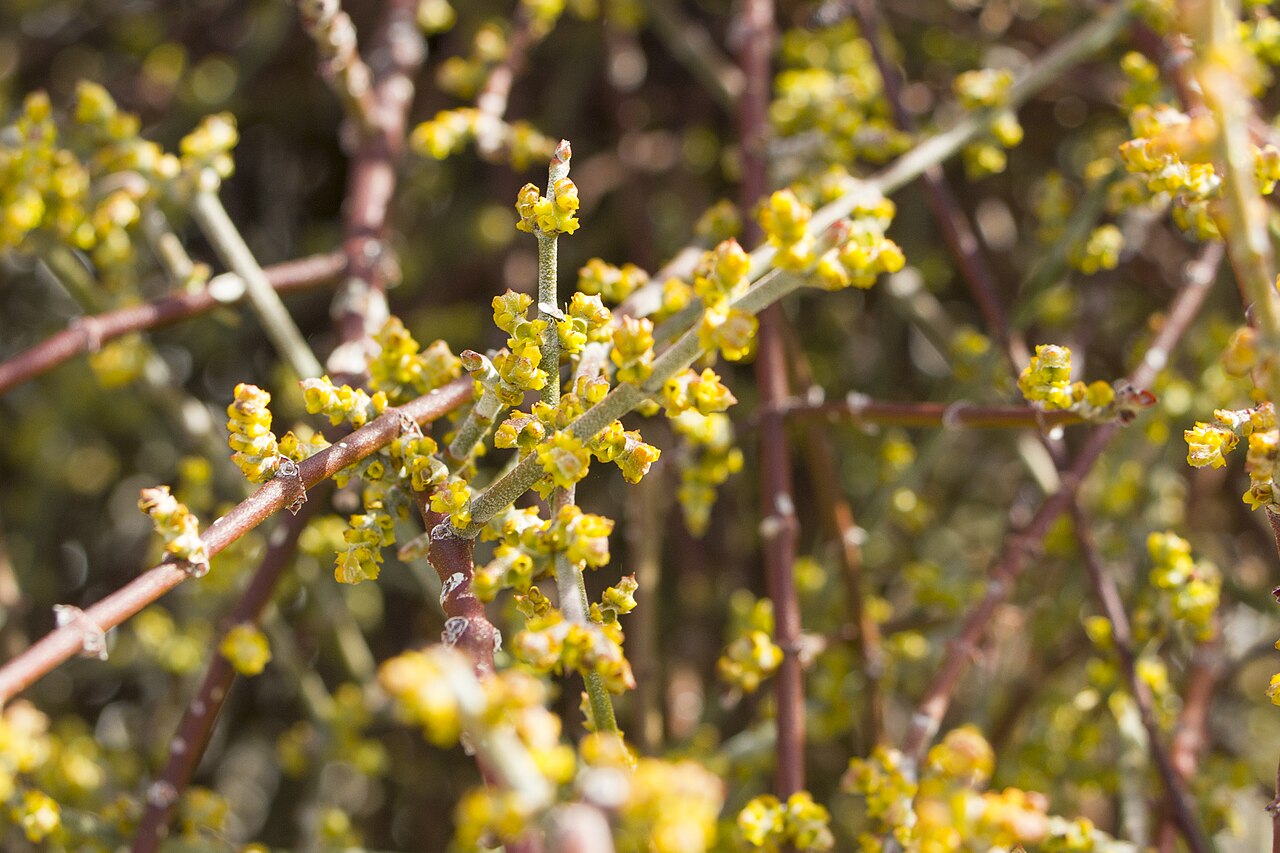
Mesquite mistletoe is dioecious: each plant is either male or female. The flowers are tiny, yellowish to greenish, and set in short spikes at the stem joints. They bloom mostly in late winter and early spring (roughly December to March), and male plants in particular give off a sweet fragrance that can be noticed some distance away on a still day.
Fruit
Female plants produce small, round berries about ⅛ to ¼ inch across. They ripen from late fall through winter and are translucent, ranging from pinkish white to coral-pink or red. Each berry has a single seed surrounded by very sticky pulp (viscin), which helps it stick to branches after birds eat the fruit and pass or wipe off the seed.
Quick Facts
| Scientific Name | Phoradendron californicum |
| Family | Viscaceae (Christmas mistletoe family; included in Santalaceae by some botanists) |
| Plant Type | Parasitic shrub (hemiparasite) on desert trees and shrubs |
| Mature Height | Clumps 1–3 ft across; stems may hang 3–5 ft |
| Mature Spread | 1–3 ft per clump; many clumps can cover a host |
| Growth Rate | Slow to moderate |
| Sun Exposure | Full sun on the host canopy |
| Water Needs | Takes water from its host; no soil roots |
| Soil Type | None; grows on branches of host trees and shrubs |
| Soil pH | Not applicable |
| Bloom Time | December–March (late winter to early spring) |
| Flower Color | Tiny, yellowish to greenish |
| Fall Color | None; stems green to reddish all year |
| Fruit | Small translucent pink to coral-red berries in winter (toxic) |
| Deer Resistant | Yes; rarely browsed (toxic) |
| USDA Hardiness Zones | About 8–11 (low-desert climates) |
Native Range
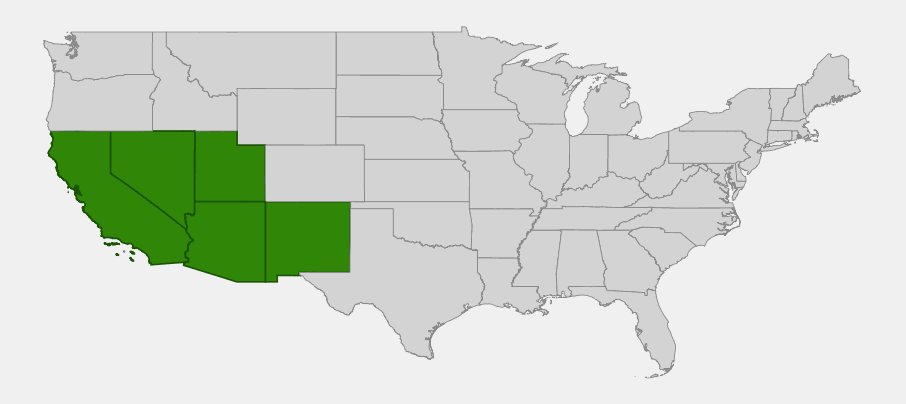
Mesquite mistletoe is native to the hot deserts of the southwestern United States and northwestern Mexico. USDA PLANTS records it in California, Nevada, Utah, Arizona and New Mexico. In California it grows in the Colorado and Mojave deserts, in Nevada and Utah in the southern Mojave Desert lowlands (including the Virgin River area of southwestern Utah), and in Arizona across the Sonoran Desert and lower Mojave Desert. New Mexico records are few and outlying, in the far southwest. In Mexico it ranges through Baja California and Sonora.
Its distribution follows its hosts. It is most common where mesquite, palo verde, catclaw acacia and desert ironwood grow in washes, bajadas and desert flats below about 4,000 feet. Large infestations are typical of mesquite bosques along desert rivers and washes, where both host trees and the birds that spread the seeds are plentiful.
Mesquite mistletoe is not found in the cooler Great Basin Desert or in the high mountains. It is a plant of low desert, where winters are mild and its winter berries coincide with the arrival of wintering birds.
📋 Regional plant lists featuring Mesquite Mistletoe: Idaho, Eastern Oregon & Eastern Washington · Utah & Western Colorado · Arizona & New Mexico · California & Nevada
Can You Grow It?
No. Mesquite mistletoe cannot be grown from nursery stock or transplanted. It has no roots in the soil and survives only attached to a living host branch, and it arrives on its own when birds deposit its sticky seeds. It is not sold by nurseries, and it should not be deliberately introduced to trees. What gardeners in the desert Southwest more often need to know is how to live with it on mesquites and palo verdes that already have it.
Living With Mistletoe
A few clumps of mistletoe on a healthy, mature mesquite or palo verde usually cause little harm, and they provide winter food for birds. Heavy infestations can weaken branches, reduce leaf growth and flowering, and add stress during drought, especially on young or already struggling trees. Healthy, properly watered host trees tolerate mistletoe much better than stressed ones.
Pruning Infected Branches
If an infestation is weakening a landscape tree, prune out infected branches at least 12 inches below the mistletoe clump, because its haustorium grows inside the branch beyond the visible stems. Removing only the outer stems does not kill the plant, and it will resprout. Avoid heavy pruning in the hottest part of summer, and follow good pruning practice so you don’t damage the tree more than the mistletoe does.
Safety Note
All parts of mesquite mistletoe, especially the berries, are toxic. Mistletoes in the genus Phoradendron contain toxic proteins (phoratoxins) that can cause vomiting, diarrhea and other symptoms in people, dogs, cats and livestock. Wear gloves when pruning, dispose of clippings where children and pets can’t reach them, and keep berries away from children. If someone swallows the berries or leaves, contact Poison Control (1-800-222-1222 in the U.S.) or a veterinarian.
Leaving It for Wildlife
Where mistletoe isn’t threatening the health of a valuable tree, consider leaving at least some clumps. In natural areas and large properties, they are one of the most important winter food sources for desert birds, and the clumps also provide nesting and roosting cover.
Propagation in Nature
Mesquite mistletoe spreads almost entirely by birds. After eating the berries, birds pass the sticky seeds or wipe them off their bills onto branches. The seeds germinate on the bark and penetrate the host branch with a haustorium. Because birds tend to perch and feed in trees that already have mistletoe, infestations often increase within the same trees and nearby ones.
Where to See It
- Desert washes and mesquite bosques: the best places to see heavy mistletoe and the birds that feed on it
- Joshua Tree, Organ Pipe Cactus and Saguaro national parks: common on palo verdes, mesquites and ironwoods in the low desert
- Desert botanical gardens and preserves: often present on mature mesquites and palo verdes
- Winter birding: look for phainopeplas guarding berry-laden clumps from November through March
- Riparian preserves on desert rivers: large mesquite stands along the lower Colorado, Gila and San Pedro rivers
Wildlife & Ecological Value
For a plant that many people see only as a pest of trees, mesquite mistletoe supports a remarkable amount of desert wildlife. Its winter berries arrive when few other fruits are available.
For Pollinators
The fragrant winter flowers are visited by small bees, flies and other insects active on warm desert days. Mesquite mistletoe is also a caterpillar host plant for the great purple hairstreak (Atlides halesus), a strikingly iridescent butterfly whose larvae feed on mistletoes in the Southwest.
For Birds
The phainopepla (Phainopepla nitens), a glossy black or gray silky-flycatcher, depends heavily on mesquite mistletoe. In the low desert in winter, phainopeplas eat large numbers of the berries, defend mistletoe-rich trees as feeding territories and nest in the same areas, raising young in late winter and spring. Their droppings spread the seeds, so the bird and the plant depend on each other. Many other birds, including northern mockingbirds, western bluebirds, cedar waxwings and Gila woodpeckers, also eat the berries, and verdins and other small birds nest or roost in the dense clumps.
For Mammals
The toxic stems and berries are rarely eaten by mammals, although some rodents and other animals may take fallen fruit. The thick clumps provide shade and cover for small animals in host trees.
Ecosystem Role
Mistletoes are considered keystone resources in many ecosystems because so many animals use their fruit, flowers and cover. In the low desert, mesquite mistletoe provides a reliable winter food supply that helps sustain wintering and resident birds. Its effects on host trees, which range from minor to severe, are also part of the natural dynamics of mesquite and palo verde woodlands.
Cultural & Historical Uses
The genus name Phoradendron means “tree thief” in Greek, from phor, thief, and dendron, tree, a fitting name for a plant that takes water and nutrients from its host. Thomas Nuttall described Phoradendron californicum in 1848, and botanists have since recognized several varieties based on stem hairiness and berry color, which are now usually included in a single species.
Ethnobotanical records describe some Indigenous peoples of the deserts, including the Cahuilla, gathering the berries for food after preparing them and using the plant medicinally. Those traditional practices relied on detailed knowledge, and they do not make the berries safe for anyone else to eat. Modern poison control centers treat Phoradendron berries as toxic.
Mesquite mistletoe is a different plant from the leafy mistletoe used for Christmas decorations. That is usually American mistletoe (Phoradendron leucarpum) in North America, or European mistletoe (Viscum album). Mesquite mistletoe, with its leafless stems, has never been used for kissing under. In the desert it is valued instead for the birds it brings, especially the phainopepla.
Frequently Asked Questions
Can I grow mesquite mistletoe?
No. It is a parasite that grows only on living host branches, and it arrives when birds deposit its seeds. It is not sold by nurseries and should not be deliberately spread to trees.
Is mesquite mistletoe poisonous?
Yes. The berries and stems contain toxic proteins and can cause vomiting, diarrhea and other symptoms in people and pets. Keep children and pets away from the berries, and call Poison Control (1-800-222-1222) or a veterinarian if any are swallowed.
Will mistletoe kill my mesquite or palo verde?
A few clumps on a healthy tree usually do little harm. Heavy infestations can weaken branches and stress the tree, especially in drought, and may contribute to decline. Keep the tree healthy and prune out badly infected branches at least a foot below the clumps if needed.
Why does my tree keep getting more mistletoe?
Birds that eat the berries tend to perch and feed in trees that already have mistletoe, so they deposit more seeds there. Infected trees and their neighbors usually accumulate more mistletoe over time.
Which birds eat mesquite mistletoe berries?
The phainopepla is the best-known mistletoe specialist, but northern mockingbirds, western bluebirds, cedar waxwings and Gila woodpeckers also eat the berries.

Looking for a nursery that carries Mesquite Mistletoe?
Browse our native plant nursery directory: Arizona · California · Nevada & New Mexico · Utah