
Rattlesnakeweed (Hieracium venosum)
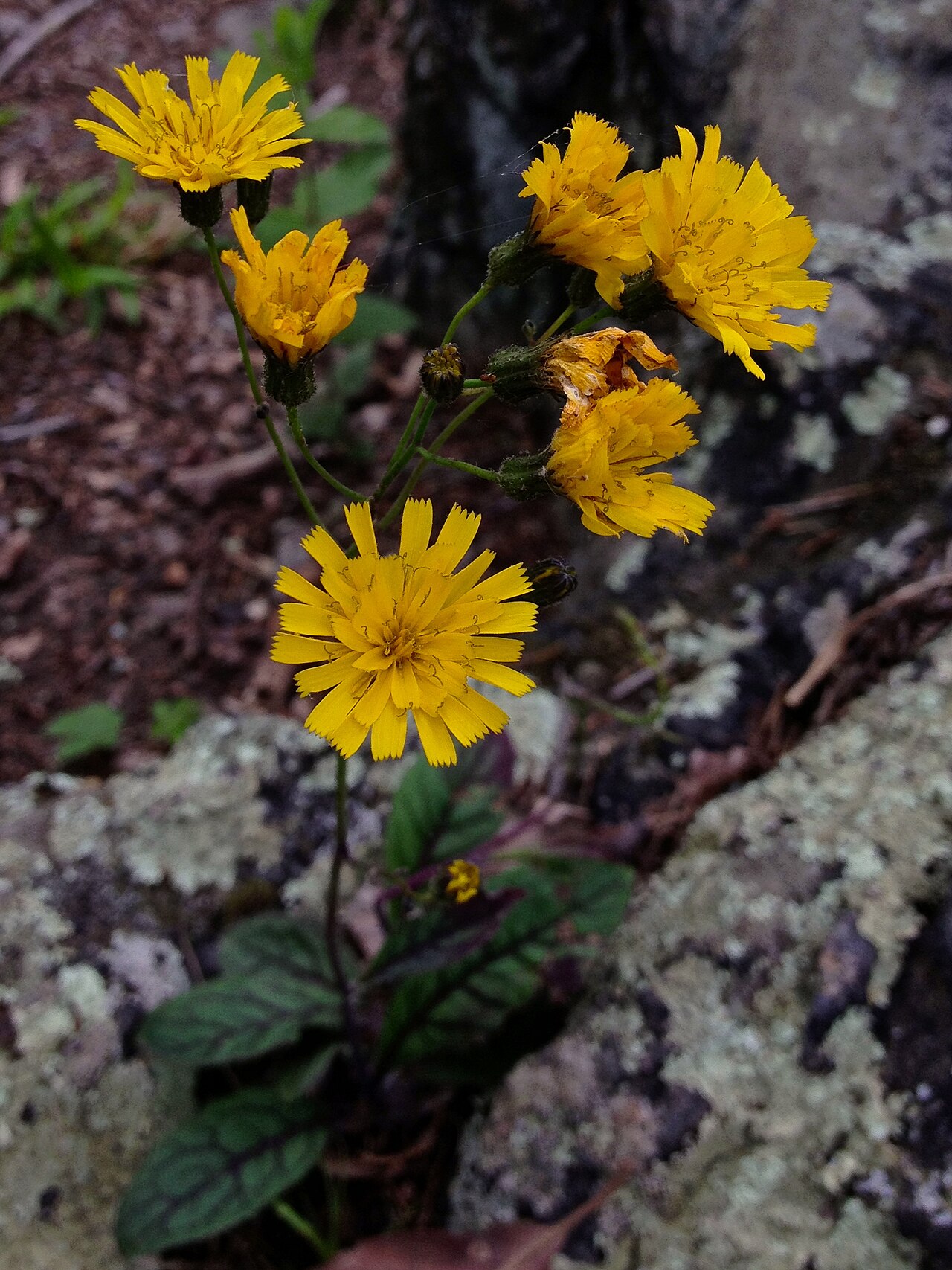
Hieracium venosum, Rattlesnakeweed, also known as rattlesnake hawkweed or veiny hawkweed, is a native perennial wildflower of dry, open woods across the eastern United States. It belongs to the aster family (Asteraceae), in the dandelion tribe, and forms a flat rosette of leaves strikingly marked with dark red-purple veins. In late spring and summer it sends up slender, nearly leafless stalks bearing small, bright yellow, dandelion-like flower heads.
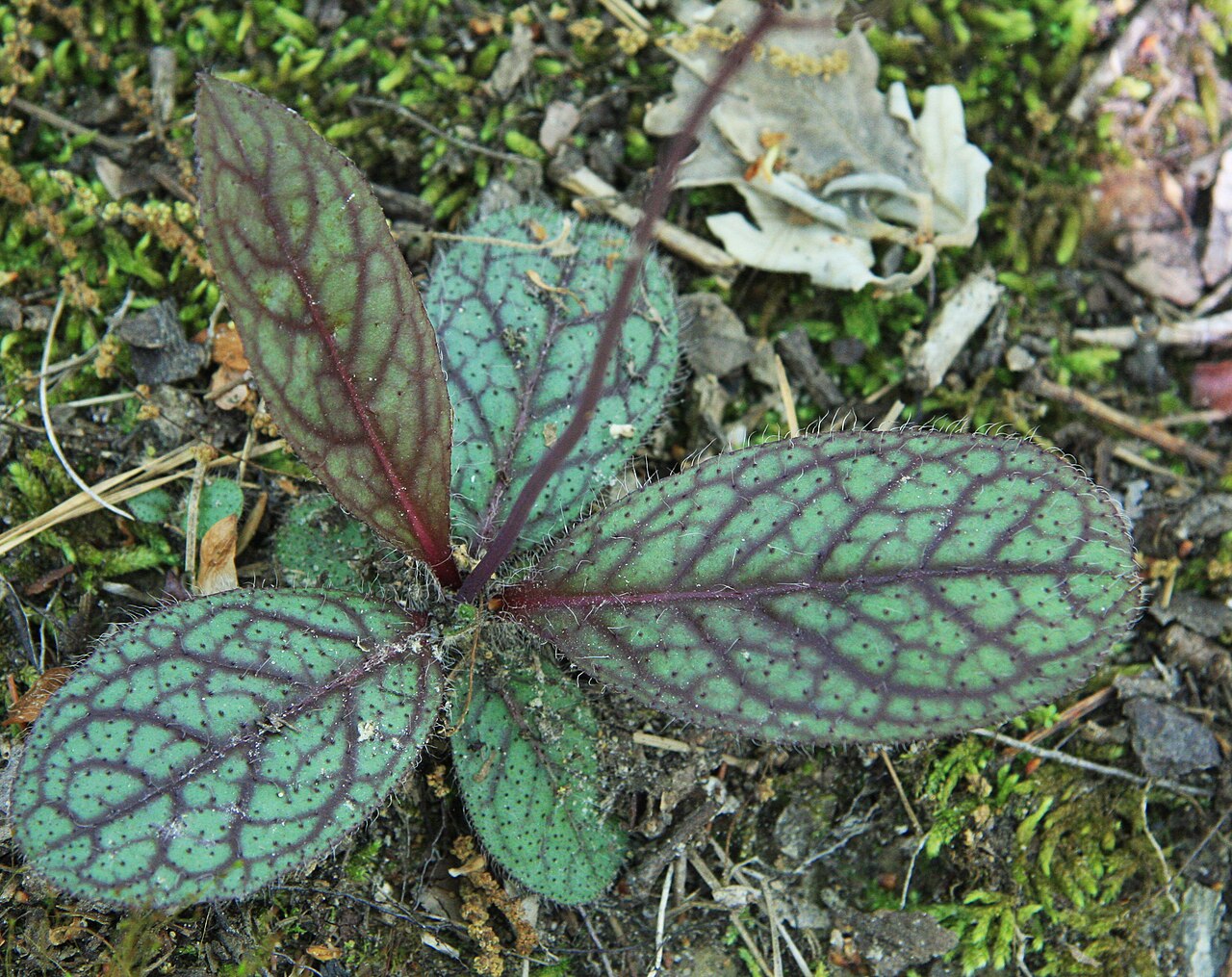
The leaves are the plant’s most memorable feature. Their gray-green to bluish surface is crossed by a network of maroon or purple veins, and they sit flat against the ground like a small, patterned rug. Several explanations for the name “rattlesnakeweed” have been suggested: the snakeskin look of the leaves, an old belief that the plant could treat snakebite, and the observation, mentioned by the Lady Bird Johnson Wildflower Center, that it is common in the same dry, rocky woodlands where rattlesnakes live.
Rattlesnakeweed is one of the few native hawkweeds most eastern gardeners will meet, and unlike the aggressive European hawkweeds it is a well-behaved woodland plant. This guide explains how to identify it, where it grows, how to grow it in a dry shade garden, and how it fits into eastern oak and pine woodlands.
Identification
The eastern United States has about a dozen yellow-flowered hawkweeds, several of them introduced from Europe. Rattlesnakeweed is easiest to recognize by its basal rosette of purple-veined leaves and its smooth, almost leafless flower stalk.
Leaves
The leaves grow in a basal rosette and are elliptic to oblong or spoon-shaped, about 1½ to 6 inches long, with smooth or slightly wavy margins. They are gray-green to bluish green above, often purplish beneath, and conspicuously veined with dark red to purple. Long, soft hairs grow along the margins and sometimes on the surfaces, especially on the midrib beneath. The stem usually has no leaves, or only one or two small ones.
Stems
The flowering stem rises from the center of the rosette, usually 8 to 18 inches tall (to about 2 feet in good conditions). It is slender, smooth or with a few hairs near the base, and branches near the top into an open, spreading cluster. Like other members of the dandelion tribe, the stems and leaves contain milky sap.
Flowers
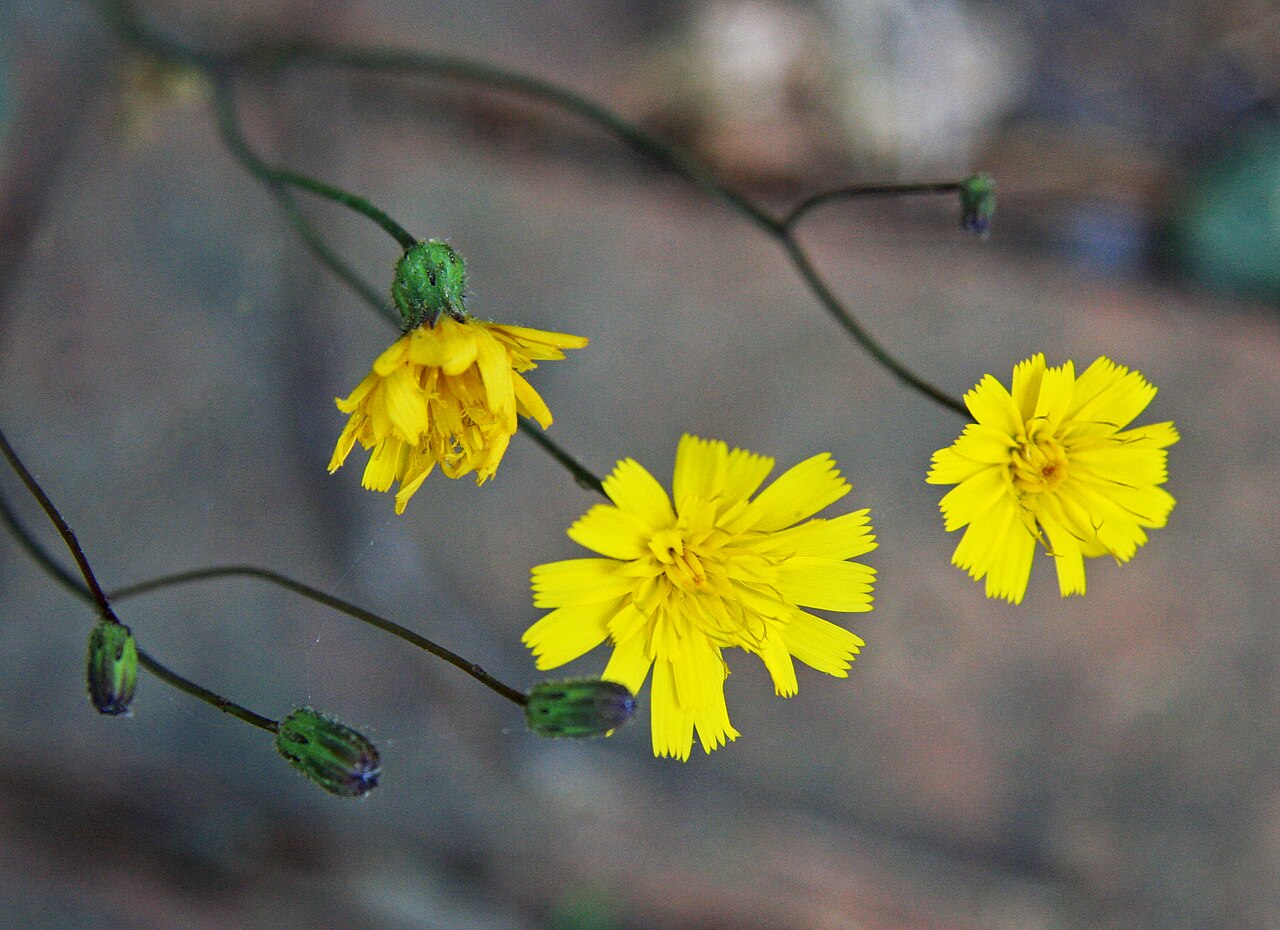
Each stem carries a loose cluster of up to about 20 flower heads. The heads are about ¾ inch across and are made entirely of bright yellow, strap-shaped ray florets, about 30 to 45 per head, each ending in five tiny teeth. There are no disk florets. The bracts beneath the head are narrow and green, sometimes with dark glandular hairs. Bloom time is mainly May through July, with scattered flowers into September.
Seeds & Look-alikes
The seeds are small, dark, ribbed achenes topped with a tuft of tan bristles, dispersed by wind. Hairy hawkweed (Hieracium gronovii) has a leafy, very hairy stem and narrower flower clusters; where the two grow together they sometimes hybridize, producing H. × marianum. The orchid Downy Rattlesnake Plantain also has a rosette of patterned leaves in dry woods, but its leaves are evergreen with a white net-veined pattern, and it bears a spike of small white flowers.
Quick Facts
| Scientific Name | Hieracium venosum (syn. H. venosum var. nudicaule) |
| Family | Asteraceae (aster family) |
| Plant Type | Herbaceous perennial with a basal rosette |
| Mature Height | 8–18 in in flower (occasionally to 2 ft) |
| Mature Spread | 4–8 in |
| Growth Rate | Slow to moderate |
| Sun Exposure | Part shade to light shade; tolerates sun on dry, open sites |
| Water Needs | Low; dry soils |
| Soil Type | Dry, sandy, gravelly or rocky, acidic soil |
| Soil pH | About 4.5–6.5 |
| Bloom Time | May–July, sporadically to September |
| Flower Color | Bright yellow |
| Fall Color | None notable; rosettes persist into fall |
| Fruit | Small ribbed achene with tan bristles |
| Deer Resistant | Moderate; rarely heavily browsed |
| USDA Hardiness Zones | 4–9 |
Native Range
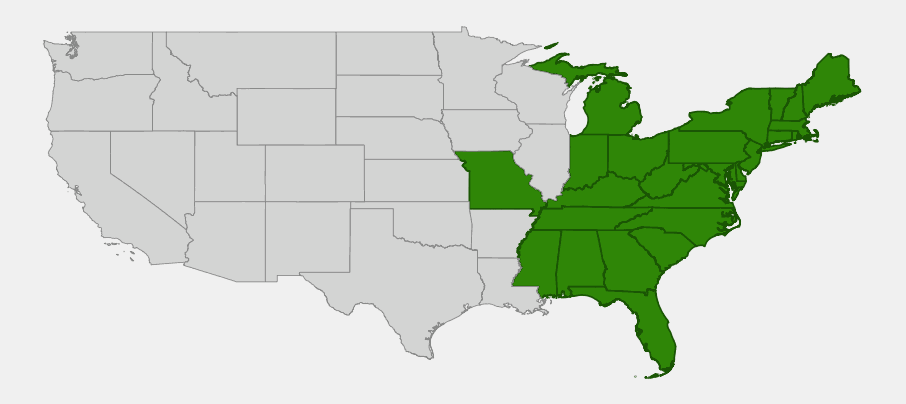
Rattlesnakeweed is native to eastern North America. USDA PLANTS records it in 25 states and the District of Columbia, from Maine, Vermont and New Hampshire south along the Atlantic states to Florida, and west to Michigan, Indiana, Kentucky, Tennessee, Missouri, Mississippi and Alabama. In Canada it grows in southern Ontario. The Lady Bird Johnson Wildflower Center summarizes the range as “Ontario; New England south to Florida, west to Louisiana, and north to Missouri and Michigan.”
It is most common in the Appalachian region, the Piedmont and the drier parts of the Atlantic Coastal Plain, where it grows in dry oak, oak-hickory and oak-pine woods, on rocky ridges and in sandy pine barrens. In New Jersey’s Pine Barrens and on dry ridges from New England to Georgia it can be one of the most frequent spring and early-summer wildflowers. It becomes scattered toward the western edge of its range in Missouri and Michigan and in the Deep South.
Within this range it favors acidic, well-drained soils with little competition, often where leaf litter is thin, on trail banks, road cuts through woods and openings in dry forest.
📋 Regional plant lists featuring Rattlesnakeweed: New York, Pennsylvania & Northern New Jersey · Ohio & Indiana · Michigan, Wisconsin & Eastern Minnesota · Kentucky & Tennessee · Connecticut, Massachusetts & Rhode Island · New Hampshire, Maine & Vermont · Maryland, Virginia & West Virginia · Delaware, Southern New Jersey & Long Island · Illinois, Iowa & Missouri · Alabama, Georgia & Mississippi · North & South Florida · North & South Carolina
Growing & Care Guide
Rattlesnakeweed is a charming plant for dry shade, one of the most difficult garden situations. It stays small, its veined leaves add interest all season, and its yellow flowers brighten a woodland garden in early summer. It is occasionally available from native plant nurseries and is easy to start from seed.
Light
Plant it in light to part shade under high-branched trees, such as oaks and pines. It also tolerates full sun on dry, open sites, but leaves are often most colorful in partial shade. Deep, dense shade reduces flowering.
Soil & Water
Give it dry to moderately dry, well-drained, acidic soil: sandy, gravelly or rocky soil with little organic matter is ideal. Rich, moist garden soil encourages competitors and rot. Once established it is drought tolerant and needs no supplemental water or fertilizer.
Planting Tips
Set plants in spring or fall where their rosettes will not be smothered by heavy leaf litter or vigorous groundcovers. They look best in small groups along the edge of a woodland path, on a dry slope or among rocks, where the patterned leaves can be seen up close. Combine them with other small dry-woodland plants such as pussytoes, wintergreen and poverty oatgrass.
Pruning & Maintenance
Little maintenance is needed. Remove spent flower stalks if you want a tidier look, or leave them to scatter seed. Keep heavy leaf litter from burying the rosettes in winter. Do not overwater or fertilize.
Propagation
Grow it from seed sown in fall or in spring after a few weeks of cold, moist stratification. Seeds are small; press them onto the surface of a sandy mix. Established plants slowly form offsets that can be separated in early spring. Dig only from your own garden: wild plants should be left in place.
Landscape Uses
- Dry shade gardens: a small native perennial for difficult dry ground under oaks and pines
- Woodland path edges: its patterned leaf rosettes reward close viewing
- Rock gardens: thrives in thin, gravelly soil between rocks
- Pine barren and oak woodland restoration: within its native range, in open, dry forest understories
- Pollinator gardens: early-summer pollen and nectar for small native bees
Wildlife & Ecological Value
Rattlesnakeweed is a modest plant, but in dry oak and pine woods it is often one of the few wildflowers blooming in early summer, after the spring ephemerals have faded.
For Pollinators
Its yellow flower heads are visited by small native bees, especially sweat bees and mining bees, as well as hover flies and small butterflies. The flowers open in the morning and provide both nectar and pollen.
For Birds
Small seed-eating birds may take the wind-dispersed seeds, and ground-foraging birds feed on insects in the open, dry woodland floor where it grows.
For Mammals
Deer and rabbits occasionally nibble the rosettes and flower stalks, but it is not usually heavily browsed. Its bitter, milky sap probably helps discourage grazing.
Ecosystem Role
Rattlesnakeweed is part of the low herb layer of dry, acidic, often fire-influenced oak and pine woodlands. It persists in thin soil where few other plants grow, and it tends to increase where occasional fire or disturbance keeps the forest floor open.
Cultural & Historical Uses
Linnaeus described Hieracium venosum in 1753, naming it for the prominent veins of its leaves (venosum means “veiny”). The genus name Hieracium comes from the Greek word for hawk. An ancient story held that hawks ate hawkweed sap to sharpen their eyesight, which is the source of the common name “hawkweed.”
Rattlesnakeweed has a long history in American folk medicine. Folk tradition held that it could treat snakebite, which is one explanation for the name. There is no evidence that it works for snakebite. Anyone bitten by a venomous snake should seek emergency medical care immediately.
For naturalists today, rattlesnakeweed is a favorite for its leaves alone. Field guides often use it as a classic example of how leaf color and pattern can identify a plant long before it flowers, and its purple-veined rosettes are a familiar sight along dry woodland trails from Maine to Georgia.
Frequently Asked Questions
Why is it called rattlesnakeweed?
Several reasons have been suggested: its purple-veined leaves look a little like snakeskin, it was once used as a folk remedy for snakebite, and it grows in the same dry, rocky woods as rattlesnakes. It is not an effective snakebite treatment.
Is rattlesnakeweed invasive like other hawkweeds?
No. Rattlesnakeweed is a native hawkweed and grows as scattered plants in dry woods. The aggressive hawkweeds that invade lawns and meadows, such as orange hawkweed and meadow hawkweed, are introduced from Europe.
How do I identify rattlesnakeweed without flowers?
Look for a flat rosette of gray-green leaves with bold dark red-purple veins and hairy margins. Downy rattlesnake plantain, an orchid, has a similar rosette but with white veins.
Can I grow rattlesnakeweed in my garden?
Yes, in dry, acidic, well-drained soil in light to part shade. It is a good choice for dry shade under oaks or pines. Start from nursery plants or seed rather than digging wild plants.
Does rattlesnakeweed attract pollinators?
Yes. Its yellow flower heads are visited by small native bees, including sweat bees and mining bees, and by hover flies and small butterflies.

Looking for a nursery that carries Rattlesnakeweed?
Browse our native plant nursery directory: Alabama · Connecticut, Delaware, Florida & Georgia · Indiana · Kentucky, Maine, Maryland, Massachusetts, Michigan, Mississippi & Missouri · New Hampshire, New Jersey, New York, North Carolina & Ohio · Pennsylvania, Rhode Island, South Carolina, Tennessee, Vermont & Virginia · West Virginia