
Summer Bluet (Houstonia purpurea)
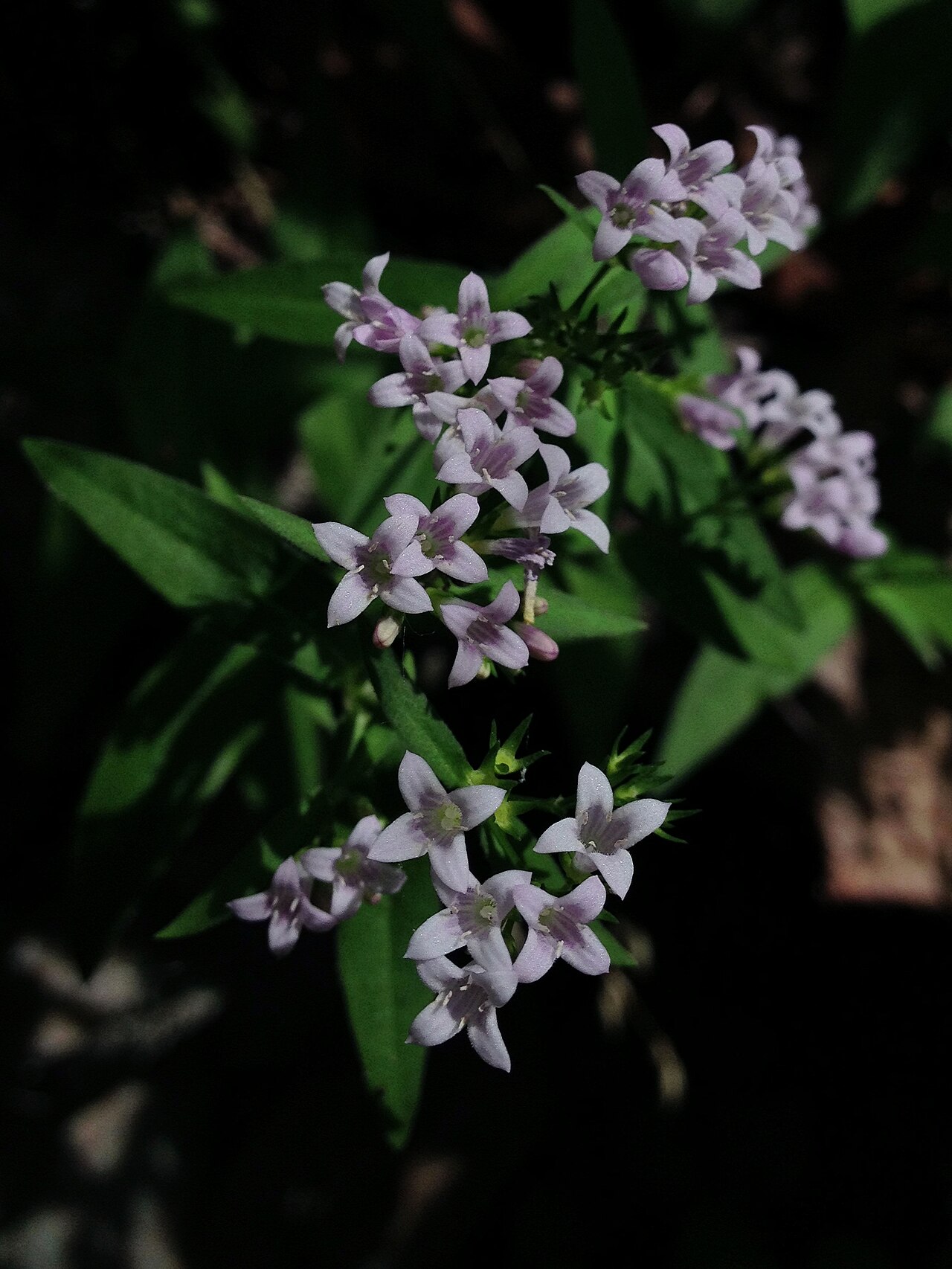
Houstonia purpurea, known as Summer Bluet, Venus’ pride, purple bluet or large bluet, is a native perennial wildflower of open woods and rocky slopes across the eastern and central United States. It forms small, upright clumps 4 to 18 inches tall with pairs of broad, stalkless leaves. In late spring and early summer, the stems end in clusters of small, funnel-shaped flowers with four pointed lobes, in shades of white, pale pink and lavender.
It belongs to the madder or coffee family (Rubiaceae), along with the more familiar spring bluets (Houstonia caerulea) that carpet lawns and meadows in early spring. Summer bluet is larger and blooms later, usually from May into July, which is how it got its common name. It is sometimes listed under the older name Hedyotis purpurea.
Summer bluet is a delicate, long-blooming plant for dry, partly shaded woodland gardens, rock gardens and meadow edges. This guide covers how to identify it, where it grows natively, how to grow it, and its value for small pollinators.
Identification
Summer bluet is identified by its upright clumps, broad opposite leaves with three to five veins, and clusters of small, four-lobed, white to lavender flowers in late spring and summer.
Growth Habit
It is a perennial with several upright, slender, four-angled stems 4 to 18 inches tall rising from a short, fibrous-rooted crown. It forms small, loose clumps rather than spreading mats.
Leaves
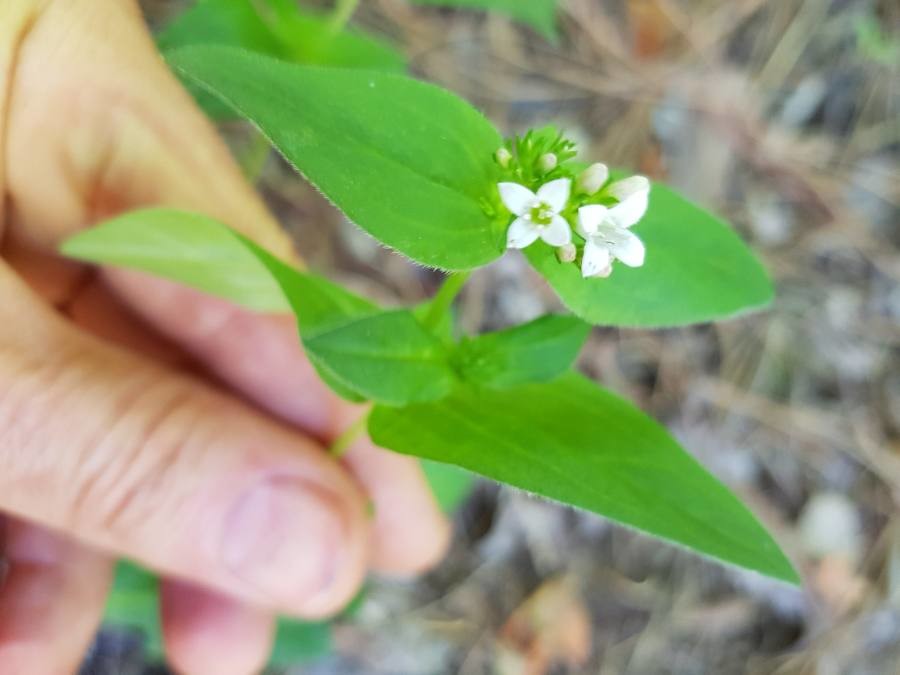
The leaves are opposite, stalkless or nearly so, and egg-shaped to lance-shaped, ½ to 2 inches long and up to 1 inch wide, with smooth edges. They usually have three to five prominent veins running lengthwise. Small basal leaves are often present early in the season but wither by flowering time.
Flowers
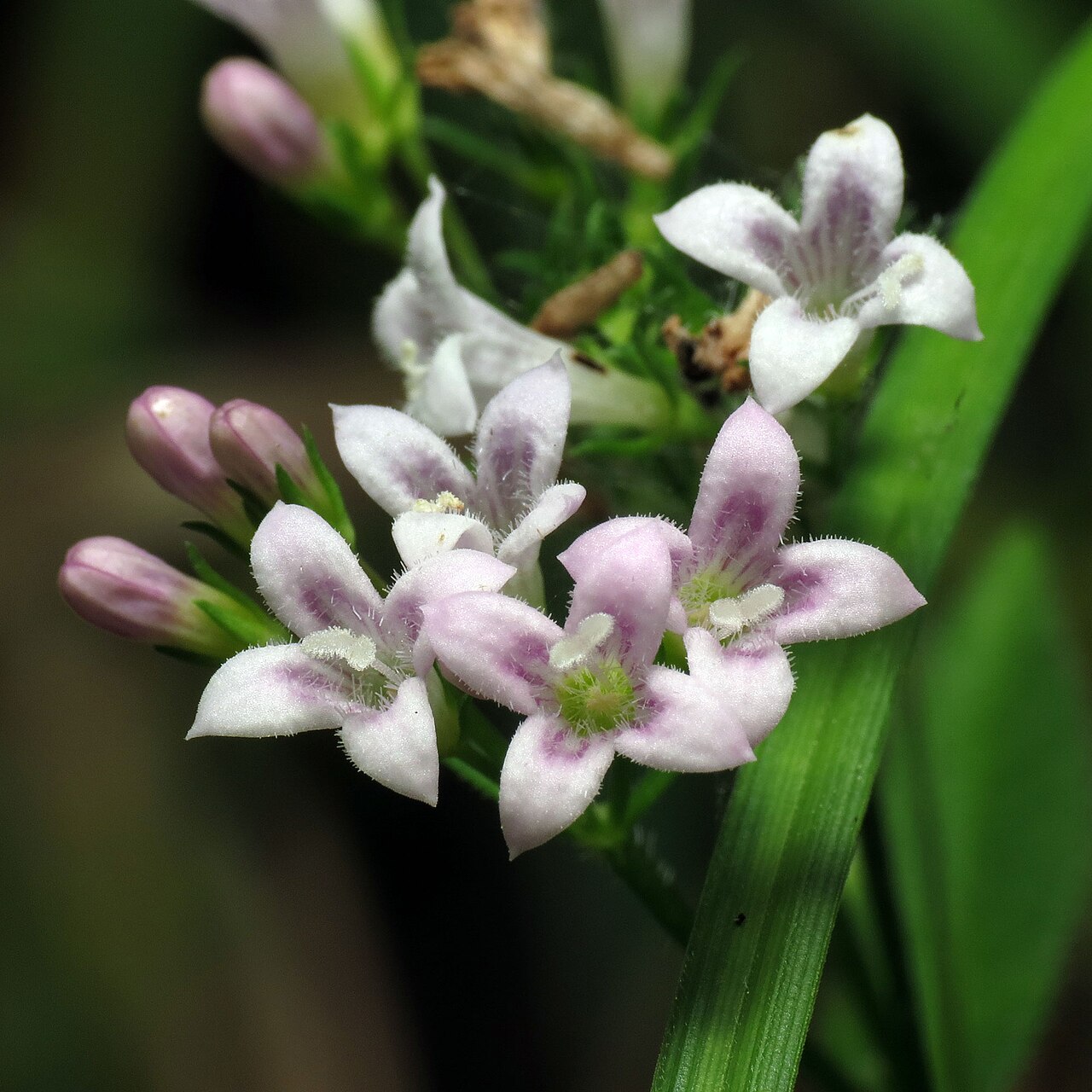
The flowers are in branched clusters (cymes) at the tops of the stems. Each flower is funnel-shaped, about ¼ to ½ inch long, with four spreading, pointed lobes. The color varies from white to pale pink, lilac or purple, often with a darker throat. Like other bluets, plants have two flower forms, one with long styles and short stamens and one with the reverse, which encourages cross-pollination. Flowers appear mainly from May to July.
Fruit & Seeds
The fruit is a small, rounded, two-lobed capsule, partly enclosed by the calyx, that splits at the top to release many tiny seeds in summer.
Look-alikes
Bluets (Houstonia caerulea) and Tiny Bluet (Houstonia pusilla) are much smaller, with single, sky-blue flowers on thread-like stalks in early spring. Longleaf bluet (Houstonia longifolia) is similar to summer bluet but has narrow, one-veined leaves. Summer bluet’s broad, three- to five-veined leaves are the best field mark.
Quick Facts
| Scientific Name | Houstonia purpurea (syn. Hedyotis purpurea) |
| Family | Rubiaceae (madder or coffee family) |
| Plant Type | Herbaceous perennial |
| Mature Height | 4–18 in |
| Mature Spread | 6–12 in |
| Growth Rate | Moderate |
| Sun Exposure | Full sun to part shade |
| Water Needs | Low to medium |
| Soil Type | Well-drained sandy, rocky or loamy soils |
| Soil pH | About 5.0–7.0 |
| Bloom Time | May–July |
| Flower Color | White, pale pink, lavender or purple |
| Fall Color | None |
| Fruit | Small two-lobed capsule |
| Deer Resistant | Moderate |
| USDA Hardiness Zones | 4–8 |
Native Range
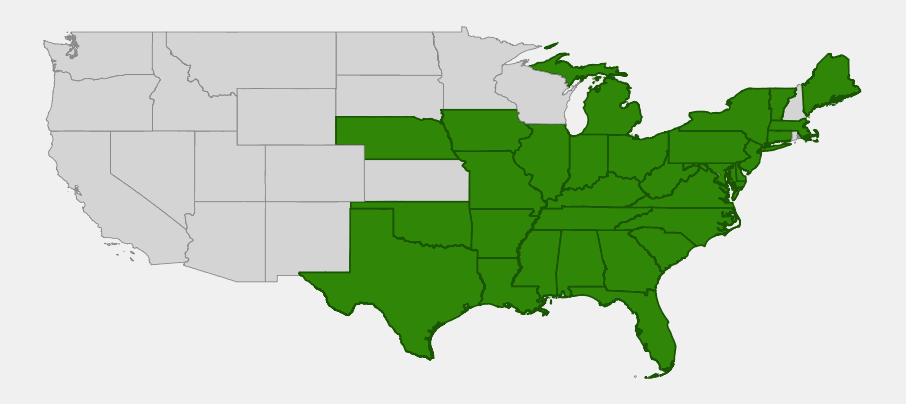
Summer bluet is widespread in the eastern and central United States. USDA PLANTS records it as native in 30 states, from Maine and Vermont south through New England, New York and the Mid-Atlantic to Florida, and west through the Ohio Valley and Great Lakes to Michigan, Iowa and Nebraska, and south to Oklahoma and Texas.
It is most common in the Appalachian Mountains, the Piedmont and the Ozark and Ouachita highlands. It grows in dry to moist open woods, rocky slopes, bluffs, glades, grassy balds, woodland edges and roadside banks, often in thin, acidic soils.
At the edges of its range, such as in New England, the Great Plains, eastern Texas and Florida, it is local and uncommon. The high-elevation variety Houstonia purpurea var. montana, known as Roan Mountain bluet, grows only on a few mountaintops in North Carolina and Tennessee and is listed as endangered under the U.S. Endangered Species Act.
📋 Regional plant lists featuring Summer Bluet: North & South Florida · Alabama, Georgia & Mississippi · North & South Carolina · Maryland, Virginia & West Virginia · Kentucky & Tennessee · Arkansas, Louisiana, Eastern Oklahoma & Eastern Texas · Illinois, Iowa & Missouri · Ohio & Indiana · Nebraska, Kansas & Eastern Colorado · Michigan, Wisconsin & Eastern Minnesota · New York, Pennsylvania & Northern New Jersey · Delaware, Southern New Jersey & Long Island · Connecticut, Massachusetts & Rhode Island · New Hampshire, Maine & Vermont
Growing & Care Guide
Summer bluet is a dainty, easy perennial for well-drained, sunny to partly shaded spots. It is small, so plant it where you can see it up close, such as along a path, in a rock garden or at the front of a woodland or meadow bed.
Light
It grows in full sun to part shade. In the wild it grows in open woods and on rocky slopes; in gardens, light afternoon shade helps it through hot summers in the South.
Soil & Water
Plant it in well-drained, sandy, rocky or loamy soil. It prefers acidic to neutral soils and tolerates thin, poor soil and dry spells once established. Avoid heavy, wet soil, where the crowns can rot.
Planting Tips
Set out small plants in spring or fall, 6 to 12 inches apart, in groups for a better show. Avoid crowding them with tall, vigorous plants that will shade them out.
Pruning & Maintenance
Little care is needed. Remove fallen leaves that smother the low clumps in spring. Plants may be short-lived in gardens but often reseed nearby if some bare soil is available.
Propagation
Grow it from seed sown on the soil surface in fall or early spring, or divide established clumps in early spring. Seeds are tiny and should be pressed into the soil rather than covered.
Landscape Uses
- Rock gardens: a small, long-blooming plant for dry, rocky pockets
- Woodland edges: adds delicate summer flowers in light shade
- Meadow and glade plantings: blends with low grasses in thin soils
- Path edges and front borders: planted in groups where it can be seen up close
- Pollinator gardens: an early-summer nectar source for small insects
Wildlife & Ecological Value
Summer bluet’s small flowers are a reliable food source for small pollinators in late spring and early summer.
For Pollinators
The flowers are visited by small bees, such as sweat bees and small carpenter bees, by bee flies, and by small butterflies and skippers, which reach the nectar at the base of the narrow flower tube.
For Birds
Birds make little direct use of the tiny seeds, but the insects that visit the flowers help support insect-eating birds.
For Mammals
Rabbits and deer occasionally browse it, but it is not a preferred food.
Ecosystem Role
As a common herb of open woods, glades and balds, summer bluet is part of the diverse low vegetation that supports small native bees and flies through late spring and early summer.
Cultural & Historical Uses
The genus Houstonia was named by Linnaeus to honor William Houstoun, an 18th-century Scottish surgeon and botanist who collected plants in the Caribbean and Mexico. The species name purpurea means “purple,” for the flower color of some plants.
For much of the 20th century, many botanists placed the bluets in the larger genus Hedyotis, and older field guides list this species as Hedyotis purpurea. Most current floras have returned to the name Houstonia.
The USDA common name “Venus’ pride” is an old folk name. The rare Roan Mountain bluet (var. montana), found on a few high peaks in the southern Appalachians, is federally endangered, so plants of this species should never be dug from the wild, especially in the high mountains.
Frequently Asked Questions
When does summer bluet bloom?
Mainly from May to July, later than the common spring bluets, which is how it gets its name.
How is summer bluet different from common bluets?
Common bluets (Houstonia caerulea) are tiny spring plants with single sky-blue flowers on thread-like stalks. Summer bluet is taller, with clusters of white to lavender flowers and broad, opposite leaves.
Does summer bluet need shade?
It grows in full sun to part shade. Light shade in the afternoon helps it in hot climates.
Is summer bluet endangered?
The species as a whole is common, but one high-elevation variety, the Roan Mountain bluet, is federally endangered. Buy nursery-propagated plants and never dig them from the wild.
Where should I plant summer bluet?
In well-drained, sandy, rocky or loamy soil in a rock garden, woodland edge, meadow or along a path where its small flowers can be seen.

Looking for a nursery that carries Summer Bluet?
Browse our native plant nursery directory: Alabama & Arkansas · Connecticut, Delaware, Florida & Georgia · Illinois, Indiana & Iowa · Kentucky, Louisiana, Maine, Maryland, Massachusetts, Michigan, Mississippi & Missouri · Nebraska, New Jersey, New York, North Carolina, Ohio & Oklahoma · Pennsylvania, South Carolina, Tennessee, Texas, Vermont & Virginia · West Virginia