
Native Buckeyes (Aesculus)
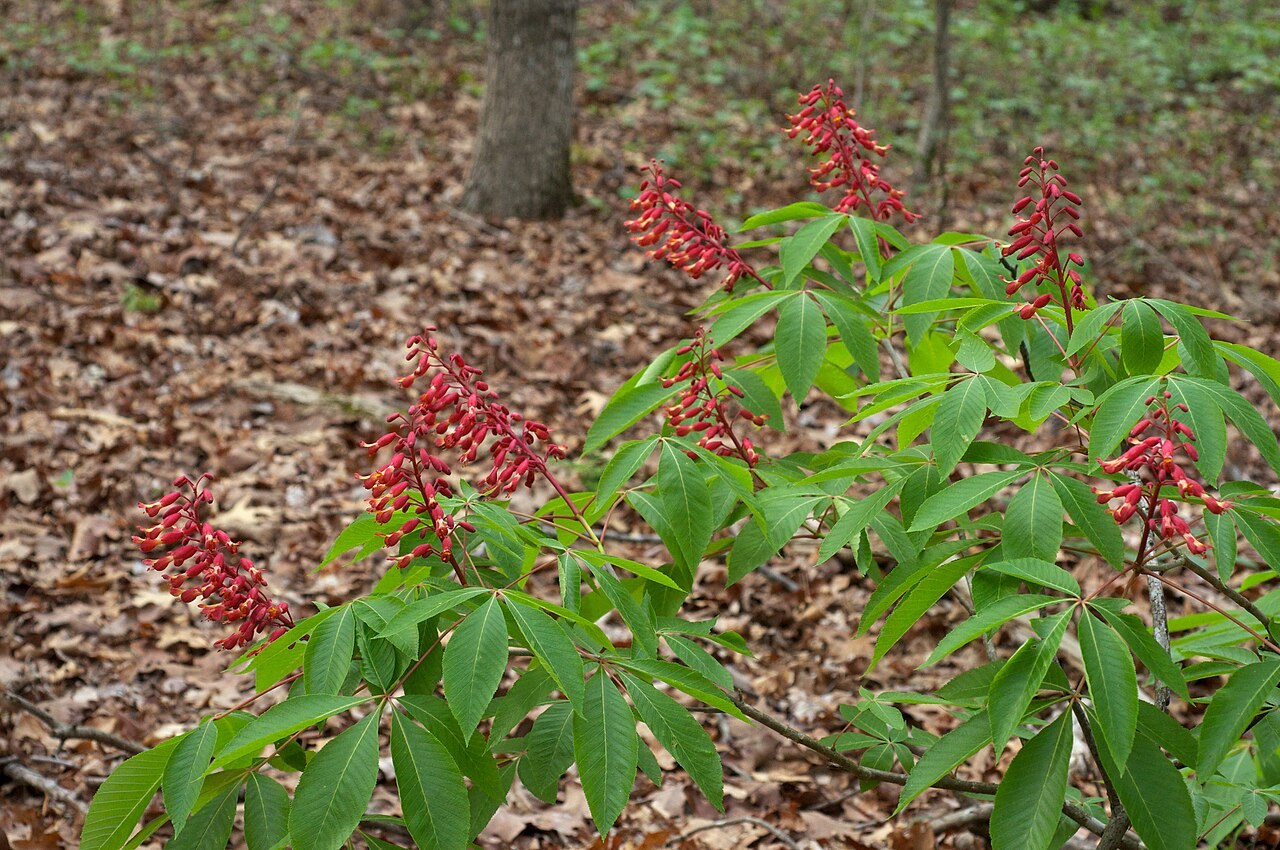
Buckeyes (genus Aesculus) are trees and shrubs with hand-shaped leaves, showy upright flower clusters in spring and glossy brown seeds that look like the eye of a deer, which is where the name comes from. Six species are native to the United States: five in the East and Midwest, from the towering yellow buckeye of Appalachian coves to the hummingbird-red buckeye of southern woodlands, and one, the California buckeye, in the foothills of California. Europeans call the same genus “horse chestnut,” and the horse chestnut that lines streets in many American towns is an import from southeastern Europe.
This guide gathers the native species in one place so you can tell them apart, see which ones grow wild near you and choose the right one for your garden. It also explains the popular garden hybrid Autumn Splendor buckeye (Aesculus × arnoldiana ‘Autumn Splendor’), which appears in many of our flowering-tree guides. Autumn Splendor is not a wild species, but all of its ancestry is North American buckeye, which makes it a reasonable choice where a native-derived shade tree with strong fall color is wanted.
One warning applies to every buckeye, native or not: the seeds, young shoots, leaves and bark contain saponins and the glycoside aesculin and are poisonous to people, pets and livestock if eaten. The nuts look like edible chestnuts but are not chestnuts. Keep that in mind if young children play under the tree.
Identification
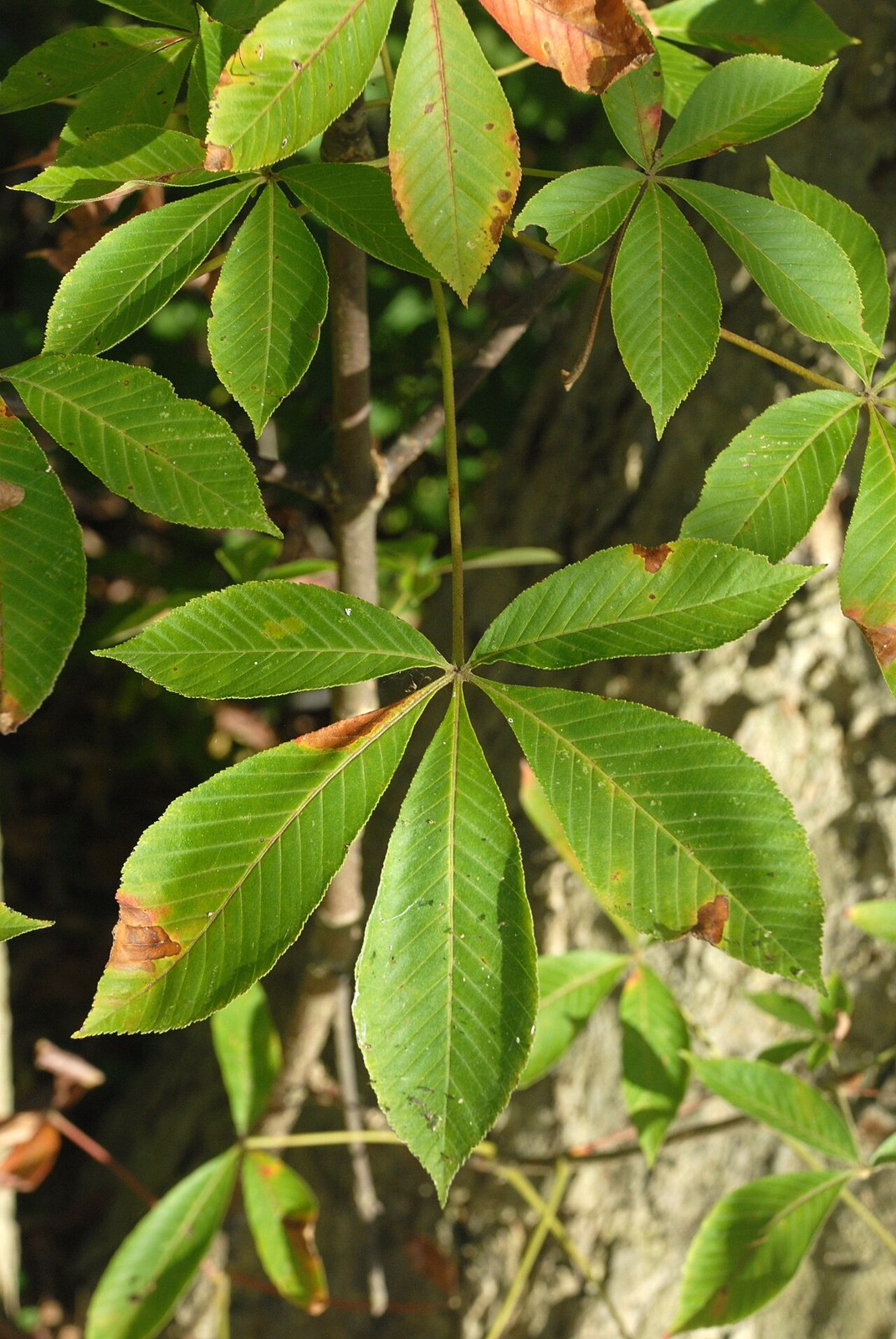
Buckeyes are easy to recognize as a group. They are the only common native trees and shrubs with palmately compound leaves: five to seven (rarely more) leaflets radiating from the tip of a long leaf stalk, like fingers from a palm. The leaves and twigs are opposite, meaning they grow in pairs across from each other on the stem.
Bark & Twigs
Young bark is smooth and gray. On older trees of Ohio buckeye it becomes rough and furrowed into scaly plates, while yellow buckeye breaks into smooth, gray-brown plates that flake off like sycamore or bigtooth patches. Twigs are stout with large buds and big shield-shaped leaf scars. Crushed twigs and leaves of Ohio buckeye give off an unpleasant smell, the source of the old name “fetid buckeye.” Native buckeye buds are not sticky; the large, resinous, sticky winter buds of the European horse chestnut are one of the best ways to tell it apart.
Leaves
Leaflets are usually 3 to 7 inches long, finely toothed and pointed. Most native buckeyes have five leaflets per leaf; California buckeye often has five to seven, and Texas buckeye (a variety of Ohio buckeye) has seven to eleven narrow leaflets. Many buckeyes leaf out very early in spring and drop their leaves early too, sometimes in late summer. Ohio and red buckeyes often brown at the edges (leaf scorch) in dry summers, and California buckeye routinely goes completely leafless by midsummer as a drought strategy.
Flowers
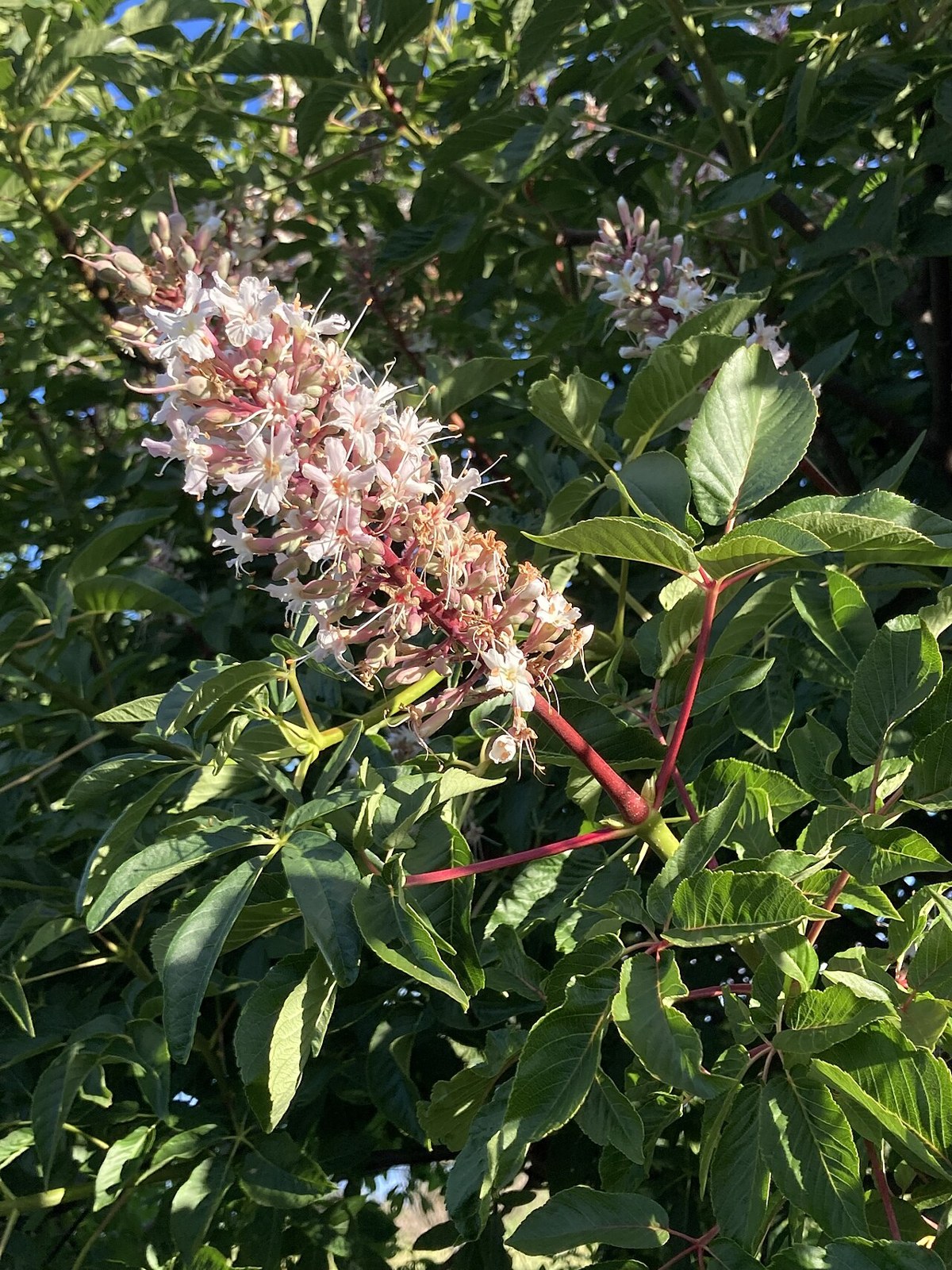
Flowers come in upright clusters (panicles) 4 to 12 inches tall at the branch tips in spring, after or with the new leaves. Each flower is tubular to bell-shaped with four or five petals and long stamens. Colors separate the species: greenish yellow in Ohio buckeye, clear yellow in yellow buckeye, red in red buckeye, a mix of yellow, green and pink in painted buckeye, and white to pale pink in bottlebrush and California buckeyes.
Fruit & Seeds
The fruit is a leathery capsule that splits in fall to release one to three large, shiny, chestnut-brown seeds, each with a pale scar (the “buck’s eye”). Ohio buckeye capsules are covered in short prickles; yellow, red and painted buckeye capsules are smooth; California buckeye produces large, pear-shaped smooth capsules with seeds up to 2 inches across.
Quick Facts
| Genus | Aesculus |
| Family | Sapindaceae (Soapberry; formerly Hippocastanaceae) |
| U.S. Native Species | 6 (plus several named varieties and natural hybrids); roughly 13–19 species worldwide |
| Growth Forms | Large shade trees, small trees and multi-stemmed shrubs |
| Mature Height | From about 6 ft (painted buckeye) to 60–90 ft (yellow buckeye) |
| Sun Exposure | Full Sun to Part Shade; red, painted and bottlebrush buckeyes tolerate shade |
| Water Needs | Mostly average to moist; California buckeye is very drought tolerant |
| Soil Type | Deep, fertile, well-drained soils; most tolerate clay |
| Bloom Time | March – July, depending on species |
| Flower Color | Red, yellow, greenish yellow, white or pink |
| Fall Color | Yellow to orange (Ohio and yellow buckeye); many drop leaves early |
| Fruit | Leathery capsules with large glossy brown seeds; prickly in Ohio buckeye |
| Toxicity | Seeds, leaves, bark and shoots are poisonous to people, pets and livestock |
| Wildlife Value | Early nectar for hummingbirds and bumblebees; seeds eaten by squirrels |
| Deer Resistant | Usually; the foliage is seldom browsed |
| USDA Hardiness Zones | About 4–9, depending on species |
Native Range
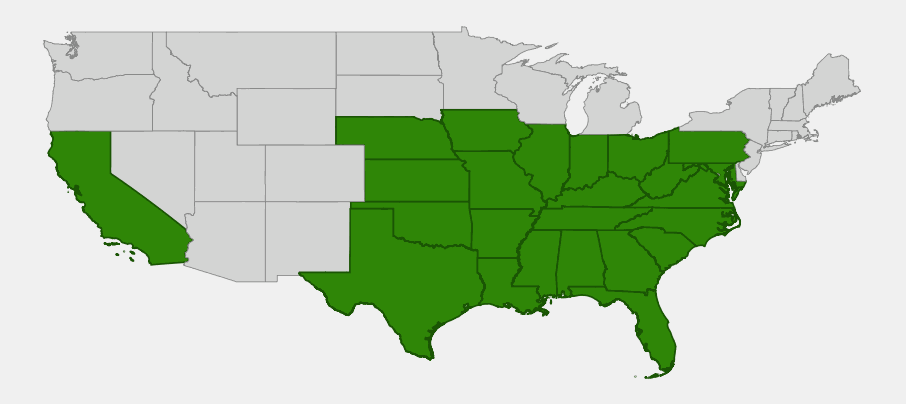
Five of the six native buckeyes grow in the eastern half of the country. Ohio buckeye has the widest range, from western Pennsylvania across the Ohio Valley and Midwest to southeastern Nebraska, Kansas, Oklahoma and central Texas. Yellow buckeye is centered on the Appalachians and the Ohio River valley, from southwestern Pennsylvania and western Maryland to northern Georgia and Alabama, reaching west into southern Indiana and Illinois. Red buckeye covers the Southeast and lower Midwest, from southeastern Virginia and the Carolinas through Florida and the Gulf states to central Texas, and north up the Mississippi Valley to Missouri, southern Illinois and Kentucky. Painted buckeye is a Piedmont shrub of Virginia, the Carolinas, Georgia, Alabama and Tennessee. Bottlebrush buckeye is native only to a small area of Alabama and Georgia.
The sixth species, California buckeye, is a California endemic. It grows in the foothills of the Coast Ranges and the Sierra Nevada and on the edges of the Central Valley, often in oak woodland and chaparral. It is the only buckeye native west of Texas.
Buckeyes are not native to New England, New York, New Jersey, Michigan or the northern Plains and Rockies, even though Ohio buckeye, bottlebrush buckeye and the European horse chestnut are commonly planted there and occasionally escape. If you garden in those states, Autumn Splendor and the native species can still be good garden trees, but they are planted, not part of the local wild flora. The range map below shows states where at least one buckeye is native.
📋 Regional plant lists featuring native buckeyes: New York, Pennsylvania & Northern NJ · Maryland, Virginia & West Virginia · North & South Carolina · Georgia, Alabama & Mississippi · Kentucky & Tennessee · Ohio & Indiana · Illinois, Iowa & Missouri · Nebraska, Kansas & Eastern Colorado · Arkansas, Louisiana, E. Oklahoma & E. Texas · South & West Texas · California & Nevada
Native Species
These are the six buckeyes native to the United States. Each name links to our full plant profile.
Ohio Buckeye (Aesculus glabra)
A medium tree, usually 30 to 50 feet tall, of river bottoms and rich slopes from Pennsylvania to Nebraska and Texas, and the state tree of Ohio. Greenish-yellow flowers open in April and May, and the seed capsules are covered in short prickles. Leaves turn yellow to orange in fall but often scorch and drop early in dry summers. Texas buckeye (var. arguta), a shrubby form with seven to eleven narrow leaflets, grows in Texas, Oklahoma, Kansas and Missouri.
Yellow Buckeye (Aesculus flava)
The largest buckeye, reaching 60 to 90 feet in the rich coves of the southern Appalachians, where it grows with tulip tree, sugar maple and basswood. It has clear yellow flowers, smooth seed capsules and gray bark that flakes into patches. It is less prone to leaf scorch than Ohio buckeye and turns pumpkin-orange in good years. It was formerly called Aesculus octandra.
Red Buckeye (Aesculus pavia)
A shrub or small tree, usually 10 to 20 feet, of southern forest understories and stream banks. Its bright red tubular flowers open in early spring just as ruby-throated hummingbirds return from the tropics, and it is one of the best native hummingbird plants in the South. It grows well in part shade. A yellow-flowered form occurs on the Edwards Plateau of Texas.
Painted Buckeye (Aesculus sylvatica)
A shrub, usually 6 to 15 feet, of the Piedmont and lower mountains from Virginia to Alabama. The flowers are a blend of yellow, green and pink, varying from plant to plant. It forms colonies in moist hardwood forest and is an attractive, shade-tolerant understory shrub for southeastern gardens. It hybridizes with yellow and red buckeyes where they meet.
Bottlebrush Buckeye (Aesculus parviflora)
A suckering, multi-stemmed shrub 8 to 12 feet tall that slowly spreads into wide thickets. In June and July it carries upright spikes of white flowers with long, wispy stamens, like bottle brushes, when few other shrubs are blooming. It is native only to Alabama and Georgia but is one of the most widely planted native shrubs in the country, hardy north to about zone 4 or 5, and excellent in shade.
California Buckeye (Aesculus californica)
A broad, often multi-trunked tree 15 to 40 feet tall of California foothill woodland and canyons. Fragrant white to pale pink flower spikes appear in May and June, and the tree usually drops its leaves by midsummer to survive the dry season, leaving silver-gray branches hung with large pear-shaped fruits. Once established it needs no summer water. Its nectar and pollen are known to be toxic to honey bees, though native bees, butterflies and hummingbirds visit it.
Autumn Splendor Buckeye (Aesculus × arnoldiana ‘Autumn Splendor’)
Arnold buckeye (Aesculus × arnoldiana) is a garden hybrid of North American buckeyes; its parentage is usually given as Ohio, yellow and red buckeye. ‘Autumn Splendor’ is a selection from the University of Minnesota Landscape Arboretum chosen for cold hardiness (about zone 4), resistance to leaf scorch and deep red to maroon fall color. It grows into a rounded tree roughly 25 to 35 feet tall with creamy yellow flower clusters in late spring. It is a cultivar rather than a wild native, so it does not replace a local species in a restoration planting, but its native ancestry means it supports the same buckeye-feeding insects and early-season bees. In New England, New York and Minnesota, where no buckeye is native, it is a planted ornamental like any other.
Non-Native Look-Alikes
Several Old World and hybrid horse chestnuts are widely planted in American towns and parks. None are major invasive plants in the United States, but European horse chestnut occasionally self-seeds near plantings in the Northeast and Pacific Northwest. Here is how to tell them from native buckeyes.
- European horse chestnut (Aesculus hippocastanum), native to the Balkans. A large tree, 50 to 75 feet, with usually seven big leaflets, large sticky, resinous winter buds and white flowers marked with a yellow blotch that turns red. The fruit husk is strongly spiny. Its seeds, the “conkers” of British children’s games, are just as poisonous as buckeyes. It is common in the Northeast, Midwest and Pacific Northwest, where no buckeye (or only Ohio buckeye) is native.
- Red horse chestnut (Aesculus × carnea), a hybrid of European horse chestnut and our native red buckeye that arose in Europe. It has pink to red flowers in large clusters, five leaflets and only slightly prickly fruit. ‘Briotii’ is the common cultivar. It is easily mistaken for red buckeye, but it becomes a much larger tree (30 to 40 feet) with bigger, coarser flower clusters.
- Japanese and Indian horse chestnuts (A. turbinata and A. indica) are occasionally grown in arboretums and large gardens; they are seldom seen elsewhere.
If you want a buckeye for wildlife, choose the native species that grows wild in your region. Red buckeye or a red-flowered cross is a better choice than red horse chestnut for hummingbirds in the Southeast, and Ohio or yellow buckeye is a native alternative to horse chestnut for large shade trees in the Midwest and Appalachians.
Growing & Care Guide
Light
The tree-sized buckeyes (Ohio, yellow, California and Autumn Splendor) flower and color best in full sun to light shade. Red, painted and bottlebrush buckeyes are understory plants that grow happily in part shade and still bloom in fairly heavy shade, which makes them some of the most useful flowering shrubs for woodland gardens.
Soil & Water
Eastern buckeyes want deep, fertile, moisture-retentive but well-drained soil, like the floodplains and coves where they grow wild. They tolerate clay and a wide range of pH. Leaf scorch and early leaf drop are signs of drought stress, so water young trees deeply in dry summers and keep a wide ring of mulch over the roots. California buckeye is the opposite: once established it needs no summer water and is happiest on dry, well-drained slopes.
Planting Tips
Buckeyes form a deep taproot early and dislike being moved, so plant young container-grown trees or sow seeds where you want the tree to grow. Plant in fall or early spring. Give tree species room: Ohio and yellow buckeyes need at least 30 feet of open space, and the fallen capsules make them a poor choice over sidewalks and patios. Bottlebrush buckeye needs 10 to 15 feet of width to spread into its natural mound.
Pruning & Maintenance
Buckeyes need little pruning. Remove dead or crossing branches in winter. On bottlebrush buckeye, remove suckers only if they spread beyond their space. Leaf blotch and powdery mildew can make leaves look ragged by late summer, but they rarely harm the tree. Rake fallen seeds where dogs, children or livestock might eat them.
Propagation
Seeds must be planted fresh. They lose viability quickly if allowed to dry out. Collect them as the capsules split in fall and plant them immediately, about 1 to 2 inches deep, outdoors or in deep pots; protect them from squirrels. Most germinate the following spring. Bottlebrush buckeye can also be propagated by digging rooted suckers.
Landscape Uses
- Shade trees for large yards and parks: Ohio buckeye, yellow buckeye and Autumn Splendor
- Hummingbird gardens in the South: red buckeye
- Woodland and shade gardens: painted, red and bottlebrush buckeyes
- Summer-flowering mass plantings: bottlebrush buckeye under tall trees
- Dry California gardens and foothill restoration: California buckeye
- Stream-bank and floodplain plantings within the native range of Ohio and yellow buckeye
Wildlife & Ecological Value
For Pollinators
Buckeye flowers open early and produce plenty of nectar. Queen bumblebees emerging in spring rely on Ohio, yellow and red buckeye flowers, and long-tongued bees, butterflies and moths visit the bottlebrush and California buckeyes. Buckeyes host the caterpillars of several native moths, and their spring leaves feed many other insects that in turn feed nesting birds.
For Birds
Red buckeye’s tubular red flowers are timed to the spring arrival of ruby-throated hummingbirds in the Southeast and are among their most important early nectar sources. Yellow and painted buckeyes are also visited. The seeds are too large and toxic for most birds, but the trees provide nesting sites and insect food.
For Mammals
Squirrels eat and bury buckeye seeds despite their toxins and are the main way the heavy seeds get moved away from the parent tree. Livestock and pets can be poisoned by eating seeds or young shoots, and deer generally avoid the foliage.
Ecosystem Role
Yellow and Ohio buckeyes are part of the rich mixed forests of the Appalachians and Ohio Valley, where their early leaves and flowers kick off the growing season. Red and painted buckeyes form part of the shrub layer of southern woods. In California, buckeye is a characteristic tree of foothill oak woodland and a nectar source in late spring when many annual wildflowers are finished.
Cultural & Historical Uses
Ohio is the “Buckeye State,” and Ohio buckeye has been its state tree since 1953. Carrying a buckeye seed in your pocket for good luck is an old folk custom in the Ohio Valley, and the nickname became attached to Ohioans in the early 1800s. Pioneers used the soft, light wood of yellow and Ohio buckeye for carving, bowls, artificial limbs and paper pulp.
Several Native American peoples knew how to use buckeye toxins. Crushed seeds and branches were historically thrown into pools to stun fish, and in California the large seeds of California buckeye were made safe only by roasting, grinding and leaching in water for long periods, and were eaten mainly in years when acorns failed. This was skilled traditional processing of a poisonous seed. Buckeye seeds are not safe to eat, and they should never be roasted or eaten like chestnuts.
The saponins in buckeye seeds and bark make a soapy lather, and early settlers used grated buckeyes as a soap substitute. Extracts of the related European horse chestnut are still studied in modern pharmacology, but home use of any buckeye is unsafe.
Frequently Asked Questions
What is the difference between a buckeye and a horse chestnut?
They belong to the same genus, Aesculus. In North America, “buckeye” usually means the native species and “horse chestnut” the European A. hippocastanum and its hybrids. Horse chestnut has sticky winter buds, usually seven leaflets and white flowers with a red or yellow blotch; native buckeyes have non-sticky buds and mostly five leaflets.
Is Autumn Splendor buckeye native?
Not as a wild plant. It is a selected garden hybrid (Aesculus × arnoldiana) whose parents are North American buckeyes. It is a good native-derived shade tree for cold regions, but where a buckeye grows wild, the local species is the better choice for restoration plantings.
Are buckeyes poisonous?
Yes. The seeds, leaves, young shoots and bark contain saponins and aesculin and can poison people, dogs and livestock. Symptoms include vomiting, diarrhea, weakness and, in severe cases, trouble walking. Do not eat buckeye seeds, even roasted.
Which buckeye attracts hummingbirds?
Red buckeye (Aesculus pavia) is the best. Its red tubular flowers bloom in early spring as ruby-throated hummingbirds return. Painted buckeye and the yellow-flowered species are also visited.
Why do my buckeye leaves turn brown in summer?
Ohio and red buckeyes often scorch and drop leaves early in hot, dry summers, and leaf blotch disease adds brown patches. It looks bad but rarely harms the tree. Deep watering in drought and a wide mulch ring help. California buckeye drops its leaves every summer by design.

Looking for a nursery that carries native buckeyes?
Browse our native plant nursery directory: Alabama & Arkansas · California · Florida & Georgia · Illinois, Indiana, Iowa & Kansas · Kentucky, Louisiana, Maryland, Mississippi & Missouri · Nebraska, North Carolina, Ohio & Oklahoma · Pennsylvania, South Carolina, Tennessee, Texas & Virginia · West Virginia

