
Native Monkshoods (Aconitum)
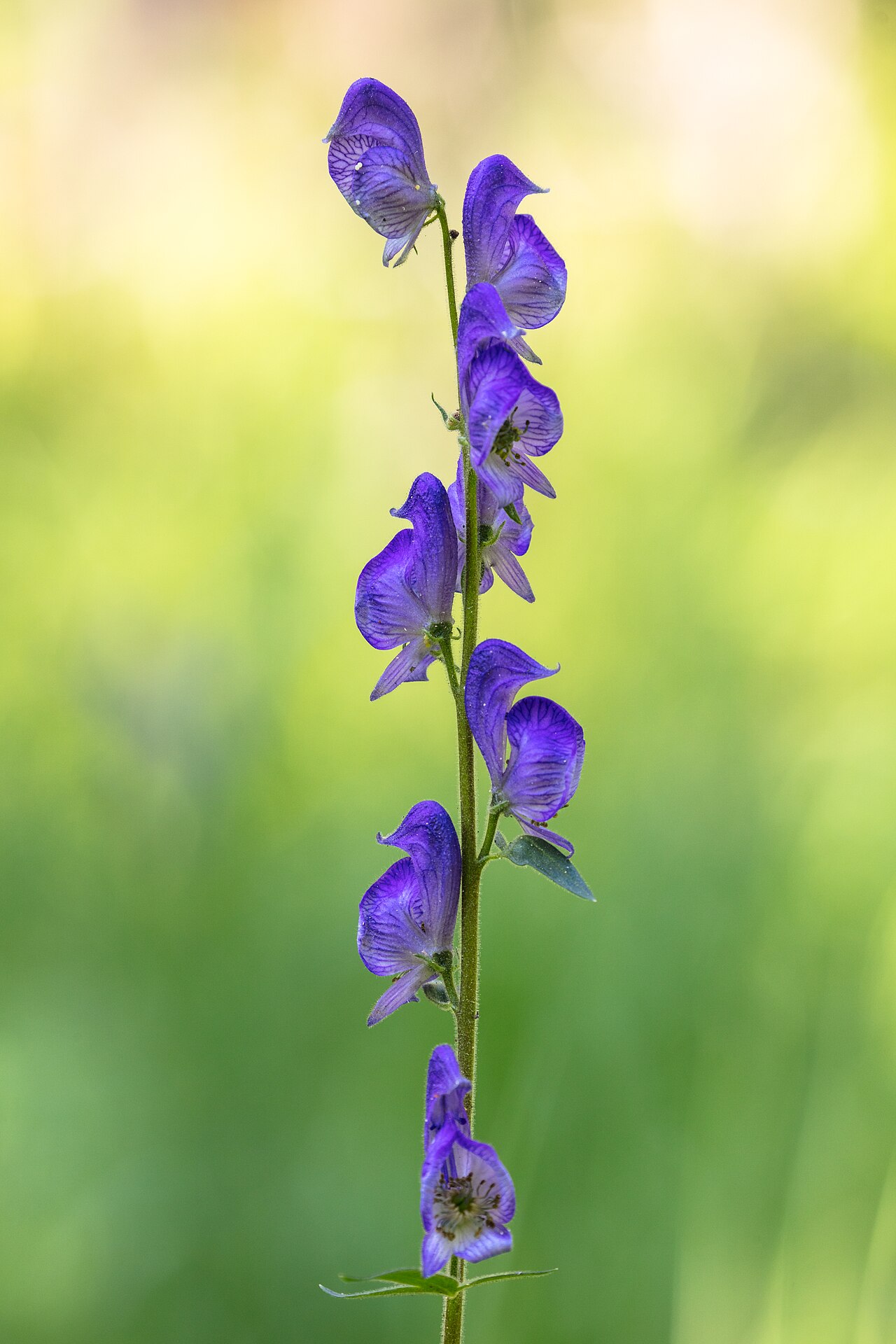
Monkshoods are tall perennials with one of the most distinctive flowers in the garden: each blossom wears a helmet-shaped hood, like the cowl of a monk’s habit, in deep blue, violet or, in a few species, cream or white. The genus Aconitum has a few hundred species across the cool, mountainous parts of the Northern Hemisphere, most of them in Asia. Only about six are native to the United States, and they are plants of cold mountain meadows, shaded stream banks and chilly cliff bases rather than ordinary garden beds.
Every monkshood, native or not, is highly poisonous. All parts of the plant, and the roots and seeds in particular, contain aconitine and related alkaloids, which affect the heart and nerves. Poisonings have happened when roots were mistaken for horseradish or other edible roots, and the toxins can be absorbed through broken skin, so wear gloves when you handle the plant. Never plant monkshood where small children or grazing animals might eat it, and keep it away from vegetable beds.
Most monkshood sold at garden centers is not native to North America. The common blue garden monkshood (Aconitum napellus) comes from Europe, and the late-blooming azure monkshood (Aconitum carmichaelii) comes from East Asia. Gardeners in Michigan and Maine should know that neither state has a native monkshood at all; the nearest wild populations are in Wisconsin and New York. This guide covers the native species, where they grow, how to tell them from the imported garden plants and from look-alikes such as larkspur, and how to grow them safely.
Identification
Monkshoods belong to the buttercup family (Ranunculaceae). The native species are herbaceous perennials that die back to the ground each winter and regrow from a tuberous root or a cluster of thickened roots in spring. Stems range from upright and wand-like to weak and sprawling, depending on the species.
Leaves & Stems
Leaves are alternate (one per node, not in pairs) and palmately divided, like an outstretched hand, into three to seven deeply toothed or lobed segments. Lower leaves have long stalks and the upper ones get smaller and nearly stalkless. Stems are usually unbranched below the flower cluster. Columbian monkshood stands upright and can reach about 6 feet in a lush meadow; southern blue monkshood and trailing white monkshood have weak stems that lean on neighboring plants or sprawl along the ground.
Flowers
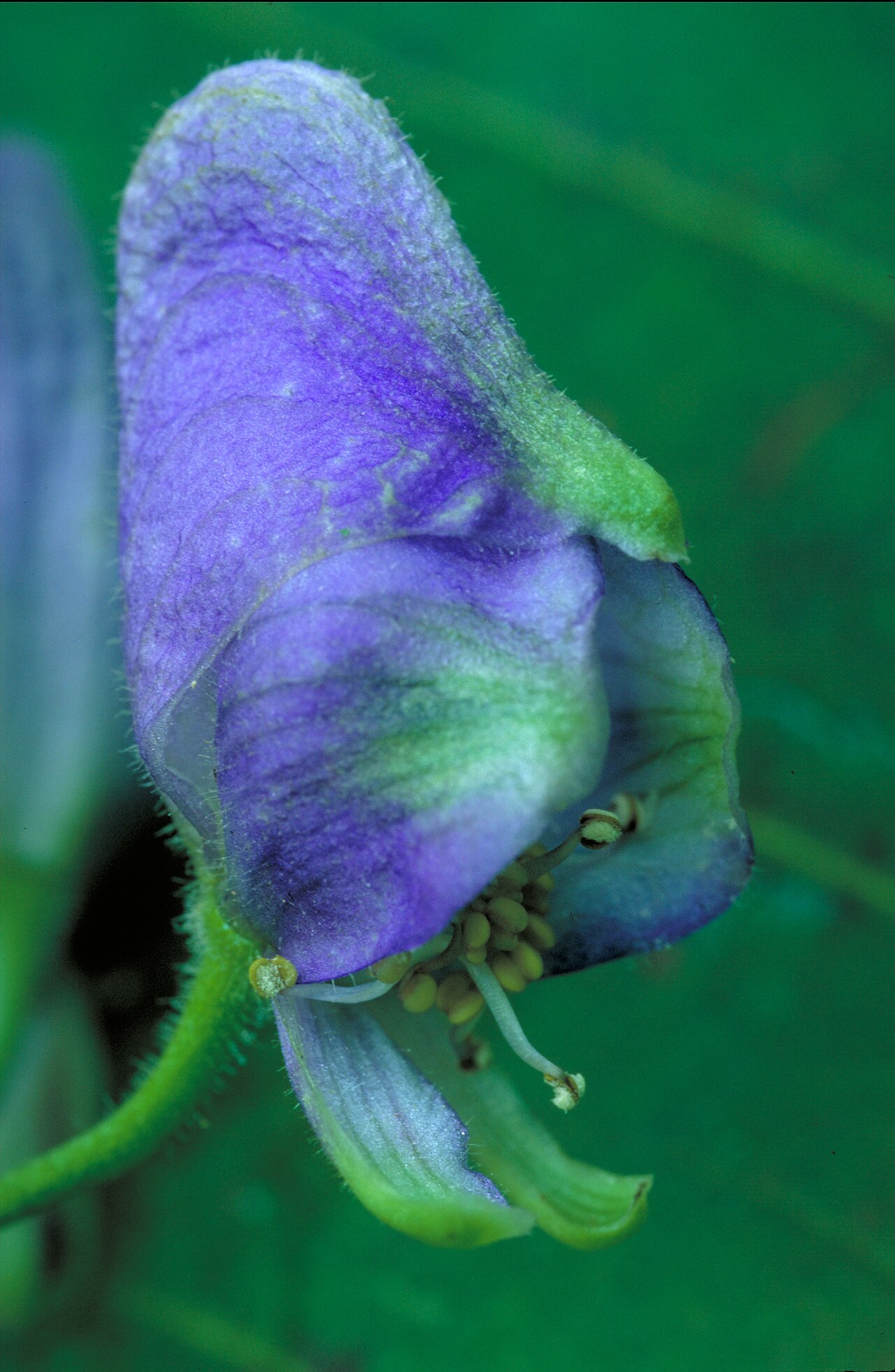
The “hood” is a sepal, not a petal. Each flower has five colorful sepals: the large upper one forms the helmet, two broad side sepals flank the opening, and two narrow lower sepals point down. Inside the helmet, hidden from view, two small petals have become nectar spurs. Flowers are held in loose spikes or clusters at the top of the stem and open from the bottom up over several weeks. Most native species are blue-violet; Columbian monkshood occasionally has white or cream flowers, and trailing white monkshood is always creamy white.
Fruit & Seeds
Each flower produces three to five small pods (follicles) that split along one side when ripe in late summer or fall, releasing many small, winged or angular seeds. The seeds are poisonous too.
Quick Facts
| Scientific Name | Aconitum L. (genus) |
| Family | Ranunculaceae (Buttercup family) |
| US-Native Species | About 6 (several hundred worldwide, mostly in Asia) |
| Growth Forms | Herbaceous perennials from tuberous or thickened roots; upright or sprawling stems |
| Mature Height | About 1–6 ft depending on species (trailing species sprawl farther) |
| Sun Exposure | Part shade to full sun in cool, moist sites; shade from afternoon heat |
| Water Needs | Moderate to high; soil should stay moist |
| Soil Type | Rich, moist, well-drained loam; stream banks, seeps and mountain meadows |
| Bloom Time | July – October depending on species |
| Flower Color | Blue-violet to deep purple; cream or white in trailing white monkshood and some Columbian monkshood |
| Wildlife Value | Bumble bees are the main pollinators; deer and rabbits usually avoid it |
| Toxicity | Highly poisonous to people, pets and livestock; wear gloves |
| Deer Resistant | Yes |
| USDA Hardiness Zones | Roughly 3–7 for most native species; Alaska species colder |
Native Range
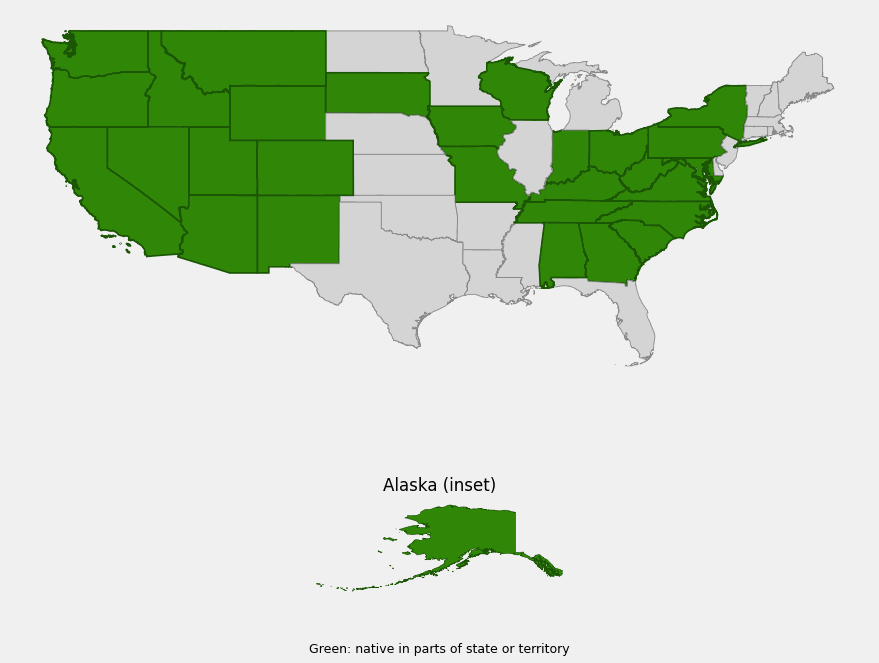
Native monkshoods fall into three groups. In the West, Columbian monkshood grows in moist mountain meadows, aspen groves and along streams from Washington, Oregon and California east to Montana, Wyoming, Colorado and New Mexico, with an outlying population in the Black Hills of South Dakota. In the East, southern blue monkshood and trailing white monkshood are Appalachian plants, found from Pennsylvania and Maryland south to Georgia and Alabama, with scattered southern blue monkshood populations west to Indiana and Missouri. In Alaska, larkspurleaf monkshood is widespread and Kamchatka aconite grows in the Aleutians and the southwest.
The fourth group is a set of rare relict populations. Northern blue monkshood survives in only a handful of cold, shaded spots in Wisconsin, Iowa, Ohio and New York, places where cold air seeps from the rocks and keeps summer temperatures low, left over from the last ice age.
Monkshood is not native in Michigan, Minnesota, Illinois, New England or the Gulf and Plains states. Plants found in Michigan or Maine gardens and old homesteads are imported European or Asian species, which occasionally persist or spread a short way from plantings.
📋 Regional plant lists with native monkshoods: Alaska · Western Oregon & Western Washington · Idaho, Eastern Oregon & Eastern Washington · California & Nevada · Montana & Wyoming · Utah & Western Colorado · Arizona & New Mexico · North Dakota, South Dakota & Western Minnesota · Michigan, Wisconsin & Eastern Minnesota · Illinois, Iowa & Missouri · Ohio & Indiana · New York, Pennsylvania & Northern New Jersey · Maryland, Virginia & West Virginia · Kentucky & Tennessee · North & South Carolina · Georgia, Alabama & Mississippi
Native Species
These are the US-native monkshoods. Two have full profiles on our site, linked below.
Columbian monkshood (Aconitum columbianum) is the native monkshood of the western mountains and the one most often grown in western native gardens. Upright stems 2 to 6 feet tall carry dark blue-purple, sometimes white or cream, hooded flowers from midsummer into early fall. It grows in wet meadows, along streams and in aspen and spruce forests from the Cascades and Sierra Nevada to the Rockies and the Black Hills. Some plants produce small bulblets in the leaf axils that drop and grow into new plants.
Northern blue monkshood (Aconitum noveboracense) is one of the rarest wildflowers in the Midwest and is listed as threatened under the federal Endangered Species Act. It grows on shaded, cool, moist slopes, especially the algific (cold-air) talus slopes of the Driftless Area in southwestern Wisconsin and northeastern Iowa, and in cool ravines in Ohio and New York’s Catskill Mountains. Its blue-violet flowers appear in late summer on stems 1 to 4 feet tall. Some botanists treat it as part of Columbian monkshood. Because it is federally protected, never collect it; it is grown only by conservation programs and a few specialist nurseries.
Southern blue monkshood (Aconitum uncinatum), also called wild monkshood, grows in moist woods, seeps and stream banks of the Appalachians and Piedmont from Pennsylvania to Georgia and Alabama, with scattered populations west to Indiana and Missouri. Its weak stems, 2 to 4 feet long or more, lean on neighboring plants, and it opens blue-violet flowers from late summer into October. This is the native monkshood most likely to be offered by eastern native-plant nurseries.
Trailing white monkshood (Aconitum reclinatum) is an Appalachian endemic of rich, moist cove forests and high-elevation woods in Pennsylvania, Virginia, West Virginia, North Carolina and Tennessee. Its long, reclining stems can sprawl several feet across the forest floor, carrying creamy white, slender-hooded flowers in summer. It is uncommon and rarely grown.
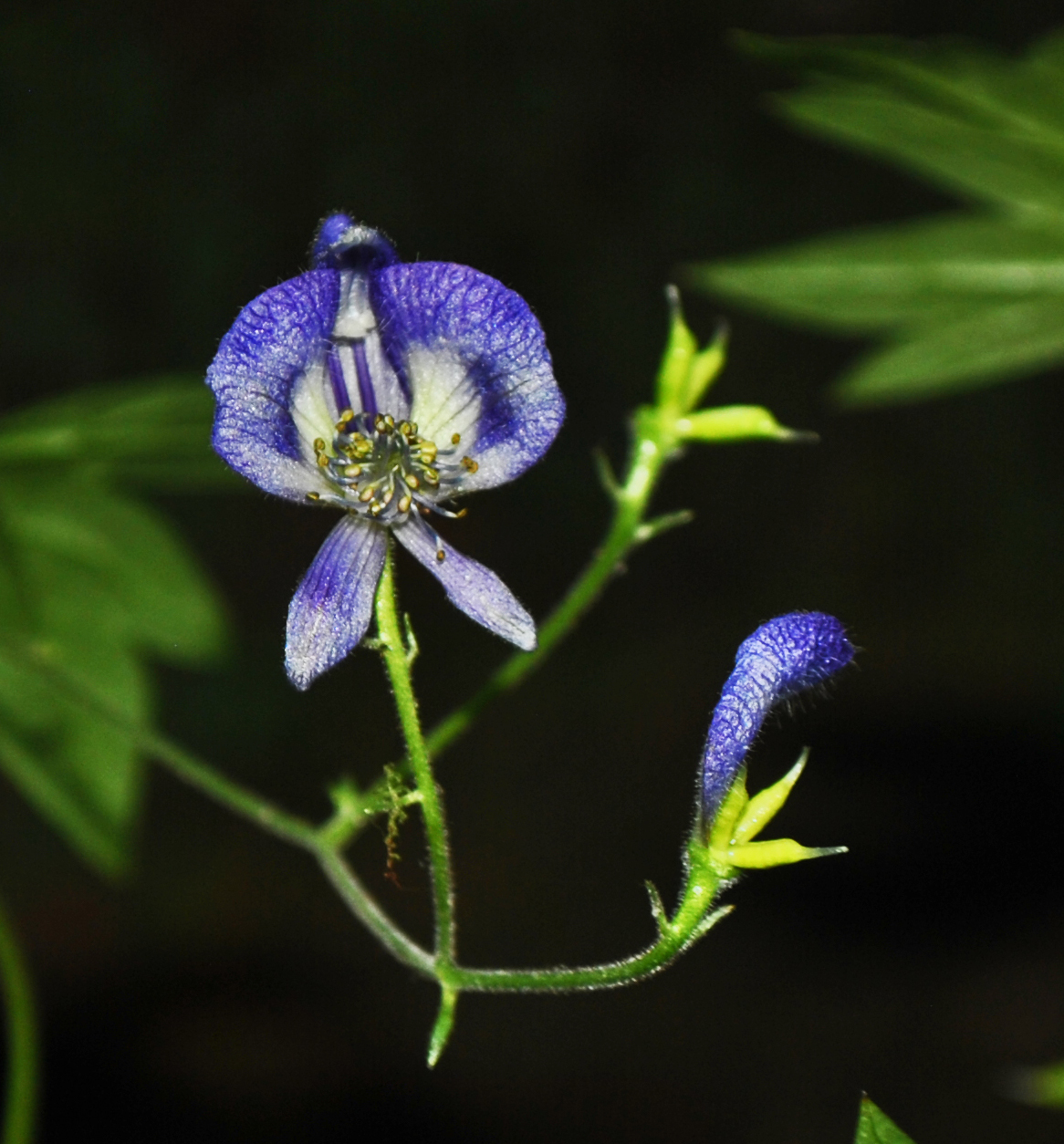
Larkspurleaf monkshood (Aconitum delphiniifolium), profiled on our site as northern monkshood, is the common monkshood of Alaska and the Yukon. It is usually 1 to 3 feet tall with finely divided, larkspur-like leaves and a few large, deep blue-purple flowers. It grows in moist meadows, thickets and tundra from sea level to the alpine zone. (The name northern monkshood is also used for A. noveboracense, so check the scientific name when buying or reading about either plant.)
Kamchatka aconite (Aconitum maximum) is a tall, purple-flowered species of northeastern Asia that reaches the United States only in the Aleutian Islands and southwestern Alaska, where it grows in meadows and thickets.
Non-Native Look-Alikes
Most monkshoods sold for gardens are imported species. None is considered a serious invasive plant in the United States, but some persist around old gardens and occasionally spread a short distance, and they are just as poisonous as the natives.
Garden monkshood (Aconitum napellus). Also called Venus’ chariot or aconite, this European species is the classic cottage-garden monkshood, with dense, upright spikes of deep blue hoods in mid to late summer and glossy, finely cut leaves. It is the plant most often found in older gardens in Michigan, Maine and the rest of the Northeast, and it is recorded as introduced (escaped from cultivation) in a few northern states. Cultivars and hybrids sold under names such as Aconitum × cammarum ‘Bicolor’ (blue and white) belong to this European group.
Azure monkshood (Aconitum carmichaelii). This Chinese species and its selections, such as ‘Arendsii’, bloom later than any other monkshood, from September into October, with large, pale to deep blue hoods on sturdy stems above thick, leathery leaves. It is sold widely as a late-season perennial for part shade. It is not native anywhere in North America.
Yellow wolfsbane (Aconitum lycoctonum). Sometimes sold as A. lycoctonum or A. vulparia, this European species has pale yellow, tall, narrow hoods. No US-native monkshood has yellow flowers, so a yellow-flowered plant is a garden import.
Larkspurs and delphiniums (Delphinium). Larkspurs share the same family, the same blue-purple colors and similar toxicity, and they often grow alongside Columbian monkshood in western meadows. The easy difference: a larkspur flower has a long backward-pointing spur, while a monkshood flower has a rounded hood on top and no spur. The eastern tall larkspur (Delphinium exaltatum) and the western tall larkspur (Delphinium glaucum) are native alternatives with a similar look.
A note on garden descriptions. Monkshood leaves are alternate, not opposite, and the flowers are not short-lived: each spike blooms for several weeks. Monkshoods want moist soil and are unhappy in hot, dry sun. If a description of “monkshood” describes white, yellow or pink day-long flowers on opposite leaves, it is describing a different plant.
Growing & Care Guide
Light
Monkshoods like cool roots and cool summers. In the mountain West and the North, Columbian monkshood can take full sun if the soil stays moist; elsewhere give it morning sun and afternoon shade. Southern blue monkshood naturally grows at woodland edges and in light shade.
Soil & Water
Plant in rich, humus-filled, moist but well-drained soil. They are at home near streams, ponds, rain gardens with steady moisture, or a shaded spot that never dries out. Hot, dry summers and drought stress cause leaf browning and weak flowering, and soggy, airless soil rots the roots in winter. A layer of leaf mulch helps keep the root zone cool and moist.
Planting Tips
Plant tubers or potted plants in spring or fall with the crown just below the soil surface. Space plants 1 to 2 feet apart. Tall Columbian monkshood may need neighbors to lean on or a discreet stake; southern blue monkshood looks best scrambling through shrubs or tall ferns. Wear gloves when planting, dividing or cutting back any monkshood, and wash your hands afterward. Label the plant clearly, and do not plant it near herbs or root vegetables.
Pruning & Maintenance
Cut stems to the ground after frost, using gloves, and put the trimmings in the trash rather than a compost pile used for food crops. Monkshoods resent being moved; once established, leave them alone. Clumps can be divided every few years in fall if they become crowded.
Propagation
Seeds need a cold, moist period before they germinate, so sow them fresh outdoors in fall. Germination is slow and seedlings take two or three years to flower. Division of the tuberous roots in fall or early spring is faster. Columbian monkshood plants that produce leaf-axil bulblets can be increased by planting the bulblets. Buy only nursery-propagated plants of native species and never dig plants from the wild, especially northern blue monkshood, which is federally protected.
Landscape Uses
- Moist mountain-meadow and streamside plantings in the West
- Shade and woodland-edge gardens in the Appalachians
- Late-season blue color for bumble bees
- Deer-resistant perennial borders, away from children’s play areas and edible gardens
Wildlife & Ecological Value
For Pollinators
Monkshoods are classic bumble bee flowers. The nectar sits deep inside the hood, and only bumble bees, with their strength and long tongues, can push in far enough to reach it while brushing against the stamens. The geographic range of the genus closely tracks the range of bumble bees. Some bumble bees “rob” nectar by chewing through the back of the hood instead of entering the front, and you may see small holes in the helmets late in the season.
Birds & Mammals
Because of their toxins, monkshoods are rarely browsed by deer, elk or rabbits, which makes them useful in gardens with heavy deer pressure. Columbian monkshood can poison cattle and sheep that eat it in quantity, although livestock losses are less common than with larkspurs. Birds do not depend on the seeds.
Ecosystem Role
In the West, Columbian monkshood is part of the lush tall-forb community of mountain meadows and stream banks, along with larkspurs, cow parsnip, bluebells and willows. In the Midwest, northern blue monkshood is an indicator of the rare algific talus slope habitat, a cold microclimate that also shelters relict snails and other ice-age survivors.
Cultural & Historical Uses
Monkshood has a dark reputation. In Europe and Asia, aconite was used historically as a poison for arrow tips, bait and wolves, which is why one species is called wolfsbane. It also appears in old herbal medicine and in traditional Chinese medicine only after heavy processing, and poisonings from improperly prepared roots still occur. None of this is a recommendation: there is no safe home use of monkshood.
Garden monkshood has been grown in European gardens for centuries for its striking blue spikes, and it arrived in North American gardens with European settlers. Today the imported species remain the standard nursery plants, while the native species are grown mostly by native-plant specialists and conservation programs.
Frequently Asked Questions
Is monkshood native to Michigan or Maine?
No. Neither state has a native monkshood. Plants grown there are European garden monkshood or Asian azure monkshood. For native late-season blue flowers in moist, partly shaded spots, consider great blue lobelia or bottle gentian, and for a tall, hooded flower in wet ground, white turtlehead.
How poisonous is monkshood?
Very. All parts are poisonous, especially the roots and seeds, and eating even a small amount can cause serious heart problems in people and animals. Wear gloves when handling it, wash your hands afterward, and keep it away from children, pets and food gardens. If you suspect poisoning, contact Poison Control or a veterinarian immediately.
What is the difference between monkshood and larkspur?
Monkshood flowers have a rounded hood on top; larkspur flowers have a long spur pointing backward. Both are in the buttercup family and both are poisonous.
Can I buy native monkshood?
Southern blue monkshood and Columbian monkshood are sometimes offered by native-plant nurseries in their home regions. Most “monkshood” at garden centers is the European or Asian species. Northern blue monkshood is federally threatened and should never be collected from the wild.
Is monkshood deer resistant?
Yes. Deer and rabbits generally avoid it because of its toxins.

Looking for a nursery that carries Native Monkshoods?
Browse our native plant nursery directory: Alabama, Alaska & Arizona · California · Colorado & Georgia · Idaho, Indiana & Iowa · Kentucky, Maryland, Missouri & Montana · Nevada, New Mexico, New York, North Carolina & Ohio · Oregon · Pennsylvania, South Carolina, South Dakota, Tennessee, Utah & Virginia · Washington · West Virginia, Wisconsin & Wyoming

