
Apple Moss (Bartramia pomiformis)
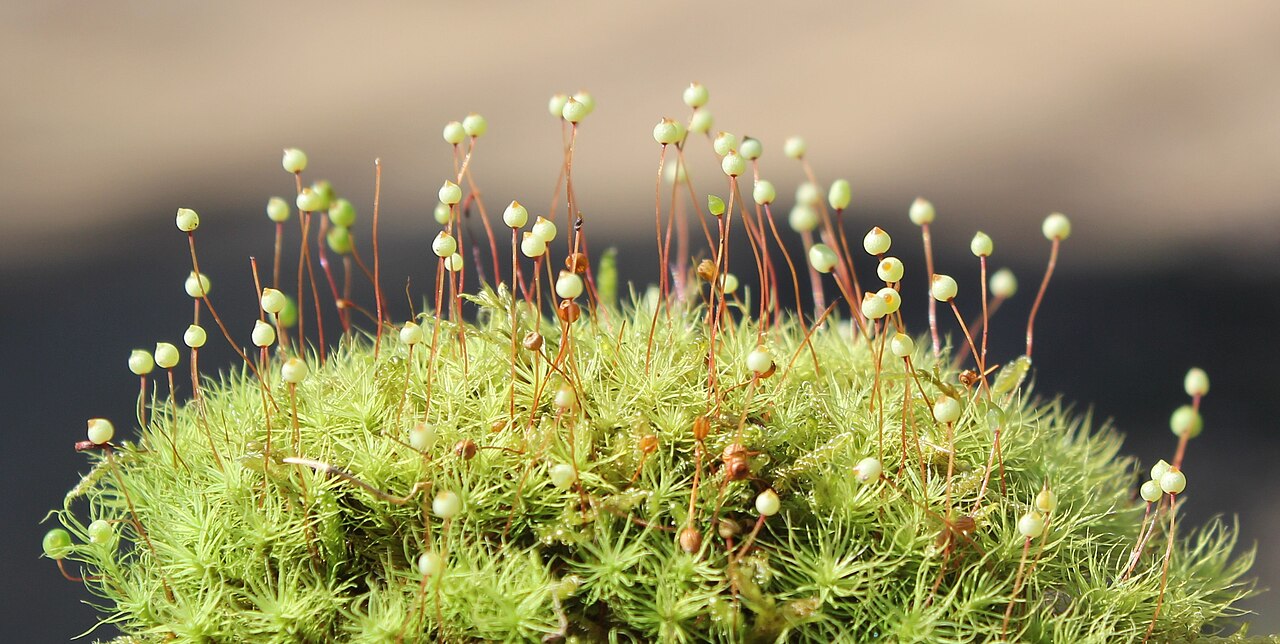
Apple moss (Bartramia pomiformis) is one of the easiest mosses to recognize and one of the prettiest. It forms soft, rounded tufts of bluish-green to yellow-green shoots on shaded rock ledges, crevices and earthen banks, and in spring it raises dozens of tiny round capsules on reddish stalks. Those capsules, green and glossy when young, look like miniature apples, and they give the moss both its common name and its scientific one: pomiformis means “apple-shaped.”
It’s a true moss, not a flowering plant. Apple moss has no flowers, seeds or roots. It anchors itself with fine reddish-brown threads called rhizoids, takes water in directly through its leaves and reproduces by spores released from those apple-like capsules. A healthy cushion is usually only 1 to 3 inches tall, and a single patch may be no bigger than your palm, though neighboring tufts can merge into a mat a foot or more across along a mossy ledge.
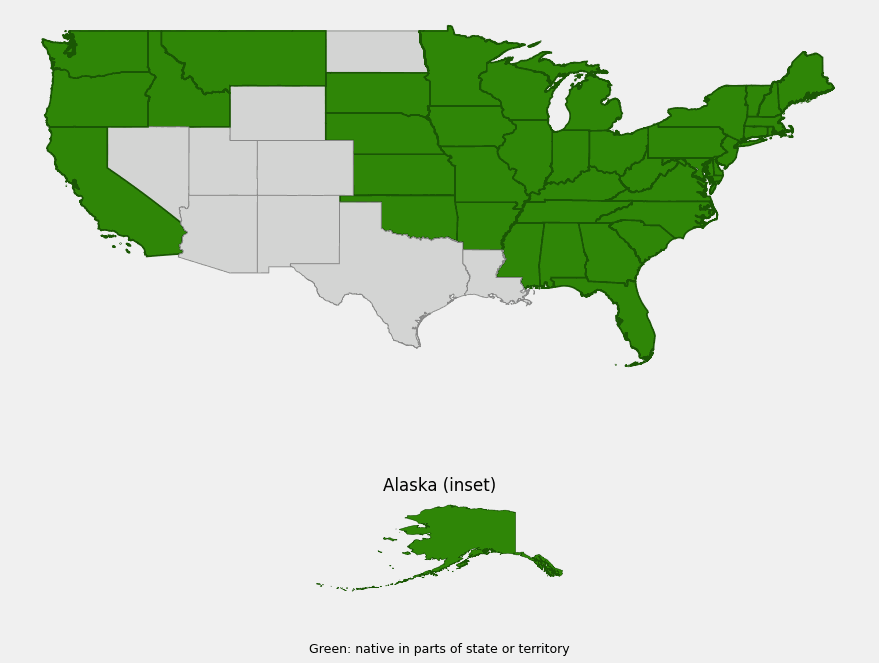
Apple moss is native across most of the United States, including all of New England, and is especially common in the Northeast, the Appalachians, the upper Midwest and the Pacific Northwest. For gardeners in Massachusetts and nearby states, it’s a lovely moss to welcome on a shady rock garden, stone wall or north-facing bank. It won’t behave like a nursery ground cover, though: it needs shade, thin acidic soil, steady moisture and no fertilizer, and it spreads slowly. This guide covers how to identify it, where it grows wild and how to encourage it.
Identification
Apple moss is an acrocarpous moss, meaning its shoots grow upright and produce capsules at their tips, so it forms tufts and cushions rather than creeping, feathery mats. Look for it at eye level on rock faces and road-cut banks in woods, where its pale, almost frosted color stands out against darker mosses.
Shoots & Rhizoids
The stems are upright, crowded and usually 1 to 3 inches tall, sometimes a little more in sheltered spots. The lower stems are densely felted with reddish-brown rhizoids that knit the cushion together and help it hold water. Pull a tuft apart gently and you’ll see this rusty felt running through the base.
Leaves
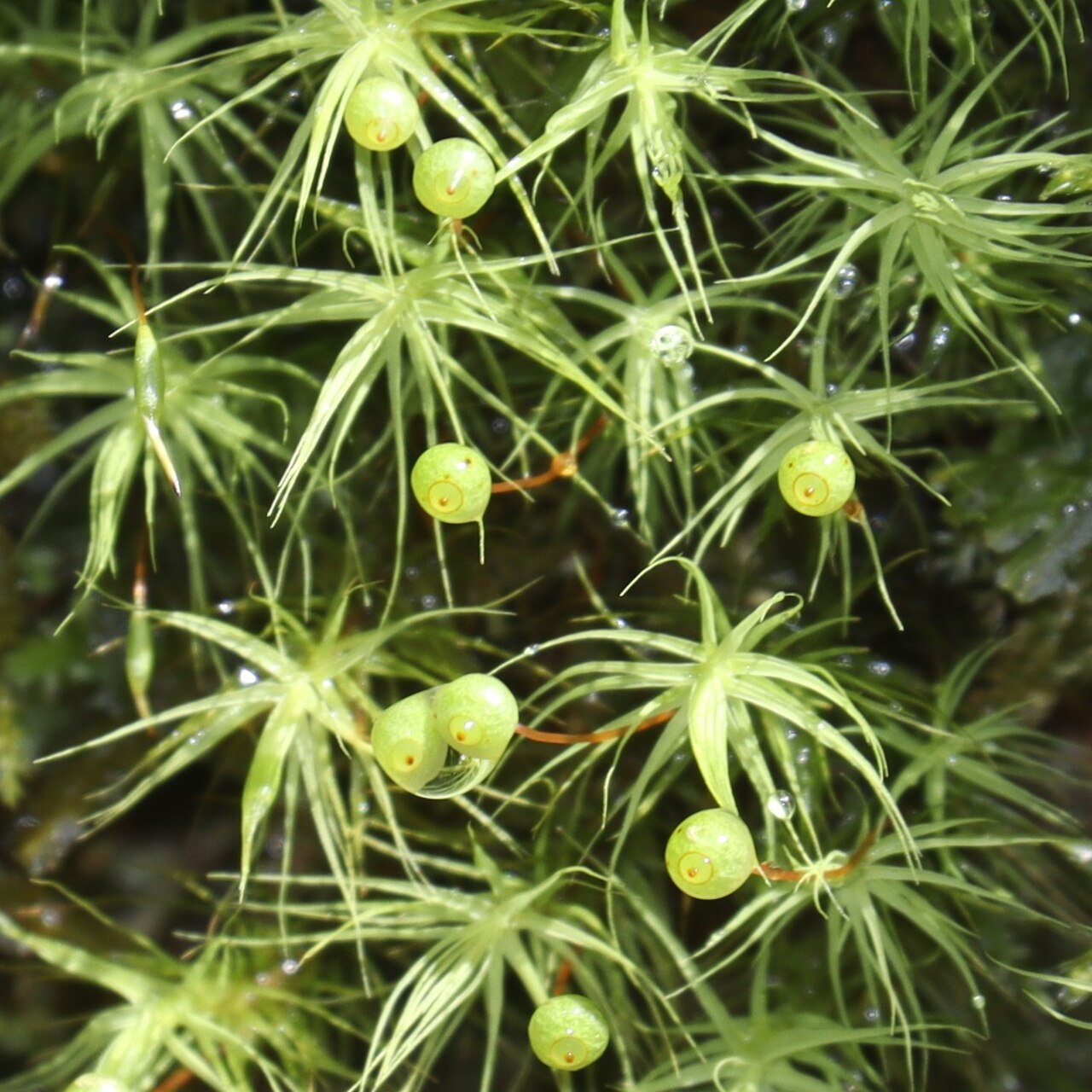
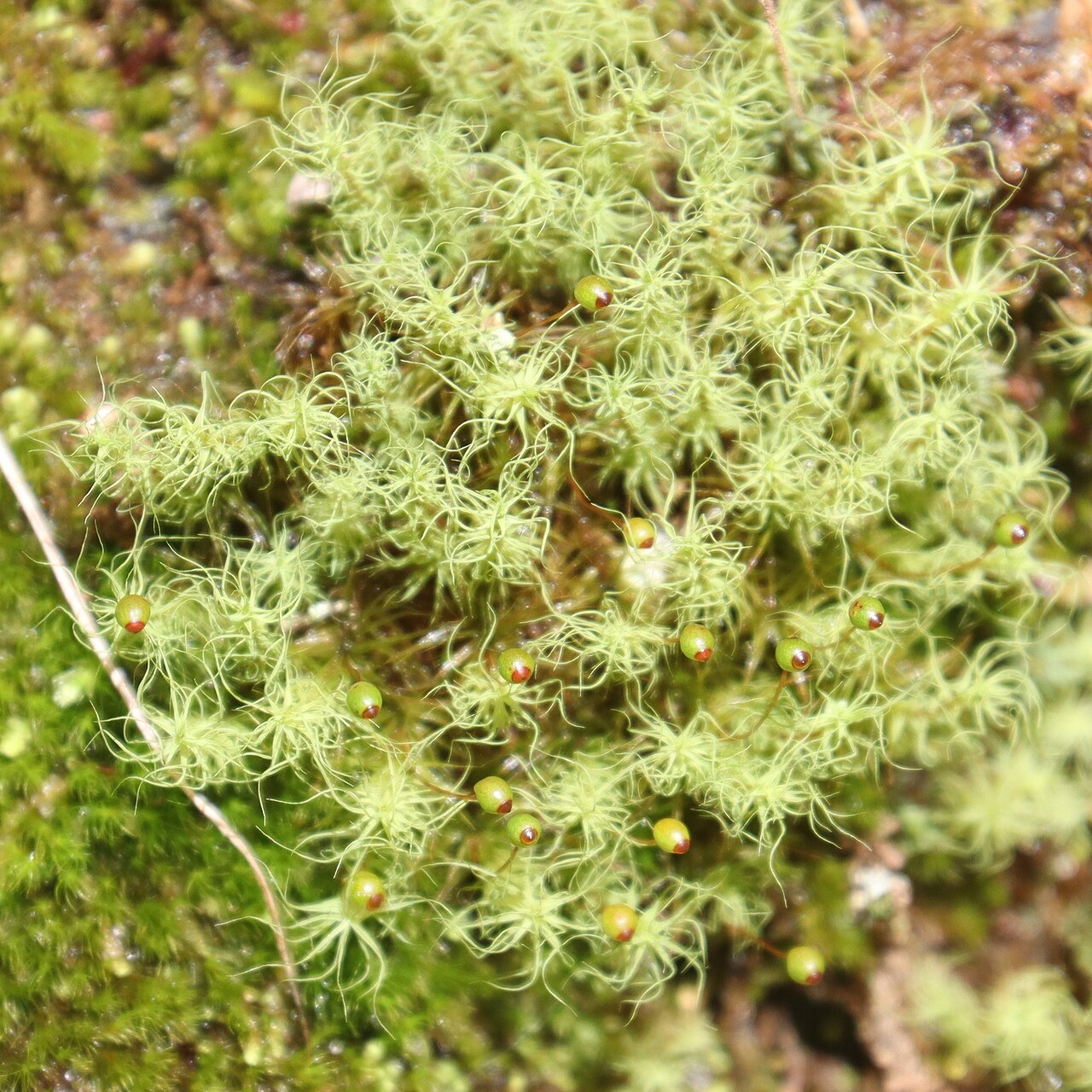
The leaves are long, narrow and tapering to a fine point, roughly a fifth to a quarter of an inch long. When moist they spread outward from the stem in a starry, bristly way; when dry they become twisted and curled, and the whole cushion looks shrunken and dull. The leaf surfaces are covered in microscopic bumps (papillae) that scatter light, which is what gives apple moss its distinctive glaucous, bluish-green or grayish-green cast. Under a hand lens, the leaf margins are finely toothed and the midrib runs out to the very tip.
Capsules & Spores
The capsules are the giveaway. Each one is nearly spherical, about an eighth of an inch across, tilted slightly to one side and held on a reddish stalk (seta) about half an inch to an inch and a half long. Young capsules are bright green and smooth, like tiny unripe apples. As they mature through spring into early summer they turn yellowish and then brown, becoming wrinkled and furrowed once the spores are shed. Old capsules often persist on the cushion into the next season.
Similar Species
Several mosses can be confused with apple moss. Bartramia ithyphylla has stiffer, straighter leaves with a shiny whitish clasping base. Halle’s apple moss (Bartramia halleriana) is larger and holds its capsules on short stalks from the sides of the stems, partly hidden among the leaves. Fountain apple moss (Philonotis fontana) has similar round capsules but grows in springs, seeps and wet ground, often with bright yellow-green shoots. Haircap mosses (Polytrichum) are taller and darker green, with stiff leaves and boxy capsules topped by a hairy hood.
Quick Facts
| Scientific Name | Bartramia pomiformis Hedw. |
| Family | Bartramiaceae (Apple Moss family) |
| Plant Type | Acrocarpous moss (tufted, upright shoots) |
| Mature Height | About 1–3 inches (cushions) |
| Mature Spread | Tufts a few inches wide; colonies can merge into mats a foot or more across |
| Growth Rate | Slow |
| Sun Exposure | Part shade to full shade (bright, open shade is best) |
| Water Needs | Moist; dries out and goes dormant in drought, then revives with rain |
| Substrate | Thin soil over rock, rock crevices, earthen banks, road cuts |
| Soil pH | Acidic to roughly neutral |
| Capsule Season | Capsules form in spring and mature by early summer |
| Color | Bluish-green to yellowish-green; capsules green, then brown |
| Flowers | None (reproduces by spores) |
| Deer Resistant | Yes; mosses are not browsed by deer |
| Toxicity | Not known to be toxic; not a food plant |
| Hardiness | Very cold-hardy; grows wild from Alaska to the Gulf states (mosses are not given USDA zone ratings) |
Native Range
Apple moss has a huge natural range. It grows across the cooler parts of the Northern Hemisphere, in North America, Europe and Asia, and is native throughout much of Canada and the United States. In the US, herbarium records are especially plentiful from the Northeast and Appalachians (New York, Pennsylvania, Vermont, Maine, Massachusetts, Virginia, North Carolina and Tennessee), the upper Midwest (Michigan, Minnesota, Wisconsin, Iowa and Missouri), the Ozarks and the Pacific Northwest, with Washington and Alaska among the best-collected states.
It becomes scarcer toward the hot, dry Southwest. There are only isolated records from the interior West outside the Northwest, and herbarium data show essentially no collections from Texas, New Mexico or the Great Basin. In the Deep South it is uncommon, restricted mostly to shaded rocky ravines and stream bluffs. Because mosses are spread by tiny airborne spores, apple moss is native wherever it occurs naturally in the US; there is no concern about it being introduced or invasive.
In Massachusetts and the rest of New England, apple moss is a familiar plant of shaded ledges, boulders, stone walls and the banks of woodland trails and roads, usually where a thin layer of acidic soil has collected over rock. It favors spots that stay moist but drain quickly, such as crevices in granite and schist outcrops, the upper sides of mossy boulders and cut banks above streams.
📋 Regional plant lists for apple moss country: Connecticut, Massachusetts & Rhode Island · New Hampshire, Maine & Vermont · New York, Pennsylvania & Northern New Jersey · Maryland, Virginia & West Virginia · North & South Carolina · Kentucky & Tennessee · Ohio & Indiana · Illinois, Iowa & Missouri · Michigan, Wisconsin & Eastern Minnesota · Western Oregon & Western Washington · Alaska
Growing & Care Guide
Apple moss is not sold like a perennial, and it doesn’t follow perennial rules. It’s best thought of as a moss you encourage where conditions already suit it, or establish in a small, carefully chosen spot in a shade or rock garden.
Light
Give it part shade to full shade. Bright, open shade under high tree canopy, or the north or east face of a boulder or wall, is ideal. Afternoon sun on an exposed site will dry and bleach it. It does not grow well in full sun, and it is not a lawn substitute for open, sunny ground.
Soil & Water
Apple moss grows on thin, lean, acidic soil over rock, or in rock crevices where a little grit and humus have collected. Do not add compost, manure or fertilizer: mosses take their nutrients from rain and dust, and rich soil simply invites weeds and other plants that will smother it. It needs steady moisture but also good drainage and air movement, because a cushion sitting in soggy, stagnant soil will rot. Like most mosses it tolerates drying out: in a drought it curls up, turns dull and stops growing, then greens up again within hours of rain. Misting or a gentle sprinkle during long dry spells keeps it growing.
Planting Tips
- Start with a site that already grows moss: shaded stone, a north-facing bank or the crevices of a dry-stacked wall.
- Source moss responsibly. Use patches from your own property, a construction or salvage site with the owner’s permission, or a supplier that grows or salvages moss legally. Never strip moss from parks, preserves or public land.
- Press small tufts firmly into contact with bare soil or a soil-filled crevice so the rhizoids touch the surface, then water. Firm contact matters more than anything else.
- Pin tufts on slopes with a few small twigs or landscape pins, and keep them moist for the first several weeks.
- Fall and early spring are the best times to transplant, when the weather is cool and damp.
Pruning & Maintenance
Apple moss needs almost no care beyond keeping it clear of fallen leaves, which block light and hold too much moisture on the cushion. Use a soft broom, a leaf blower on low or your hand to clear leaves in fall. Pull weeds and tree seedlings while they are small, and keep foot traffic off the cushions; apple moss is a moss to look at, not to walk on.
Propagation
In nature, apple moss spreads by spores released from its capsules and by broken pieces of shoots that root where they land. In gardens, the easiest method is to divide an established cushion into thumb-sized tufts and press them into new crevices. Crumbled fragments scattered on moist, shaded bare soil can also start new patches, though growth from fragments is slow and can take a season or two to show.
Landscape Uses
- Shady rock gardens and boulder plantings
- Crevices of dry-stacked stone walls and stone steps (away from the tread)
- North-facing banks and cut slopes in woodland gardens
- Moss gardens, troughs and terrariums kept cool and bright
- Companion to small native ferns and wildflowers on shaded ledges, such as rock polypody, partridgeberry and checkerberry
Wildlife & Ecological Value
For Pollinators
Apple moss has no flowers, so it offers no nectar or pollen. Its value to insects is as habitat: the damp interior of a moss cushion shelters springtails, mites, tiny beetles and other small invertebrates, along with microscopic tardigrades and rotifers that revive with each rain.
Birds
Many woodland birds line or build their nests with moss, and soft tufted mosses from ledges and banks are among the materials they gather. Wrens, phoebes, juncos and many warblers use moss in their nests. Moss cushions also hold the insects and spiders that ground-foraging birds pick through.
Mammals
Mammals rarely eat mosses, and apple moss is not browsed by deer. Chipmunks, mice and other small mammals forage over mossy rock faces for the invertebrates living in them.
Ecosystem Role
Apple moss is a pioneer on bare rock and freshly exposed soil. Its rhizoid-bound cushions trap dust, grit and leaf litter, slowly building the thin soil that ferns, saxifrages and columbine later root into. On steep banks it helps hold soil against rain, and in dry weather the cushions buffer the surface from drying and temperature extremes.
Cultural & Historical Uses
The genus Bartramia was named by the German bryologist Johann Hedwig, the founder of modern moss classification, in honor of John Bartram, the 18th-century Pennsylvania botanist and plant collector who sent many North American plants to Europe. Hedwig formally described Bartramia pomiformis in his 1801 work that serves as the starting point for moss names.
Its common name, apple moss, comes straight from the capsules. The same family includes the fountain apple mosses (Philonotis) and other “apple mosses” with similar round capsules, and naturalists have long used the plump spring capsules as an easy, satisfying way to begin learning mosses with a hand lens.
Apple moss has no significant history of food or practical use. Its main role in human culture is aesthetic: it is a favorite subject for close-up nature photography and one of the mosses gardeners most enjoy finding on shaded stonework.
Frequently Asked Questions
How tall does apple moss get?
Only about 1 to 3 inches. It forms low cushions, not 2-foot clumps. Individual tufts spread slowly, and neighboring tufts can merge into mats a foot or more across over many years.
Can apple moss grow in full sun?
Not well. It’s a moss of shaded rock and banks. Bright, open shade or morning sun with afternoon shade suits it; hot, exposed sites dry and bleach it.
Should I fertilize or add compost when planting apple moss?
No. Mosses don’t need rich soil, and compost or fertilizer feeds weeds and competing plants. Press apple moss onto lean, acidic soil or into rock crevices and simply keep it moist.
Why are the little “apples” on my moss turning brown?
That’s normal. The round capsules are green in spring, then turn yellowish and brown and become wrinkled as they ripen and release their spores in early summer. Old brown capsules may stay on the cushion for months.
Is apple moss native to Massachusetts?
Yes. Apple moss is native throughout New England, including Massachusetts, where it is common on shaded ledges, boulders, stone walls and woodland banks.

Looking for a nursery that carries Apple Moss?
Browse our native plant nursery directory: Alabama, Alaska & Arkansas · California · Connecticut, Delaware, Florida & Georgia · Idaho, Illinois, Indiana, Iowa & Kansas · Kentucky, Maine, Maryland, Massachusetts, Michigan, Minnesota, Mississippi, Missouri & Montana · Nebraska, New Hampshire, New Jersey, New York, North Carolina, Ohio & Oklahoma · Oregon · Pennsylvania, Rhode Island, South Carolina, South Dakota, Tennessee, Vermont & Virginia · Washington · West Virginia & Wisconsin

