
Native Roses (Rosa)
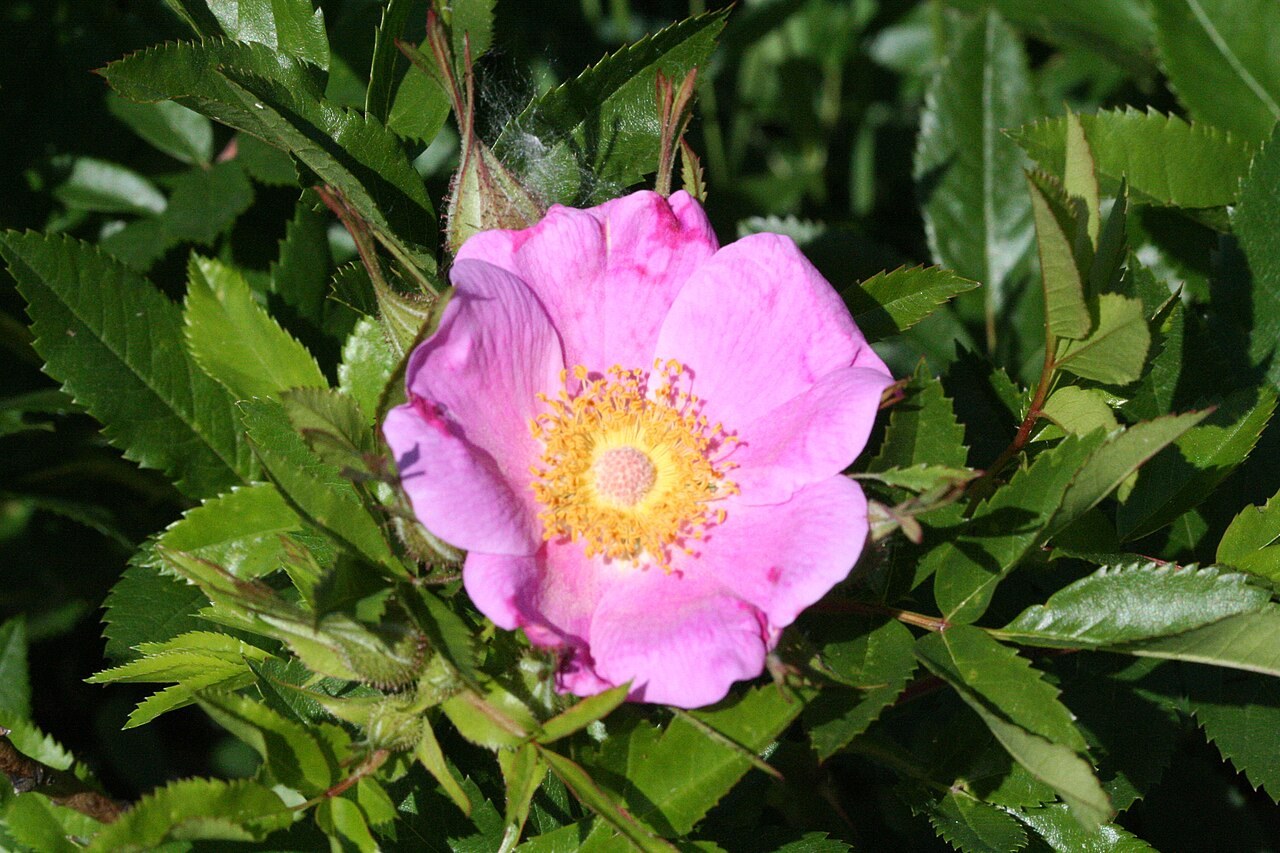
When most people picture a rose, they think of a hybrid tea or a climbing rose with big, double flowers. Those garden roses were bred mainly from Asian and European species. But the United States has its own wild roses, about 20 species of the genus Rosa, and at least one grows wild in every state except Hawaii. Native roses have simple, five-petaled pink flowers (occasionally white), a sweet scent, bright red hips that last into winter and thickets that shelter birds.
This guide is for readers who arrived from a heading about roses or climbing roses and want to know which roses are actually native, how to tell them from the garden and invasive kinds, and which one fits their region. It links every native rose profile on Plant Native, explains the one native rose that truly climbs, and shows how to recognize the two Asian roses, multiflora and rugosa, that have become serious invasive weeds.
Native roses are tougher and less fussy than hybrid roses. They do not need spraying, deadheading or winter protection, and most spread by suckers into informal hedges. In return they give you a few weeks of flowers in late spring or early summer, then months of colorful hips and, in many species, red or orange fall leaves.
Identification
All roses are woody shrubs or scrambling vines with prickly stems (gardeners call them thorns), leaves divided into leaflets, and flowers that become fleshy hips. Within the genus, native species are separated mostly by small details of prickles, leaflets, sepals and habitat, and many hybridize, so exact identification can be tricky.
Stems & Prickles
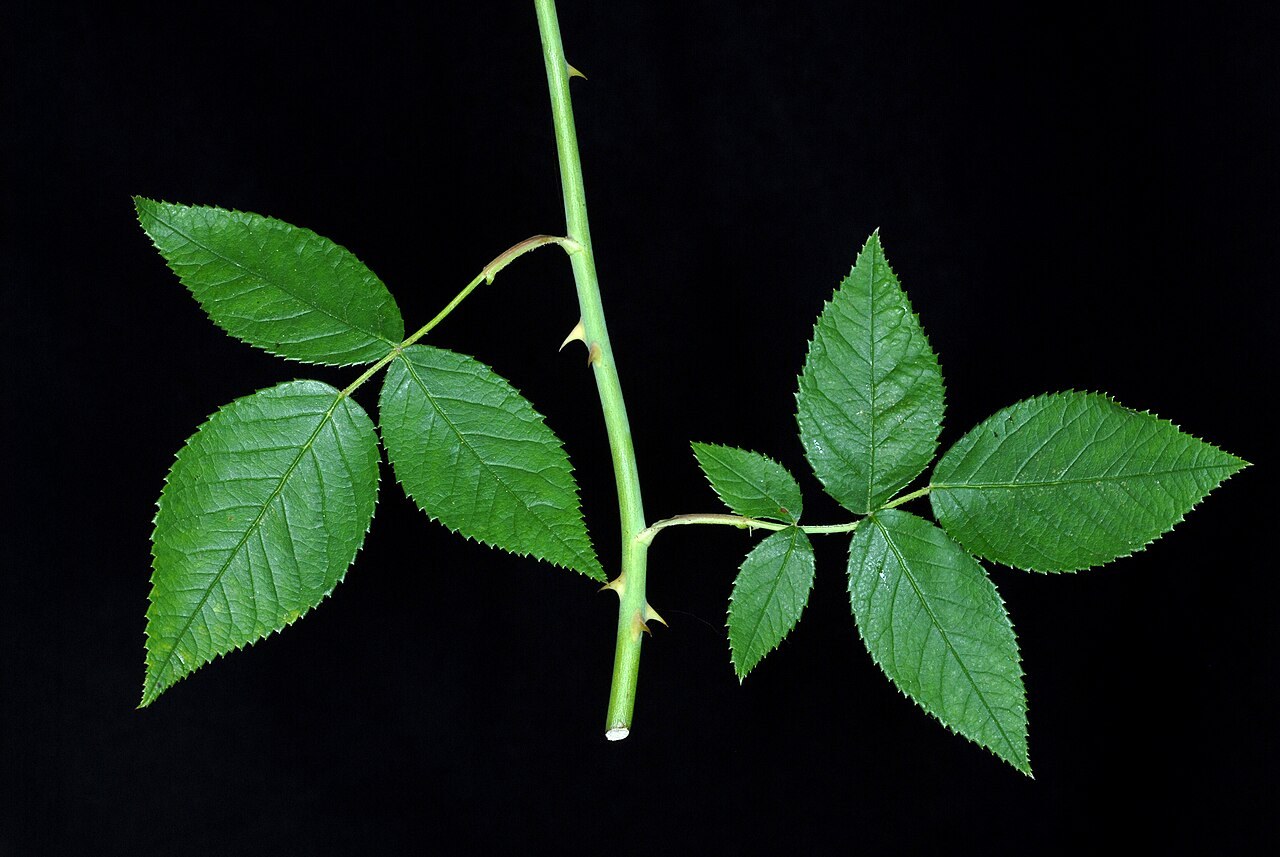
Look at the prickles first. Carolina rose has slender, straight, needle-like prickles. Virginia rose and swamp rose have stout, hooked prickles, often in pairs at the base of each leaf. Prickly rose and Wood’s rose have dense bristles on the lower stems. Meadow rose (smooth rose) has few or no prickles on the upper stems. Illinois rose has long, arching canes with scattered hooked prickles.
Leaves
Most native roses have leaves with five to nine leaflets, each finely toothed. The leafy wings at the base of the leaf stalk (stipules) are smooth-edged or glandular in native roses; in invasive multiflora rose they are deeply fringed like a comb, which is the single best way to identify it. Illinois rose is the only native rose that usually has just three leaflets on most leaves.
Flowers
Native roses have single flowers with five petals, usually 1.5 to 3 inches across, in shades from pale pink to deep rose. They have a ring of many yellow stamens and little or no nectar; bees visit them for pollen. Most bloom for several weeks in late spring or early summer. Swamp rose and Illinois rose bloom later, into midsummer, after most other roses are done.
Fruit (Hips)
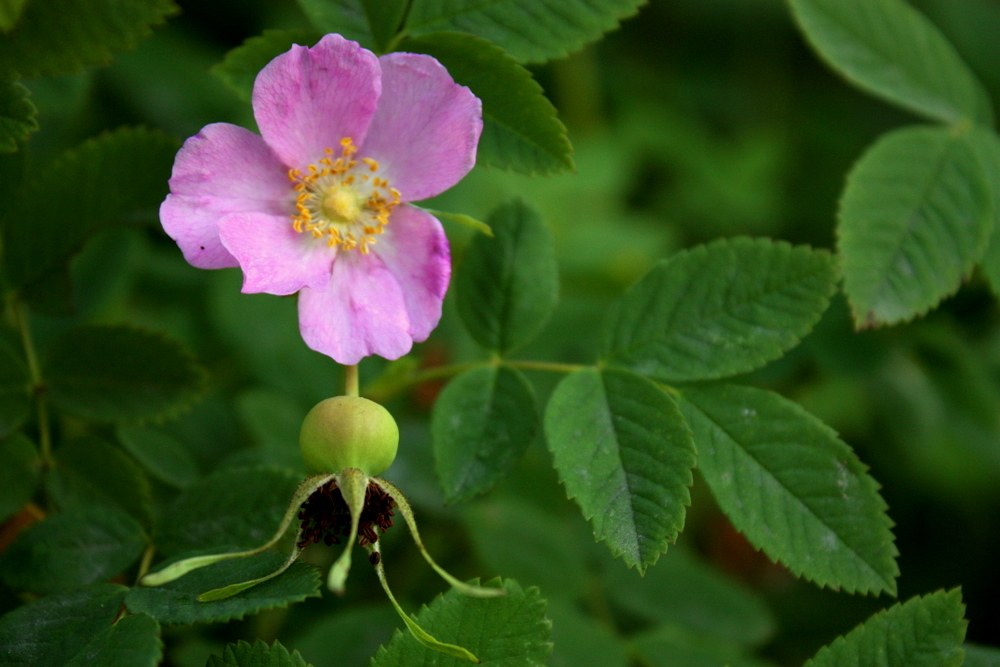
The hips are round to pear-shaped, red to orange-red, usually 1/3 to 3/4 inch across, and often persist into winter. Whether the sepals stay attached on the ripe hip is a useful clue: they fall off in baldhip rose (hence the name) and Carolina rose, but stay on in Wood’s and Nootka roses.
Quick Facts
| Genus | Rosa |
| Family | Rosaceae (Rose) |
| U.S. Native Species | About 20, plus natural hybrids |
| Growth Forms | Low suckering shrubs, thicket-forming shrubs, one climbing rose (Illinois rose) |
| Mature Height | About 1 ft (prairie roses) to 10–15 ft canes (Illinois rose) |
| Sun Exposure | Full Sun to Part Shade; baldhip rose grows in shade |
| Water Needs | Dry to wet depending on species; swamp and cluster roses tolerate flooding |
| Soil Type | Most soils, from sand to clay |
| Bloom Time | May – July (mostly a single flush) |
| Flower Color | Pale to deep pink; occasionally white |
| Fall Color | Red, orange or purplish in many species |
| Fruit | Red hips, often persisting into winter |
| Wildlife Value | Pollen for bees, hips for winter birds and mammals, thicket cover |
| Deer Resistant | No; deer browse new shoots and flowers |
| USDA Hardiness Zones | About 2–9, depending on species |
Native Range
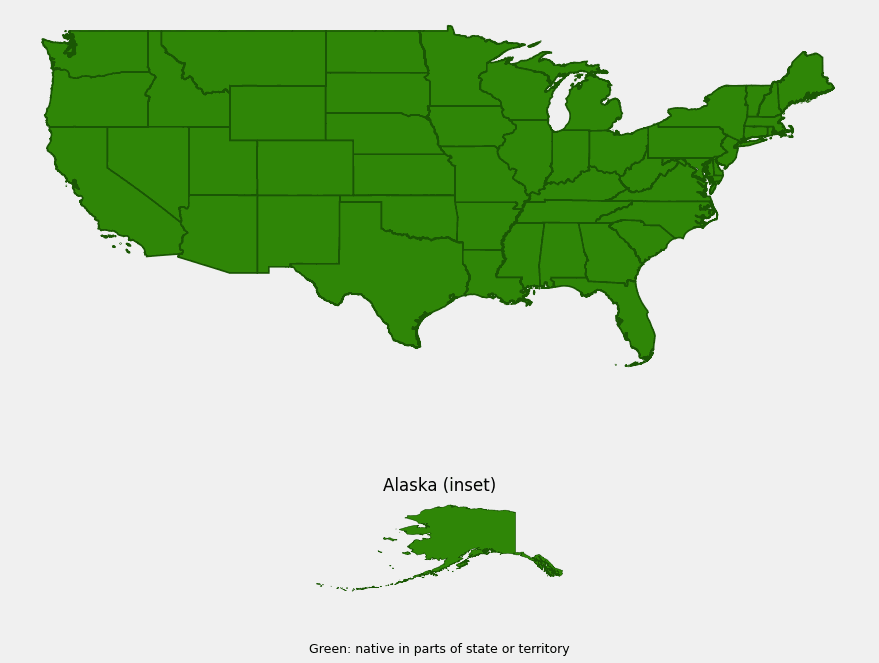
Wild roses grow in all 49 continental states. In the East, Carolina rose is the most widespread, from Maine and Minnesota to Florida and Texas, and it shares the region with Virginia rose along the Atlantic coast, swamp rose in wetlands from Nova Scotia to Florida and the Gulf, and Illinois rose in the Midwest and central South. Across the northern Plains and Midwest the common roses are prairie wild rose and meadow rose.
In the West, Wood’s rose is the common rose of the Great Plains, Rockies, Great Basin and Southwest, growing along streams and in sagebrush country from the Dakotas to California and Arizona. The Pacific states have their own set: Nootka rose along the coast from Alaska to northern California and inland to the Rockies, baldhip rose in shaded forests, cluster rose in wet thickets, and California wild rose along streams in California and southern Oregon. Prickly rose ranges across Alaska and the boreal north, reaching the northern tier of the lower 48.
No rose is native to Hawaii. Several Asian and European roses, including multiflora, rugosa, sweetbriar and Macartney roses, have escaped widely and are now far more common than native roses in some areas. The map shows states where at least one rose is native; it does not include places where only escaped garden roses grow.
📋 Regional plant lists featuring native roses: NH, ME, VT · CT, MA, RI · NY, PA, NJ north · DE, NJ south, NY Long Island · MD, VA, WV · NC, SC · GA, AL, MS · AR, LA, OK east, TX east · KY, TN · OH, IN · IL, IA, MO · MI, WI, MN east · ND, SD, MN west · NE, KS, CO east · UT, CO west · MT, WY · ID, OR east, WA east · OR west, WA west · AZ, NM · AK · CA, NV · TX south/west/central
Native Species
These native roses all have profiles on Plant Native. Click a name for range, care and wildlife details.
Eastern and Midwestern Roses
- Carolina Rose (Rosa carolina): a low, suckering shrub usually 1 to 3 feet tall with straight, slender prickles and pink flowers in June. It grows in dry, open woods, fields and prairies over most of the East and makes a good low groundcover rose for sunny banks.
- Virginia Rose (Rosa virginiana): a 3- to 6-foot shrub of the Northeast and Mid-Atlantic coast with glossy leaves, hooked prickles, red winter stems and some of the best fall color of any native rose. It tolerates salt spray, making it the native alternative to rugosa rose for seaside gardens.
- Swamp Rose (Rosa palustris): a 3- to 7-foot rose of marshes, stream banks and swamp edges from the Maritimes to Florida and the Gulf. It tolerates standing water and blooms into July. Good for rain gardens and pond edges.
- Illinois Rose, also called climbing prairie rose (Rosa setigera): the native climber. Its arching canes reach 6 to 15 feet and will scramble over fences, arbors or shrubs. It has three leaflets per leaf and clusters of deep pink flowers that fade paler, opening in late June and July. Native mainly from Ohio and Michigan to Kansas, Texas and Georgia.
- Meadow Rose or smooth rose (Rosa blanda): a 2- to 5-foot rose of the northern states and southern Canada, nearly thornless on the upper stems. A good choice where prickles are a nuisance.
- Prairie Wild Rose (Rosa arkansana): a short prairie rose, often 1 to 2 feet, that dies back nearly to the ground in harsh winters and blooms on new growth. It is a characteristic flower of the Great Plains and Midwest prairies.
- White Prairie Rose (Rosa foliolosa): a low, nearly thornless rose of the southern Plains (Oklahoma, Texas, Arkansas and nearby) with narrow leaflets and white to pale pink flowers.
Western and Northern Roses
- Wood’s Rose (Rosa woodsii): the most widespread western rose, a 3- to 6-foot thicket-former of streamsides, meadows and sagebrush from the Plains to the Pacific states and Arizona. Small pink flowers and clusters of red hips. Very cold and drought tolerant.
- Nootka Rose (Rosa nutkana): a Pacific Northwest rose with some of the largest flowers of any native rose, 2 to 3 inches across, and big round hips. It grows from Alaska to northern California and east to the Rockies.
- Baldhip Rose (Rosa gymnocarpa): a delicate, shade-tolerant woodland rose of the Pacific states and northern Rockies with small flowers and hips that drop their sepals. One of the few roses for shady gardens.
- Cluster Rose (Rosa pisocarpa): a Pacific Northwest rose of wet thickets with flowers and small hips in clusters. Good for wetland edges west of the Cascades.
- California Wild Rose (Rosa californica): a thicket-forming rose of California and southern Oregon stream banks, 3 to 8 feet, with pink flowers through late spring and summer. Excellent bird habitat.
- Prickly Rose (Rosa acicularis): a densely bristly rose of boreal forests, the common wild rose of Alaska and found across the northern tier of states.
- Desert Rose (Rosa stellata): an unusual small rose of rocky mountain slopes in New Mexico, west Texas and Arizona, with gooseberry-like leaves, star-shaped bristles and deep rose flowers. Very drought tolerant.
What About Climbing Roses?
Several of our vine articles feature “climbing roses.” Almost all climbing roses sold in garden centers, including ramblers and large-flowered climbers, are hybrids bred from Asian species such as Rosa multiflora, R. wichuraiana and R. chinensis, crossed with European roses. None are native. The only true native climber in the eastern U.S. is Illinois rose, which can be trained up a trellis or fence just like a garden climber, and it is hardy to about zone 4. In the West there is no native climbing rose, but Wood’s, Nootka and California wild roses make tall, arching thickets along fences. In Arizona and Utah, Wood’s rose is the native rose to plant.
Non-Native Look-Alikes
- Multiflora rose (Rosa multiflora), from East Asia. A large, arching shrub up to 10 to 15 feet with clusters of many small white flowers in late spring and comb-like fringed stipules at the leaf bases. Once planted for living fences and erosion control, it is now one of the worst invasive shrubs in the East and Midwest and is listed as a noxious weed in many states. It is also a reservoir for rose rosette disease, which can kill native and garden roses alike. Remove it wherever you find it.
- Rugosa rose (Rosa rugosa), from coastal East Asia. A dense, very prickly shrub with deeply wrinkled (rugose) leaves, large magenta or white flowers and big tomato-shaped hips. It is widely planted at the beach because it tolerates salt and sand, but it has invaded coastal dunes in New England, New York, New Jersey and the Great Lakes, crowding out native dune plants. Virginia rose and Carolina rose are native alternatives.
- Hybrid tea, floribunda, shrub and climbing roses: these are garden hybrids of mostly Asian and European parentage. They are not invasive, but they are not native and give less to wildlife than single-flowered native roses, especially double-flowered kinds whose stamens have been bred into extra petals.
- Other escaped roses: sweetbriar and dog rose (R. rubiginosa and R. canina) from Europe are naturalized in the West and Northeast; Cherokee rose (R. laevigata) and Macartney rose (R. bracteata) from China form dense thickets in the South, and Macartney rose is a serious pasture weed in Texas and the Gulf states.
Growing & Care Guide
Light
Most native roses bloom best in full sun and stay healthy with good air movement. Carolina, Virginia, meadow and Wood’s roses tolerate some light shade but flower less. Baldhip rose is the exception, a true woodland rose that grows in part to full shade.
Soil & Water
Match the species to your site. Carolina rose, prairie wild rose, white prairie rose and desert rose like dry, well-drained soils. Swamp rose, cluster rose and California wild rose thrive in moist to wet soils and tolerate flooding. Virginia, meadow, Wood’s and Nootka roses handle average garden soils. None need fertilizer, and rich feeding mainly encourages leafy growth and suckers.
Planting Tips
Plant container-grown roses in spring or fall. Most native roses spread by underground runners into colonies, which is ideal for hedgerows, banks and wildlife thickets but can be a problem in a tidy bed; give them room or plant them where mowing or edging will contain them. Space plants 3 to 4 feet apart for a hedge. Train Illinois rose canes onto a sturdy fence or arbor and tie them loosely.
Pruning & Maintenance
Native roses bloom on older wood (except prairie wild rose), so prune lightly right after flowering if needed, or remove a few of the oldest canes at the base in late winter to renew the clump. Do not deadhead if you want hips. Watch for rose rosette disease, which causes witches’ brooms of red, extremely thorny growth; remove and destroy affected plants, roots and all, and remove nearby multiflora rose.
Propagation
Native roses are easy to propagate. Dig and replant rooted suckers in early spring or fall. Softwood cuttings taken in early summer root readily. To grow from seed, collect ripe hips in fall, clean the seeds and give them a winter outdoors (or two to three months of cold, moist stratification); germination is often slow and uneven.
Landscape Uses
- Wildlife hedgerows and thickets with Wood’s, Nootka, California, Virginia and swamp roses
- Prairie and meadow plantings with prairie wild rose, Carolina rose and white prairie rose
- Climbing on fences and arbors with Illinois rose
- Coastal gardens with Virginia rose and Carolina rose instead of rugosa
- Rain gardens and wet edges with swamp and cluster roses
- Shade gardens in the Pacific Northwest with baldhip rose
Wildlife & Ecological Value
For Pollinators
Single-flowered native roses offer plenty of pollen. Bumblebees, sweat bees, mining bees and many other native bees visit them, along with pollen-feeding beetles and flies. Leafcutter bees cut neat circles from rose leaves to line their nests, which is a sign of a healthy garden, not a pest problem. Native roses also host the caterpillars of a number of moths.
For Birds
Rose hips hang on through winter and are eaten by birds such as American robins, cedar waxwings, northern mockingbirds, thrushes, grouse and pheasants, often late in the season when other fruit is gone. Dense, prickly rose thickets are prime nesting and escape cover for catbirds, cardinals, sparrows and quail.
For Mammals
Deer and elk browse rose shoots and leaves, and hips are eaten by bears, coyotes, foxes, rabbits and rodents. In the West, Wood’s rose thickets along streams are important cover for small mammals.
Ecosystem Role
Suckering roses stabilize stream banks, dunes and slopes, and their thickets form part of the shrubby edge between forest and open land that many species need. After fires, Wood’s rose and other western roses resprout quickly from their roots and help hold soil.
Cultural & Historical Uses
Native American peoples across the continent used wild roses. Hips were gathered for food, especially in winter and lean times, and petals, roots and leaves were used for teas and in traditional remedies. These are historical uses and are not offered here as medical advice. Nootka rose and other western roses were particularly important to Pacific Northwest peoples.
Rose hips are rich in vitamin C, and during World War II, when citrus was scarce in Britain, people gathered wild hips to make syrup. Today hips from native roses are still used for tea and jelly. If you try it, remove the hairy seeds inside, which irritate the mouth and throat, and only use hips from plants you know have not been sprayed.
The wild prairie rose is the state flower of Iowa and North Dakota, and Wood’s rose and prairie roses appear on many Plains and Rocky Mountain landmarks and place names. Georgia’s state flower, the Cherokee rose, is ironically a Chinese species that naturalized in the South long ago.
Frequently Asked Questions
Are there any native climbing roses?
Yes, one: Illinois rose (Rosa setigera), also called climbing prairie rose. Its canes reach 6 to 15 feet and can be trained on fences and arbors. Nearly all other climbing roses sold in nurseries are Asian-derived hybrids.
How can I tell multiflora rose from a native rose?
Look at the base of the leaf stalk. Multiflora rose has fringed, comb-like stipules and large clusters of small white flowers. Native roses have smooth-edged or glandular stipules and fewer, larger pink flowers.
Do native roses get black spot and other rose diseases?
They can, but they are far less troubled than hybrid tea roses and rarely need spraying. Rose rosette disease is the serious threat; remove infected plants and any nearby multiflora rose.
Which native rose is best for a small garden?
Carolina rose or prairie wild rose for a low, sunny spot; meadow rose where you want few prickles; baldhip rose for Pacific Northwest shade. All spread by suckers, so plan for edging or give them room to colonize.
Is rugosa rose native?
No. Rugosa rose comes from coastal East Asia. It is common on beaches in the Northeast but is invasive on dunes. Virginia rose is the native alternative for salty, sandy seaside gardens.

Looking for a nursery that carries native roses?
Browse our native plant nursery directory: Alabama, Alaska, Arizona & Arkansas · California · Colorado, Connecticut, Delaware, Florida & Georgia · Idaho, Illinois, Indiana, Iowa & Kansas · Kentucky, Louisiana, Maine, Maryland, Massachusetts, Michigan, Minnesota, Mississippi, Missouri & Montana · Nebraska, Nevada, New Hampshire, New Jersey, New Mexico, New York, North Carolina, North Dakota, Ohio & Oklahoma · Oregon · Pennsylvania, Rhode Island, South Carolina, South Dakota, Tennessee, Texas, Utah, Vermont & Virginia · Washington · West Virginia, Wisconsin & Wyoming

