
Native Palo Verdes (Parkinsonia)
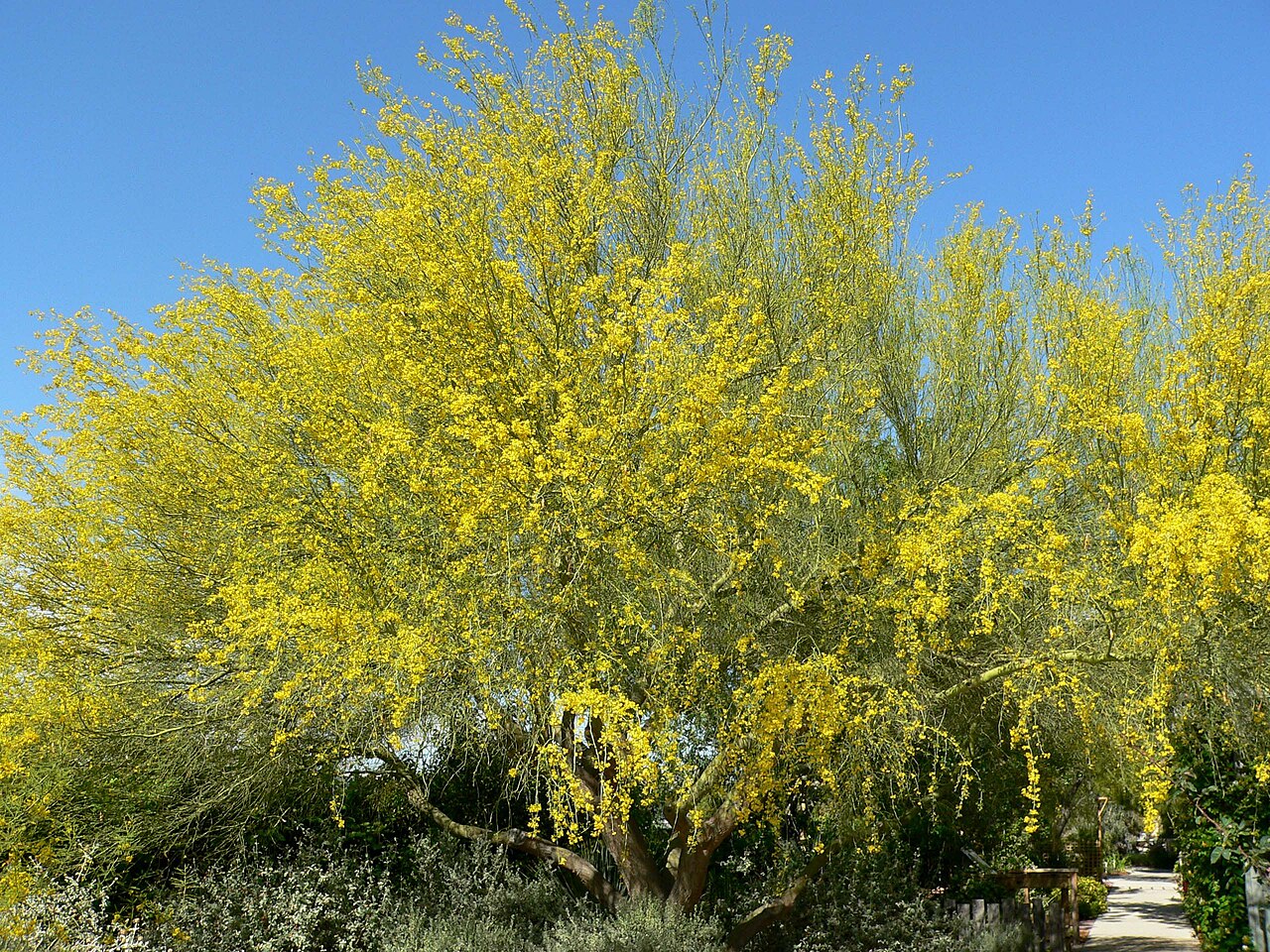
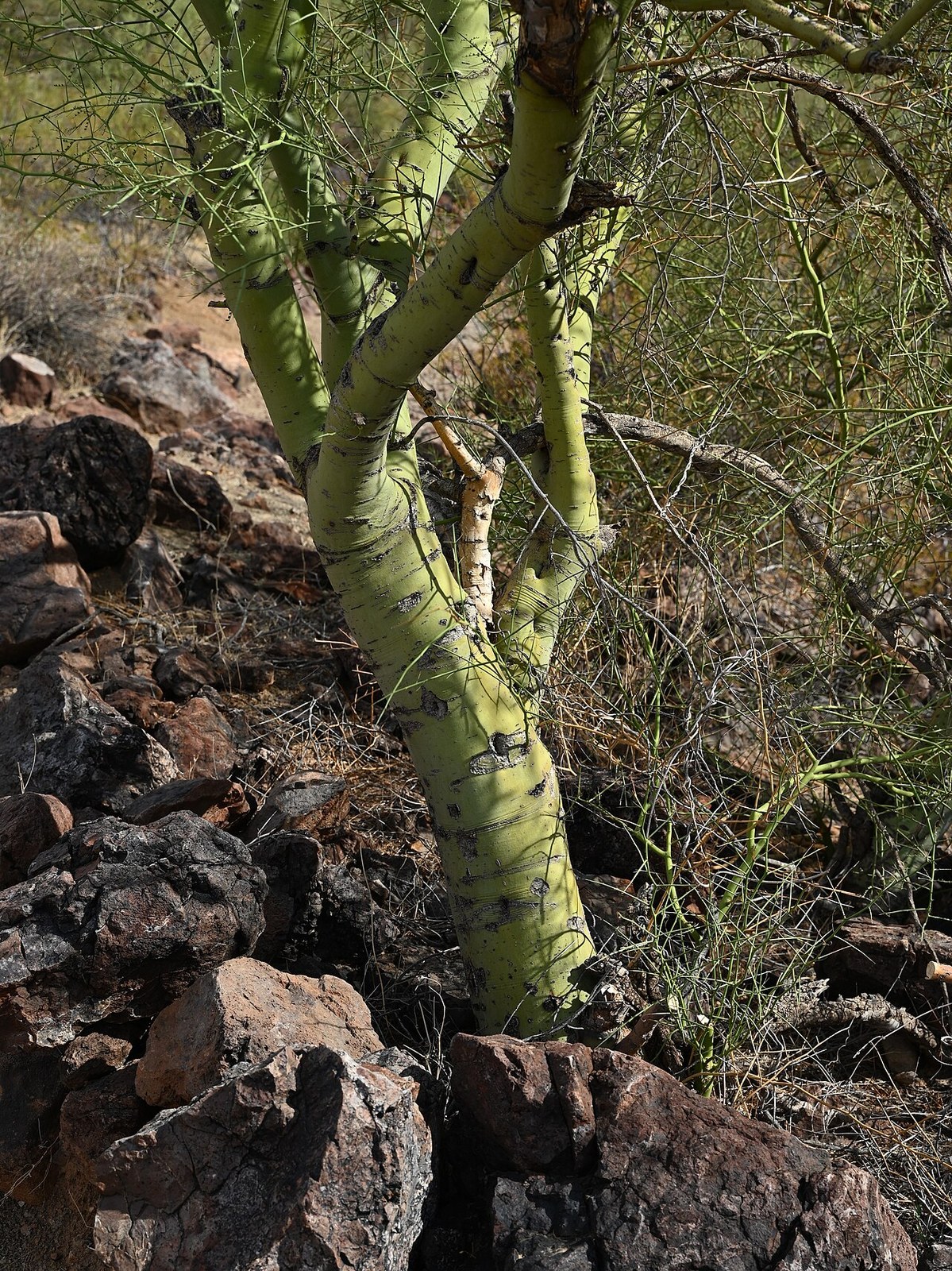
Palo verdes (genus Parkinsonia) are the green-barked trees of the southwestern deserts. Their Spanish name means “green stick,” and it describes them perfectly: the trunks and branches are smooth and green and carry out much of the tree’s photosynthesis, so the trees can drop their tiny leaves in drought and keep growing. Each spring, usually in April and May, palo verdes burst into masses of yellow flowers that turn whole hillsides and washes gold.
Four palo verdes grow wild in the United States. Foothill palo verde (Parkinsonia microphylla) and blue palo verde (P. florida) are the classic trees of the Sonoran Desert in Arizona and southeastern California, and together they are the state tree of Arizona. Texas palo verde (P. texana) grows in South Texas, and Mexican palo verde or Jerusalem thorn (P. aculeata) is native in southern Arizona and possibly South Texas but has been planted so widely around the world that its original range is hard to pin down. It is invasive in many places where it was introduced.
This guide covers the native species, the popular hybrid ‘Desert Museum’ palo verde, and how to choose and grow palo verdes in desert gardens. Palo verdes are some of the most water-thrifty flowering trees in North America, and in the Sonoran Desert they are keystone plants that shelter young saguaros and feed native bees, birds and mammals.
Identification
Palo verdes are legumes, related to mesquite and ironwood. All have green bark, small, twice-divided (bipinnate) leaves that fall early in dry seasons, yellow five-petaled flowers and bean-like pods. Most have thorns at the nodes or at the tips of the twigs.
Bark & Stems
Bark color is the first clue to the species. Foothill palo verde has yellow-green bark and stiff twigs that end in sharp spine tips. Blue palo verde has smooth, blue-green bark and short, straight thorns at the nodes. Texas palo verde has bright green bark and small thorns. Mexican palo verde has green bark, long, sharp thorns, and drooping, willowy branches. On older trunks the bark turns gray, rough and scaly near the base.
Leaves
Leaves are tiny and short-lived. Foothill palo verde has extremely small leaflets, often only a few pairs, and the tree is leafless most of the year. Blue palo verde has slightly larger blue-green leaflets. Mexican palo verde is unmistakable: its leaves have long, flat, ribbon-like green stalks up to a foot or more long, lined with dozens of tiny leaflets that drop in drought, leaving the green ribbons behind.
Flowers
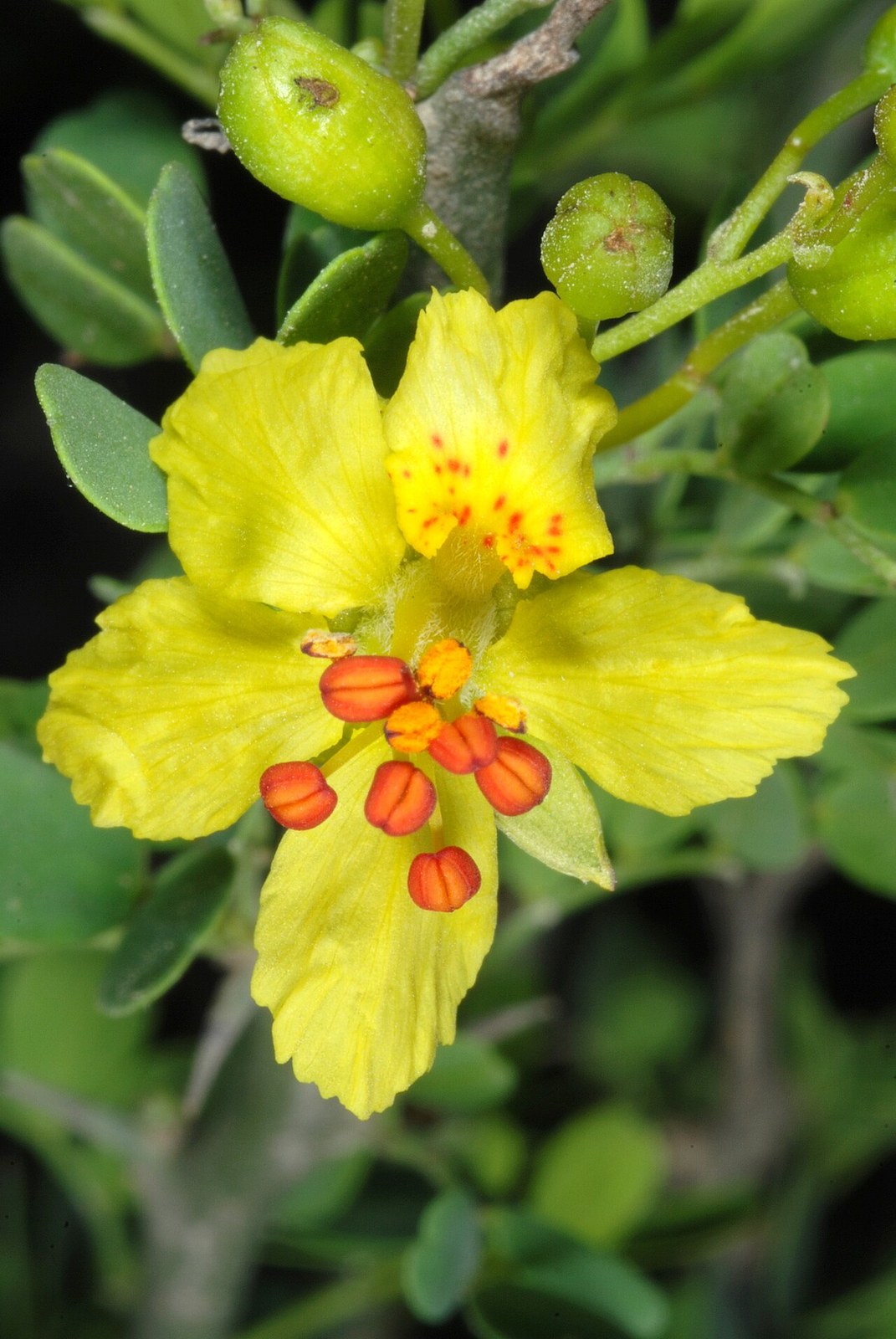
Flowers are about ½ to 1 inch across, with five petals, one of which (the banner) is often marked or colored differently. Blue palo verde has bright, uniformly golden-yellow flowers and blooms first, in March and April. Foothill palo verde has paler yellow flowers with a white or cream banner petal and blooms a few weeks later, in April and May. Texas palo verde has yellow flowers with red-orange spots on the banner, and Mexican palo verde has fragrant yellow flowers with a banner that turns orange-red. Several species rebloom lightly after summer rains.
Fruit & Seeds
Pods are 1½ to 4 inches long. Foothill palo verde pods are constricted between the seeds like a string of beads and end in a long beak. Blue palo verde pods are flat and not constricted. Mexican palo verde pods are narrow and strongly constricted. Pods ripen in early summer and are eaten by many desert animals.
Quick Facts
| Genus | Parkinsonia (including the former genus Cercidium) |
| Family | Fabaceae (Legume family) |
| U.S. Native Species | 4: foothill, blue, Texas and Mexican palo verde (about 12 species worldwide) |
| Growth Forms | Small deciduous trees and large, thorny shrubs with green bark |
| Mature Height | About 10–20 ft for foothill and Texas palo verde; 20–30 ft for blue and Mexican palo verde |
| Mature Spread | About 15–30 ft |
| Growth Rate | Slow (foothill) to fast (blue, Mexican and hybrid palo verdes) |
| Sun Exposure | Full Sun |
| Water Needs | Very low; occasional deep watering in summer for fastest growth |
| Soil Type | Well-drained gravelly, sandy or rocky soils; tolerant of alkaline soils |
| Bloom Time | March – May; some rebloom after summer rains |
| Flower Color | Yellow; banner petal white, red-spotted or orange in some species |
| Fruit | Bean-like pods ripening in early summer |
| Wildlife Value | Nectar and pollen for native bees; nesting cover for desert birds; nurse tree for saguaro |
| Deer Resistant | Mostly; thorny twigs are lightly browsed |
| USDA Hardiness Zones | About 8–11 (foothill and blue palo verde hardy to roughly 15–20°F) |
Native Range
Foothill palo verde is the most abundant tree of the Arizona Upland of the Sonoran Desert, growing on rocky slopes, bajadas and foothills from central and southwestern Arizona into Sonora and Baja California, with a few populations in the desert mountains of southeastern California. Together with saguaro and triangle-leaf bursage it forms the classic Sonoran Desert scene around Tucson and Phoenix.
Blue palo verde grows along desert washes and floodplains, where its roots reach deeper water, in southern and western Arizona and in the Colorado Desert of southeastern California, including the Coachella Valley and Anza-Borrego. Texas palo verde is native to South Texas, especially the Rio Grande Plains and the Coastal Bend, and to northeastern Mexico. Mexican palo verde is generally considered native in southern Arizona and northern Mexico and is treated as native in South Texas by many Texas botanists, but it has been planted throughout the warm Americas for so long that its natural range is uncertain.
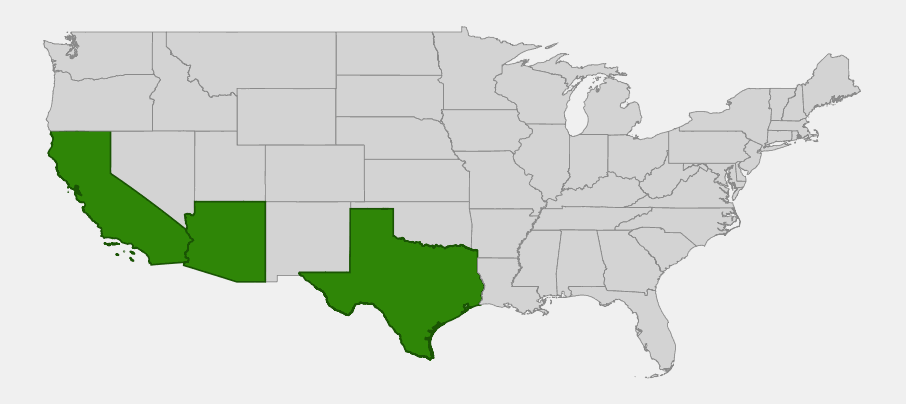
No palo verde is native to Nevada, New Mexico or Florida, although blue palo verde, foothill palo verde and hybrid palo verdes are commonly planted around Las Vegas, Albuquerque, El Paso and other desert cities, and Mexican palo verde is planted and naturalized across the Gulf Coast and Florida. The map below shows states where at least one palo verde is native.
📋 Regional plant lists covering native palo verde country: Arizona & New Mexico · California & Nevada · South & West Texas
Native Species
These are the four palo verdes native to the United States. Each name links to our full plant profile.
Foothill Palo Verde (Parkinsonia microphylla)
Also called little-leaf or yellow palo verde. A slow-growing, many-branched small tree 10 to 20 feet tall with yellow-green bark and stiff, spine-tipped twigs. It is leafless most of the year and blooms in April and May with pale yellow flowers with a white banner. It is extremely drought tolerant, living on rainfall alone on rocky slopes, and very long-lived; some trees are thought to be several hundred years old. It is the best palo verde for small, dry gardens in the Sonoran Desert, and it is the most important nurse tree for young saguaros.
Blue Palo Verde (Parkinsonia florida)
A faster-growing tree 20 to 30 feet tall with smooth blue-green bark and a broad crown. It grows along washes and is the showiest palo verde in bloom, covered in golden-yellow flowers in March and April. It drops large amounts of flowers and pods, and needs more room and more water than foothill palo verde, but it makes good light shade. Formerly called Cercidium floridum.
Texas Palo Verde (Parkinsonia texana)
A shrub or small tree, usually 10 to 20 feet tall, with bright green bark, small thorns and yellow flowers with red-spotted banners in spring and after rains. It is native to South Texas and northeastern Mexico and is the best palo verde for gardens in San Antonio, Corpus Christi and the Rio Grande Valley. Two varieties are recognized: var. texana and the smaller-leaved var. macra.
Mexican Palo Verde or Jerusalem Thorn (Parkinsonia aculeata)
A fast-growing, thorny tree 15 to 30 feet tall with drooping branches, long, ribbon-like green leaf stalks and fragrant yellow flowers with an orange-red banner. It blooms longer than other palo verdes and is widely planted for quick shade. Within its native range in southern Arizona (and, by many accounts, South Texas) it is a legitimate native tree, but outside that range it seeds heavily along washes, canals and riverbanks. It is invasive in Florida, Hawaii and much of the world’s tropics and is a declared noxious weed in Australia. Even within the Southwest, plant it with care and remove seedlings where they spread.
‘Desert Museum’ Palo Verde (Parkinsonia hybrid)
A hybrid selected at the Arizona-Sonora Desert Museum in Tucson from crosses involving foothill, blue and Mexican palo verde. It combines the fast growth and large flowers of Mexican palo verde with the upright form and green bark of the native species, is nearly thornless and produces few seeds. It grows 20 to 25 feet tall and blooms for a long season in spring. It is the most popular palo verde in Arizona landscapes today. Because it is a cultivated hybrid, it is not a wild native, but its parents are all regional species, and it is not known to spread aggressively.
Non-Native Look-Alikes
A few non-native trees are sold alongside palo verdes in Southwestern nurseries and are easily mixed up with them.
- Palo brea or Sonoran palo verde (Parkinsonia praecox), from Mexico, Central and South America. A small tree with bright, smooth, lime-green bark, a broad umbrella-shaped crown and yellow flowers. It is popular in Phoenix and Tucson landscapes and is frost-tender. It is not native to the US.
- Mexican palo verde outside its native range. In Florida, along the Gulf Coast and in Hawaii, Parkinsonia aculeata is an introduced, invasive tree; it forms thorny thickets along waterways.
- Acacias and mesquites. Sweet acacia (Vachellia farnesiana), Australian acacias and mesquites share the feathery bipinnate leaves and thorns, but they have gray or brown bark rather than green, and acacias have ball-shaped or spike-shaped flower clusters.
- Retama or Jerusalem thorn confusion. In Texas, “retama” usually means Parkinsonia aculeata, while the Mediterranean “retama” is a broom (Retama). Check the scientific name.
A green trunk plus feathery leaves, thorns and yellow five-petaled flowers is the signature of a palo verde. If the bark is lime-green and the tree has a flat, umbrella crown, it is probably palo brea.
Growing & Care Guide
Light
Palo verdes need full sun and reflected heat. They will not flower well or keep a good shape in shade.
Soil & Water
Plant in fast-draining gravelly, sandy or rocky soil; palo verdes tolerate alkaline and caliche soils but not standing water. Once established, foothill palo verde can live on rainfall alone in the Sonoran Desert. Blue, Mexican and hybrid palo verdes grow faster and look better with a deep watering every two to four weeks in summer, applied at the edge of the canopy. Overwatering produces weak, fast growth that breaks in storms and shortens the tree’s life.
Planting Tips
Plant small trees (5- or 15-gallon) in spring after frost danger, or in early fall. Dig a hole no deeper than the root ball and several times as wide, and do not amend the soil. Give blue and hybrid palo verdes 25 to 30 feet of room, and keep thorny species away from walkways and pools, where falling flowers and pods also make a mess.
Pruning & Maintenance
Prune in late spring or early summer, after flowering. Remove dead wood and crossing branches and, if needed, raise the canopy gradually. Avoid heavy “lion-tailing” (stripping inner branches), which weakens limbs and invites sunscald. Palo verde root borer beetles attack old, stressed or overwatered trees; deep, infrequent watering and avoiding root damage help prevent them.
Propagation
Palo verdes grow easily from seed. Nick or soak the hard seeds in hot water overnight before planting in warm weather; they sprout within a week or two. Hybrids such as ‘Desert Museum’ do not come true from seed and are propagated by cuttings or grafting.
Landscape Uses
- Desert shade trees: blue and ‘Desert Museum’ palo verde for light, filtered shade
- Small, low-water accent trees: foothill and Texas palo verde
- Native desert landscapes and habitat gardens, paired with saguaro, ironwood and bursage
- Wash and arroyo restorations: blue palo verde
- Spring color in xeriscapes
Wildlife & Ecological Value
For Pollinators
Palo verde flowers are visited by hundreds of species of native bees. In Arizona they are especially important for large solitary bees such as the desert digger bee (Centris pallida) and carpenter bees, as well as many small native bees, honey bees and butterflies. The massive spring bloom is one of the major nectar events of the Sonoran Desert year.
For Birds
Verdins, cactus wrens, Gila woodpeckers, white-winged doves and many other desert birds nest in palo verdes or forage in them for insects. Doves, quail and finches eat the seeds.
For Mammals
Desert bighorn sheep, mule deer, jackrabbits and javelinas browse palo verde twigs and pods. Pack rats, ground squirrels and kangaroo rats gather and store the seeds.
Ecosystem Role
Foothill palo verde is the classic nurse plant for saguaro. Young saguaros sprout and grow in its shade, which protects them from heat, frost and grazing animals. Over many decades the saguaro grows up through the tree and may eventually outcompete it. Palo verdes, like other legumes, also host nitrogen-fixing bacteria in their roots that enrich desert soils.
Cultural & Historical Uses
The Tohono O’odham, Akimel O’odham and other peoples of the Sonoran Desert historically gathered palo verde pods and seeds as a seasonal food, eating the young pods green and grinding the dried seeds into meal. Palo verde was one of several legume trees, with mesquite and ironwood, that supplied food and wood in a dry land.
Arizona named the palo verde its state tree in 1954, recognizing both foothill and blue palo verde. The scientific name honors John Parkinson, a seventeenth-century English botanist and herbalist, and the former genus name Cercidium still appears on many nursery labels and in older books.
Today palo verdes are among the most planted trees in Phoenix, Tucson and other desert cities, valued for spring color, filtered shade and low water use. Planting native palo verdes in place of thirsty non-native shade trees is one of the most effective ways to save water in desert landscapes.
Frequently Asked Questions
Which palo verde is best for my yard?
In the Sonoran Desert, foothill palo verde for small, very dry gardens, blue palo verde or ‘Desert Museum’ for larger shade trees. In South Texas, Texas palo verde. Avoid Mexican palo verde outside its native range, and in any area where it spreads into washes or canals.
Why is palo verde bark green?
The green bark contains chlorophyll and can photosynthesize. This lets palo verdes drop their tiny leaves during drought and still make food, an important adaptation to the desert.
When do palo verdes bloom?
Blue palo verde blooms in March and April, foothill palo verde in April and May, and Mexican and hybrid palo verdes over a longer period in spring. Some trees rebloom lightly after summer monsoon rains.
Is Mexican palo verde invasive?
It is invasive in Florida, Hawaii, Australia and many tropical regions, and it can spread along waterways in the Southwest. It is considered native in southern Arizona and, by many accounts, South Texas. Where it is not native, choose blue, foothill or Texas palo verde instead.
Is ‘Desert Museum’ palo verde native?
It is a garden hybrid, not a wild species, but all its parents are palo verdes native to the Sonoran Desert. It is thornless, fast-growing and sets few seeds, so it is a good choice for desert landscapes.

Looking for a nursery that carries native palo verdes?
Browse our native plant nursery directory: Arizona · California · Texas

