
Nettle-Leaf Giant Hyssop (Agastache urticifolia)
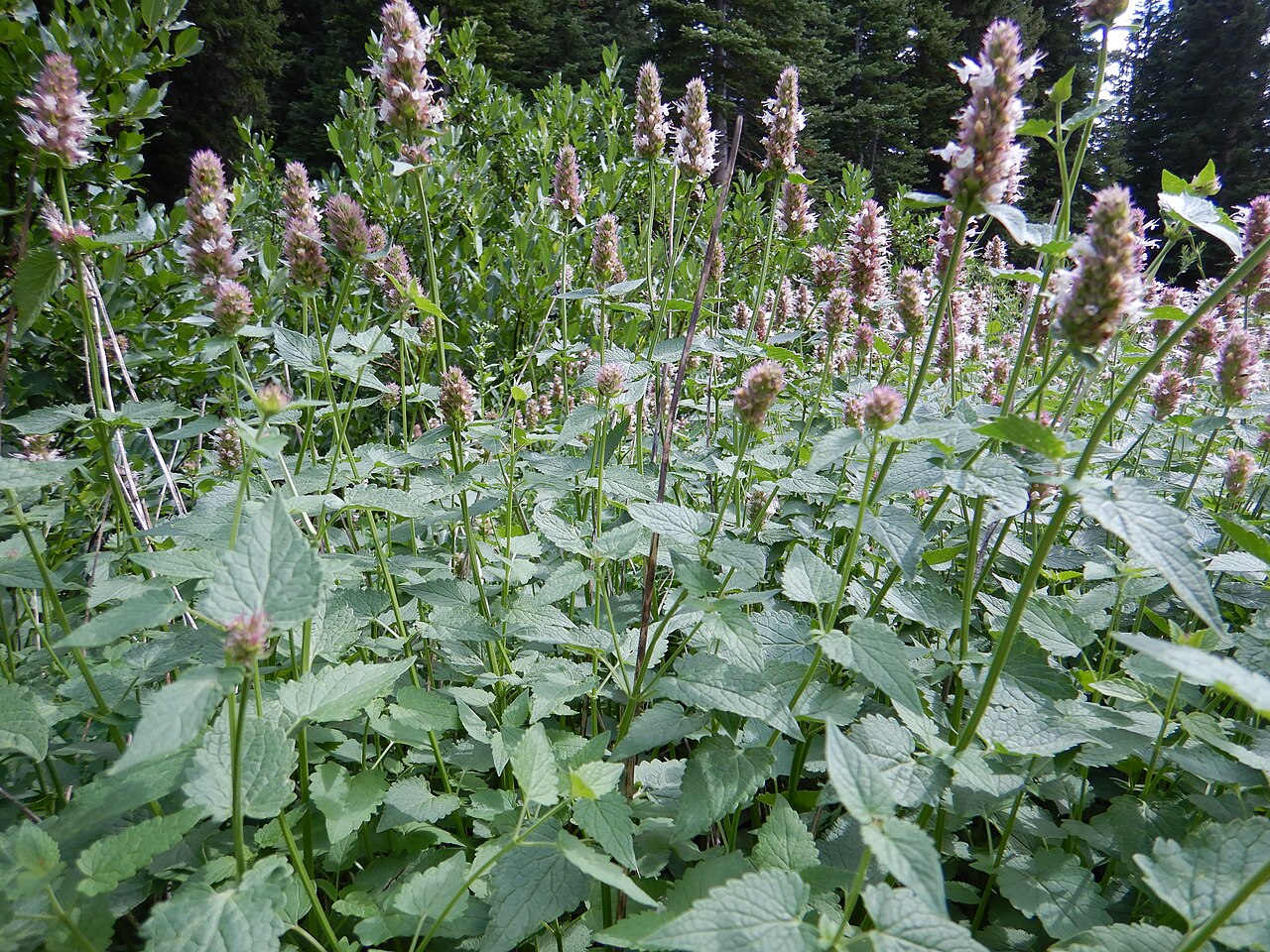
Agastache urticifolia, known as Nettle-Leaf Giant Hyssop or horsemint, is a tall, aromatic perennial in the mint family (Lamiaceae) of the western mountains. Its square stems grow 2 to 5 feet tall, with toothed, nettle-like leaves, and from early to late summer they are topped with dense, bottlebrush spikes of small pink, lavender or white flowers with long, protruding stamens.
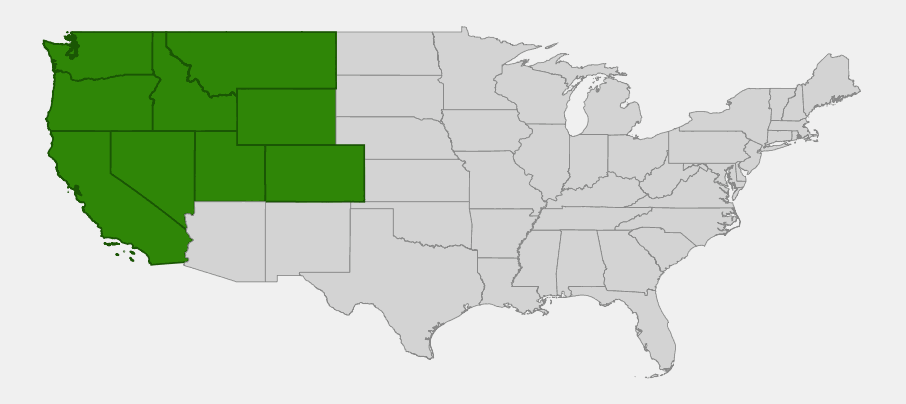
It is native from British Columbia and Washington south through the Cascades, Sierra Nevada and Great Basin ranges to the mountains of California, and east through Idaho, Montana, Wyoming, Utah and Nevada to western Colorado. It is common in mountain meadows, aspen groves, sagebrush slopes, forest openings and along streams, often forming big, showy patches from the foothills to near treeline.
Despite the name, it does not sting. The leaves have a strong minty, licorice-like scent, and the flowers are a favorite of bumble bees, hummingbirds and butterflies. In gardens it is a tough, long-blooming perennial for western pollinator and meadow plantings.
Identification
Look for clumps of tall, square, leafy stems in mountain meadows and aspen groves, with toothed, triangular, minty-smelling leaves and dense, pinkish bottlebrush spikes in summer.
Growth Habit
Nettle-leaf giant hyssop grows from a woody root crown, sending up several to many upright, square stems 2 to 5 feet tall (occasionally up to 6 feet), usually unbranched below the flower spikes. Plants form clumps that can merge into large colonies in good sites.
Leaves
The opposite leaves are triangular to broadly oval, 1 1/2 to 3 inches long, with coarsely toothed edges, a squared or slightly heart-shaped base and a short stalk. They resemble the leaves of stinging nettle (Urtica), which gives the species its name, but they have no stinging hairs. Crushed leaves smell strongly of mint and anise.
Flowers
Tiny tubular flowers about 1/2 inch long are packed into dense, cylindrical spikes 1 to 6 inches long at the stem tips, sometimes interrupted near the base. The flowers are white, pale pink or rose-lavender, and the colored, pointed calyxes are often pink to purple, giving the spikes a rosy cast. Four long stamens stick out well beyond each flower. Bloom time is about June to August, sometimes into September at high elevations.
Fruit
Each flower produces four small, smooth, brown nutlets that remain inside the dry calyx. The dry spikes stand into fall and winter.
Look-alikes
Western giant hyssop (Agastache occidentalis), found mainly in the Cascades of Washington, Oregon and northern California, is very similar and is best separated with a technical key. Anise hyssop (A. foeniculum) of the northern plains has whitish undersides and blue-purple flowers. Wild bergamot (Monarda fistulosa) has rounded heads of larger, two-lipped flowers.
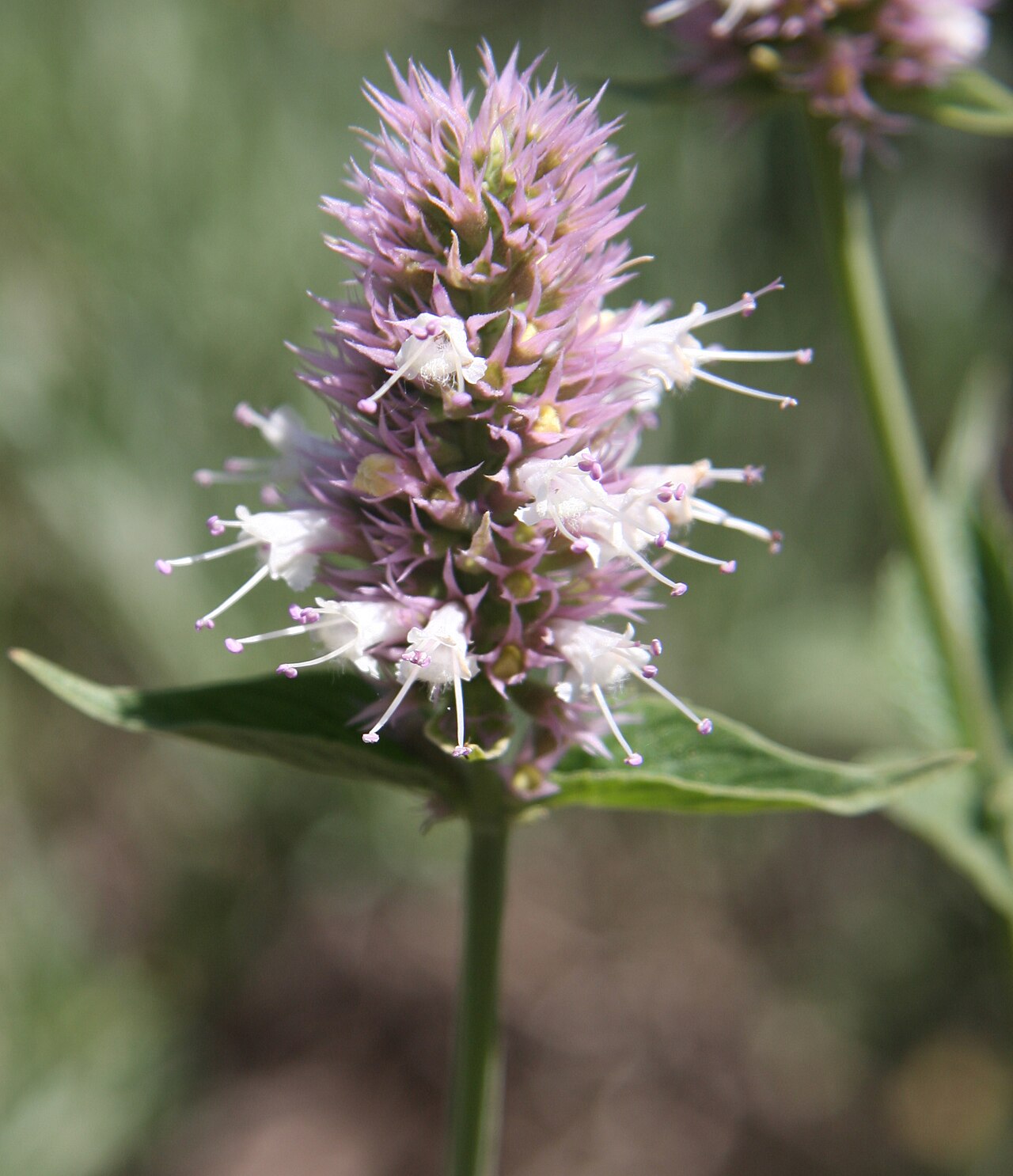
Quick Facts
| Scientific Name | Agastache urticifolia (Benth.) Kuntze |
| Family | Lamiaceae (mint family) |
| Plant Type | Herbaceous perennial wildflower |
| Mature Height | 2–5 ft |
| Mature Spread | 1–3 ft |
| Growth Rate | Moderate to fast |
| Sun Exposure | Full sun to part shade |
| Water Needs | Medium; moist in spring, tolerates summer dryness |
| Soil Type | Loam, sandy or gravelly soils; well drained |
| Soil pH | Slightly acidic to slightly alkaline (about 6.0–8.0) |
| Bloom Time | June–August (into September at high elevations) |
| Flower Color | White, pale pink or rose-lavender |
| Fall Color | Stems turn tan; dry spikes persist |
| Fruit | Small brown nutlets |
| Deer Resistant | Yes; aromatic foliage is seldom browsed heavily |
| USDA Hardiness Zones | 4–8 |
Native Range
USDA PLANTS lists nettle-leaf giant hyssop as native in nine western states: Washington, Oregon, California, Idaho, Nevada, Montana, Wyoming, Utah and Colorado. In Canada it grows in southern British Columbia.
It is widespread in the Rocky Mountains of Idaho, western Montana, western Wyoming, Utah and western Colorado, in the Great Basin ranges of Nevada, and through the Sierra Nevada, Cascades and other mountains of California. In Oregon and Washington it grows mostly east of the Cascade crest and in the Blue and Wallowa mountains, with populations on the western slope of the Cascades in Oregon.
It grows in moist to fairly dry mountain meadows, aspen groves, sagebrush and mountain brush slopes, forest openings, avalanche chutes, streambanks and roadsides, from about 2,000 feet in the north to about 10,500 feet in the Sierra Nevada and Rockies.
📋 Regional plant lists featuring Nettle-Leaf Giant Hyssop: Idaho, Eastern Oregon & Eastern Washington · Montana & Wyoming · Utah & Western Colorado · Western Oregon & Western Washington · California & Nevada
Growing & Care Guide
Nettle-leaf giant hyssop is an easy, long-lived perennial for pollinator gardens, meadows and naturalistic plantings in the West, especially at higher elevations and in cold-winter areas.
Light
Full sun to part shade. It flowers most heavily in full sun, but in hot, low-elevation gardens it appreciates afternoon shade.
Soil & Water
It grows in most well-drained soils, from gravelly to loamy, and prefers moist soil in spring with drier conditions later. Once established, it needs only occasional deep watering in dry summers. Avoid heavy, waterlogged clay, which can rot the crown.
Planting Tips
Plant it in groups in a meadow, woodland edge or the back of a perennial border, with plants about 18 to 24 inches apart. Combine it with sticky geranium, penstemons, lupines and native grasses for a mountain-meadow look.
Pruning & Maintenance
Leave the dry spikes standing over winter for birds and winter interest, then cut stems to the ground in early spring. Plants may self-sow modestly; pull extra seedlings in spring if needed.
Propagation
Grow it from seed sown outdoors in fall or given 4 to 8 weeks of cold, moist stratification before spring sowing. Seeds need light to germinate, so press them onto the soil surface. Established clumps can also be divided in early spring.
Landscape Uses
- Pollinator gardens: one of the best summer nectar plants for bees and hummingbirds
- Mountain meadow plantings: tall, showy spikes for high-elevation gardens
- Habitat restoration: a native forb for meadows, aspen stands and disturbed slopes
- Herb and fragrance gardens: minty, anise-scented leaves
- Deer-prone gardens: aromatic foliage is seldom browsed
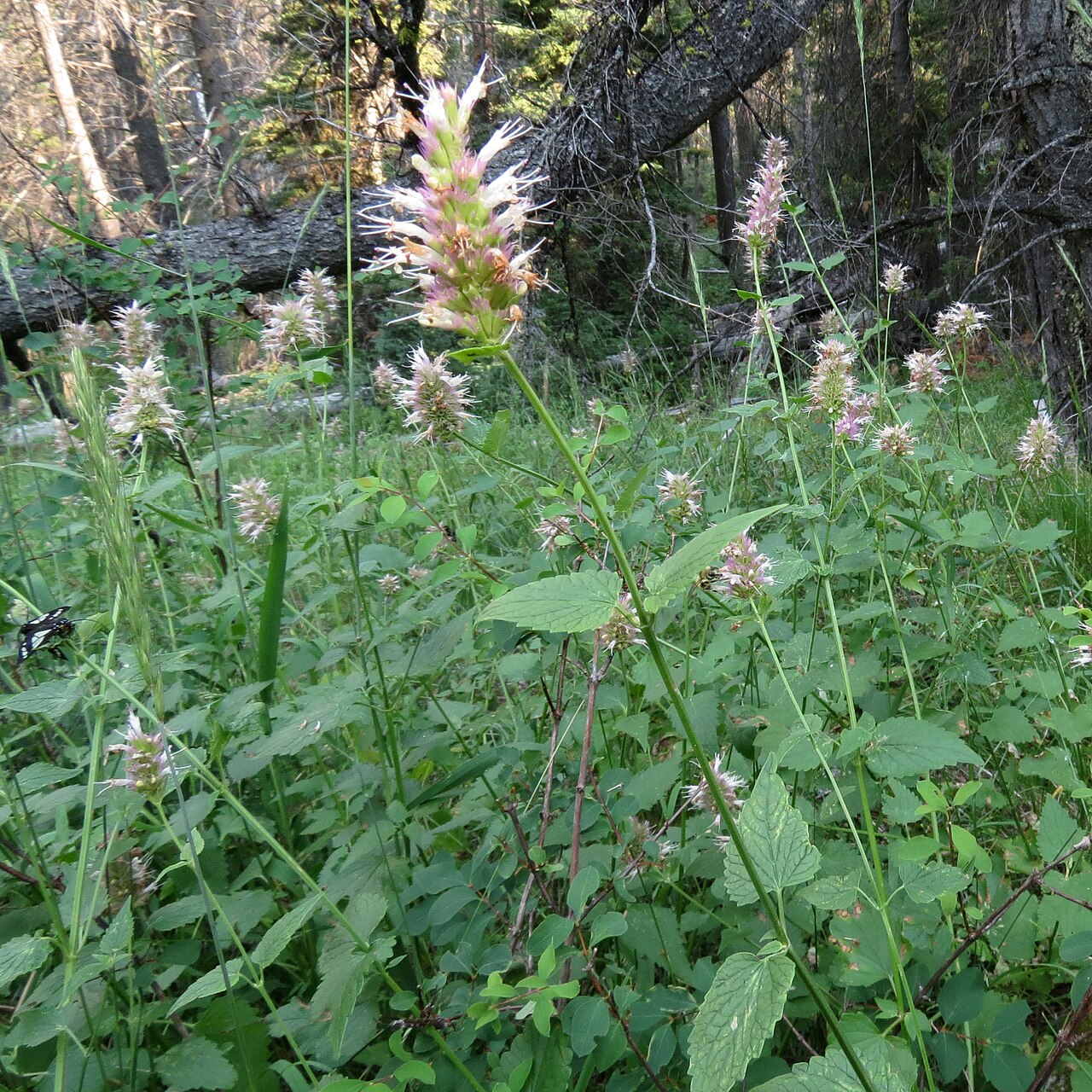
Wildlife & Ecological Value
Nettle-leaf giant hyssop is one of the most important summer nectar plants in western mountain meadows.
For Pollinators
Bumble bees are its most frequent visitors, but honey bees, solitary bees, butterflies such as fritillaries and swallowtails, sphinx moths and hummingbird moths also feed at the flowers. Its abundant nectar is a mainstay for pollinators in mid to late summer.
For Birds
Broad-tailed, calliope and rufous hummingbirds sip nectar from the flowers, and finches and other small birds eat the seeds in fall.
For Mammals
Deer, elk and livestock graze it lightly, mostly early in the season. Sheepherders valued it as summer forage in the mountains.
Ecosystem Role
By forming large colonies in meadows and aspen groves, it provides concentrated nectar resources that support diverse pollinator communities, and its persistent stems give shelter to overwintering insects.
Cultural & Historical Uses
The genus name Agastache comes from Greek words meaning “very many spikes,” for the abundant flower spikes. The species name urticifolia means “nettle-leaved,” for the resemblance of its leaves to stinging nettle.
Several Indigenous peoples of the Great Basin and Intermountain West used nettle-leaf giant hyssop. The seeds were eaten raw or cooked, and the leaves were used to make tea and in medicines for colds and other ailments.
The plant was first described by George Bentham in the genus Lophanthus in the 1830s and later moved to Agastache. Gardeners have since used several western and Mexican species of Agastache to breed popular hybrid hyssops.
Frequently Asked Questions
Does nettle-leaf giant hyssop sting?
No. Its leaves only look like stinging nettle. They have no stinging hairs and smell pleasantly of mint and anise when crushed.
Where does nettle-leaf giant hyssop grow?
In mountain meadows, aspen groves and forest openings of the western United States, from Washington and British Columbia to California, and east to Montana, Wyoming, Utah and Colorado.
When does it bloom?
From about June to August, sometimes into September at high elevations.
Is nettle-leaf giant hyssop good for pollinators?
Yes. It is a top nectar plant for bumble bees, hummingbirds, butterflies and moths in summer.
Can I grow nettle-leaf giant hyssop in my garden?
Yes. It is easy in full sun or light shade and well-drained soil, especially in cold-winter western gardens. It can be grown from fall-sown seed or divided clumps.

Looking for a nursery that carries Nettle-Leaf Giant Hyssop?
Browse our native plant nursery directory: California · Colorado · Idaho · Montana · Nevada · Oregon · Utah · Washington · Wyoming