
Rose Twisted-Stalk (Streptopus lanceolatus)
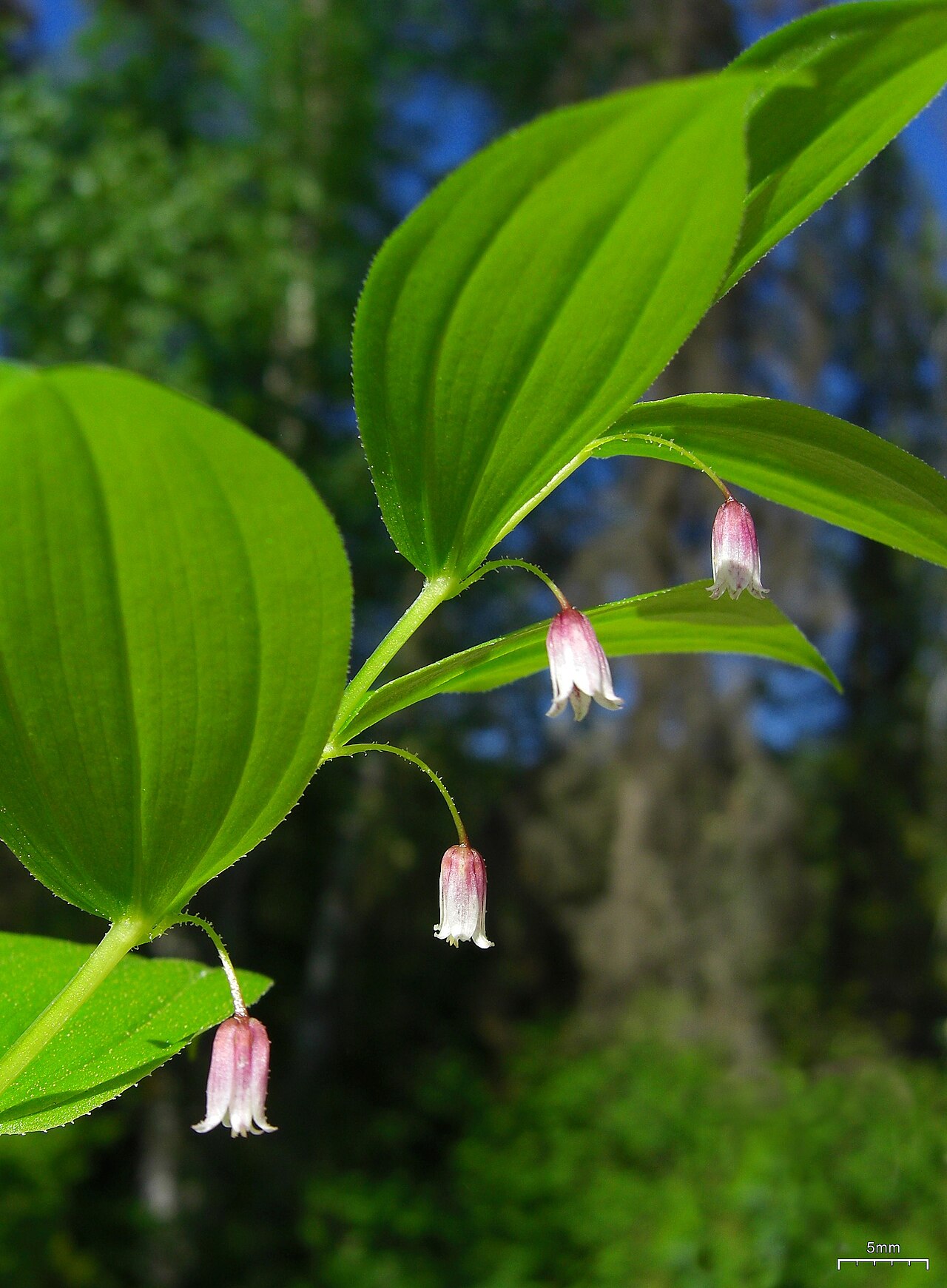
Streptopus lanceolatus, known as Rose Twisted-Stalk, rosy twisted-stalk or simply twistedstalk (the USDA name), is a native perennial wildflower of cool, moist forests in the northern United States, the Appalachians, the Pacific Northwest, Alaska and much of Canada. It belongs to the lily family (Liliaceae). Older books call it Streptopus roseus.
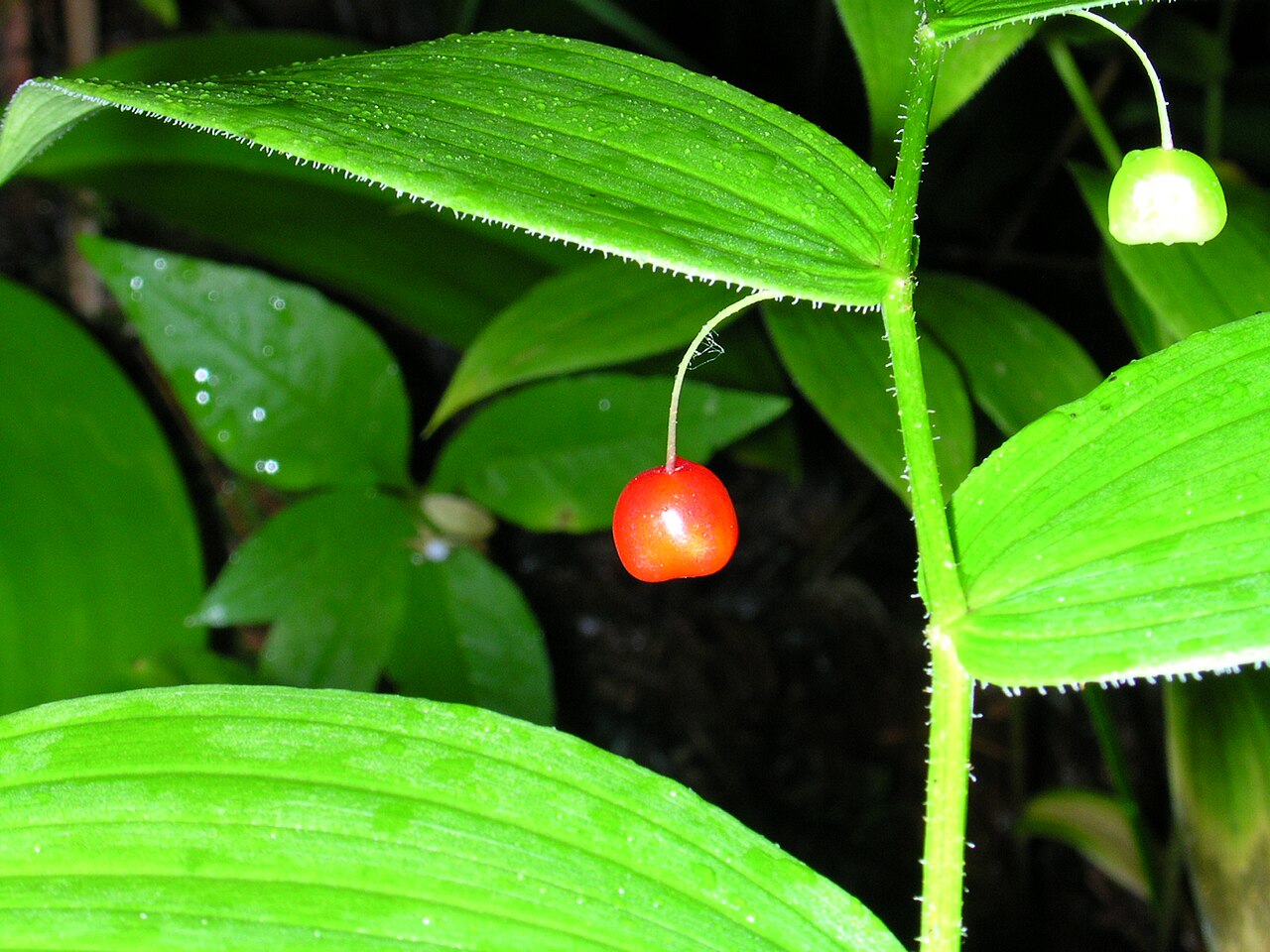
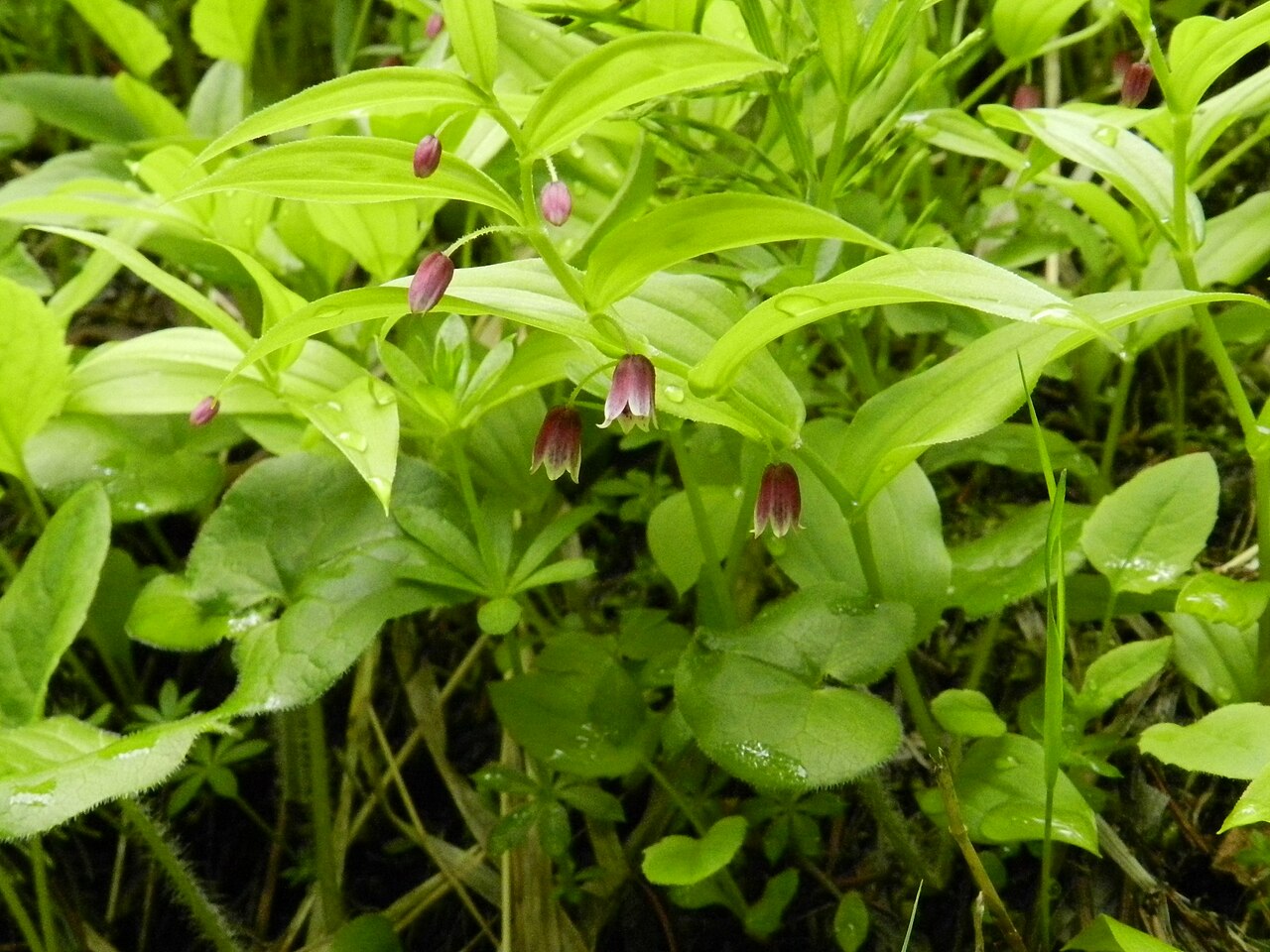
Plants have arching, often zigzag stems 1 to 2 1/2 feet long, with neat rows of stalkless, parallel-veined leaves. In late spring, small pink to rose-purple bells hang singly under the leaves on short, curved stalks. By late summer they become round, bright red berries. The overall look is similar to Solomon’s seal or fairybells, and the plant is often overlooked until the berries appear.
Rose twisted-stalk is a characteristic plant of northern hardwood, spruce-fir and moist mountain forests. It is a graceful, low-maintenance choice for cool, shady woodland gardens with rich, acidic, moist soil, but it is slow to establish and does not thrive in hot, dry summers.
Identification
Look for rose twisted-stalk in cool, moist forests from May to July for flowers and July to September for berries. The arching stem with stalkless leaves, and the small pink bells hanging under the leaves on short, kinked stalks, identify it.
Growth Habit
Plants grow from a creeping rhizome and form loose colonies. Each stem is 1 to 2 1/2 feet long, arching and often slightly zigzag, simple or with one or two branches. The stem is green and usually has fine, scattered hairs, especially at the nodes.
Leaves
The leaves are alternate, stalkless, lance-shaped to oval, about 2 to 4 inches long, with pointed tips and many parallel veins. The leaf bases do not clasp the stem. The leaf edges carry a fringe of tiny hairs, visible with a hand lens. Leaves are bright green above and paler beneath.
Flowers
From about May to July, single (occasionally paired) flowers hang beneath the leaves from short stalks that arise near each leaf joint and bend or twist sharply. Each flower is a narrow bell about 3/8 inch long, made of six pink to rose-purple tepals, often with darker streaks and flared, curled-back tips.
Fruit & Seeds
The fruit is a round, juicy berry about 1/4 to 3/8 inch across, ripening from green to bright red in mid to late summer. Each berry contains several pale seeds. Birds and small mammals eat the berries and spread the seeds.
Look-alikes
White twisted-stalk (Streptopus amplexifolius) is taller and more branched, with leaves that clasp the stem, greenish-white flowers and oval red berries. Solomon’s seals (Polygonatum) have flowers hanging from the leaf axils in pairs or clusters and blue-black berries. Fairybells (Prosartes) have flowers and berries at the branch tips. Before flowering, the fringe of tiny hairs on the leaf edges and the non-clasping leaves help identify rose twisted-stalk.
Quick Facts
| Scientific Name | Streptopus lanceolatus (syn. Streptopus roseus) |
| Family | Liliaceae (lily family) |
| Plant Type | Herbaceous perennial wildflower |
| Mature Height | 1–2.5 ft (arching stems) |
| Mature Spread | 1–2 ft; slowly forms colonies |
| Growth Rate | Slow |
| Sun Exposure | Part shade to full shade |
| Water Needs | Medium to high; consistently moist soil |
| Soil Type | Rich, humusy loam with plenty of leaf litter |
| Soil pH | About 4.5–6.5 (acidic) |
| Bloom Time | May–July |
| Flower Color | Pink to rose-purple |
| Fall Color | Leaves yellow before dying back |
| Fruit | Round red berry, ripe July–September |
| Deer Resistant | No; deer browse the foliage |
| USDA Hardiness Zones | 2–7 |
Native Range
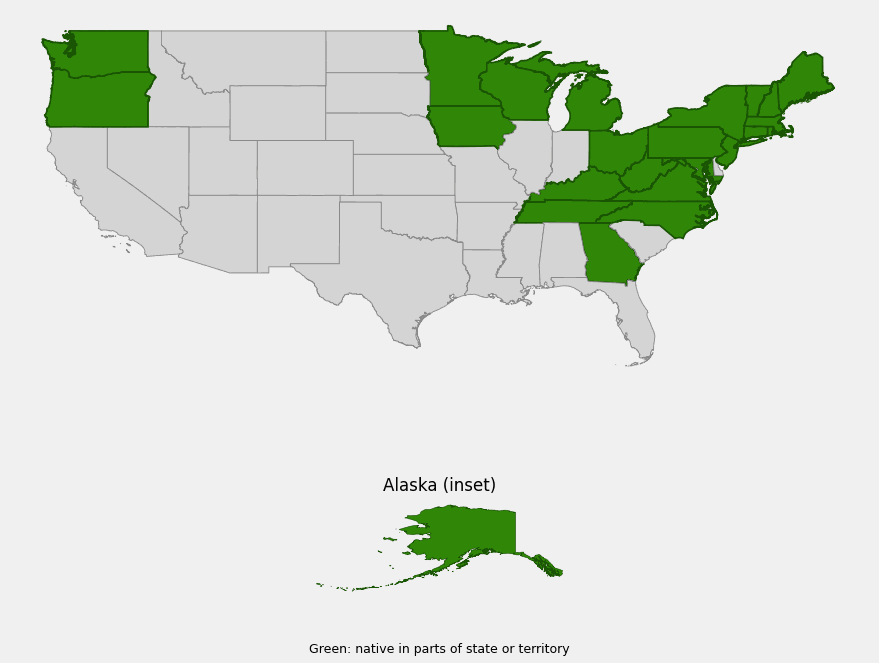
Rose twisted-stalk is native to northern North America. USDA PLANTS lists it as native in Alaska, the lower 48 states, Canada and Saint Pierre and Miquelon, and records it from 24 states. It grows from Newfoundland, Labrador and the Maritime provinces west across Quebec, Ontario and Manitoba, and in Alberta, British Columbia and coastal Alaska. In the United States it ranges through New England, New York, New Jersey and Pennsylvania west through Ohio, Michigan, Wisconsin, Minnesota and Iowa, and south in the Appalachians through Maryland, West Virginia, Virginia, Kentucky, Tennessee and North Carolina to northern Georgia. In the West it grows in Washington and Oregon.
Two varieties are usually recognized. Variety roseus is the eastern plant, and variety curvipes grows from Alaska and British Columbia south through western Washington and Oregon, mostly in the Cascades and Coast Ranges west of the Cascade crest. In the southern Appalachians it is confined to high, cool mountains, and the records from Georgia, Kentucky and Tennessee are outlying southern populations. NatureServe ranks it as critically imperiled (S1) in Ohio and Maryland and imperiled in Iowa and Tennessee, where it reaches the edge of its range.
Typical habitats are cool, moist forests: northern hardwood and hemlock forests, spruce-fir and subalpine forests, moist mountain slopes and coves, the edges of bogs and streams, and shaded ravines. It grows in rich, acidic, humusy soil that stays moist through the summer.
📋 Regional plant lists featuring Rose Twisted-Stalk: New York, Pennsylvania & Northern New Jersey · Ohio & Indiana · Michigan, Wisconsin & Eastern Minnesota · Kentucky & Tennessee · Connecticut, Massachusetts & Rhode Island · New Hampshire, Maine & Vermont · Maryland, Virginia & West Virginia · Delaware, Southern New Jersey & Long Island · Illinois, Iowa & Missouri · Alabama, Georgia & Mississippi · Alaska · North & South Carolina · Western Oregon & Western Washington
Growing & Care Guide
Rose twisted-stalk is a quiet, elegant plant for cool woodland gardens in the North and in the mountains. It is offered by some native plant nurseries that specialize in woodland plants. Buy nursery-propagated plants, since it is slow to grow and wild plants should never be dug, especially where it is rare.
Light
Part shade to full shade under deciduous or mixed trees suits it best. Morning sun is fine in cool climates, but hot afternoon sun scorches the leaves.
Soil & Water
It needs rich, moist, acidic soil with plenty of organic matter, like a natural forest floor. Keep the soil evenly moist through summer and mulch with shredded leaves. It does not tolerate drought, heavy clay that stays waterlogged, or alkaline soil.
Planting Tips
Plant rhizomes or potted plants in spring or early fall, setting the rhizome about 1 inch deep and spacing plants 12 to 18 inches apart. It looks best in small groups along shady paths or among ferns, where the hanging flowers and berries can be seen from below. It grows best in cool-summer regions (roughly zones 2 to 6, and higher elevations farther south).
Pruning & Maintenance
Little care is needed. Leave the stems to die back naturally in fall, and leave fallen leaves in place as mulch. Protect plants from deer where browsing is heavy. Slugs occasionally damage young shoots.
Propagation
Divide established clumps in early spring or fall, keeping a growing point with each rhizome section. Seed can be cleaned from ripe berries and sown outdoors in fall; it needs a long cold period and often takes two winters to germinate, and seedlings take several years to bloom.
Landscape Uses
- Woodland gardens: graceful arching stems for cool, moist shade
- Fern gardens: pairs well with ferns, trilliums and goldthread
- Wildlife gardens: red berries eaten by birds and small mammals
- Northern and mountain gardens: a native for cool-summer regions
- Forest restoration: understory planting in northern hardwood and spruce-fir forests
Wildlife & Ecological Value
Rose twisted-stalk provides flowers for early-season bees in cool forests and berries for wildlife in late summer.
For Pollinators
The small, hanging bells are visited mainly by bumblebees and other small bees, which cling to the flowers to reach the nectar and pollen. Flies may also visit.
For Birds
The red berries are eaten by thrushes, grouse and other forest birds, which spread the seeds through the forest.
For Mammals
Deer browse the foliage, and small mammals such as chipmunks and mice eat the berries.
Ecosystem Role
As a long-lived, colonial forest herb, rose twisted-stalk is part of the rich herb layer of cool, undisturbed forests. It is slow to recover from logging, heavy deer browsing and soil disturbance, so healthy colonies are a sign of a mature forest floor.
Cultural & Historical Uses
The genus name Streptopus comes from the Greek streptos, twisted, and pous, foot, for the sharply bent flower stalks. The species name lanceolatus refers to the lance-shaped leaves, and the older name roseus to the rose-pink flowers.
The Lady Bird Johnson Wildflower Center reports that the tender young shoots have been added to salads, but it lists the berries as mildly poisonous, and eating wild plants is not recommended, especially since young shoots can be confused with toxic false hellebore (Veratrum).
Rose twisted-stalk is one of the plants many hikers in northern and mountain forests first notice in late summer, when its bright red berries dangle beneath the leaves along shaded trails.
Frequently Asked Questions
Why is it called twisted-stalk?
Each small flower hangs on a short stalk that bends or twists sharply where it joins the stem. The genus name Streptopus means twisted foot.
How do I tell rose twisted-stalk from white twisted-stalk?
Rose twisted-stalk has pink flowers, round berries and leaves that do not clasp the stem. White twisted-stalk is taller and more branched, with greenish-white flowers, oval berries and leaves that clasp the stem.
Are rose twisted-stalk berries edible?
They are considered mildly poisonous and are not recommended for eating. Birds and small mammals eat them without harm.
Can I grow rose twisted-stalk in my garden?
Yes, in cool, moist, shady woodland gardens with rich, acidic soil. It grows best where summers are cool and does poorly in hot, dry conditions.
Where does rose twisted-stalk grow?
It grows in cool, moist forests across Canada, Alaska, the northern United States, the Appalachian Mountains south to Georgia, and western Washington and Oregon.

Looking for a nursery that carries Rose Twisted-Stalk?
Browse our native plant nursery directory: Alaska · Connecticut & Georgia · Iowa · Kentucky, Maine, Maryland, Massachusetts, Michigan & Minnesota · New Hampshire, New Jersey, New York, North Carolina & Ohio · Oregon · Pennsylvania, Rhode Island, Tennessee, Vermont & Virginia · Washington · West Virginia & Wisconsin