
Large-leaved Aster (Eurybia macrophylla)
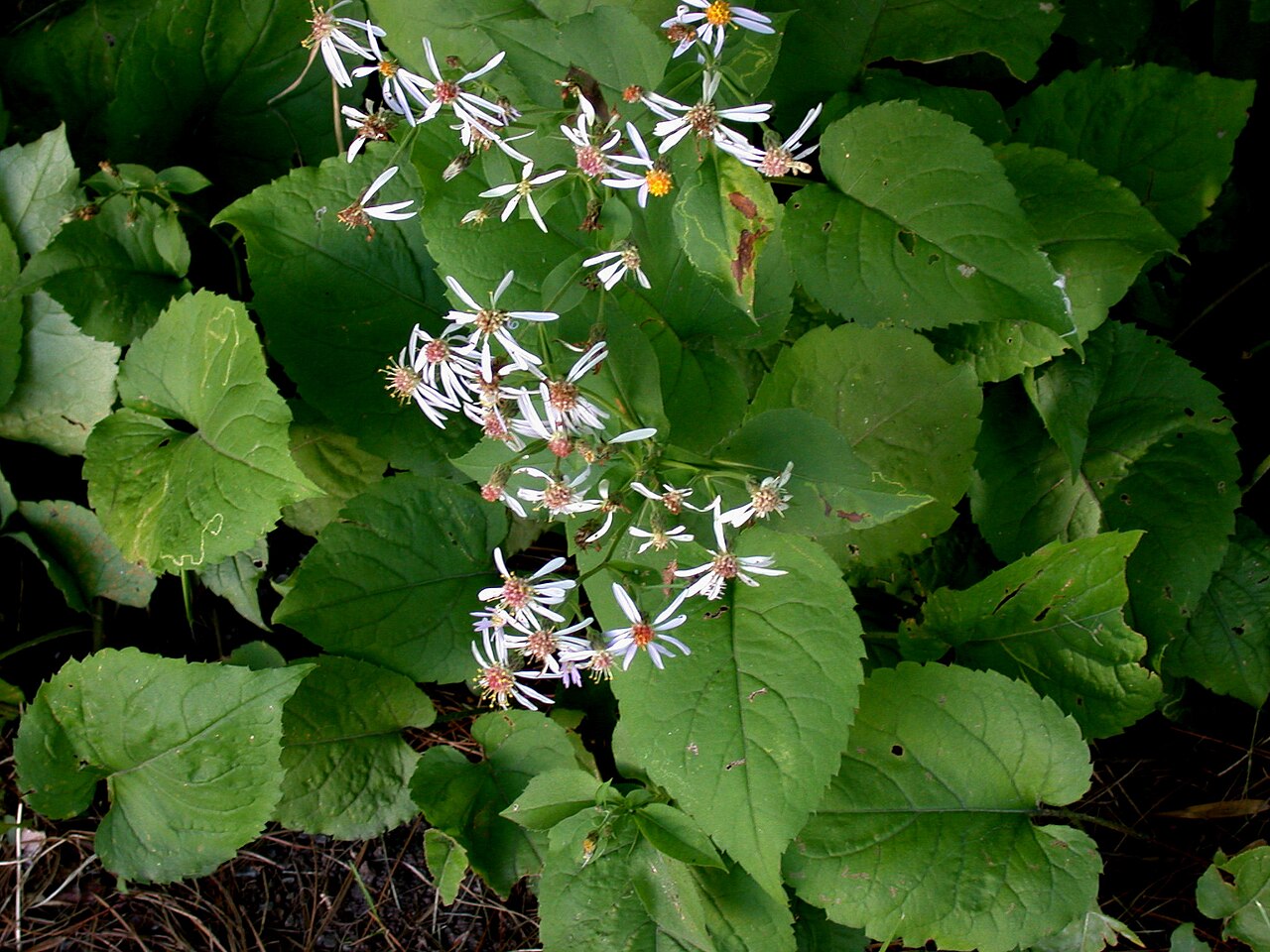
Eurybia macrophylla, known as Large-leaved Aster, bigleaf aster (its USDA name) or big-leaved aster, is a native woodland aster of northeastern North America, named for its unusually large, heart-shaped basal leaves, often 4 to 8 inches wide. It spreads by rhizomes into broad colonies that carpet the floor of open forests, and in late summer it sends up stems 1 to 3 feet tall topped by flat-topped clusters of pale lavender to white flowers.
It was long known as Aster macrophyllus, and many field guides and nurseries still use that name. Genetic studies led botanists to split the North American asters into several genera, and large-leaved aster moved to Eurybia, the group that also contains white wood aster (Eurybia divaricata).
In gardens it is valued less for its flowers than for its foliage: it is one of the best native ground covers for dry shade, the difficult spot under trees where few plants thrive. This guide covers identification, range, growing it and its value to wildlife.
Identification
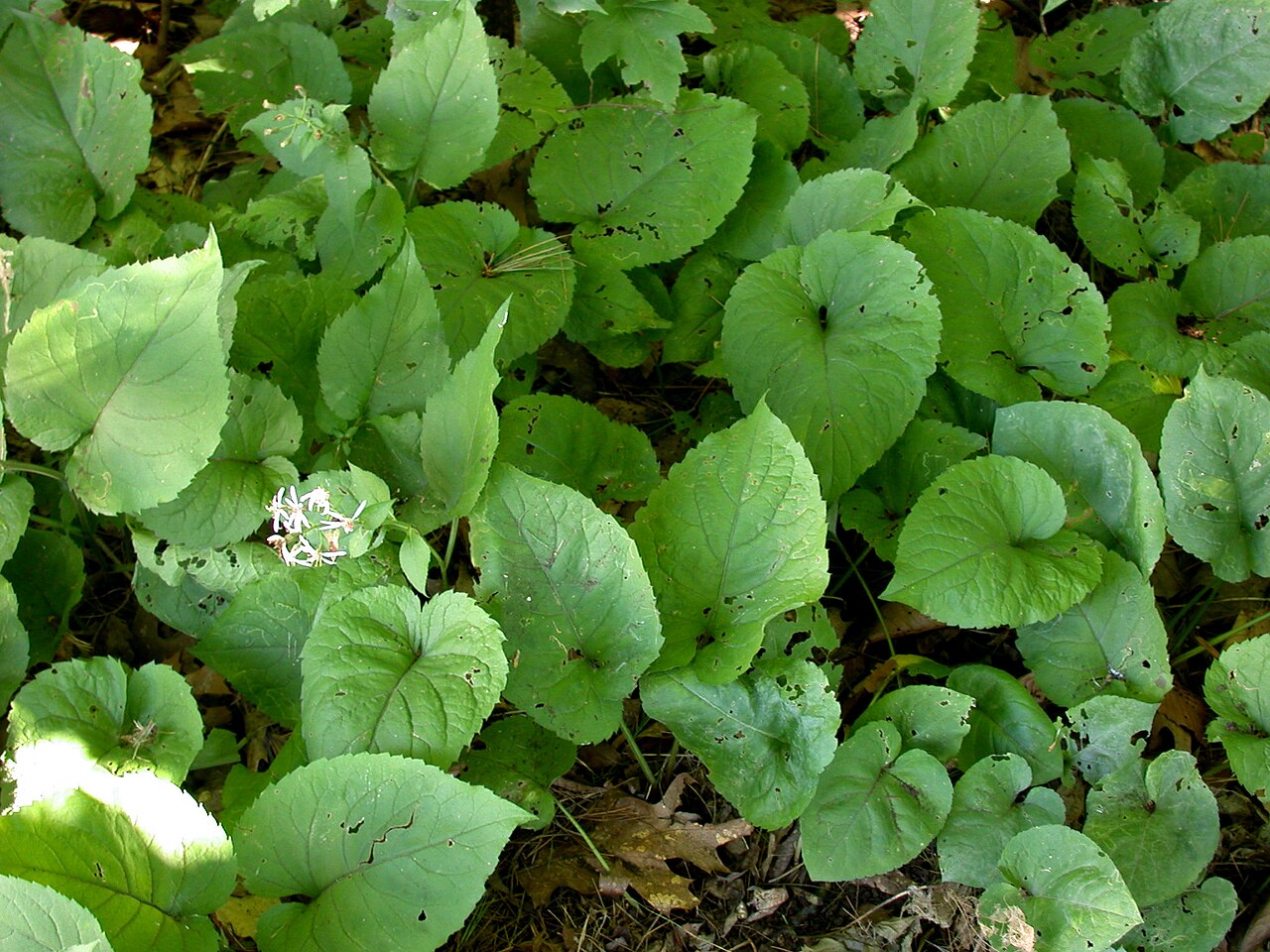
Large-leaved aster is easy to recognize by its big, rough, heart-shaped basal leaves, which often form extensive colonies with only a few flowering stems.
Leaves
The basal leaves are heart-shaped with a long stalk, coarsely toothed, rough or sandpapery above, and often 4 to 8 inches wide, though size varies with light and soil. Most plants in a colony are non-flowering rosettes. Leaves on the flowering stem are smaller, becoming stalkless and oval toward the top.
Stems
Flowering stems are 1 to 3 feet tall (occasionally more), often reddish-purple, and glandular-hairy in the upper part. They rise from slender, spreading rhizomes.
Flowers
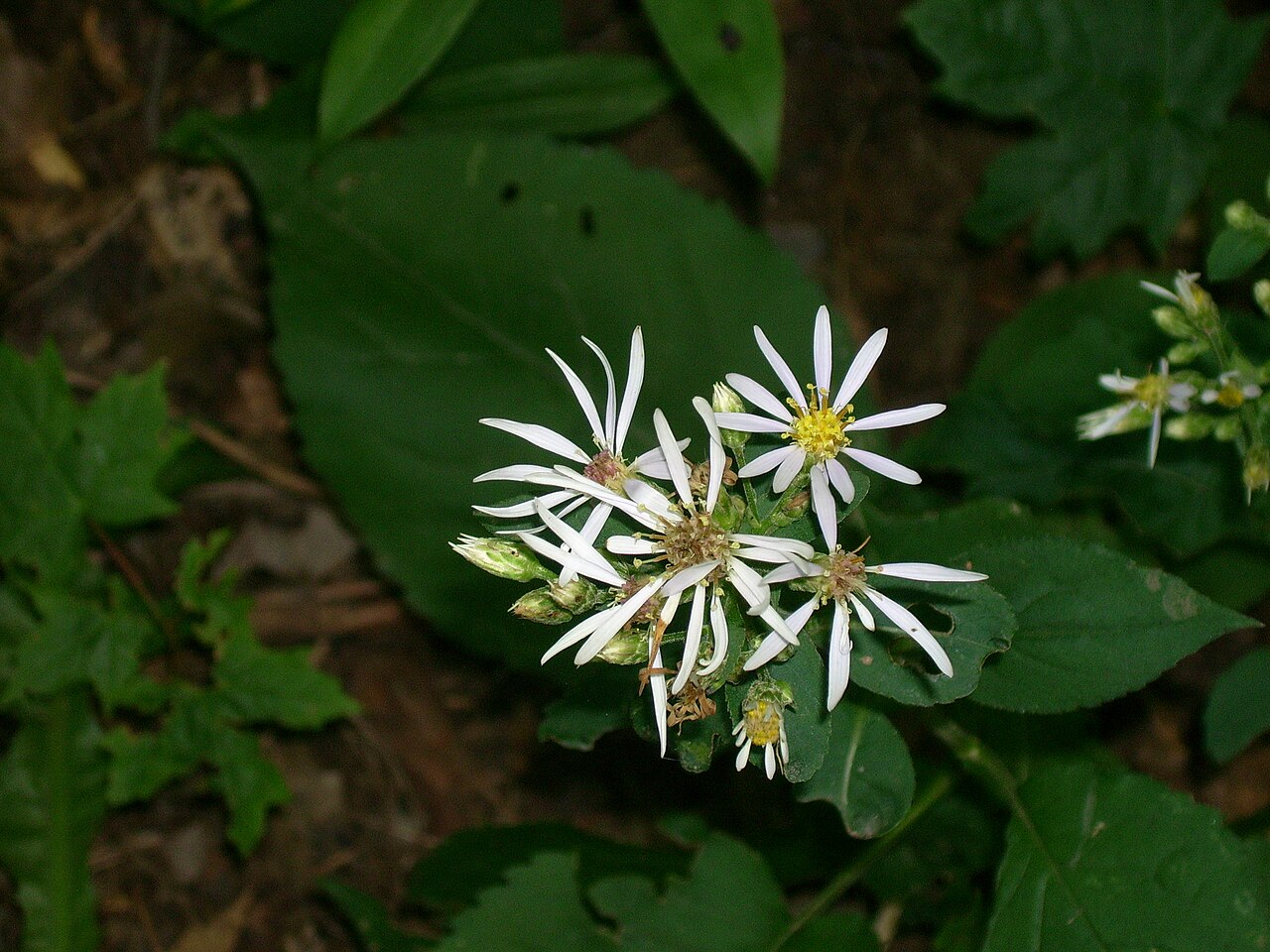
From late July into October each stem ends in a broad, flat-topped or rounded cluster of flower heads about 1 inch across. Each head has 9 to 20 ray florets, pale lavender, blue-violet or nearly white, around a disk of yellow florets that turn reddish-purple with age. The bracts beneath the head are sticky with glands.
Fruit & Seeds
The small, dry seeds (cypselae) each carry a tuft of whitish to tan bristles that carries them on the wind in fall.
Similar Species
White wood aster (Eurybia divaricata) has smaller, thinner, heart-shaped leaves, white rays, zigzag stems and no sticky glands. Heart-leaved aster (Symphyotrichum cordifolium) has many small blue flower heads in an elongated, branching cluster and lacks the large basal leaf carpets. Before flowering, colonies can be mistaken for young basswood or violet leaves, but the rough texture and aster scent of crushed leaves help.
Quick Facts
| Scientific Name | Eurybia macrophylla (syn. Aster macrophyllus) |
| Family | Asteraceae (aster family) |
| Plant Type | Herbaceous perennial; colony-forming ground cover |
| Mature Height | Leaves 6–12 in; flowering stems 1–3 ft |
| Mature Spread | Spreads by rhizomes to form broad colonies |
| Growth Rate | Moderate |
| Sun Exposure | Part shade to full shade; tolerates some sun |
| Water Needs | Low to moderate; dry to moist soil |
| Soil Type | Well-drained loam or sandy soil; tolerates dry, rooty soils |
| Soil pH | About 4.5–7.0 |
| Bloom Time | Late July–October |
| Flower Color | Pale lavender to white with yellow centers |
| Fall Color | Leaves may turn yellowish to purplish |
| Fruit | Small seeds with wind-borne bristles |
| Deer Resistant | No; deer and rabbits browse the leaves |
| USDA Hardiness Zones | 3–8 |
Native Range
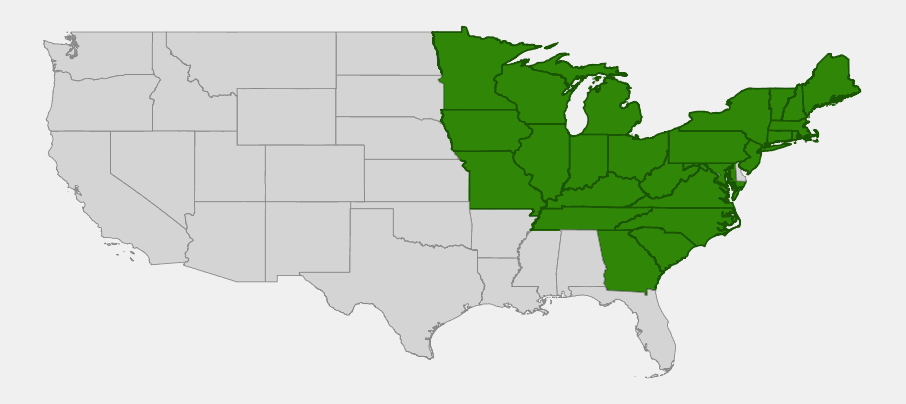
Large-leaved aster is native to northeastern North America. USDA PLANTS records it in 25 states, from Maine and Minnesota south through the Great Lakes states, Ohio Valley and Mid-Atlantic, and along the Appalachians to Tennessee, the western Carolinas and northern Georgia. In Canada it ranges from Manitoba and Ontario east to Quebec and the Maritime provinces.
It is most abundant in the northern hardwood and mixed forests of the Great Lakes region, New York and New England. Southward it becomes largely confined to the mountains, and in Iowa and Missouri it is at the southwestern edge of its range, where it is scattered and uncommon.
It grows in dry to moist deciduous and mixed woods, often under oak, maple, birch, aspen and pine, as well as in clearings, thickets and woodland edges. It is common on well-drained, somewhat acidic soils and often dominates the ground layer of open, rocky or sandy forests.
📋 Regional plant lists featuring Large-leaved Aster: New York, Pennsylvania & Northern New Jersey · Ohio & Indiana · Michigan, Wisconsin & Eastern Minnesota · Kentucky & Tennessee · Connecticut, Massachusetts & Rhode Island · New Hampshire, Maine & Vermont · Maryland, Virginia & West Virginia · Delaware, Southern New Jersey & Long Island · Illinois, Iowa & Missouri · Alabama, Georgia & Mississippi · North & South Carolina
Growing & Care Guide
Large-leaved aster is a tough, easy native ground cover for shade, including dry shade under trees where lawn grass and many perennials fail. Give it room: once established it spreads steadily by rhizomes.
Light
Part to full shade is best. It tolerates morning sun and grows in clearings, but the leaves look best and the plant competes best in the dappled light of open woods. In deep shade it forms leaf carpets with few flowers.
Soil & Water
It prefers well-drained, somewhat acidic loam or sandy soil with leaf litter, and once established it tolerates dry, root-filled soil under trees. Water regularly the first season, then only in prolonged droughts. Avoid heavy, waterlogged soils.
Planting Tips
Plant 12 to 18 inches apart as a ground cover under trees, on wooded slopes or along shady paths. It combines well with wild sarsaparilla, Canada mayflower, wreath goldenrod and northern bush honeysuckle.
Pruning & Maintenance
Little care is needed. Leave fallen leaves in place as mulch. Flowering stems can be cut after seed has dispersed, or left for winter interest and to provide seed. Edge or pull runners if it spreads into areas where it is not wanted.
Propagation
Divide established colonies in spring or fall; pieces of rhizome with a few leaves re-establish easily. It can also be grown from seed sown outdoors in fall or after about 60 days of cold, moist stratification.
Landscape Uses
- Dry shade ground cover: one of the best natives for root-filled soil under trees
- Woodland gardens: bold, heart-shaped leaves carpet the forest floor
- Lawn alternative under trees: a low-maintenance replacement for struggling turf in shade
- Late-season pollinator gardens: late summer to fall flowers for bees and butterflies
- Woodland restoration: within its native range, from local sources
Wildlife & Ecological Value
Large-leaved aster provides late-season nectar in the shade, when few woodland plants bloom, and its leaves feed several insects.
For Pollinators
The flowers are visited by bumblebees, small native bees, flies and butterflies in late summer and fall. Like other asters, it is part of the late-season nectar supply that helps bees build up reserves before winter.
For Birds
Small birds such as finches and juncos may eat the seeds in fall and winter, and the leaf carpets give cover to ground-foraging birds.
For Mammals
White-tailed deer and snowshoe hares browse the leaves, and heavy deer browsing can noticeably thin colonies.
Ecosystem Role
As a common dominant of the forest ground layer, it helps hold soil on slopes, shelters insects and other small animals in its leaf carpets, and supports caterpillars of moths that feed on asters.
Cultural & Historical Uses
Carl Linnaeus named the species Aster macrophyllus; macrophyllus means “large-leaved.” The French botanist Henri Cassini later placed it in his genus Eurybia, but most botanists kept it in Aster until DNA studies showed that North American asters belong to several separate lineages, and the name Eurybia macrophylla came back into use.
The young leaves have been used as a cooked green by some Indigenous peoples of the Great Lakes region, and the plant is sometimes jokingly called “lumberjack’s toilet paper” for its big, soft leaves. It is not a common food today, and wild greens should only be eaten when identification is certain.
In gardens it is a quiet, dependable plant that fills a real need: a native, low-maintenance ground cover for the dry shade under trees.
Frequently Asked Questions
Is large-leaved aster the same as Aster macrophyllus?
Yes. Aster macrophyllus is the older name. Botanists now place it in the genus Eurybia, but many books and nurseries still use the old name.
Will large-leaved aster grow in dry shade?
Yes. It is one of the best native plants for dry, root-filled soil under trees once it is established.
Why are there so few flowers in my patch?
Most rosettes in a colony do not flower, especially in deep shade. More light, such as at a woodland edge, usually means more flowering stems.
Is large-leaved aster invasive?
It is native and spreads by rhizomes, so it can form large colonies, but it is easy to edge or pull and is not aggressive in rich, moist soil where other plants compete.
Do deer eat large-leaved aster?
Yes. Deer browse its leaves, and heavy browsing can reduce colonies. Protect young plantings where deer are numerous.

Looking for a nursery that carries Large-leaved Aster?
Browse our native plant nursery directory: Connecticut & Georgia · Illinois, Indiana & Iowa · Kentucky, Maine, Maryland, Massachusetts, Michigan, Minnesota & Missouri · New Hampshire, New Jersey, New York, North Carolina & Ohio · Pennsylvania, Rhode Island, South Carolina, Tennessee, Vermont & Virginia · West Virginia & Wisconsin