
Winged Loosestrife (Lythrum alatum)
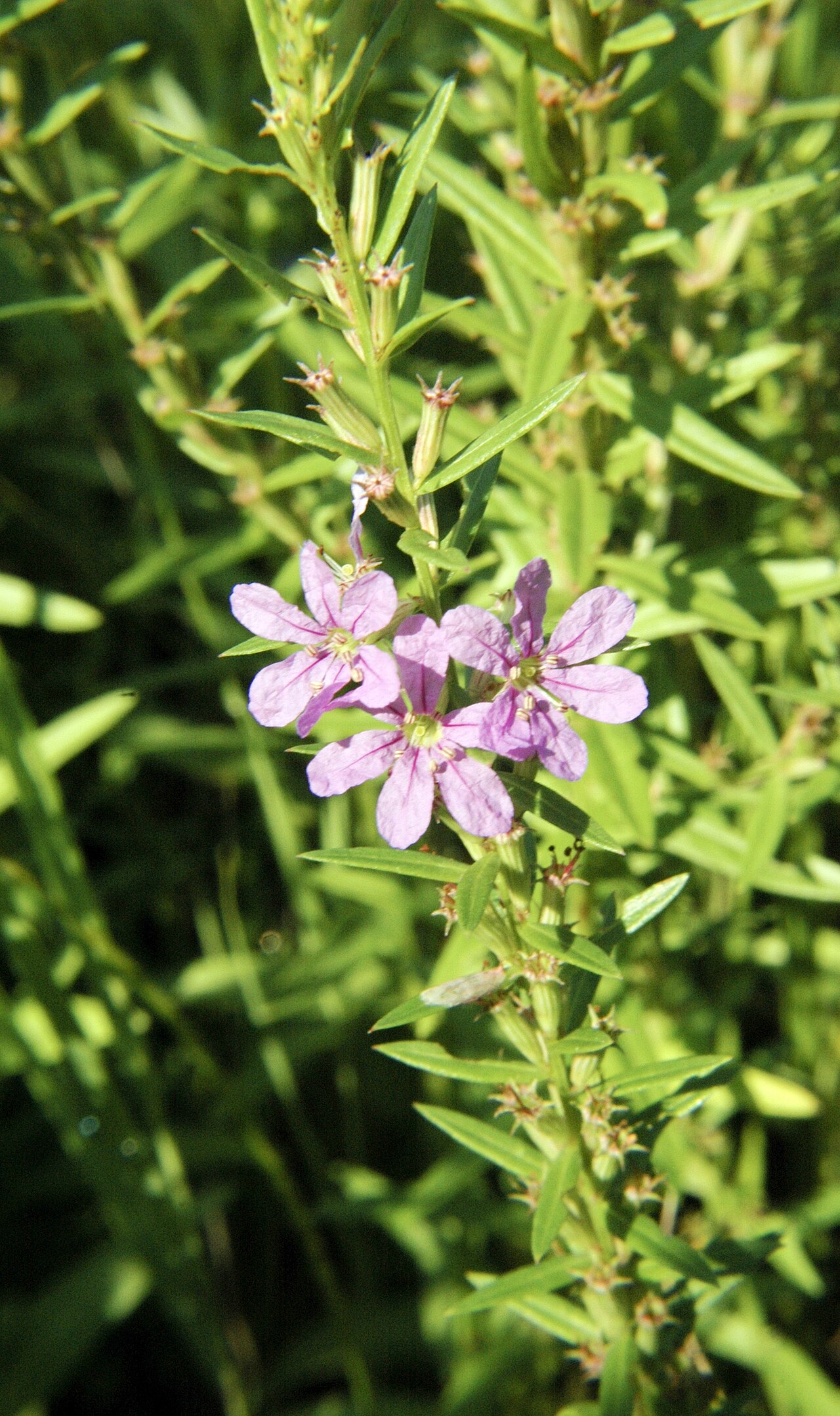
Lythrum alatum, known as Winged Loosestrife (USDA PLANTS: winged lythrum), is a slender, native wetland perennial in the loosestrife family (Lythraceae). It grows 1 to 3 feet tall on square, narrowly winged stems with small, stalkless leaves, and from early summer into fall it bears small, magenta to lavender, six-petaled flowers singly in the upper leaf axils.
It grows in wet prairies, sedge meadows, fens, marsh edges, wet ditches and shores across much of the central and eastern United States and southern Ontario. It is the native cousin of purple loosestrife (Lythrum salicaria), a Eurasian plant that has become one of the most damaging invasive weeds of North American wetlands. Winged loosestrife is much smaller and less showy, and it is not invasive.
For gardeners, winged loosestrife is a graceful, long-blooming native for rain gardens, pond margins and wet meadows. It attracts many bees and butterflies. Buy it from a reputable native plant nursery that labels it as Lythrum alatum, so you never introduce purple loosestrife by mistake.
Identification
Look for a slender, wiry wetland plant with square, slightly winged stems, small narrow leaves and scattered, single magenta flowers in the axils of the upper leaves.
Growth Habit
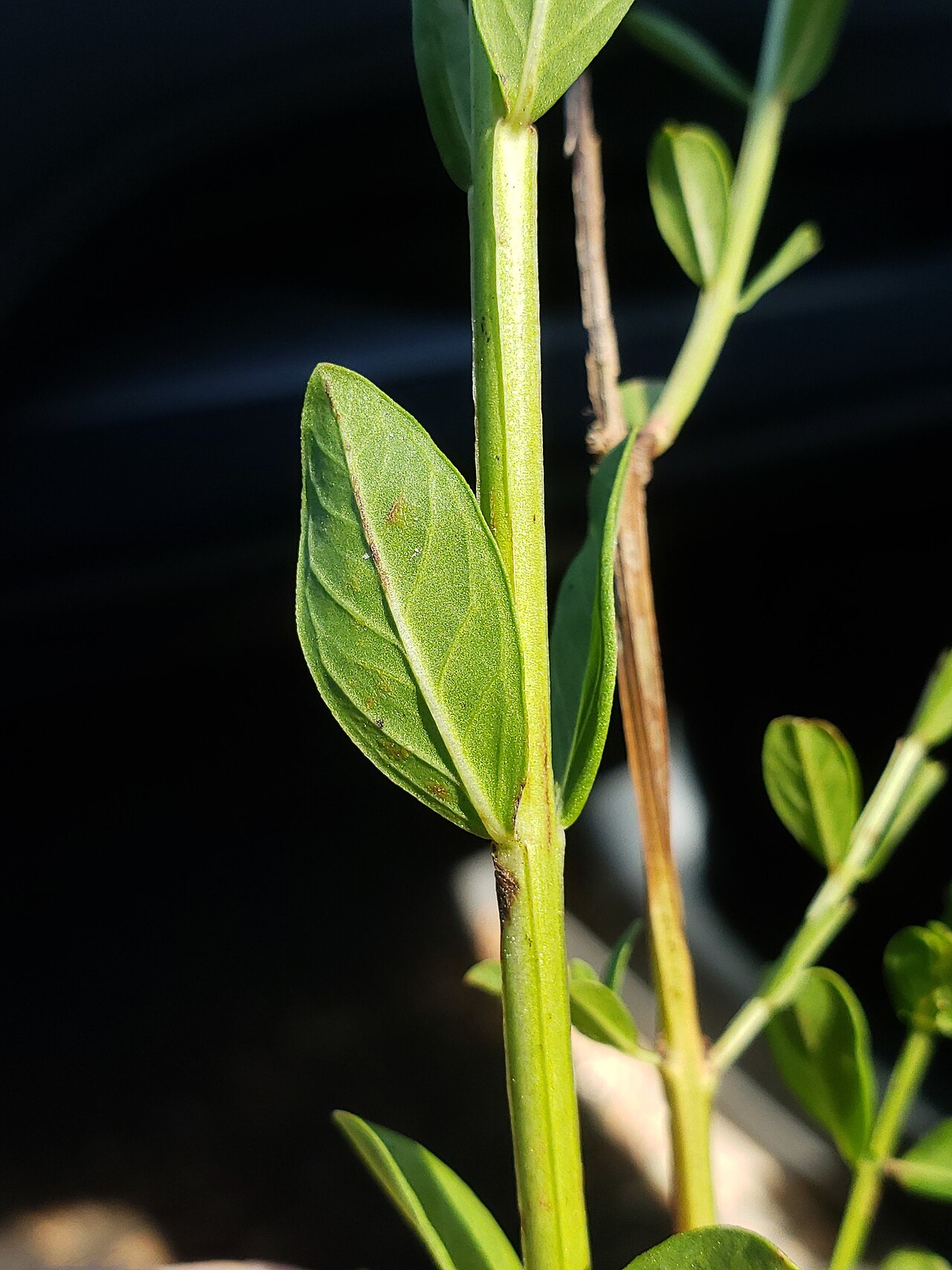
Plants grow from a rhizome and form loose clumps of several stems, 1 to 3 feet tall (occasionally to 4 feet), often branching in the upper half. The stems are smooth, four-angled and have narrow, thin wings along the angles.
Leaves
The leaves are small, about 1/2 to 2 inches long, lance-shaped to narrowly oblong, smooth and stalkless, with a rounded or slightly heart-shaped base. Lower leaves are usually opposite, and upper leaves are alternate. They become smaller toward the top of the stem.
Flowers
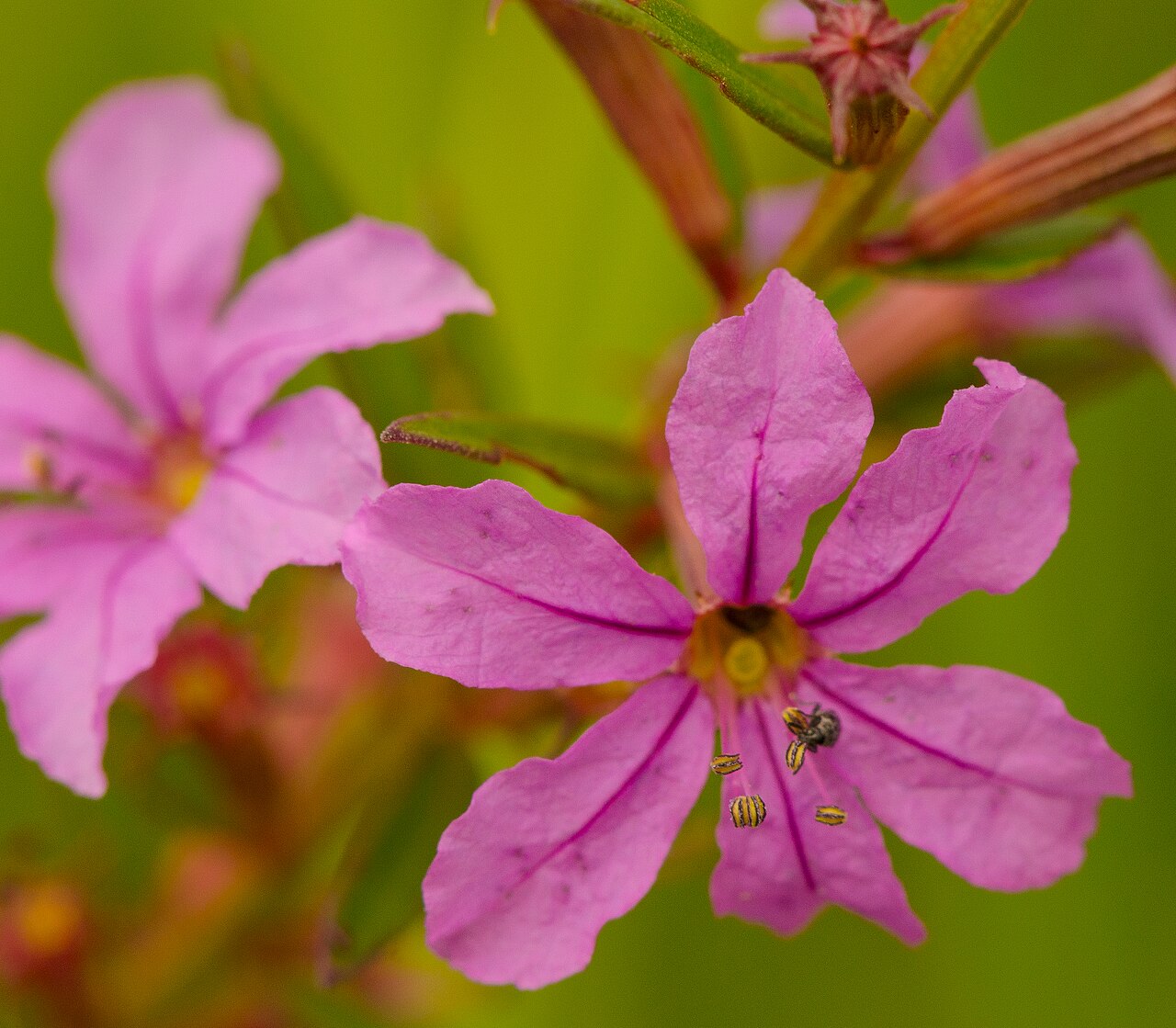
Single flowers (sometimes two) grow on very short stalks from the axils of the upper leaves. Each is about 1/2 inch across, with six crinkled, magenta, rose-purple or lavender petals that have a darker central vein, sitting on a narrow green floral tube. Plants have two flower forms with different style and stamen lengths, which encourages cross-pollination. Flowering runs from about June to September.
Fruit
The fruit is a small capsule enclosed in the persistent floral tube. It splits to release many tiny seeds in late summer and fall.
Look-alikes
Purple loosestrife (Lythrum salicaria), an invasive Eurasian plant, is much taller (3 to 7 feet), with downy stems, opposite or whorled leaves and dense, showy spikes of many flowers at each node. Winged loosestrife has only one or two flowers per leaf axil and is smooth. Swamp loosestrife (Decodon verticillatus) is a woody-based plant with arching stems and clusters of flowers. Fringed loosestrife (Lysimachia) is in a different family and has yellow flowers.
Quick Facts
| Scientific Name | Lythrum alatum |
| Family | Lythraceae (loosestrife family) |
| Plant Type | Herbaceous perennial wetland wildflower |
| Mature Height | 1–3 ft |
| Mature Spread | 1–2 ft |
| Growth Rate | Moderate |
| Sun Exposure | Full sun to part shade |
| Water Needs | High; moist to wet soil |
| Soil Type | Wet loam, clay, muck or sandy soil |
| Soil pH | Slightly acidic to alkaline (about 6.0–8.0) |
| Bloom Time | Early summer to early fall (June–September) |
| Flower Color | Magenta, rose-purple or lavender |
| Fall Color | Leaves sometimes turn reddish |
| Fruit | Small capsules with many tiny seeds |
| Deer Resistant | Moderately; seldom heavily browsed |
| USDA Hardiness Zones | 3–9 |
Native Range
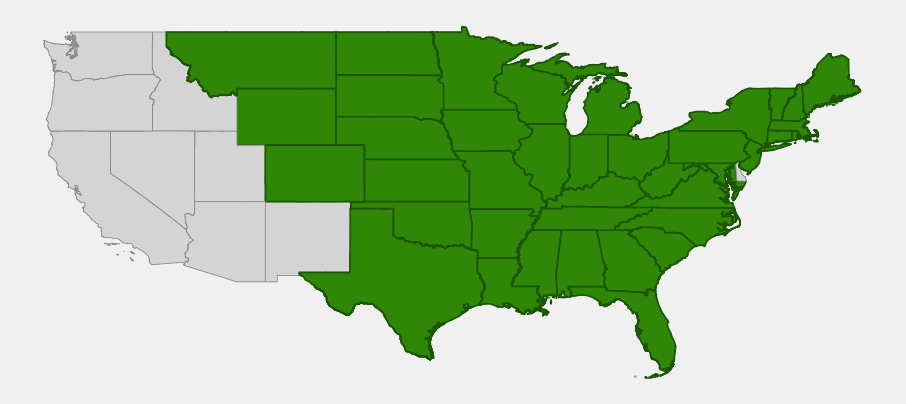
Winged loosestrife is native to central and eastern North America. USDA PLANTS records it from 39 states and the province of Ontario, from Maine and the Great Lakes south to Florida and Texas and west across the Great Plains to the Dakotas, Nebraska, Kansas and Oklahoma.
It is most common in the wet prairies and sedge meadows of the Midwest (Illinois, Iowa, Indiana, Wisconsin, Michigan, Missouri and Minnesota) and on the Coastal Plain of the Southeast, where the southern variety lanceolatum grows. It is scarcer in the Northeast and New England, where it is found at scattered sites. USDA also lists outlying records from Colorado, Montana and Wyoming at the western edge of its range.
It grows in open, sunny, wet places: wet and mesic prairies, sedge meadows, fens, marshes, wet savannas and pine flatwoods, lake and pond shores, stream banks, wet ditches and seepy roadsides. It is often a sign of good-quality native wet prairie in the Midwest.
📋 Regional plant lists featuring Winged Loosestrife: New York, Pennsylvania & Northern New Jersey · Ohio & Indiana · Montana & Wyoming · Michigan, Wisconsin & Eastern Minnesota · Kentucky & Tennessee · Nebraska, Kansas & Eastern Colorado · Connecticut, Massachusetts & Rhode Island · New Hampshire, Maine & Vermont · Maryland, Virginia & West Virginia · Delaware, Southern New Jersey & Long Island · Illinois, Iowa & Missouri · Alabama, Georgia & Mississippi · North & South Florida · North & South Carolina · Arkansas, Louisiana, Eastern Oklahoma & Eastern Texas · North Dakota, South Dakota & Western Minnesota
Growing & Care Guide
Winged loosestrife is easy to grow in any sunny spot that stays moist. It is sold by many Midwestern native plant nurseries as plants and seed.
Light
Full sun is best for compact plants and heavy flowering. It tolerates light shade, but becomes leggier and blooms less.
Soil & Water
Plant in moist to wet soil: loam, clay, muck or sand. It tolerates seasonal flooding and saturated soil, and it does well in rain gardens and at pond edges. It does not tolerate long dry periods, so water it during droughts if it grows in a garden bed.
Planting Tips
Set out plants in spring, about 12 to 18 inches apart. Because individual plants are slender, plant them in groups of three or more for a good show. Combine them with other wet-prairie plants such as swamp milkweed, blue vervain, mountain mints and sedges.
Pruning & Maintenance
Little care is needed. Cut back old stems in late winter or early spring. It spreads slowly by rhizomes and seeds but is not aggressive.
Propagation
Grow from seed sown on the surface of moist soil; seeds need light to germinate, and a period of cold, moist stratification improves results. Plants can also be divided in spring or grown from stem cuttings.
Landscape Uses
- Rain gardens: tolerates wet feet and periodic flooding
- Pond and stream edges: a slender, long-blooming native for shorelines
- Wet prairie restoration: a characteristic native of wet meadows
- Pollinator gardens: summer-long flowers for bees and butterflies
- A native alternative: a non-invasive substitute for purple loosestrife
Wildlife & Ecological Value
Winged loosestrife supports a wide variety of pollinators over a long blooming season in wetlands and wet prairies.
For Pollinators
The flowers attract long-tongued and short-tongued bees, including bumble bees, small carpenter bees, leafcutter bees and sweat bees. Butterflies and skippers also visit for nectar.
For Birds
It is not a major bird food plant, but its dense stands in wet meadows provide cover for wetland birds and insects that birds eat.
For Mammals
Deer and rabbits sometimes browse it, but rarely heavily.
Ecosystem Role
As a native component of wet prairies and fens, it contributes to the diverse plant community of these increasingly rare habitats. Its rhizomes help bind soil along shores and ditches.
Cultural & Historical Uses
The genus name Lythrum comes from the Greek lythron, meaning “blood,” possibly for the color of the flowers of some species. The species name alatum means “winged,” for the narrow wings along the stem angles.
Winged loosestrife has been studied by botanists for its two flower forms, with styles and stamens of different lengths. This arrangement, called heterostyly, encourages pollination between different plants. Charles Darwin studied the same phenomenon in purple loosestrife.
Many U.S. states list purple loosestrife as a noxious weed and ban its sale, and its cultivars have sometimes been sold under misleading names. Buy winged loosestrife only from reputable native nurseries.
Frequently Asked Questions
Is winged loosestrife invasive?
No. It is a native North American plant and does not spread aggressively. The invasive species is purple loosestrife (Lythrum salicaria), from Eurasia.
How do I tell winged loosestrife from purple loosestrife?
Winged loosestrife is shorter and smooth, with single flowers in the leaf axils. Purple loosestrife is taller and downy, with dense spikes of many flowers.
Where should I plant winged loosestrife?
In full sun and moist to wet soil, such as a rain garden, pond edge or wet meadow.
When does winged loosestrife bloom?
From about June to September.
Can I buy winged loosestrife?
Yes. Many native nurseries in the Midwest sell plants and seed. Check that the label says Lythrum alatum.

Looking for a nursery that carries Winged Loosestrife?
Browse our native plant nursery directory: Alabama & Arkansas · Colorado, Connecticut, Florida & Georgia · Illinois, Indiana, Iowa & Kansas · Kentucky, Louisiana, Maine, Maryland, Massachusetts, Michigan, Minnesota, Mississippi, Missouri & Montana · Nebraska, New Hampshire, New Jersey, New York, North Carolina, North Dakota, Ohio & Oklahoma · Pennsylvania, Rhode Island, South Carolina, South Dakota, Tennessee, Texas, Vermont & Virginia · West Virginia, Wisconsin & Wyoming