
Sensitive Partridge Pea (Chamaecrista nictitans)
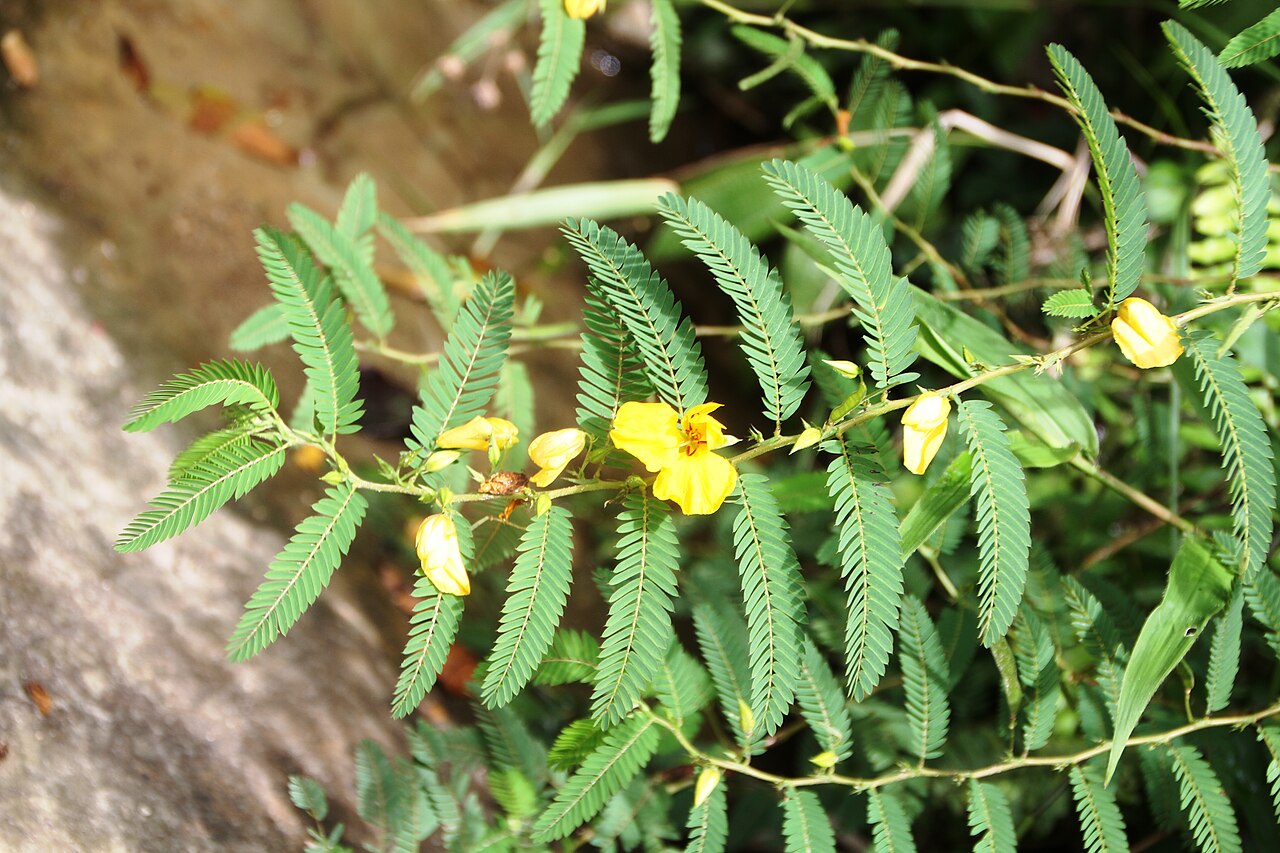
Chamaecrista nictitans, known as Sensitive Partridge Pea (also sensitive pea, small partridge pea or wild sensitive plant), is a slender annual legume of the pea family (Fabaceae). It grows in sandy fields, open woods, prairies, pine savannas, shores and roadsides across the eastern United States, with outlying populations in the Southwest and a wide range in the American tropics, including Puerto Rico.
Its feathery leaves are made of many small leaflets that fold together when touched, much like the tropical sensitive plant. The species name nictitans means “blinking” or “winking” and refers to this movement. From midsummer to fall, small yellow flowers appear on very short stalks in the leaf axils, followed by flat, hairy pods that split open with a twist and fling their seeds.
Sensitive partridge pea is a quiet but valuable wildflower. Its flowers feed bumble bees and other pollen-collecting bees, glands on its leaf stalks offer nectar to ants and wasps, its leaves feed the caterpillars of sulphur butterflies, and its seeds feed quail and other birds. Like many legumes, it improves poor soils through partnerships with nitrogen-fixing root bacteria. It is easy to establish from seed on sunny, sandy sites.
Identification
Sensitive partridge pea looks like a smaller, finer version of the familiar partridge pea. Check the flower size, the number of stamens and the short flower stalks to tell them apart.
Growth Form
It is an annual herb 6 to 20 inches tall, with a single slender stem or several branches that are upright to sprawling. Stems are often reddish and covered with short, curved hairs. Plants may grow singly or form loose patches where seed has fallen.
Leaves
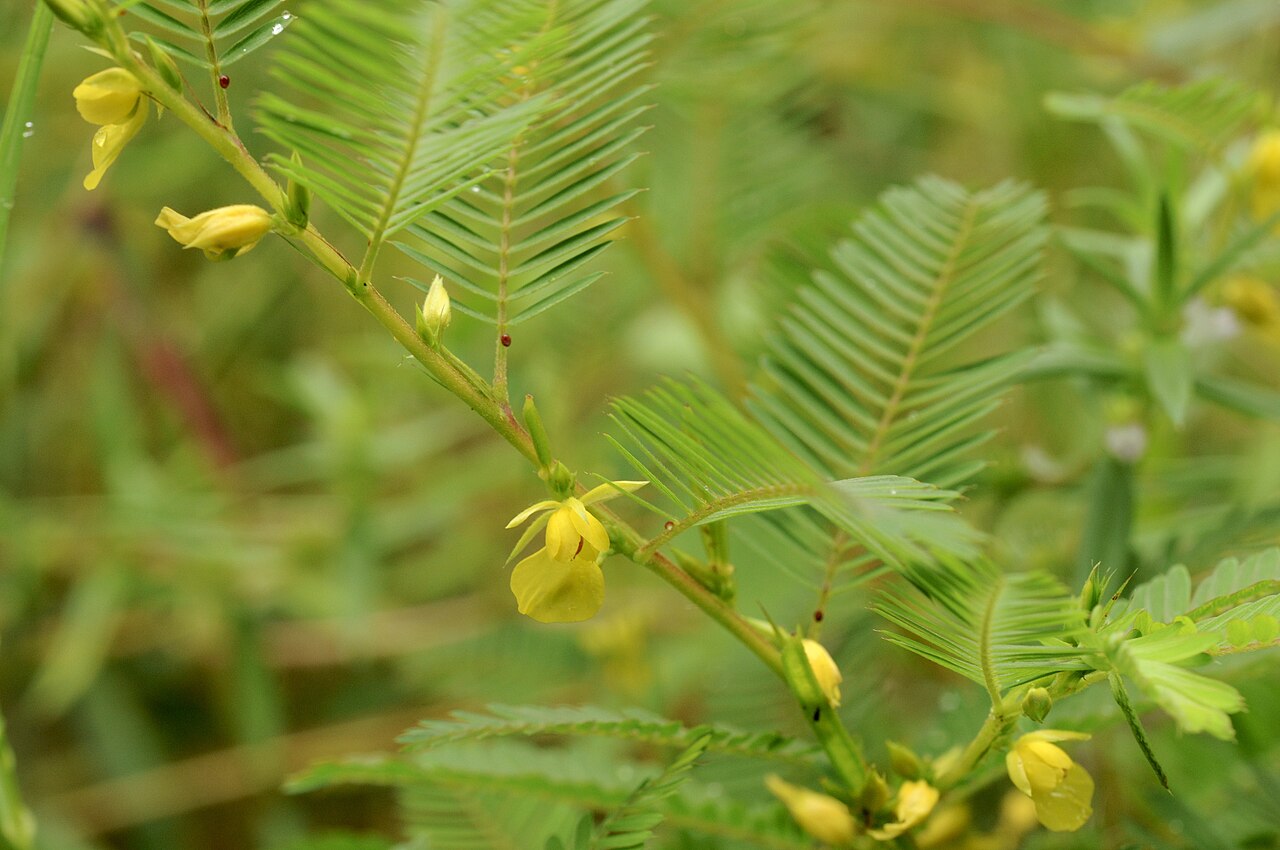
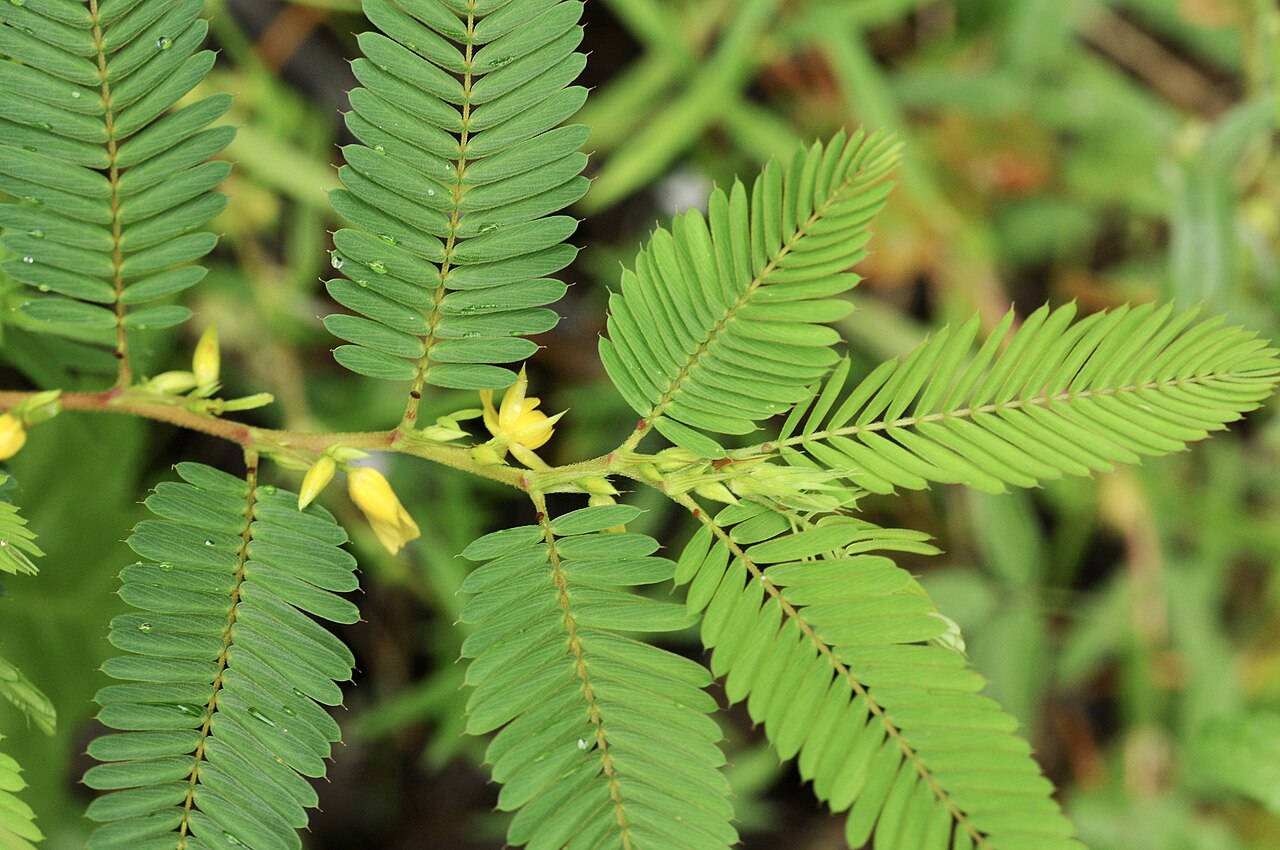
Leaves are alternate and evenly pinnately compound, 1 to 3 inches long, with about 6 to 20 or more pairs of small, narrow-oblong leaflets about 1/4 to 1/2 inch long. A tiny, stalked, cup- or umbrella-shaped gland sits on the leaf stalk below the lowest pair of leaflets. When touched, or at night, the leaflets fold together along the midrib.
Flowers
From July to October, flowers appear singly or in groups of two or three in the leaf axils on stalks only a few millimeters long. Each flower is about 1/4 to 1/2 inch across, with five bright yellow, slightly unequal petals; the lowest petal is the largest. There are five stamens. The flowers are often partly hidden among the leaves.
Fruit & Seeds
The fruit is a flat, narrow, usually hairy pod about 1 to 1 1/2 inches long. When dry, the two halves twist apart suddenly, throwing the small, flat, dark seeds some distance from the plant.
Look-alikes
Partridge Pea (Chamaecrista fasciculata) is larger and showier, with flowers 1 to 1 1/2 inches across on longer stalks, ten stamens (often with red-purple anthers), and often red spots at the petal bases. Sensitive partridge pea has much smaller flowers, five stamens and very short flower stalks. The non-native sensitive plant (Mimosa pudica) has pink, ball-shaped flower heads.
Safety
Sensitive partridge pea is considered poor, undesirable forage, and livestock generally avoid it. It is not a food plant for people. Enjoy it for its wildlife value rather than as an edible or medicinal herb.
Quick Facts
| Scientific Name | Chamaecrista nictitans |
| Family | Fabaceae (pea family) |
| Plant Type | Annual herb (legume) |
| Mature Height | 6–20 in |
| Mature Spread | 6–18 in |
| Growth Rate | Fast |
| Sun Exposure | Full sun to light shade |
| Water Needs | Low to medium; dry to moist, well-drained soil |
| Soil Type | Sandy, gravelly or loamy; tolerates poor soil |
| Soil pH | About 5.0–7.0 |
| Bloom Time | July–October |
| Flower Color | Yellow |
| Fall Color | Foliage may turn reddish-bronze before dying |
| Fruit | Flat, hairy pod, 1–1 1/2 in, splits explosively |
| Deer Resistant | Moderately |
| USDA Hardiness Zones | Annual; grows across zones 4–11 |
Native Range
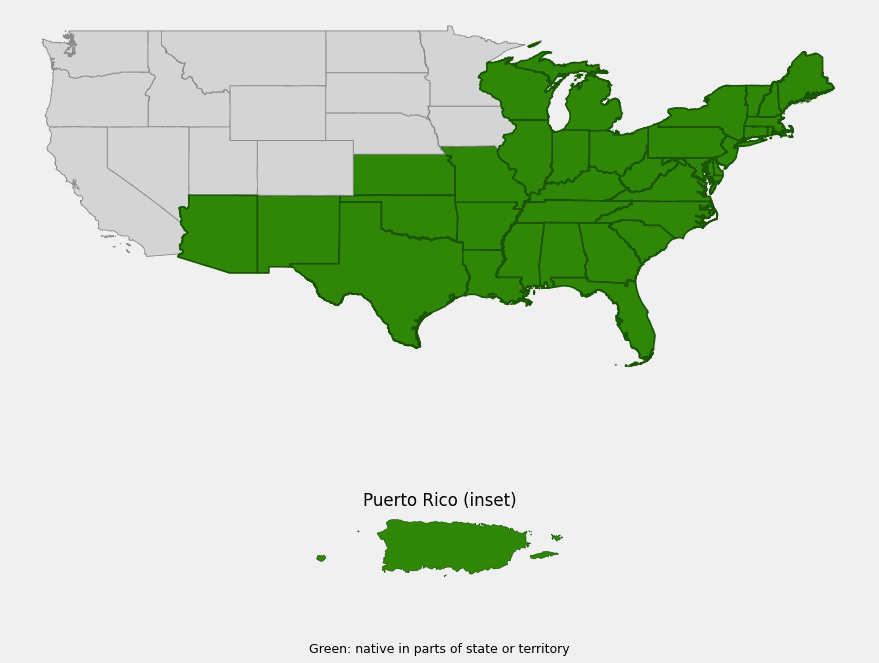
Sensitive partridge pea is widely distributed through the temperate and tropical Americas. USDA PLANTS lists it as native in the lower 48 states, Puerto Rico, the U.S. Virgin Islands and Navassa Island. It has been introduced to Hawaii and to parts of tropical Asia, so Hawaii is not shown as native range here.
In the United States it is most common on the Atlantic and Gulf Coastal Plains and in the Southeast, ranging north to New England, New York, Michigan and Wisconsin and west to eastern Kansas, Oklahoma and Texas. The Lady Bird Johnson Wildflower Center summarizes its range as Vermont to extreme southeastern Kansas, south to Florida and Texas. Outlying populations grow in the mountains of southern Arizona and New Mexico, and northern records near the edge of its range are scattered.
It grows in open, sunny or lightly shaded sites, usually on sandy soils: open woods and woodland edges, pine savannas and sandhills, prairies and old fields, dry or wet sandy shores, thickets and roadsides. It responds well to disturbance such as fire or light soil scraping, which opens space for its seedlings.
📋 Regional plant lists featuring Sensitive Partridge Pea: New York, Pennsylvania & Northern New Jersey · Ohio & Indiana · Michigan, Wisconsin & Eastern Minnesota · Kentucky & Tennessee · Nebraska, Kansas & Eastern Colorado · Connecticut, Massachusetts & Rhode Island · New Hampshire, Maine & Vermont · Maryland, Virginia & West Virginia · Delaware, Southern New Jersey & Long Island · Arizona & New Mexico · Illinois, Iowa & Missouri · Alabama, Georgia & Mississippi · North & South Florida · Puerto Rico · North & South Carolina · Arkansas, Louisiana, Eastern Oklahoma & Eastern Texas · South & West Texas
Growing & Care Guide
Sensitive partridge pea is an annual that is easy to grow from seed on sunny, sandy or poor soils. It is best in meadows, prairie and savanna plantings, sandy slopes and wildlife plots, where it can reseed itself from year to year.
Light
Full sun gives the strongest plants and most flowers. It tolerates light shade at woodland edges and under open pines.
Soil & Water
It prefers well-drained sandy, gravelly or loamy soils of low fertility and handles drought well once growing. Avoid rich, heavily fertilized soil, where grasses and weeds crowd it out. It does not need added nitrogen because it forms root nodules with nitrogen-fixing bacteria.
Planting Tips
Sow seed in fall or early spring on bare or lightly disturbed soil, about 1/4 inch deep. Scarifying the hard seed coat (rubbing it lightly with sandpaper) or a hot-water soak improves spring germination. Mix it with native grasses such as little bluestem and other wildflowers in meadow plantings.
Pruning & Maintenance
No pruning is needed. Leave the plants standing until the pods have opened so they can reseed. Occasional light disturbance, such as burning, mowing in late winter or raking open patches, helps maintain a population over time.
Propagation
Grow it from seed only. Plants complete their life cycle in one season and drop seed that can stay viable in the soil for several years.
Landscape Uses
- Meadows and prairie plantings: a fine-textured annual that fills gaps among grasses
- Sandy slopes and roadsides: stabilizes and enriches poor, sandy soils
- Wildlife and quail plots: seeds feed bobwhite quail and other birds
- Butterfly gardens: larval host for sulphur butterflies
- Pine savanna and sandhill restoration: a native legume for fire-maintained habitats
Wildlife & Ecological Value
Sensitive partridge pea supports a surprising range of wildlife for such a small plant.
For Pollinators
The flowers offer pollen rather than nectar. Bumble bees and other bees collect the pollen by vibrating the flowers (buzz pollination). The small gland on each leaf stalk is an extrafloral nectary that produces nectar visited by ants, wasps, small bees and flies; the ants may help protect the plant from plant-eating insects. The leaves are a caterpillar food plant for sulphur butterflies, including the little yellow (Pyrisitia lisa) and the cloudless sulphur (Phoebis sennae).
For Birds
Northern bobwhite quail and other seed-eating birds, such as sparrows and wild turkeys, eat the seeds, which remain available into fall and winter.
For Mammals
Small mammals eat some seeds. Deer browse it lightly, but it is generally not a preferred forage.
Ecosystem Role
As a legume, it adds nitrogen to poor, sandy soils through root nodules. It is a characteristic plant of fire-maintained savannas, sandhills and open woods, where it quickly appears after fire or disturbance.
Cultural & Historical Uses
The name Chamaecrista means “low crest” and the species name nictitans means “blinking,” for the leaflets that fold when touched. Sensitive partridge pea was long placed in the genus Cassia as Cassia nictitans, and older references use that name.
The Cherokee used sensitive partridge pea, together with wild senna (Senna marilandica), in traditional medicine, including as a treatment for spasms in infants, and it was also used as a cathartic and vermifuge. It should not be used as a home remedy today.
Partridge peas get their common name from their use by gamebirds such as northern bobwhite (sometimes called partridges), and both sensitive partridge pea and partridge pea are planted in wildlife food plots and roadside erosion mixes in the Southeast.
Frequently Asked Questions
Why do the leaves fold when I touch them?
Sensitive partridge pea, like the sensitive plant, can fold its leaflets in response to touch and at night. The movement is caused by rapid changes in water pressure in cells at the base of each leaflet.
How do I tell it from partridge pea?
Sensitive partridge pea has much smaller flowers (about 1/4 to 1/2 inch) on very short stalks and five stamens. Partridge pea has showy flowers 1 to 1 1/2 inches across with ten stamens.
Is sensitive partridge pea an annual?
Yes. It grows, flowers and sets seed in one season, then reseeds itself in sunny, open ground.
Is it good for butterflies?
Yes. It is a caterpillar host for sulphur butterflies such as the little yellow and cloudless sulphur, and bees collect its pollen.
Is it native to Hawaii?
No. It is native to the continental United States, Puerto Rico and the American tropics, but introduced in Hawaii.

Looking for a nursery that carries Sensitive Partridge Pea?
Browse our native plant nursery directory: Alabama, Arizona & Arkansas · Connecticut, Delaware, Florida & Georgia · Illinois, Indiana & Kansas · Kentucky, Louisiana, Maine, Maryland, Massachusetts, Michigan, Mississippi & Missouri · New Hampshire, New Jersey, New Mexico, New York, North Carolina, Ohio & Oklahoma · Pennsylvania, Rhode Island, South Carolina, Tennessee, Texas, Vermont & Virginia · West Virginia & Wisconsin