
Prairie Nymph (Herbertia lahue)
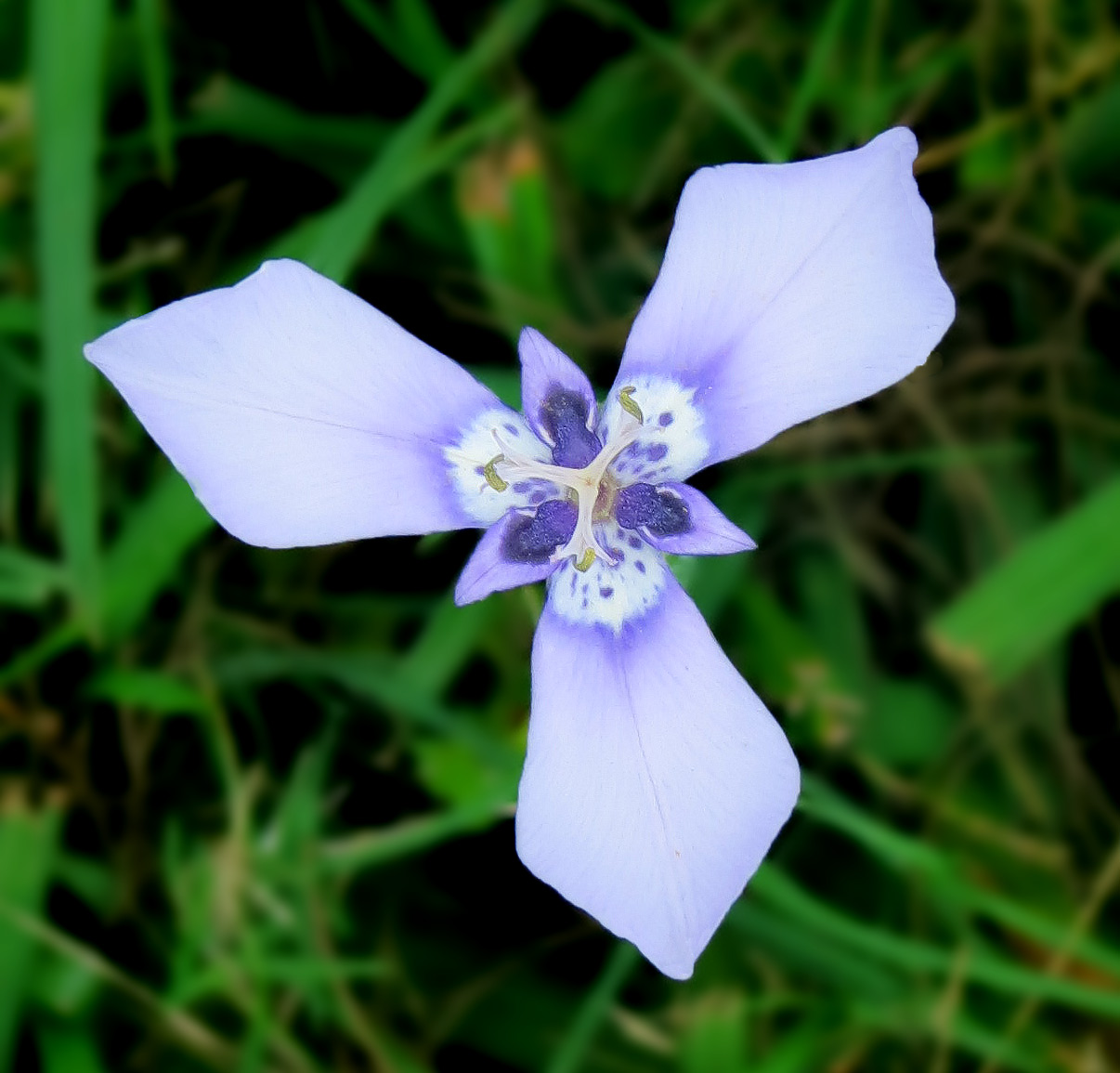
Herbertia lahue, known as Prairie Nymph or prairienymph (the USDA spelling), is a small native bulb of the iris family (Iridaceae) found in the coastal prairies and grasslands of Texas, Louisiana and Mississippi. In early spring it opens delicate, iris-like flowers of pale blue to violet, each with three broad petals around a white center finely spotted with dark purple.
It is a tiny plant, only a few inches tall, with narrow, grass-like leaves, and each flower lasts just one day, opening in the morning and closing by late afternoon. Over two weeks or so of bloom in March to May, a colony can dot a meadow, pasture or even an unmowed lawn with color.
Prairie nymph has an unusual distribution: the same species also grows in southern South America, while plants in the United States are often treated as a separate subspecies. This guide covers how to identify it, where it grows, how to grow it from seed, and its value for bees.
Identification
In spring, look low in short grass for small, flat, three-petaled blue-violet flowers with a white, purple-spotted center, held on short stems above narrow, pleated, grass-like leaves.
Growth Form
A small perennial from a bulb about the size of a marble, buried a few inches deep. Each plant forms a small tuft of leaves only a few inches tall and sends up one or more short flowering stems, usually 4 to 10 inches tall. Plants are dormant from late spring until fall rains.
Leaves
The leaves are few, narrow, grass-like and lengthwise pleated, up to about 8 to 12 inches long but often lying among grasses, so the plant is very hard to find out of bloom.
Flowers
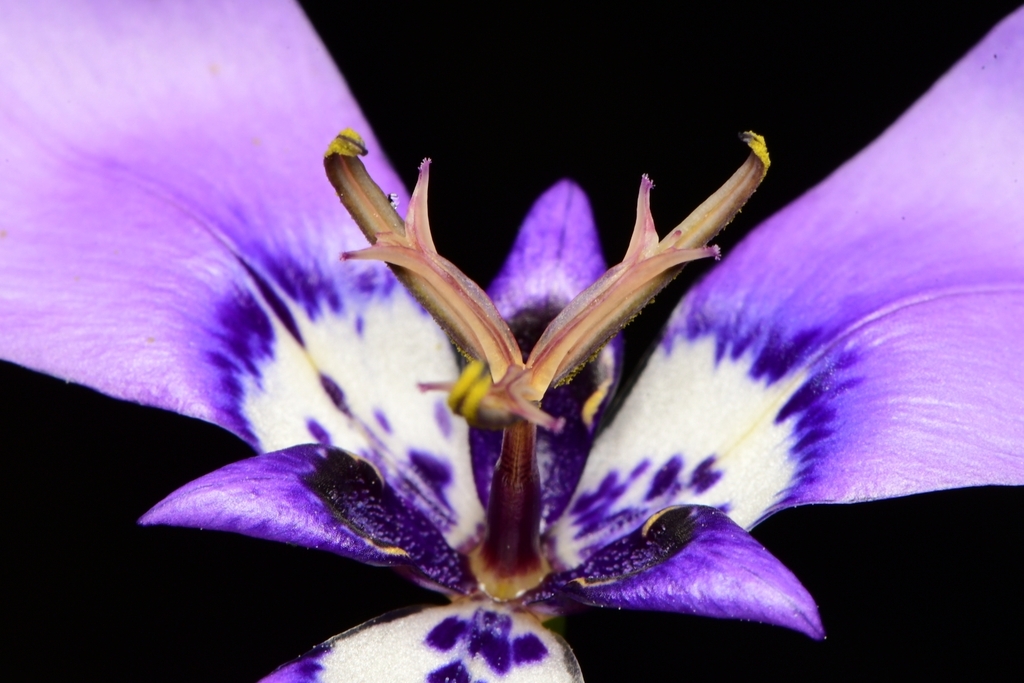
Each flower is about 1½ to 2 inches across. The three large outer tepals (petals) are broad, spreading and pale blue to lavender or violet, with a white base spotted and streaked with deep violet. The three inner tepals are very small and dark, and the style is divided into forked branches. Flowers open in the morning and close by late afternoon, and each lasts one day. Bloom is mainly March to May.
Fruit & Seeds
The fruit is a small, oblong capsule that splits into three parts in late spring, releasing many small, angular brown seeds.
Similar Species
Prairie celestial lily (Nemastylis geminiflora) has six equal, sky-blue tepals and a white center without purple spots. Purple pleatleaf (Alophia drummondii) has darker purple flowers on taller plants with broader pleated leaves. Blue-eyed grasses (Sisyrinchium) have smaller flowers with six equal tepals and a yellow eye.
Quick Facts
| Scientific Name | Herbertia lahue |
| Family | Iridaceae (iris family) |
| Plant Type | Perennial bulb (spring wildflower) |
| Mature Height | 4–10 in |
| Mature Spread | 2–4 in |
| Growth Rate | Slow; 2–3 years from seed to bloom |
| Sun Exposure | Full sun to part shade |
| Water Needs | Moderate in winter and spring; dry in summer |
| Soil Type | Sand, loam or clay; tolerates heavy prairie clays |
| Soil pH | About 6.0–8.0 |
| Bloom Time | March–May |
| Flower Color | Pale blue to violet with a white, purple-spotted center |
| Fall Color | None; dormant in summer |
| Fruit | Small three-part capsules |
| Deer Resistant | Mostly; too small to attract much browsing |
| USDA Hardiness Zones | 8–10 |
Native Range
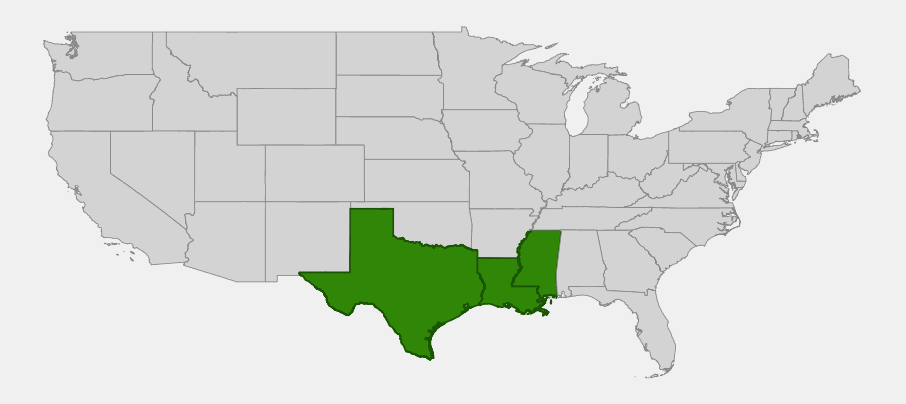
In the United States, prairie nymph is native to Texas, Louisiana and Mississippi. It is most common on the Gulf Coast prairies of Texas and southwestern Louisiana, from the Houston area south through the Coastal Bend toward Corpus Christi, and it extends inland into the post oak savannas and prairies of central and east Texas. USDA PLANTS also records it in Florida, but the Atlas of Florida Plants treats it as not native there, known only from Escambia County, so Florida is not included on the map.
Outside the United States, the species grows in southern South America, in Chile, Argentina, Uruguay and southern Brazil. The North American plants are often treated as a separate subspecies, Herbertia lahue subsp. caerulea, and some older books call them Herbertia caerulea.
It grows in coastal and inland prairies, savannas, meadows and pastures, and it often persists in mowed roadsides, cemeteries, parks and old lawns where native prairie soil has not been plowed. Mowing in summer, while the bulbs are dormant, does it no harm.
📋 Regional plant lists featuring Prairie Nymph: Alabama, Georgia & Mississippi · Arkansas, Louisiana, Eastern Oklahoma & Eastern Texas · South & West Texas
Growing & Care Guide
Prairie nymph is a charming small bulb for prairie gardens, meadows and “lawn alternatives” along the Gulf Coast and in central and east Texas. The Lady Bird Johnson Wildflower Center calls it easy to grow. Its main needs are winter and spring moisture, a dry summer rest and low competition.
Light
It grows in full sun to part shade. It flowers best with several hours of sun but tolerates light shade at the edge of trees.
Soil & Water
It grows in sandy, loamy or clay soils, including the heavy black clays of the coastal prairie. Moisture in winter and spring supports growth and bloom; in summer the bulbs are dormant and tolerate dry soil.
Planting Tips
Plant it where it will not be overgrown by tall grasses or groundcovers, such as at the front of a border, in a short-grass meadow or in a lawn that is mowed high and not treated with herbicides. It combines well with Drummond phlox, pink evening primrose and blue-eyed grass.
Pruning & Maintenance
Do not mow until after the seed capsules ripen and the leaves begin to yellow in late spring. After that, mowing does no harm, since the plants are dormant. Avoid broadleaf herbicides in lawns where it grows.
Propagation
Grow it from seed, sown in fall on the surface of soil or a pot of gritty mix and lightly covered. Seedlings form small bulbs and usually bloom in two to three years. Established clumps slowly increase and self-sow. Buy seed from native seed suppliers; do not dig bulbs from the wild.
Landscape Uses
- Prairie and meadow gardens: early spring color low among grasses
- Lawn alternatives: blooms in high-mowed, herbicide-free lawns
- Rock gardens and containers: a tiny bulb best seen up close
- Pollinator plantings: spring pollen for native bees
- Coastal prairie restoration: part of the native spring flora
Wildlife & Ecological Value
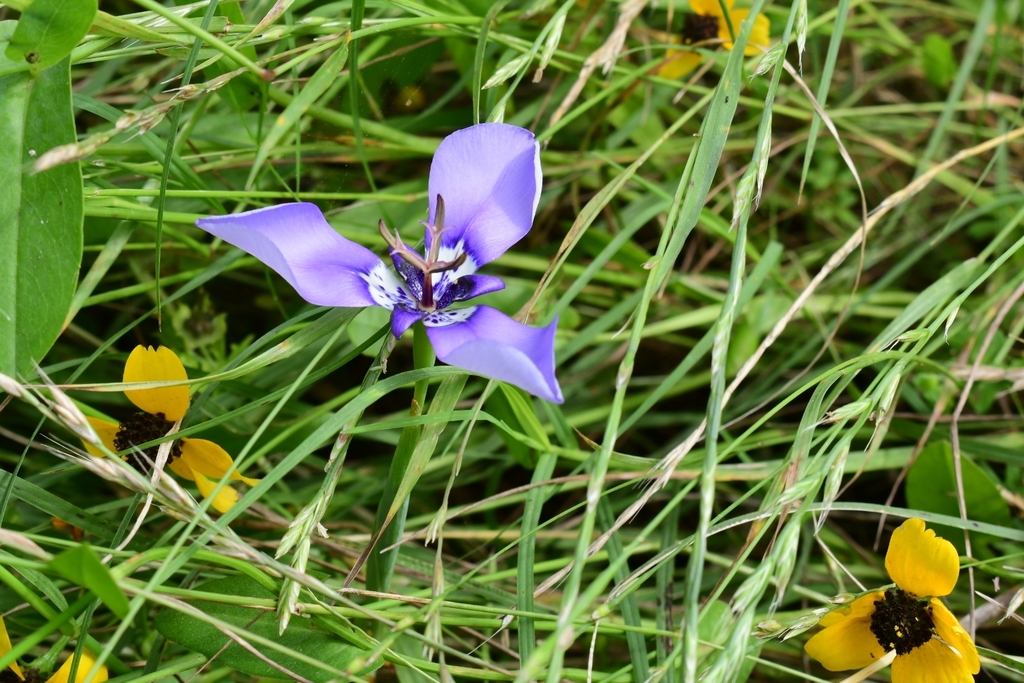
Small as it is, prairie nymph is part of the early spring flowering of the Gulf Coast prairies, when many native bees are just emerging.
For Pollinators
The Lady Bird Johnson Wildflower Center lists it as a nectar plant for bees. Small native bees visit the open flowers for pollen and nectar during their short daily opening.
For Birds
Birds benefit indirectly from the insects that visit the flowers, and some ground-feeding birds may eat the small seeds.
For Mammals
Rodents such as pocket gophers may eat the bulbs. The plants are too small to be important browse for deer.
Ecosystem Role
As one of several spring-blooming bulbs of the coastal prairie, it adds diversity to a disappearing native grassland and is often a sign of unplowed prairie soil in old pastures and lawns.
Cultural & Historical Uses
The genus Herbertia honors William Herbert (1778–1847), an English clergyman, politician and botanist who specialized in bulbous plants of the iris and amaryllis families. The species name lahue comes from a native Chilean name for the plant, recorded by the Chilean naturalist Juan Ignacio Molina, who described it in the eighteenth century.
The disjunct distribution of prairie nymph, in the Gulf Coast prairies of North America and in southern South America, has long interested botanists. Similar patterns occur in a few other grassland plants that share the climates of both regions.
Its common name, prairie nymph, suits a plant that appears for only a few weeks each spring, opens each flower for a single day and then vanishes underground for the rest of the year.
Frequently Asked Questions
Why do the flowers close in the afternoon?
Each flower opens in the morning and closes by late afternoon, lasting only one day. New flowers open over a period of about two weeks.
Can I grow prairie nymph in my lawn?
Yes, in its native region. Mow high, avoid herbicides, and wait to mow until the leaves start to yellow in late spring. After that the bulbs are dormant and mowing does no harm.
Is prairie nymph native to Florida?
USDA PLANTS lists it in Florida, but the Atlas of Florida Plants treats it as not native there, with only an Escambia County record. Its native range in the United States is Texas, Louisiana and Mississippi.
How do I tell prairie nymph from celestial lily?
Prairie nymph has three large petals with a white, purple-spotted center. Prairie celestial lily has six nearly equal sky-blue tepals and a white center without spots.
Where does prairie nymph grow?
In coastal and inland prairies, pastures and old lawns of Texas, Louisiana and Mississippi, and also in southern South America.

Looking for a nursery that carries Prairie Nymph?
Browse our native plant nursery directory: Louisiana & Mississippi · Texas