
Redstem Springbeauty (Claytonia rubra)
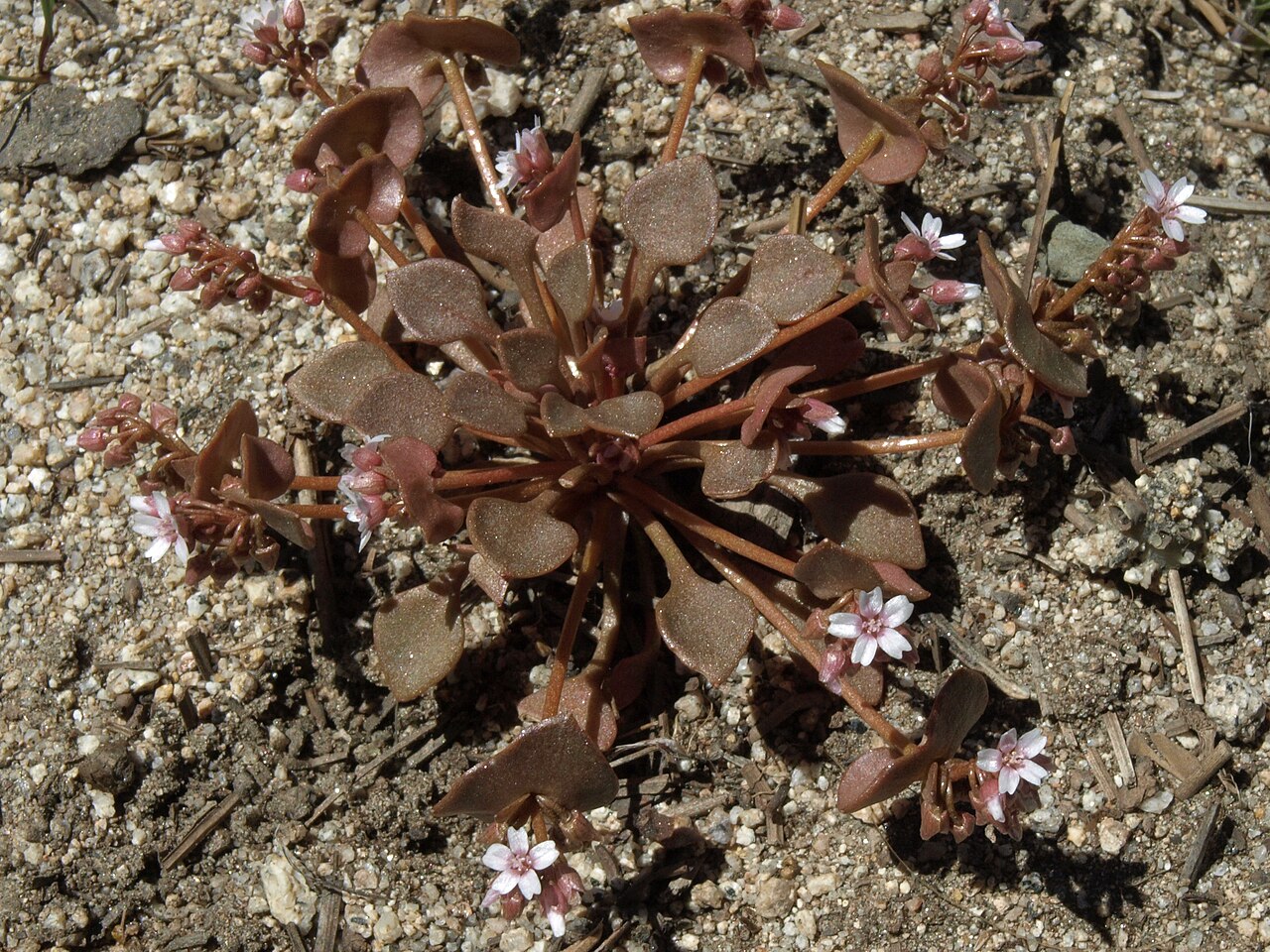
Claytonia rubra, known as Redstem Springbeauty or redstem miner’s lettuce, is a small, spring-flowering annual in the miner’s lettuce family (Montiaceae). It grows across much of the western United States and southern British Columbia, in open conifer and oak woodlands, sagebrush, rocky slopes and gravelly, often disturbed ground. Botanists formerly treated it as part of miner’s lettuce (Claytonia perfoliata), as subspecies mexicana or rubra.
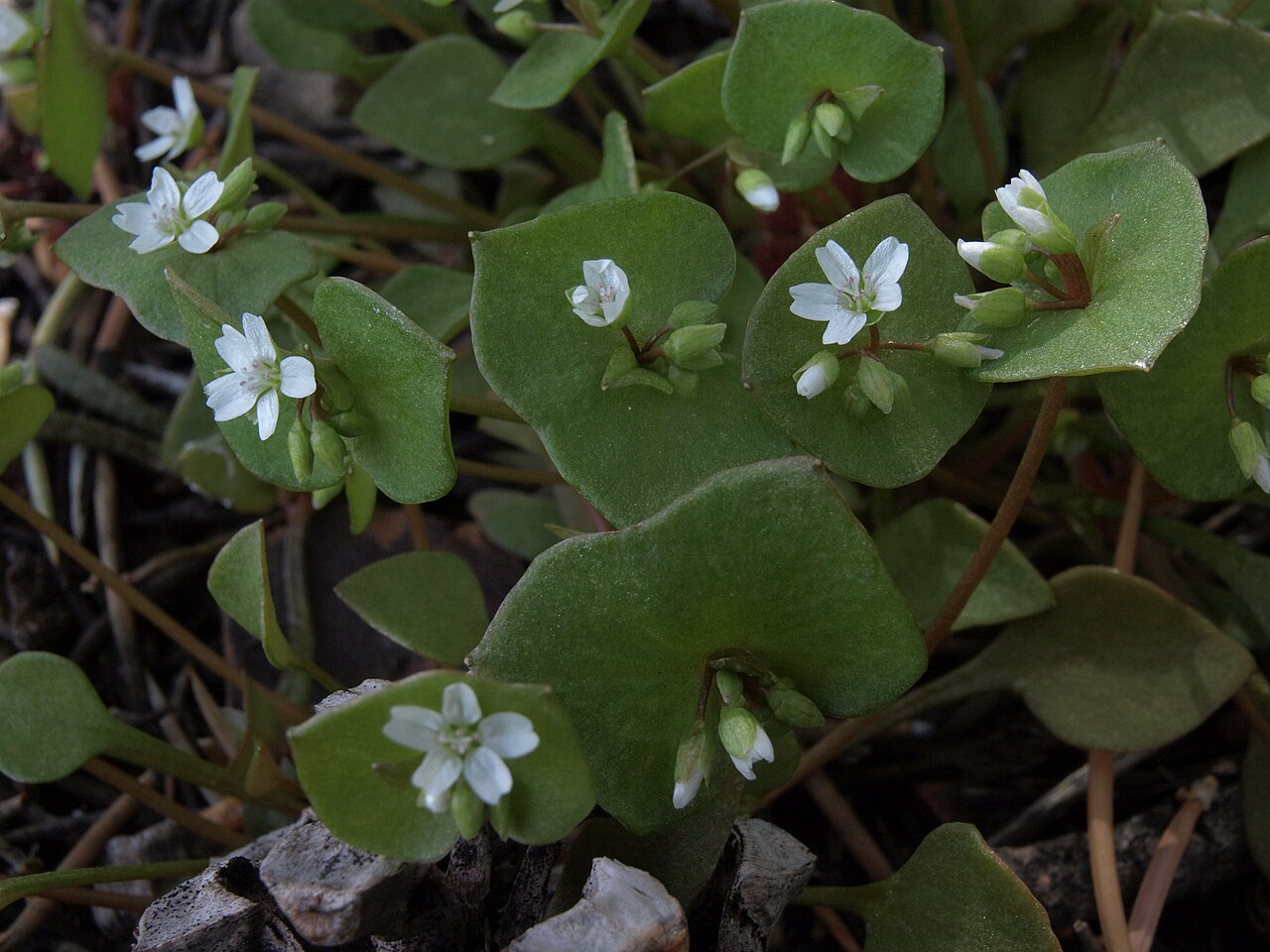
Like miner’s lettuce, it has a rosette of stalked basal leaves and a distinctive pair of stem leaves fused into a round disk or cup, from whose center rise small white to pinkish flowers. Unlike typical miner’s lettuce, its basal leaves are usually narrower, diamond-shaped to spoon-shaped, and in sunny, dry places the whole plant often turns deep red or purplish.
Redstem springbeauty is a common, short-lived wildflower of early spring, growing from fall and winter moisture and setting seed before summer drought. Its leaves are edible in the same way as miner’s lettuce, but it is a small plant best appreciated in the wild or allowed to self-sow in informal native gardens.
Identification
Look for a small annual with a rosette of narrow, stalked basal leaves, often reddish, and one or more stems each topped by a round, fused leaf disk with tiny white or pink flowers in the center.
Growth Habit
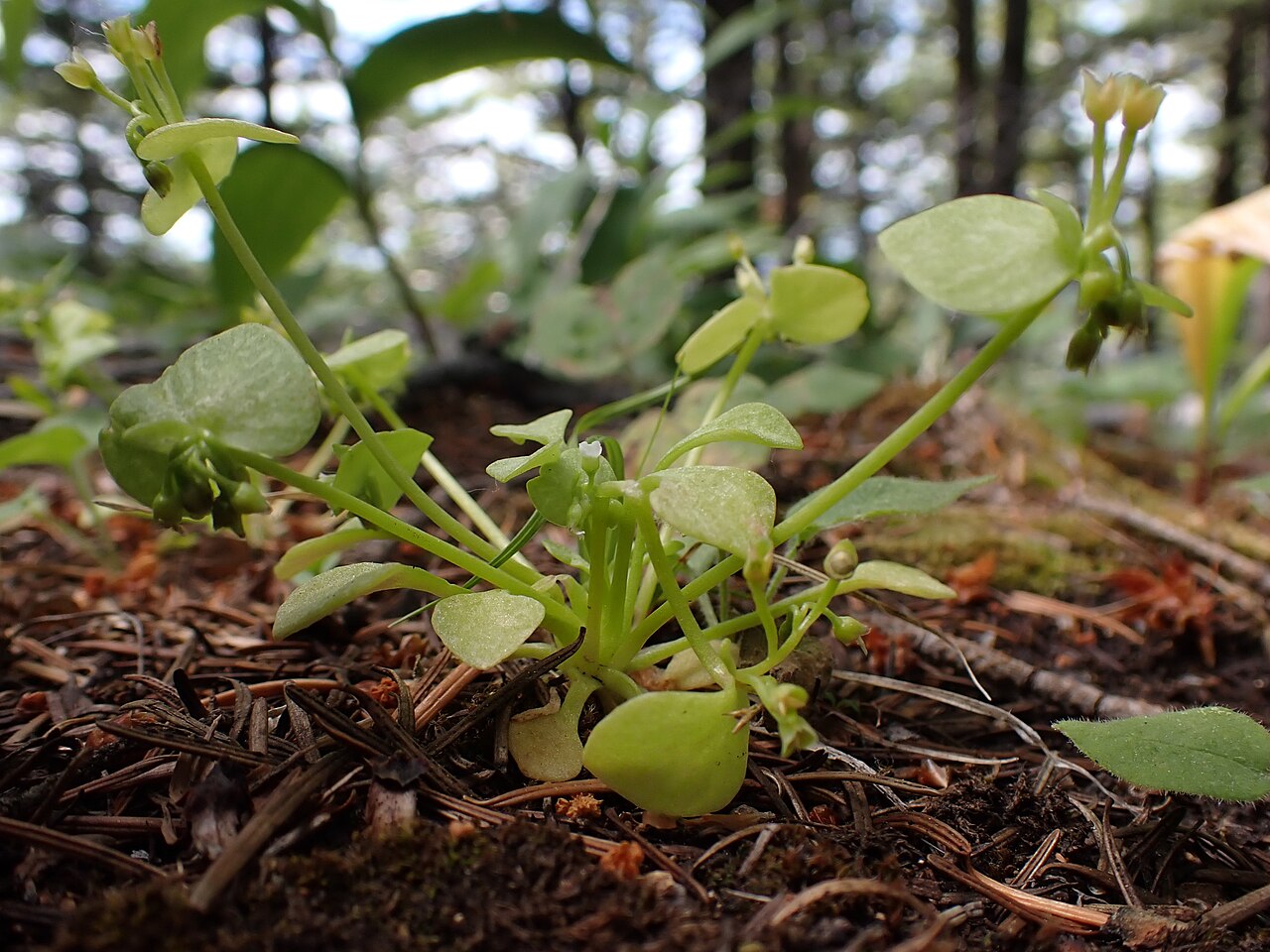
A low, often tufted annual 1 to 8 inches tall. Plants grow from a basal rosette, with several stems spreading or curving upward. Size and color vary greatly with conditions: plants in shade stay green and lax, while those in sun and dry soils are compact and red to purple.
Leaves
The basal leaves have long stalks and small, diamond-shaped to spoon-shaped or linear blades, usually narrower than those of miner’s lettuce, and often reddish. Each stem carries a single pair of leaves fused into a round to slightly two-lobed disk or shallow cup just below the flowers.
Flowers
The flowers are borne in a short cluster above the leaf disk. Each has five small white to pale pink petals, about 1/8 inch long, and two green sepals. Flowering runs from late winter at low elevations into early summer in the mountains, mostly March to June.
Fruit
The fruit is a small capsule that splits into three parts, flinging out a few shiny black seeds.
Subspecies
Two subspecies are recognized. Subspecies rubra is upright, with reddish stems and leaf disks. Subspecies depressa is a low, compact form with stems spreading close to the ground, common in the Sierra Nevada, Great Basin and Pacific Northwest.
Look-alikes
Miner’s lettuce (C. perfoliata) has broader, more rounded basal leaves and is usually greener and larger, mainly in moister, lower-elevation sites west of the Cascades and Sierra. Candy flower (C. sibirica) has separate, unfused stem leaves. Lanceleaf springbeauty is a perennial from a round corm with a pair of narrow, separate stem leaves.
Quick Facts
| Scientific Name | Claytonia rubra (formerly C. perfoliata ssp. mexicana or ssp. rubra) |
| Family | Montiaceae (miner’s lettuce family) |
| Plant Type | Cool-season annual |
| Mature Height | 1–8 in |
| Mature Spread | 2–6 in |
| Growth Rate | Fast |
| Sun Exposure | Full sun to part shade |
| Water Needs | Moist in winter and spring; dry in summer |
| Soil Type | Sandy, gravelly or rocky, well-drained soils |
| Soil pH | Acidic to neutral (about 5.5–7.5) |
| Bloom Time | March–June |
| Flower Color | White to pale pink |
| Fall Color | None; leaves often red in spring |
| Fruit | Small three-valved capsule with black seeds |
| Deer Resistant | No; browsed by deer and rodents |
| USDA Hardiness Zones | Annual; grows where zones 4–9 occur |
Native Range
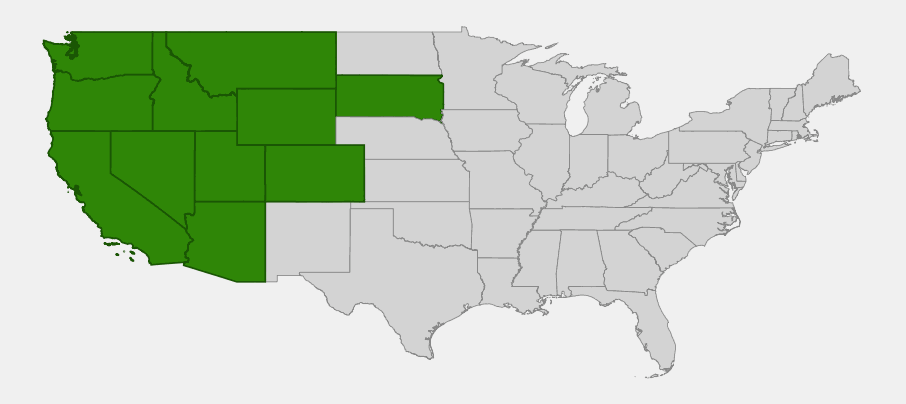
Redstem springbeauty is native to western North America. USDA PLANTS lists it as native in Arizona, California, Colorado, Idaho, Montana, Nevada, Oregon, South Dakota, Utah, Washington and Wyoming, and in Canada it grows in southern British Columbia. USDA also has a record from Virginia, which is far outside the natural range and is not treated as native here.
It is most common in the Pacific Northwest east of the Cascade crest, the Sierra Nevada, the northern Rocky Mountains and the Great Basin ranges, but it also grows west of the Cascades in Washington and Oregon, including the Puget Sound lowlands and parts of western Oregon. In South Dakota it is known from the Black Hills, an outlying, isolated part of its range, and records from Arizona are near its southern limit.
It grows in open ponderosa pine, Douglas-fir and mixed conifer forest, oak woodland, sagebrush and bitterbrush steppe, rocky and gravelly slopes, burned areas and disturbed sites such as trail edges and roadsides, from low elevations to about 9,000 feet.
📋 Regional plant lists featuring Redstem Springbeauty: Idaho, Eastern Oregon & Eastern Washington · Montana & Wyoming · Utah & Western Colorado · Arizona & New Mexico · North Dakota, South Dakota & Western Minnesota · Western Oregon & Western Washington · California & Nevada
Growing & Care Guide
Redstem springbeauty is a self-sowing annual for informal native gardens in the West. It needs cool, moist conditions in late winter and spring and does not mind summer drought, since it has already set seed and died by then.
Light
Full sun to part shade. In shade it grows larger and greener; in sun it stays small and turns red.
Soil & Water
Grow it in well-drained sandy, gravelly or rocky soil. It relies on fall, winter and spring moisture; water only if spring is unusually dry. No summer water is needed.
Planting Tips
Scatter seed in fall on bare, lightly raked soil under open trees, among bunchgrasses or in a rock garden. Let some plants go to seed so they return each year. It is a good companion for spring bulbs and other small annuals.
Pruning & Maintenance
No pruning is needed. Plants die back naturally by early summer. Avoid heavy mulch where you want it to reseed.
Propagation
Grow from seed, sown outdoors in fall so it receives natural winter moisture and cold. Seedlings come up in late winter or early spring.
Landscape Uses
- Native woodland gardens: a small spring annual under open trees
- Rock gardens: reddish rosettes in gravelly soil
- Edible wild greens: leaves eaten like miner’s lettuce, in moderation
- Restoration: spring cover on burned or disturbed ground
- Where to see it: spring trails in pine and sagebrush country of the West
Wildlife & Ecological Value
Redstem springbeauty is one of the earliest spring annuals in many western woodlands and steppes.
For Pollinators
The small flowers are visited by small native bees and flies early in the season, when few other flowers are open. Plants can also self-pollinate.
For Birds
Sparrows, juncos, doves and quail eat the small black seeds.
For Mammals
Deer, ground squirrels, chipmunks and other rodents eat the tender leaves and stems in spring.
Ecosystem Role
It quickly covers bare ground after fire and disturbance, and as a winter annual it uses moisture early in the year before perennial plants are fully active.
Cultural & Historical Uses
The genus name Claytonia honors John Clayton, an 18th-century Virginia plant collector. The species name rubra means “red,” for the reddish color of the plant.
Miner’s lettuce and its relatives, including redstem springbeauty, were eaten as fresh greens by Native peoples of the West and later by miners and settlers during the California Gold Rush, which gave miner’s lettuce its name. The leaves contain oxalates, like spinach, so eat them in moderation, and identify plants carefully before eating any wild plant.
For years redstem springbeauty was lumped with miner’s lettuce. Later revisions of the genus treated it as a separate species, and many older field guides still list it as Claytonia perfoliata.
Frequently Asked Questions
Is redstem springbeauty the same as miner’s lettuce?
They are close relatives with the same round, fused stem leaves. Redstem springbeauty has narrower basal leaves, is often red, and grows in drier, more inland sites. It was formerly treated as part of miner’s lettuce.
Is redstem springbeauty edible?
Yes. Its leaves and stems can be eaten raw like miner’s lettuce. They contain oxalates, so eat them in moderation, and be sure of your identification.
Is redstem springbeauty an annual?
Yes. It sprouts in fall or winter, flowers in spring and dies by early summer after dropping its seeds.
Why is it red?
Plants in sunny, dry or cold sites produce red pigments that may protect the leaves from strong light. In shade they stay green.
Where does redstem springbeauty grow?
Across the western United States and southern British Columbia, mostly in open pine and fir forests, oak woodlands and sagebrush, with an outlying population in the Black Hills of South Dakota.

Looking for a nursery that carries Redstem Springbeauty?
Browse our native plant nursery directory: Arizona · California · Colorado · Idaho · Montana · Nevada · Oregon · South Dakota & Utah · Washington · Wyoming

