
Crown of Thorns (Koeberlinia spinosa)
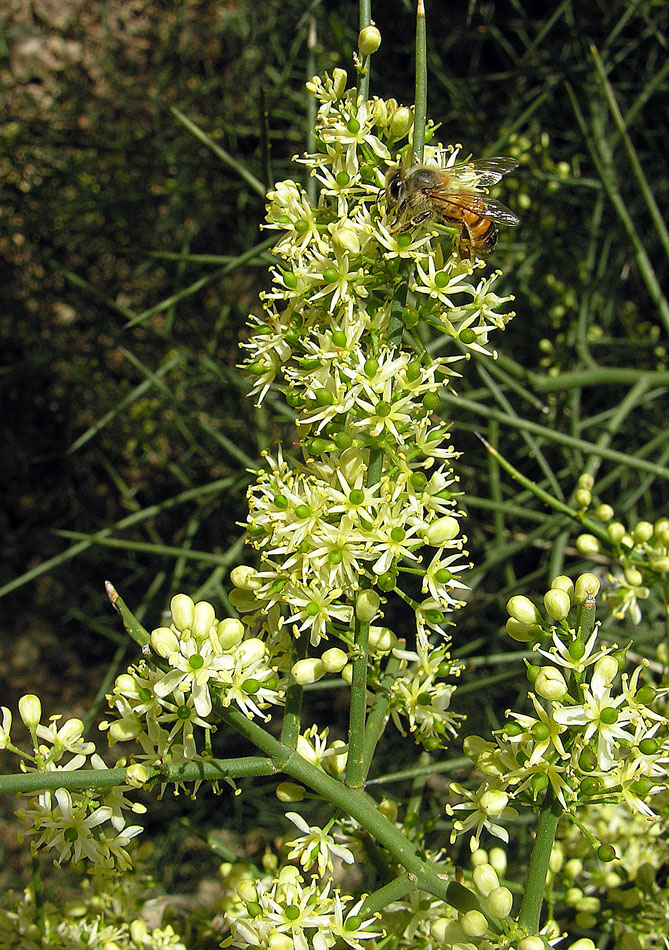
Koeberlinia spinosa, known as Crown of Thorns, allthorn, junco or corona de Cristo, is a dense, nearly leafless, extremely spiny shrub or small tree of the Chihuahuan and Sonoran deserts. Its rigid, green branches end in sharp thorns, so the whole plant looks like a thicket of green spines. It usually grows 3 to 10 feet tall, and old plants can become small trees up to about 20 feet or more.
This native desert plant is not the popular houseplant also called crown of thorns (Euphorbia milii), a spiny succulent from Madagascar. The two are unrelated, and they share only a name inspired by the crown of thorns of Christian tradition. Koeberlinia is so distinctive that it is placed in its own small family, Koeberliniaceae, related to the capers and mustards.
Crown of thorns grows from West and South Texas across southern New Mexico and Arizona to a few sites in the Colorado Desert of southeastern California, and south into northern Mexico. Its green stems do the work of leaves, it blooms after rains with small, fragrant, greenish-white flowers, and its black berries feed desert birds. This guide covers how to identify it, where it grows, its uses as a barrier plant, and its value for wildlife.
Identification
Crown of thorns is unmistakable once you know it: a mass of stiff, green, leafless, sharply pointed branches. Several other desert shrubs share its common names, however.
Growth Habit
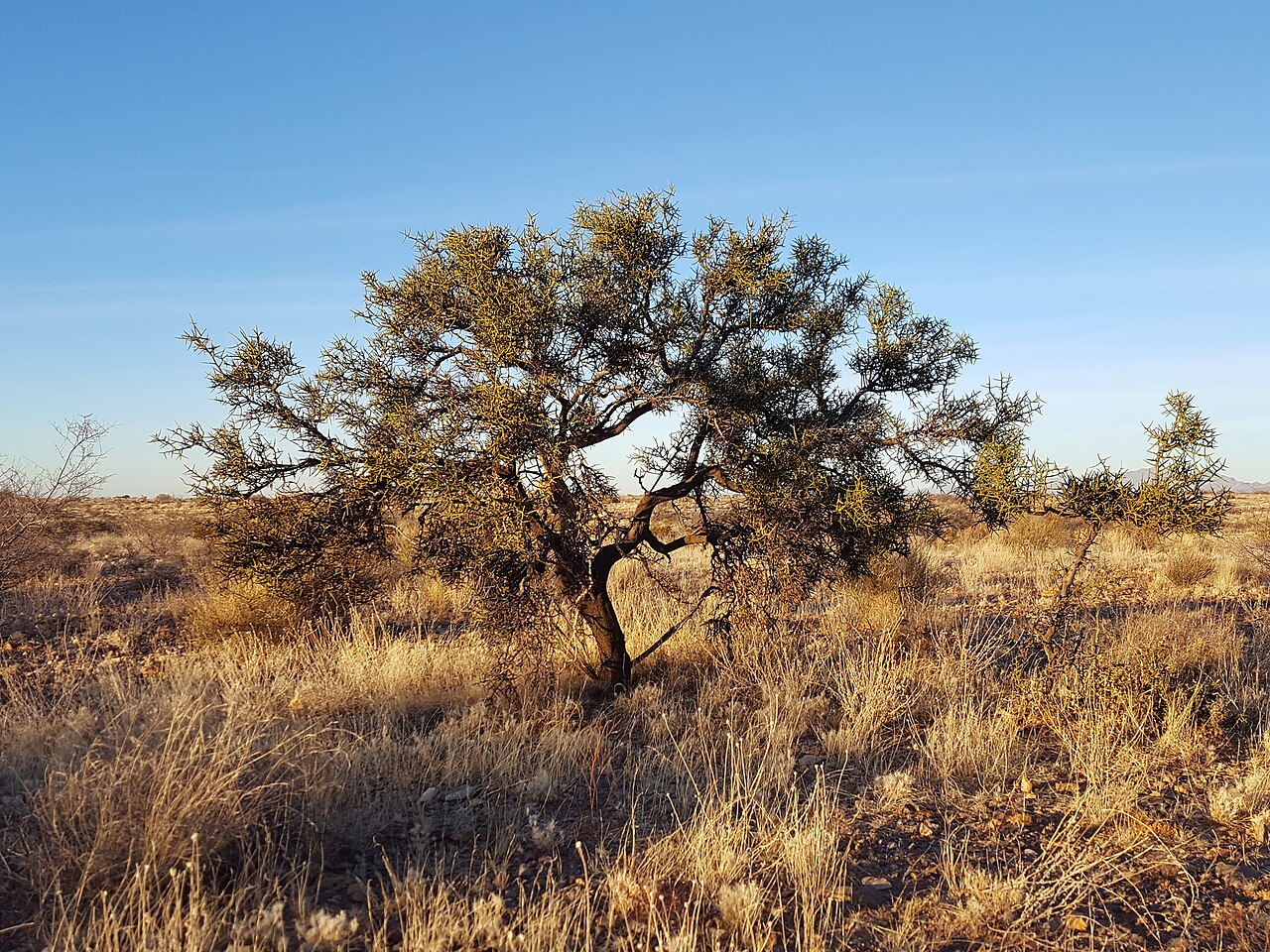
It is a dense, intricately branched shrub, usually 3 to 10 feet tall, forming a rounded thicket. Over decades, some plants develop a short trunk and become small trees, occasionally 20 feet tall or more. Old trunks have gray to brown, shaggy bark.
Stems & Leaves
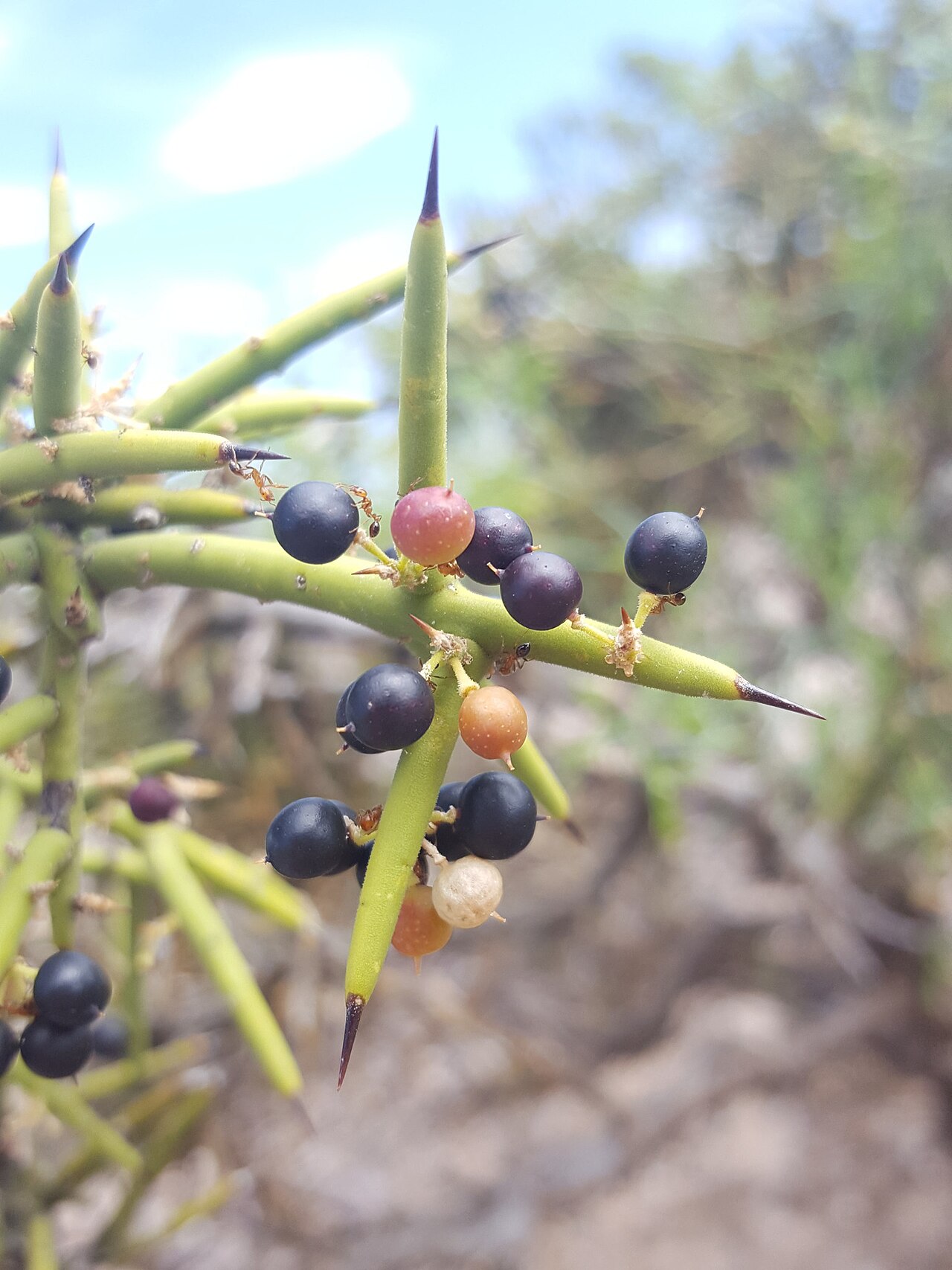
The branches and twigs are smooth, rigid and green to yellow-green, and every twig ends in a sharp thorn. The leaves are tiny scales that fall off soon after they appear, so the plant is effectively leafless and photosynthesizes with its green stems. This saves water in the desert heat.
Flowers
The small flowers, about 1/4 inch across, are borne in short clusters along the stems. They have four greenish-white to cream petals and eight stamens, and they are mildly fragrant. Crown of thorns can bloom from spring to fall, mostly after rains.
Fruit & Seeds
The fruit is a round, glossy berry about 1/4 inch across, ripening from green to red to black, with one or a few seeds. The berries are bitter and are not eaten by people.
Look-alikes
Several unrelated desert shrubs are also called crucifixion thorn, including crucifixion thorn (Canotia holacantha), which has longer, more upright, gray-green stems and woody capsules, and Castela emoryi, which has dry, flattened fruits. Jointfirs (Ephedra) have green, jointed stems but no sharp thorn tips. Remember that the houseplant crown of thorns (Euphorbia milii) has leaves, milky sap and red or pink bracts.
Quick Facts
| Scientific Name | Koeberlinia spinosa Zucc. |
| Family | Koeberliniaceae (allthorn family) |
| Plant Type | Spiny, nearly leafless shrub or small tree |
| Mature Height | 3–10 ft (old plants occasionally to about 20 ft or more) |
| Mature Spread | 4–10 ft |
| Growth Rate | Slow |
| Sun Exposure | Full sun |
| Water Needs | Very low; extremely drought tolerant |
| Soil Type | Dry, well-drained gravelly, rocky, sandy or limy soils; tolerates caliche |
| Soil pH | About 7.0–8.5 |
| Bloom Time | March–October, mostly after rains |
| Flower Color | Greenish-white to cream |
| Fall Color | None; green stems all year |
| Fruit | Small, glossy black berries |
| Deer Resistant | Yes; protected by its thorns |
| USDA Hardiness Zones | 7–10 |
Native Range
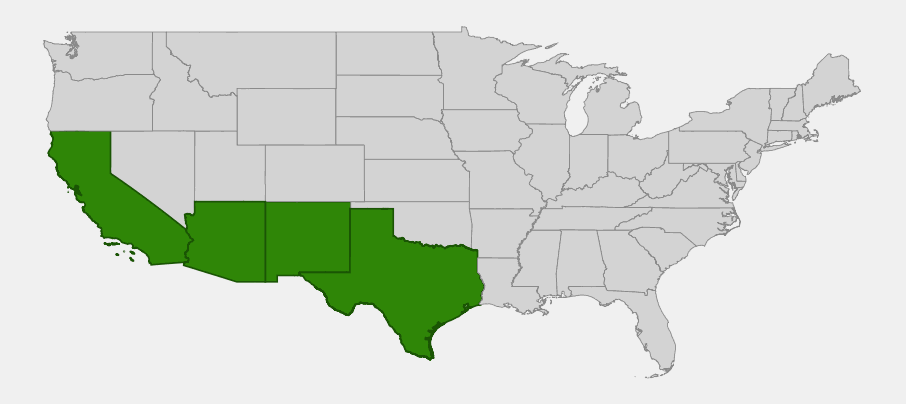
Crown of thorns is native to the deserts and dry grasslands of the southwestern United States and northern Mexico. USDA PLANTS lists it in Arizona, California, New Mexico and Texas. In Mexico it ranges through the Chihuahuan Desert and into Sonora and other northern states.
In Texas it grows mainly in the Trans-Pecos and in the South Texas plains along the Rio Grande, reaching the western edge of the Edwards Plateau. It is common in the Chihuahuan Desert of southern New Mexico and southeastern Arizona, and it extends into the Sonoran Desert of southern Arizona. In California it is rare, known from a few sites in the Colorado Desert of eastern Riverside and Imperial counties.
Typical habitats are desert scrub, desert grassland, mesquite flats, gravelly bajadas, rocky hills and limestone slopes, from about 1,000 to 5,000 feet. Botanists recognize more than one variety: the widespread var. spinosa, and var. tenuispina, with more slender thorns, in the Sonoran Desert of Arizona, California and Sonora.
📋 Regional plant lists featuring Crown of Thorns: Arizona & New Mexico · South & West Texas · California & Nevada
Growing & Care Guide
Crown of thorns is a tough, slow-growing desert native that needs almost no care once established. It is occasionally sold by native plant nurseries in Texas and the Southwest, and it is best used as a barrier or wildlife plant where its fierce thorns are an asset rather than a hazard.
Light
Plant it in full sun. It grows in the open desert and will become thin and weak in shade.
Soil & Water
It needs well-drained soil and does well in rocky, gravelly, sandy and limy soils, including caliche. Water young plants occasionally during their first summer; after that, rainfall alone is usually enough. Overwatering and poor drainage are the main causes of failure.
Planting Tips
Use it as a living barrier along property lines, as a wildlife thicket, or as a sculptural accent in a desert garden. Keep it well away from paths, play areas, pools and places where people or pets might brush against it. Wear heavy gloves and eye protection when planting.
Pruning & Maintenance
Little or no pruning is needed. If you must prune, wear thick gloves, long sleeves and eye protection, and dispose of the thorny clippings carefully, as they can puncture shoes and tires.
Propagation
Grow it from fresh seed collected from ripe black berries. Clean the seeds and sow them in a well-drained mix in warm weather. Germination can be slow and irregular. Seedlings grow slowly and need careful watering until established. Plants do not transplant well from the wild.
Landscape Uses
- Security and barrier hedges: dense, thorny growth that people and animals avoid
- Wildlife thickets: safe nesting and roosting cover for desert birds
- Xeriscapes and desert gardens: green stems all year with almost no water
- Erosion control: holds dry, rocky slopes and gravelly soils
- Habitat restoration: a native of Chihuahuan and Sonoran desert scrub and grassland
Wildlife & Ecological Value
Despite its fierce appearance, crown of thorns is a valuable source of food and shelter in the desert.
For Pollinators
The small, fragrant flowers attract many insects, including native bees, honey bees, wasps and flies. Because it blooms after rains for much of the year, it can provide nectar and pollen when few other plants are flowering.
For Birds
The berries are eaten by desert birds, and the dense, thorny branches offer safe nesting and roosting sites protected from predators. Thorny desert shrubs like this are used for cover by species such as verdins, cactus wrens and quail, and loggerhead shrikes use sharp thorns to impale their prey.
For Mammals
Its thorns protect it from most browsing, but small mammals may eat fallen berries and shelter beneath the plant. Its dense cover is used by rodents, rabbits and lizards.
Ecosystem Role
Crown of thorns is a long-lived, deep-rooted part of the Chihuahuan and Sonoran desert scrub and grassland. Its thickets shelter wildlife and catch windblown soil and seeds, creating small islands of life around them.
Cultural & Historical Uses
The genus Koeberlinia honors Christoph Ludwig Koeberlin, a 19th-century German clergyman and amateur botanist, and the species name spinosa means “spiny.” The plant was described by the German botanist Joseph Gerhard Zuccarini in the 1830s from Mexican specimens.
Its common names, crown of thorns and corona de Cristo, refer to the crown of thorns placed on Jesus’ head in the Christian Passion story. According to popular legend in the Southwest and Mexico, this shrub supplied the thorns. The same names are applied to several unrelated thorny plants around the world, which can cause confusion.
Other common names include allthorn and junco. Because the plant is so distinctive and has no close relatives, it has long interested botanists, who have placed it in several different families before giving it its own.
Frequently Asked Questions
Is this the same as the crown of thorns houseplant?
No. The houseplant crown of thorns is Euphorbia milii, a spiny succulent from Madagascar with milky sap and red or pink flower bracts. Koeberlinia spinosa is an unrelated native desert shrub of the Southwest and Mexico.
Why does crown of thorns have no leaves?
It produces tiny scale-like leaves that fall off almost immediately. Its green stems carry out photosynthesis, which reduces water loss in the hot, dry desert.
Where does crown of thorns grow?
It grows in the Chihuahuan and Sonoran deserts of West and South Texas, southern New Mexico, southern Arizona, a few sites in southeastern California, and northern Mexico.
Is crown of thorns good for wildlife?
Yes. Its flowers feed insects, its berries feed birds, and its thorny thickets shelter birds, small mammals and lizards.
Can I use it as a hedge?
Yes. It makes an excellent drought-tolerant barrier hedge in desert regions, but plant it away from paths and play areas because its thorns are extremely sharp.

Looking for a nursery that carries Crown of Thorns?
Browse our native plant nursery directory: Arizona · California · New Mexico · Texas

