
Roundleaf Bluet (Houstonia procumbens)
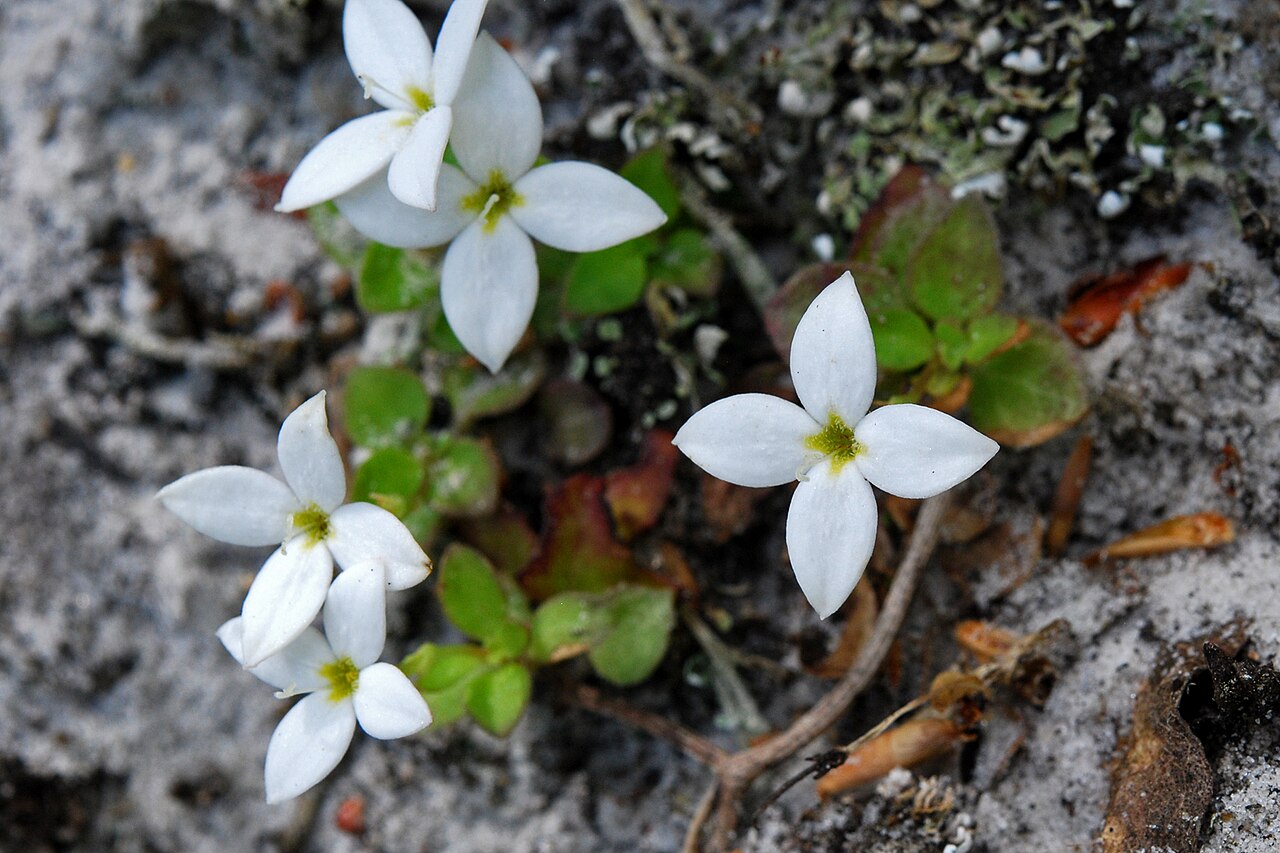
Houstonia procumbens, known as Roundleaf Bluet, is a tiny, creeping native wildflower of the coffee family (Rubiaceae). In Florida it is often called innocence, and it was formerly known as Hedyotis procumbens. It forms low mats of small, round to oval leaves on trailing stems, dotted with starry white, four-lobed flowers for much of the year.
This is a plant of the Southeastern Coastal Plain, found from South Carolina through Georgia and Florida and west along the Gulf Coast to Alabama, Mississippi and Louisiana. It grows in moist to dry, open, sandy places: pine flatwoods, sandhills, scrub, clearings, trail edges, lawns and roadsides. It blooms mainly from about March to October, and in mild parts of Florida it can flower almost year-round.
Although each flower is less than half an inch across, roundleaf bluet is charming up close, and its flowers feed small native bees, flies and butterflies. It is a good choice for sandy gardens, between stepping stones, and in sunny native groundcover plantings in the Deep South.
Identification
Roundleaf bluet is a low, creeping perennial. Look for trailing stems that root at the nodes, small, paired, round to oval leaves, and single white flowers with four spreading lobes on short stalks.
Stems & Growth Habit
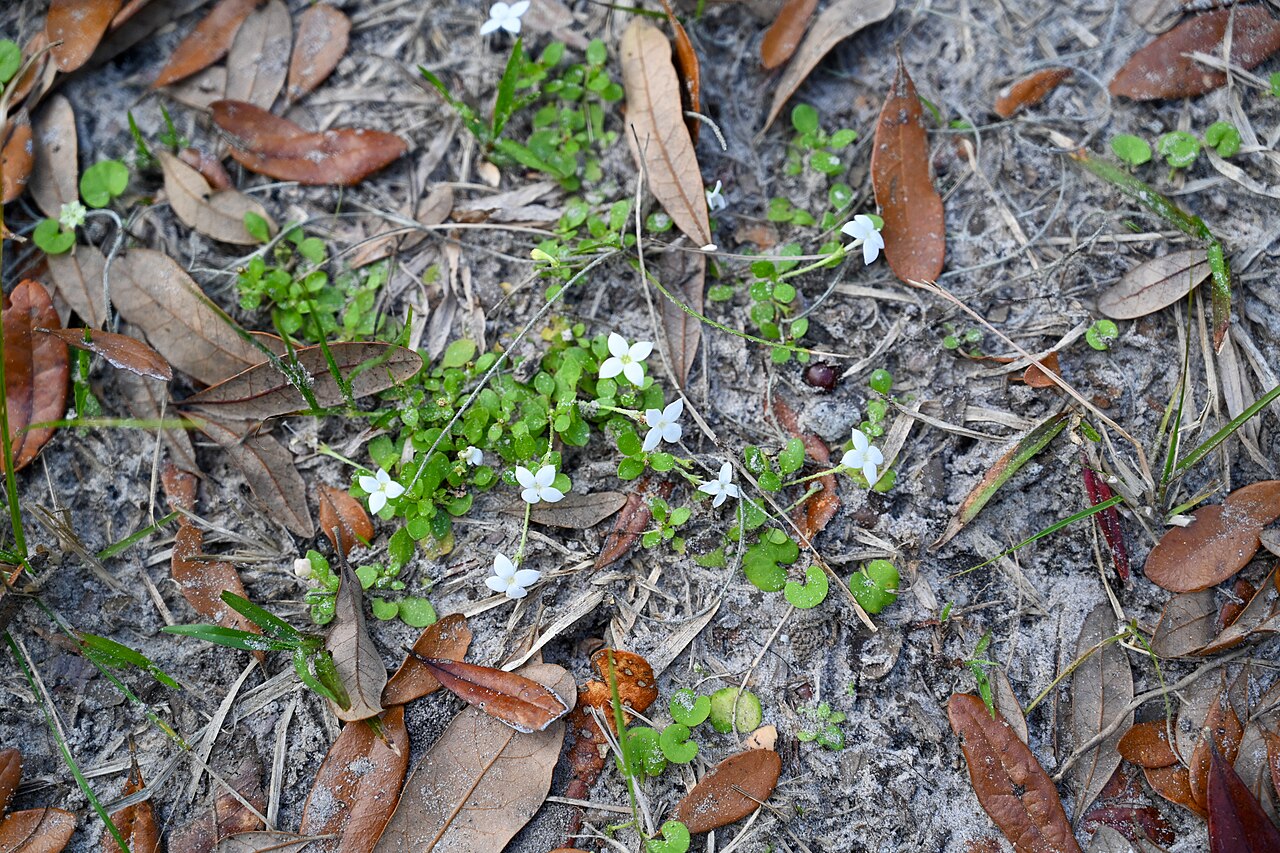
The stems are slender and trail along the ground, up to about 8 inches long, rooting at the leaf nodes to form loose mats. Plants usually stay just 1 to 3 inches tall. Though usually perennial, plants can behave like annuals in some sites.
Leaves
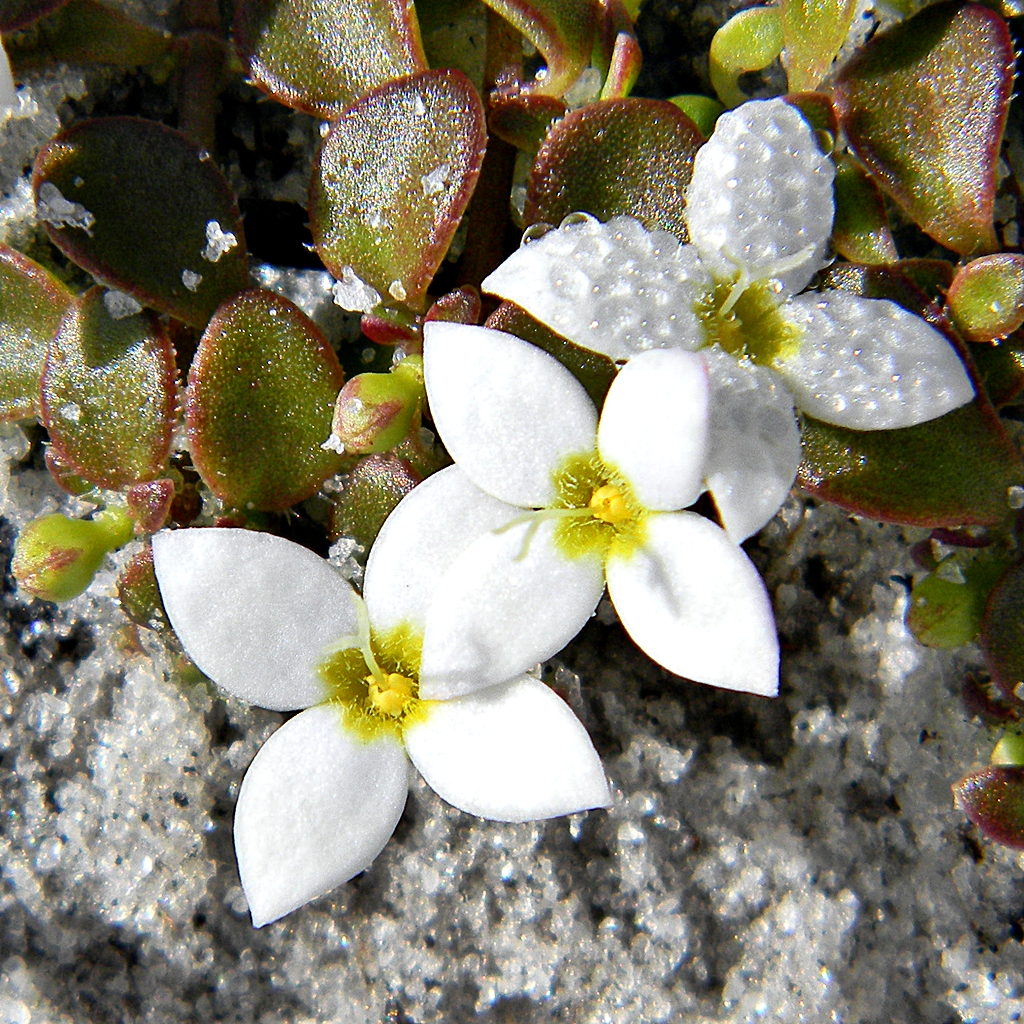
The leaves are opposite, ovate to almost round, and small, only about 1/4 to 3/8 inch long and wide. They are smooth, slightly thick and often edged or tinged with red, especially in sun or cool weather.
Flowers
The flowers are held singly on short, upright stalks from the leaf axils. Each flower is a slender tube that opens into four spreading, pointed white lobes, about 1/4 to 1/2 inch across, with a small yellowish-green center. Some plants have flowers with long styles and short stamens, and others the reverse, a trait shared with other bluets that encourages cross-pollination. Bloom time is mainly March to October.
Fruit & Seeds
The fruit is a small, rounded, two-lobed capsule that splits open across the top to release many tiny seeds.
Look-alikes
Common bluets (Houstonia caerulea) and tiny bluet (Houstonia pusilla) have pale blue to violet flowers and grow mostly farther north or inland. Roundleaf bluet is the creeping, white-flowered bluet of southern sandy coastal plain habitats, with very small round leaves.
Safety
Roundleaf bluet is not known to be toxic. As with any wild plant, do not eat it unless you are certain of its safety.
Quick Facts
| Scientific Name | Houstonia procumbens |
| Family | Rubiaceae (coffee or madder family) |
| Plant Type | Creeping herbaceous perennial |
| Mature Height | 1–3 in |
| Mature Spread | 6–12 in, forming mats |
| Growth Rate | Moderate |
| Sun Exposure | Full sun to part shade |
| Water Needs | Low to medium |
| Soil Type | Sandy, well-drained to moist |
| Soil pH | Acidic |
| Bloom Time | March–October; nearly year-round in mild Florida |
| Flower Color | White |
| Fall Color | Leaves may redden in cool weather |
| Fruit | Small two-lobed capsule |
| Deer Resistant | Generally yes; too small to attract much browsing |
| USDA Hardiness Zones | 8–10 |
Native Range
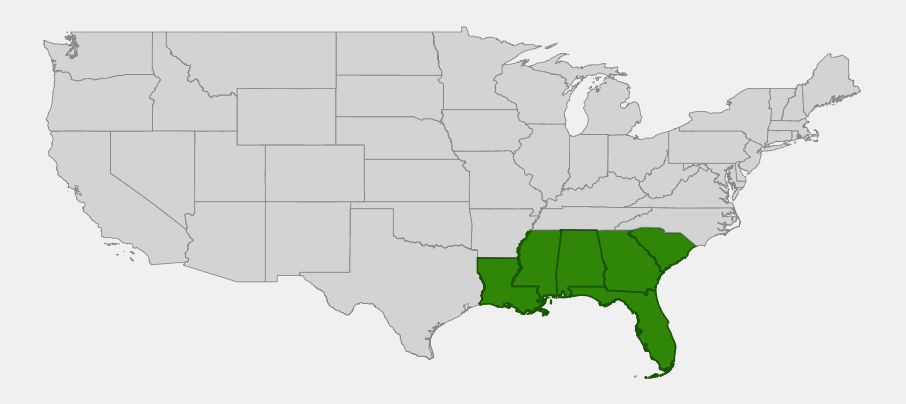
Roundleaf bluet is native to the southeastern United States. USDA PLANTS lists it as native in Alabama, Florida, Georgia, Louisiana, Mississippi and South Carolina. The Lady Bird Johnson Wildflower Center describes its range as the coastal areas of South Carolina to Louisiana.
It is a plant of the Atlantic and Gulf Coastal Plains. It is widespread in Florida and occurs in the coastal counties of South Carolina and Georgia, including the sea islands, and westward through the coastal plain of Alabama and Mississippi to southeastern Louisiana.
It grows in moist to dry, open, sandy places: pine flatwoods, sandhills, coastal scrub and dunes, clearings and openings in oak and pine woods, and disturbed sites such as trail edges, firebreaks, lawns and roadsides. Fire and light disturbance that keep the ground open help it thrive.
📋 Regional plant lists featuring Roundleaf Bluet: Alabama, Georgia & Mississippi · North & South Florida · North & South Carolina · Arkansas, Louisiana, Eastern Oklahoma & Eastern Texas
Growing & Care Guide
Roundleaf bluet is a delicate but easy little groundcover for sunny, sandy sites in the Coastal Plain. It is occasionally offered by Florida native nurseries. It is best in informal spots where it can creep and reseed without competition from taller plants.
Light
Full sun to part shade. It flowers best in open, sunny spots and also grows in the light shade of pines and scrub oaks.
Soil & Water
It needs sandy, acidic soil and grows in both moist and fairly dry sites. Water new plants until they root in; afterward, normal rainfall is usually enough in its native range, though a drink during long droughts helps keep the mats green.
Planting Tips
Plant small plugs about 6 inches apart in bare, sandy soil, between stepping stones, along the edges of paths, or in openings in a sandhill or flatwood garden. Keep taller plants and thick mulch away, since this tiny plant is easily shaded out or smothered.
Pruning & Maintenance
No pruning is needed. Pull competing weeds by hand and avoid heavy mulch. In lawns, it tolerates occasional mowing at a high setting. Patches that thin out often return from seed.
Propagation
The Lady Bird Johnson Wildflower Center recommends planting seeds outside as soon as they ripen, or storing, stratifying and sowing them in spring at a shallow depth; seedlings germinate the first year and flower the second. Rooted pieces of the creeping stems can also be divided and replanted.
Landscape Uses
- Sandy groundcover: a tiny creeping carpet for open sandy spots
- Between stepping stones: softening paths and patios in sunny gardens
- Pollinator gardens: nectar for small native bees, flies and butterflies
- Flatwood and sandhill restoration: part of the native groundcover layer under pines
- Native lawns: a low-growing flowering lawn plant in the Deep South
Wildlife & Ecological Value
Small as it is, roundleaf bluet adds flowers to open sandy ground for many months of the year and supports a range of small pollinators.
For Pollinators
The small white flowers are visited by small native bees, bee flies, hover flies, small butterflies and wasps, which find nectar at the base of the narrow flower tube. Its long bloom season provides food in spring and fall when other flowers may be scarce.
For Birds
The plant offers little direct food for birds, but the insects it supports are eaten by ground-foraging birds in flatwoods and scrub.
For Mammals
It is too small and low to be important browse for deer, though rabbits and other small mammals may nibble it.
Ecosystem Role
Roundleaf bluet is part of the diverse, low groundcover layer of Coastal Plain pinelands, which depends on frequent fire to stay open. It helps cover and hold bare sand and adds to the rich mix of small wildflowers that make longleaf pine and scrub habitats so diverse.
Cultural & Historical Uses
The genus Houstonia honors William Houstoun, an 18th-century Scottish surgeon and botanist who collected plants in the Caribbean and Mexico. The species name procumbens means “lying flat” or “trailing,” describing its creeping stems.
The name innocence is widely used for this plant in Florida, and the same name has long been applied to bluets in general, perhaps for their small, pure white or pale blue flowers. Older references list it as Hedyotis procumbens, from the time when bluets were placed in the large tropical genus Hedyotis.
Bluets are among the few members of the coffee family that are common small wildflowers in the eastern United States. Like coffee, gardenia and partridgeberry, they belong to the Rubiaceae, a huge family that is mostly tropical.
Frequently Asked Questions
Is roundleaf bluet native to Florida?
Yes. It is native to Florida and the rest of the Southeastern Coastal Plain, from South Carolina to Louisiana. In Florida it is often called innocence.
What color are roundleaf bluet flowers?
The flowers are white, with four pointed lobes and a small yellowish-green center. Most other bluets have pale blue or violet flowers.
When does roundleaf bluet bloom?
It blooms mainly from March to October, and in mild parts of Florida it may flower in almost any month.
Can roundleaf bluet be used as a groundcover?
Yes, for small areas. It forms low, creeping mats in sunny, sandy soil and works well between stepping stones or along paths, but it is easily crowded out by taller plants.
Does roundleaf bluet need a lot of water?
No. It grows in both moist and fairly dry sandy soils and usually gets by on rainfall once established.

Looking for a nursery that carries Roundleaf Bluet?
Browse our native plant nursery directory: Alabama · Florida & Georgia · Louisiana & Mississippi · South Carolina