
Scorpion’s-Tail (Heliotropium angiospermum)
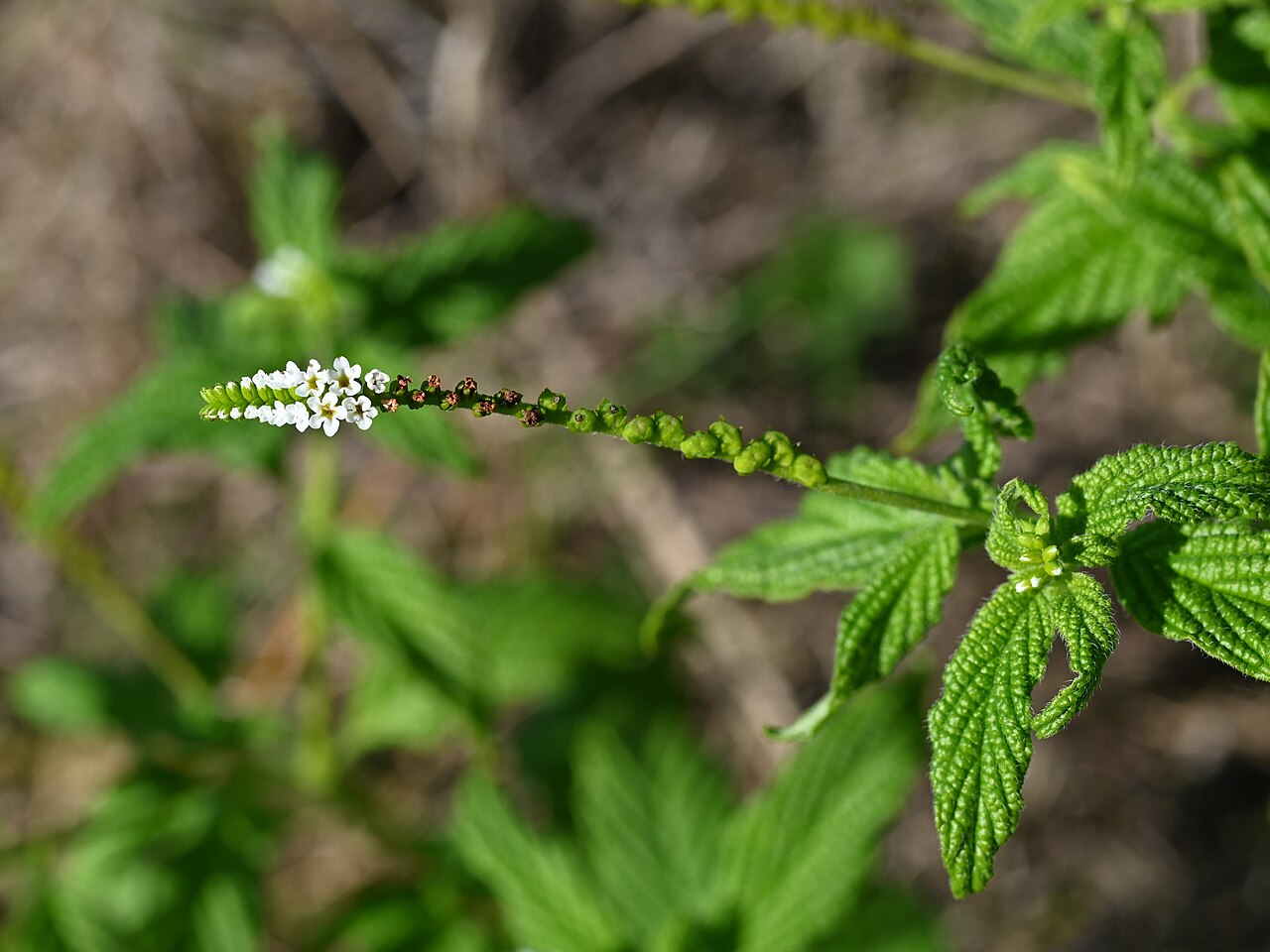
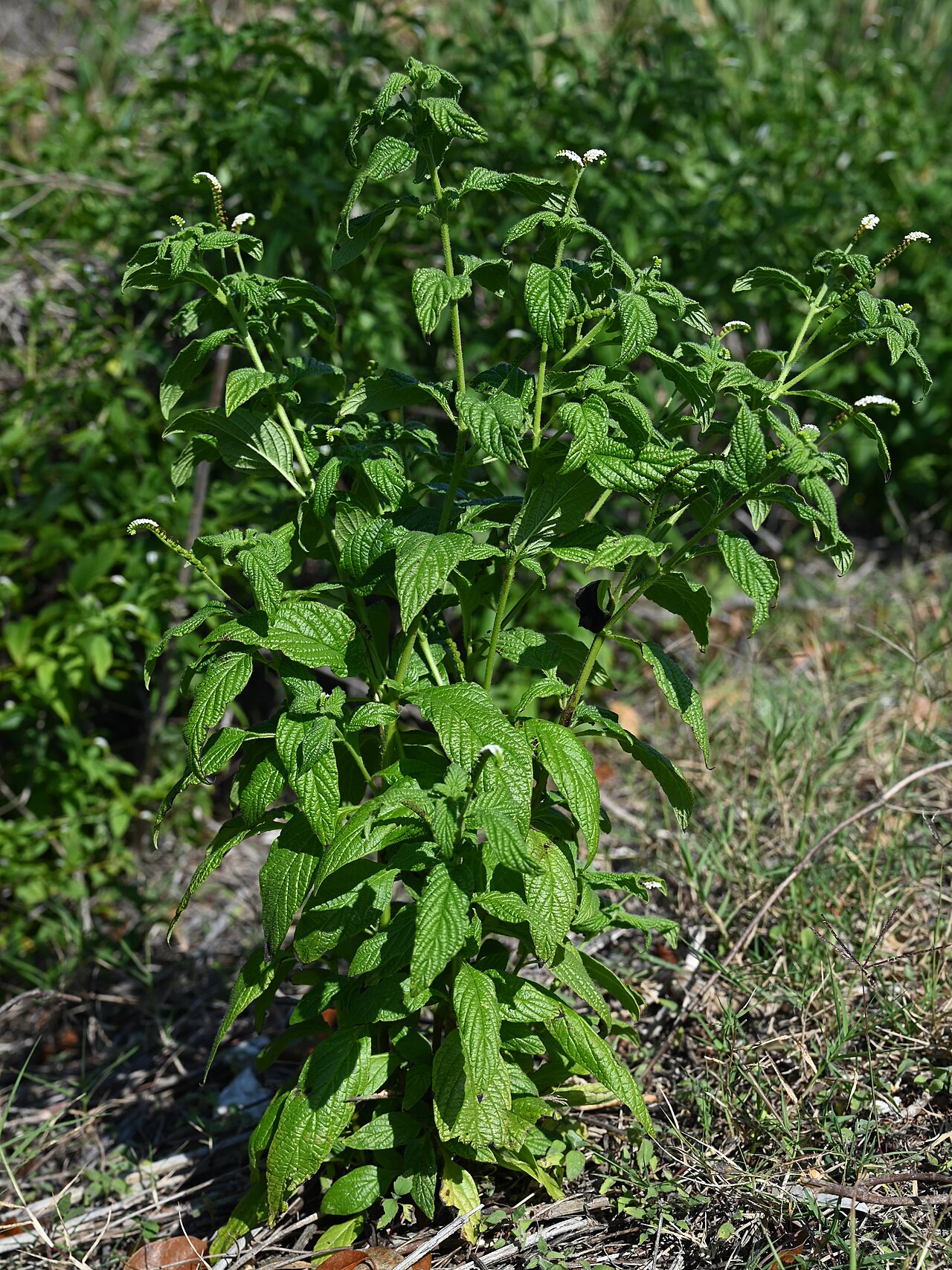
Heliotropium angiospermum, known as Scorpion’s-Tail, is a bushy, short-lived perennial of hammock edges, coastal thickets and open ground in South Florida, South Texas and the tropical Americas. It belongs to the borage family (Boraginaceae), in the heliotrope group. It usually grows 1 to 3 feet tall, with rough, deeply veined, oval leaves.
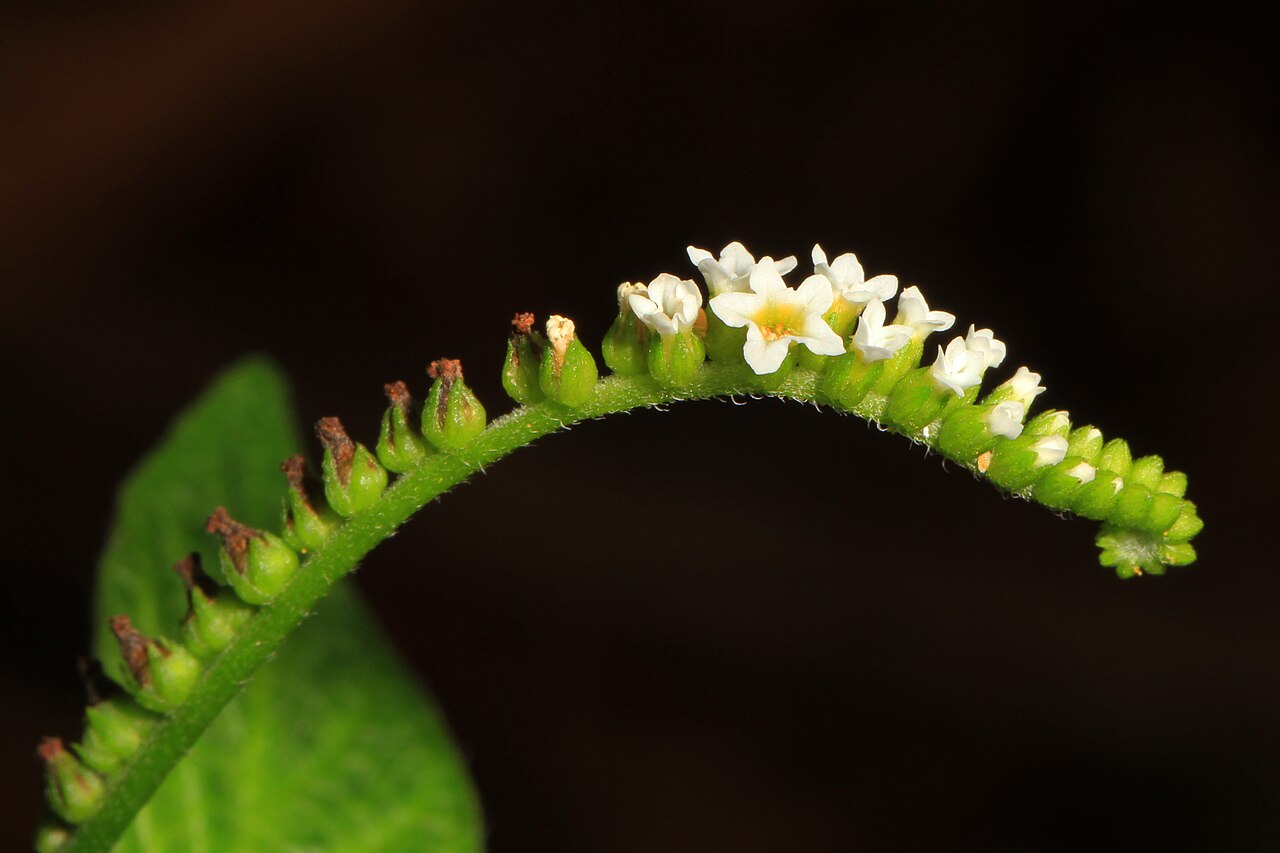
Its common name describes its flower spikes. Each one is a long, slender, curving stalk with a coiled tip, like a scorpion’s tail, that slowly unrolls as tiny white flowers with yellow centers open in a row along its upper side. It can bloom nearly all year in frost-free areas.
Scorpion’s-Tail is easy to grow in warm climates and is a favorite butterfly plant in Florida and South Texas native gardens. It reseeds readily in open, sunny or partly shaded spots. Like other heliotropes it contains toxic alkaloids, so it should never be eaten and should be kept away from grazing livestock.
Identification
Look for a bushy plant with rough, strongly veined leaves and long, curling spikes of tiny white flowers that look like the tail of a scorpion.
Growth Habit
A short-lived herbaceous perennial or small subshrub, often behaving as an annual, with upright, branching, hairy stems 1 to 3 feet tall (occasionally taller). Plants are often woody at the base and can form small, bushy clumps.
Leaves
The leaves are alternate, oval to lance-shaped, 1 to 4 inches long, with pointed tips and smooth edges. They are rough to the touch and covered with short hairs, with deeply impressed veins that give them a crinkled look.
Flowers
The flowers are borne in slender, one-sided spikes 2 to 8 inches long, at the stem tips or opposite the leaves. The tips of the spikes are coiled and unroll as flowers open. Each flower is tiny, about 1/8 inch across, white with a yellow or greenish center and five spreading lobes. In South Florida it can bloom in every month of the year.
Fruit
Each flower produces a small, rounded, two-lobed fruit about 1/16 to 1/8 inch wide, which splits into two nutlets as it dries. Rows of green, then brown, fruits line the lower part of each spike.
Look-alikes
Other native heliotropes, such as seaside heliotrope (H. curassavicum) and sea rosemary (H. gnaphalodes), have fleshy or silvery leaves and grow on beaches and salt flats. Indian heliotrope (H. indicum), a weedy plant of wet ground, has pale blue to lavender flowers.
Quick Facts
| Scientific Name | Heliotropium angiospermum |
| Family | Boraginaceae (borage family) |
| Plant Type | Short-lived perennial or subshrub |
| Mature Height | 1–3 ft |
| Mature Spread | 1–2 ft |
| Growth Rate | Fast |
| Sun Exposure | Full sun to part shade |
| Water Needs | Low to medium; drought tolerant |
| Soil Type | Sandy, limestone, shell or loamy soils |
| Soil pH | Neutral to alkaline (about 6.5–8.5) |
| Bloom Time | Year-round in frost-free areas; spring–fall in Texas |
| Flower Color | White with a yellow center |
| Fall Color | None |
| Fruit | Small, two-lobed fruit splitting into nutlets |
| Deer Resistant | Yes; rarely browsed |
| USDA Hardiness Zones | 9–11 |
Native Range
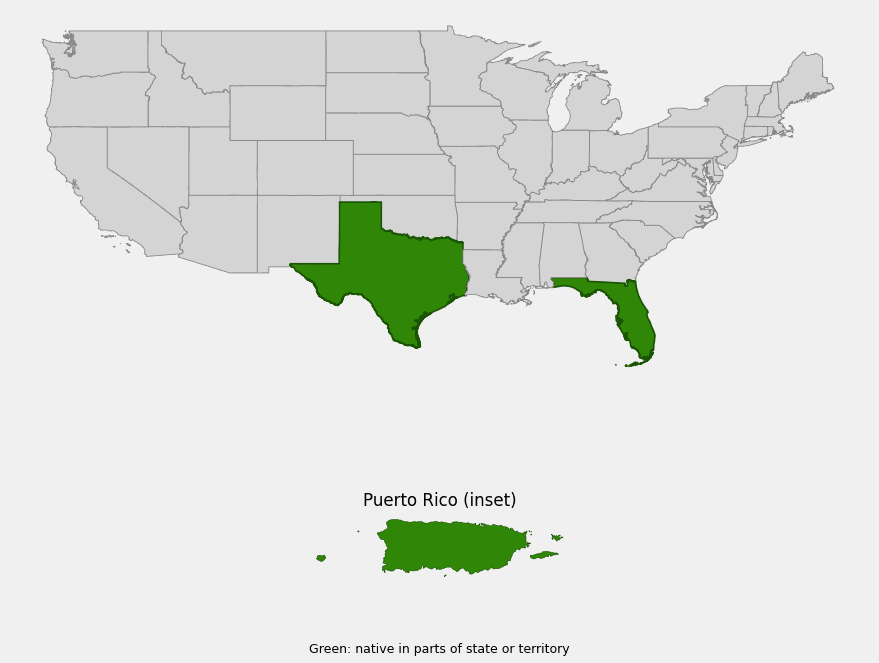
Scorpion’s-Tail is native to the warm parts of the Americas. In the United States, USDA PLANTS lists it as native in Florida and Texas and in Puerto Rico. It is also widespread in the Bahamas, the Caribbean, Mexico, Central America and northern South America.
In Florida it grows mainly in the southern half of the peninsula and the Keys, and is scattered farther north in central Florida. In Texas it is found in South Texas, especially in the Lower Rio Grande Valley and along the Coastal Bend. In Puerto Rico it is common in dry and coastal areas.
It grows in sunny or partly shaded openings: the edges of tropical hardwood hammocks, coastal thickets and shell mounds, clearings, pinelands, Tamaulipan thornscrub, and disturbed ground such as roadsides, vacant lots and field edges. It often colonizes new openings quickly and fades as shrubs and trees close in.
📋 Regional plant lists featuring Scorpion’s-Tail: North & South Florida · Puerto Rico · South & West Texas
Growing & Care Guide
Scorpion’s-Tail is an easy, fast-growing plant for warm-climate gardens. It is often available from native nurseries in Florida and South Texas, and it reseeds on its own once established.
Light
Full sun to part shade. It flowers well in light shade at the edge of trees and shrubs, and grows more compact in full sun.
Soil & Water
It grows in almost any well-drained soil, including sand, limestone rubble and shell. Once established it tolerates drought, though it looks best with occasional water in long dry spells. It does not tolerate standing water.
Planting Tips
Plant in spring or summer, 1 to 2 feet apart, in a butterfly garden, a hammock-edge planting or an informal border. Because it is short-lived, let a few seedlings grow each year to replace older plants.
Pruning & Maintenance
Cut back leggy plants by about a third to encourage new growth and more flower spikes. Pull extra seedlings where they are not wanted. Frost kills the tops, but plants often resprout or return from seed.
Propagation
Grows easily from seed, which germinates readily in warm weather, and often appears as volunteers near existing plants. It can also be grown from stem cuttings.
Landscape Uses
- Butterfly gardens: a reliable nectar plant for small butterflies
- Hammock-edge plantings: fills sunny gaps at the edge of trees and shrubs
- Informal borders: long-blooming, low-maintenance filler in warm climates
- Coastal gardens: tolerates sandy, limey soils and some salt wind
- Wildlife plantings: flowers for pollinators nearly all year in frost-free areas
Wildlife & Ecological Value
Scorpion’s-Tail is a busy plant for insects, with small flowers available through much of the year.
For Pollinators
Its tiny flowers are visited by many small butterflies, such as hairstreaks, blues and skippers, and by bees, wasps and flies. Heliotropes also attract male queen and other milkweed butterflies, which gather alkaloids from the plants that they use in courtship and defense.
For Birds
Seed-eating birds, such as buntings and ground doves, eat the small nutlets, and the plants shelter insects that birds feed on.
For Mammals
It is rarely browsed, because the leaves are rough and contain toxic alkaloids.
Ecosystem Role
As a quick colonizer of openings and disturbed ground, it provides nectar and cover in gaps along hammock edges and in coastal thickets until shrubs and trees grow back.
Cultural & Historical Uses
The genus name Heliotropium comes from the Greek helios, sun, and tropos, turning, from an old belief that heliotrope flowers and leaves turn to follow the sun. The coiled flower spikes, called scorpioid cymes by botanists, are typical of the borage family and gave this plant its common name.
Scorpion’s-Tail has been used in traditional medicine in parts of the Caribbean and Latin America. However, like many heliotropes, it contains pyrrolizidine alkaloids, which can damage the liver. It should not be eaten or used as a home remedy.
Safety note: all parts of the plant are considered toxic to people, pets and livestock if eaten in quantity. Wear gloves if you have sensitive skin, since the rough hairs can irritate.
Frequently Asked Questions
Why is it called scorpion’s-tail?
Its long flower spikes have coiled tips that curl like a scorpion’s tail and slowly unroll as the flowers open.
Is scorpion’s-tail good for butterflies?
Yes. Its small white flowers are visited by many small butterflies, bees and other insects, and heliotropes attract queen butterflies and their relatives.
Is scorpion’s-tail poisonous?
It contains pyrrolizidine alkaloids, which are toxic if eaten. Do not eat it or use it as an herbal remedy, and keep it away from grazing animals.
Where does scorpion’s-tail grow in the United States?
It grows wild in South and Central Florida and the Keys, in South Texas, and in Puerto Rico.
Does scorpion’s-tail come back every year?
It is a short-lived perennial that is killed back by frost, but it reseeds easily, so it usually persists in a garden.


