
Seabeach Amaranth (Amaranthus pumilus)
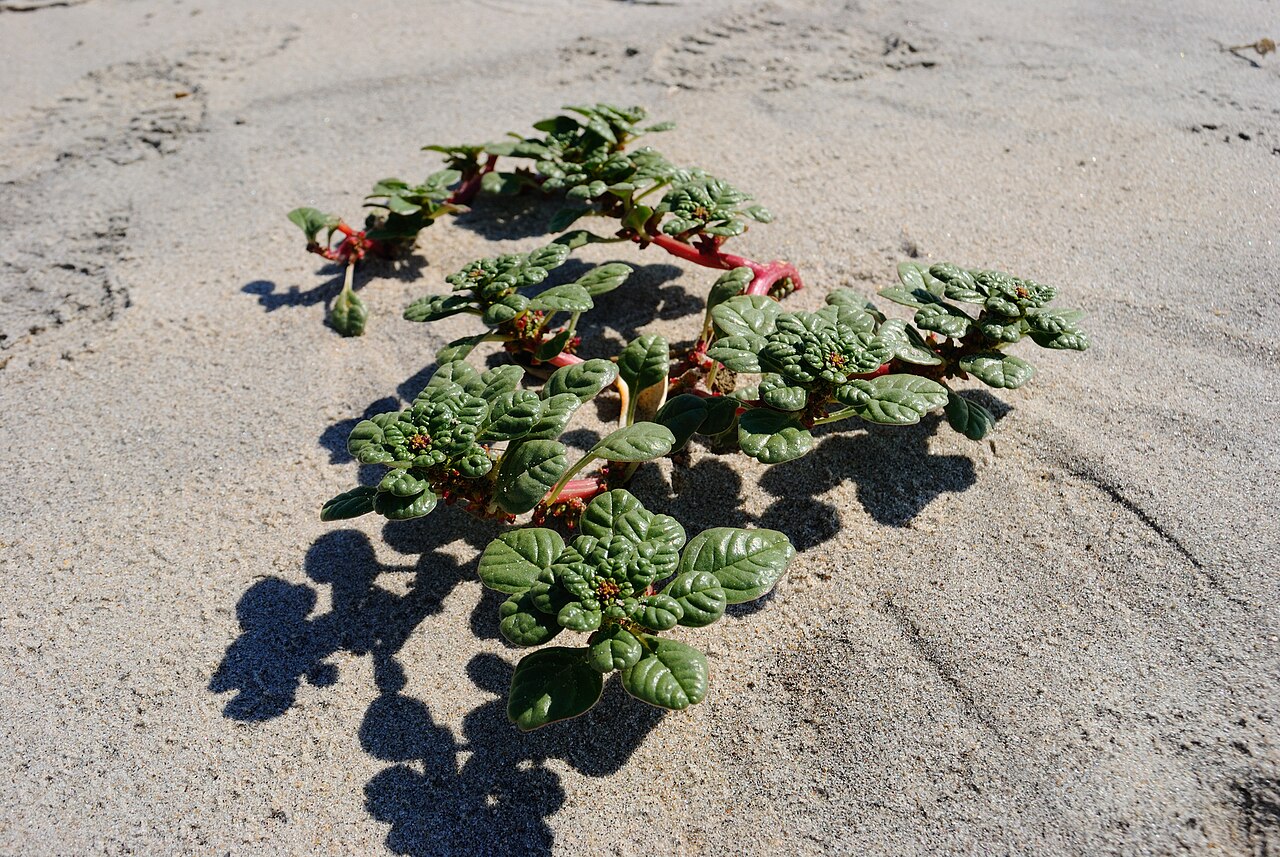
Amaranthus pumilus, the Seabeach Amaranth (USDA: seaside amaranth), is a small, fleshy annual that lives on the open sand of Atlantic Ocean beaches, from Massachusetts to South Carolina. It grows on the upper beach and the low dunes and overwash flats of barrier islands, where few other plants can survive the salt spray, shifting sand and storms.
It is a federally threatened species, listed by the U.S. Fish and Wildlife Service in 1993 after it disappeared from most of its historic range. Beach development, seawalls and jetties, beach driving and heavy foot traffic destroyed much of its habitat. It still survives mainly on the beaches of North Carolina, with smaller and often fluctuating populations from South Carolina to New York.
This is an identification and appreciation guide. Seabeach amaranth is not a garden plant and is not sold by nurseries; it should never be dug up, picked or have its seed collected. Beachgoers can help it simply by recognizing it, staying off fenced nesting and plant areas, and keeping vehicles off the upper beach.
Identification
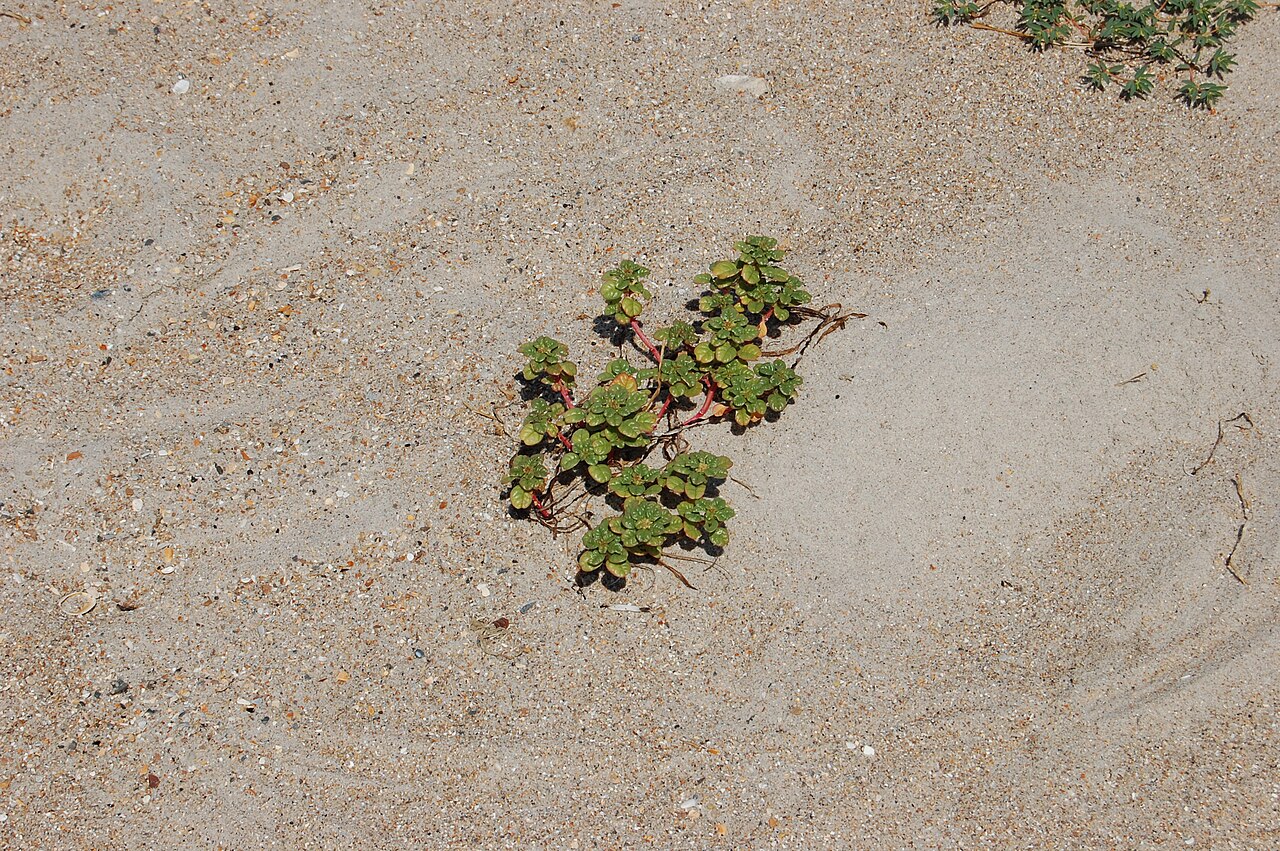
Seabeach amaranth is easy to recognize once you know it: a low, spreading clump of thick, rounded, dark green leaves on bright pink to red stems, sitting on bare sand above the high-tide line. It looks a bit like a small spinach plant growing on the beach.
Stems & Growth Form
Seedlings start as a single small stem, then branch to form a low clump or mat. Mature plants can be anywhere from a few inches to about 3 feet across, with fleshy, reddish-pink stems lying on or close to the sand. A large plant may have hundreds of branches.
Leaves
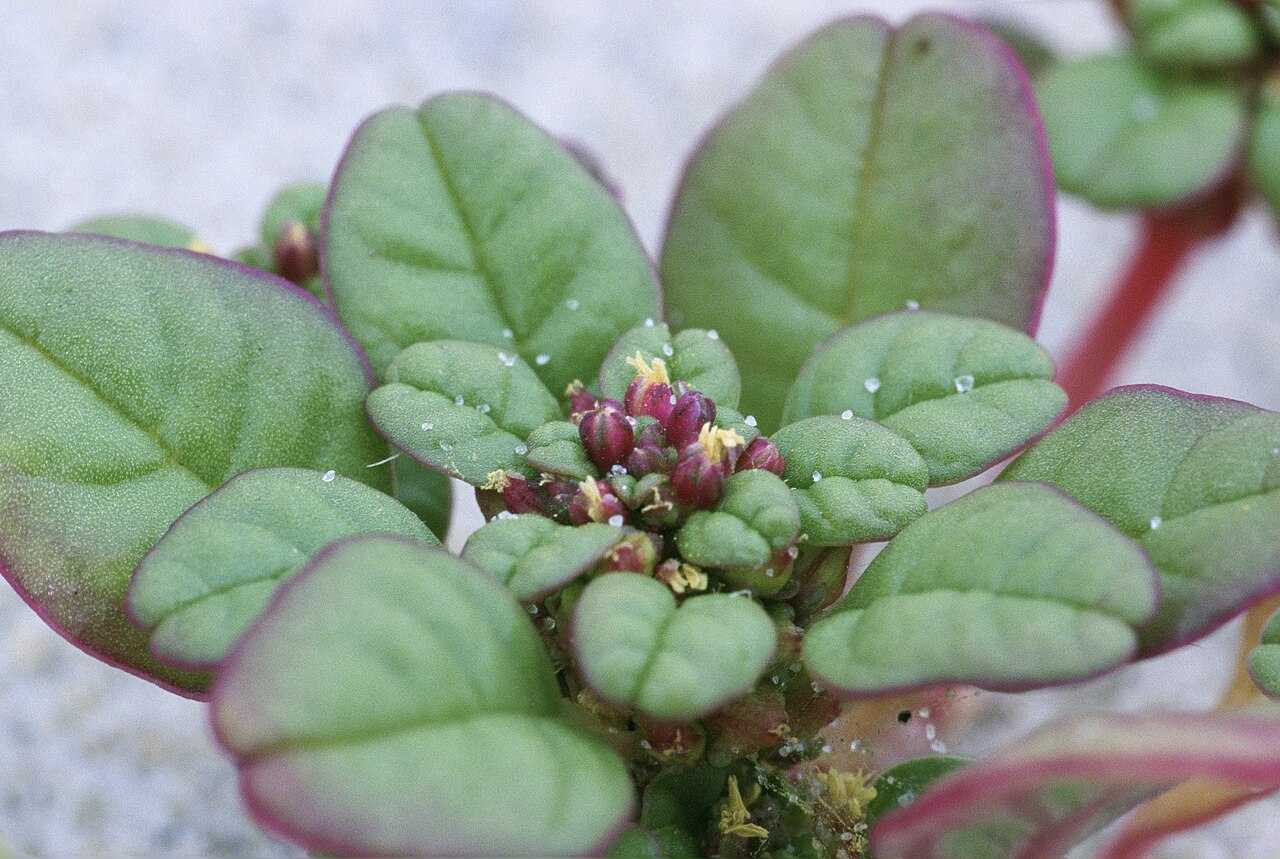
The leaves are small, about ½ to 1 inch long, rounded to spoon-shaped, thick and somewhat succulent, with a shallow notch at the tip. They are spinach-green, often with a slightly crinkled surface, and are crowded toward the tips of the stems.
Flowers & Seeds
The flowers are tiny and greenish to reddish, with no showy petals, and grow in small clusters in the leaf axils from about June until frost. Male and female flowers are separate but on the same plant. Each fruit is a small papery utricle holding one glossy, dark reddish-brown to black seed, about ⅒ inch across. Plants keep producing seed until they die in late fall or are washed away by storms.
Look-alikes
Few beach plants look similar. Sea purslane (Shoreline Seapurslane) has narrow, smooth succulent leaves and pink star-shaped flowers. Seaside sandmat (Euphorbia polygonifolia) has tiny opposite leaves and milky sap. American Sea Rocket has fleshy lobed leaves and four-petaled pale purple flowers. Sea Sandwort has pairs of pointed, overlapping leaves on upright stems. Seabeach amaranth’s notched, rounded leaves on pink stems are distinctive.
Quick Facts
| Scientific Name | Amaranthus pumilus Raf. |
| Family | Amaranthaceae (amaranth family) |
| Plant Type | Annual herb, low and spreading |
| Mature Height | 2–6 in |
| Mature Spread | A few inches to 3 ft |
| Growth Rate | Fast (germinates spring and summer, dies in late fall) |
| Sun Exposure | Full sun |
| Water Needs | Dry, well-drained sand; tolerates salt spray |
| Soil Type | Bare beach sand of upper beaches, overwash flats and low dunes |
| Soil pH | Neutral to slightly alkaline sand |
| Bloom Time | June–November |
| Flower Color | Inconspicuous greenish to reddish |
| Fall Color | Stems and leaves often redden before the plant dies |
| Fruit | Small utricle with one glossy dark seed |
| Deer Resistant | No; deer and feral horses graze it, and webworm caterpillars eat the leaves |
| USDA Hardiness Zones | 6–9 (annual; grown only for recovery) |
Native Range
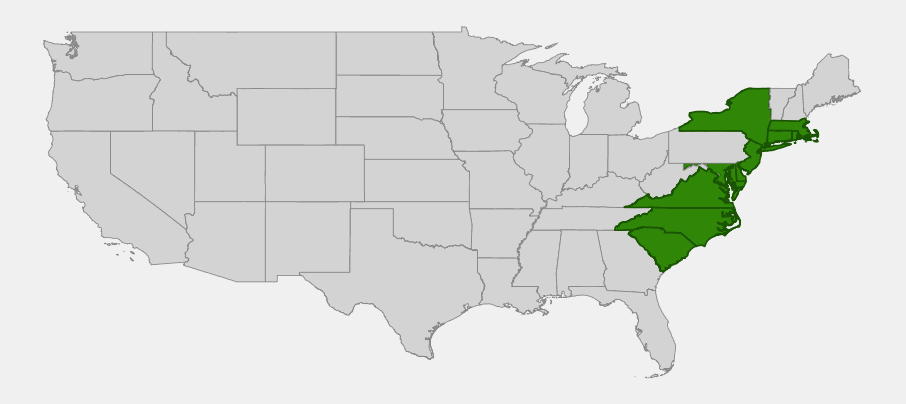
Seabeach amaranth is native to the Atlantic coast of the United States. Historically it grew on ocean beaches from Massachusetts (Nantucket and Cape Cod) south to South Carolina. USDA PLANTS lists it in Connecticut, Delaware, Massachusetts, Maryland, New Jersey, New York, North Carolina, Rhode Island, South Carolina and Virginia. USDA also lists Pennsylvania, from old collections far from any ocean beach; that record is not part of its natural beach habitat and is not shown on the map. It is endemic to the U.S. Atlantic coast and grows nowhere else in the world.
By the late 1980s it had vanished from most of its range. North Carolina’s barrier islands remained the stronghold, with smaller numbers in South Carolina. In 1990 it was rediscovered on Long Island, New York, and in the late 1990s and early 2000s it reappeared on beaches in New Jersey, Delaware, Maryland and Virginia, likely from long-buried seed or seed carried by currents. Numbers rise and fall sharply from year to year with storms and beach conditions.
Its habitat is the most dynamic part of the coast: the upper beach above the normal high-tide line, the low foredunes, and the overwash flats at the ends of barrier islands and near inlets, where storms keep the sand bare and open. It needs that disturbance. Where beaches are stabilized by seawalls, jetties or dense planted dune grass, it is shaded out or loses its habitat.
📋 Regional plant lists featuring Seabeach Amaranth: Connecticut, Massachusetts & Rhode Island · New Hampshire, Maine & Vermont · Delaware, Southern New Jersey & Long Island · New York, Pennsylvania & Northern New Jersey · Maryland, Virginia & West Virginia · North & South Carolina
Growing & Care Guide
Seabeach amaranth is not a garden plant. It is federally threatened, it is not sold by nurseries, and its natural habitat cannot be recreated in a yard. Never dig plants or collect seed. Seed collection and planting are done only by recovery partners working under federal and state permits. What anyone can do is help protect the beaches where it grows.
Light
In the wild it needs full, all-day sun on open sand. Shading by dense planted dune grass or fencing is one reason it disappears from stabilized beaches.
Soil & Water
It grows in bare, salty, nutrient-poor beach sand, with roots reaching moisture below the dry surface. It tolerates salt spray and sand burial, but long flooding by storm tides kills it.
Planting Tips
Do not plant it. Recovery projects in North Carolina, New York and elsewhere have grown and planted it only under permit, using seed from local populations. If you are a land manager, contact your state natural heritage program or the U.S. Fish and Wildlife Service before any project in its habitat.
Pruning & Maintenance
Protection is the “maintenance” it needs. Many beaches post symbolic fencing around plants, often shared with nesting shorebirds and sea turtles. Stay out of fenced areas, keep dogs leashed, and do not drive on the upper beach where plants grow. Beach managers time beach raking and nourishment to avoid the growing season where possible.
Propagation
It reproduces only from seed. Seeds germinate from about April to July on bare sand. Some fall near the parent plant, and others are blown along the beach or floated by tides to new sites. Seeds can stay dormant in the sand for years, which is how populations can reappear after a long absence.
Landscape Uses
- Beach conservation: a symbol of healthy, naturally dynamic barrier-island beaches
- Natural sand-building: plants trap blowing sand and start small dunes
- Citizen science: report sightings to state natural heritage programs or iNaturalist
- Beach education: featured in coastal parks alongside nesting shorebirds and sea turtles
Wildlife & Ecological Value
Seabeach amaranth is a small part of a harsh ecosystem, but it plays a real role in how beaches and dunes form, and it shares its habitat with several other protected species.
For Pollinators
Like other amaranths, it is pollinated mainly by wind, and its tiny flowers attract few insects. Its importance lies in its habitat rather than its nectar.
For Birds
It grows in the same open, sparsely vegetated upper-beach habitat used for nesting by piping plovers, least terns and black skimmers, and it is often protected inside the same fenced areas. Shorebirds may eat some seeds.
For Mammals
White-tailed deer and feral horses graze it on some barrier islands, and the caterpillars of a webworm moth can strip the leaves in late summer.
Ecosystem Role
Each plant traps windblown sand, forming a small mound around itself that can become the start of a new dune. It is one of the “pioneer” plants of the upper beach, part of the natural cycle in which storms remove dunes and pioneer plants help rebuild them. Loggerhead sea turtles nest in the same parts of the beach.
Cultural & Historical Uses
Constantine Rafinesque described Amaranthus pumilus in 1808. The species name means “dwarf,” fitting its low, ground-hugging habit. It is one of very few amaranths in North America that are tied to a single, narrow habitat.
Its decline mirrors the history of the Atlantic coast. As beaches were developed, armored with seawalls and jetties, and opened to vehicles, its open, shifting habitat shrank. It was listed as threatened under the Endangered Species Act in 1993, and the Fish and Wildlife Service published a recovery plan in 1996.
Seabeach amaranth has become a lesson in the value of natural beach processes. Its reappearance from New York to Virginia after decades of absence shows how long its seeds can wait in the sand, and how quickly it can return when beaches are left to move naturally and protected from heavy use.
Frequently Asked Questions
Is seabeach amaranth endangered?
It is listed as threatened under the U.S. Endangered Species Act (1993). It is also listed by several Atlantic coastal states. It is rare throughout its range, with North Carolina home to most remaining plants.
Where can I see seabeach amaranth?
On open upper beaches and inlet flats of barrier islands, mostly in North Carolina, and in smaller numbers from South Carolina to New York. Look for low, reddish-stemmed clumps of rounded leaves on bare sand in summer and fall, and stay outside any fenced areas.
Can I grow seabeach amaranth?
No. It is a federally threatened species, it is not sold by nurseries, and seed and plants can only be handled by permitted recovery partners. Never dig plants or collect seed.
Is it related to garden and grain amaranths?
Yes. It belongs to the same genus as pigweeds, grain amaranths and love-lies-bleeding, but it is a small, fleshy coastal specialist that grows only on Atlantic beaches.
Why does it come and go from beaches?
It is an annual that depends on bare, recently disturbed sand. Its seeds can lie dormant for years, and storms can both wipe out plants and create new habitat, so populations can rise and fall sharply from year to year.

Looking for a nursery that carries Seabeach Amaranth?
Browse our native plant nursery directory: Connecticut & Delaware · Maryland & Massachusetts · New Jersey, New York & North Carolina · Rhode Island, South Carolina & Virginia

