
Marsh Mermaidweed (Proserpinaca palustris)
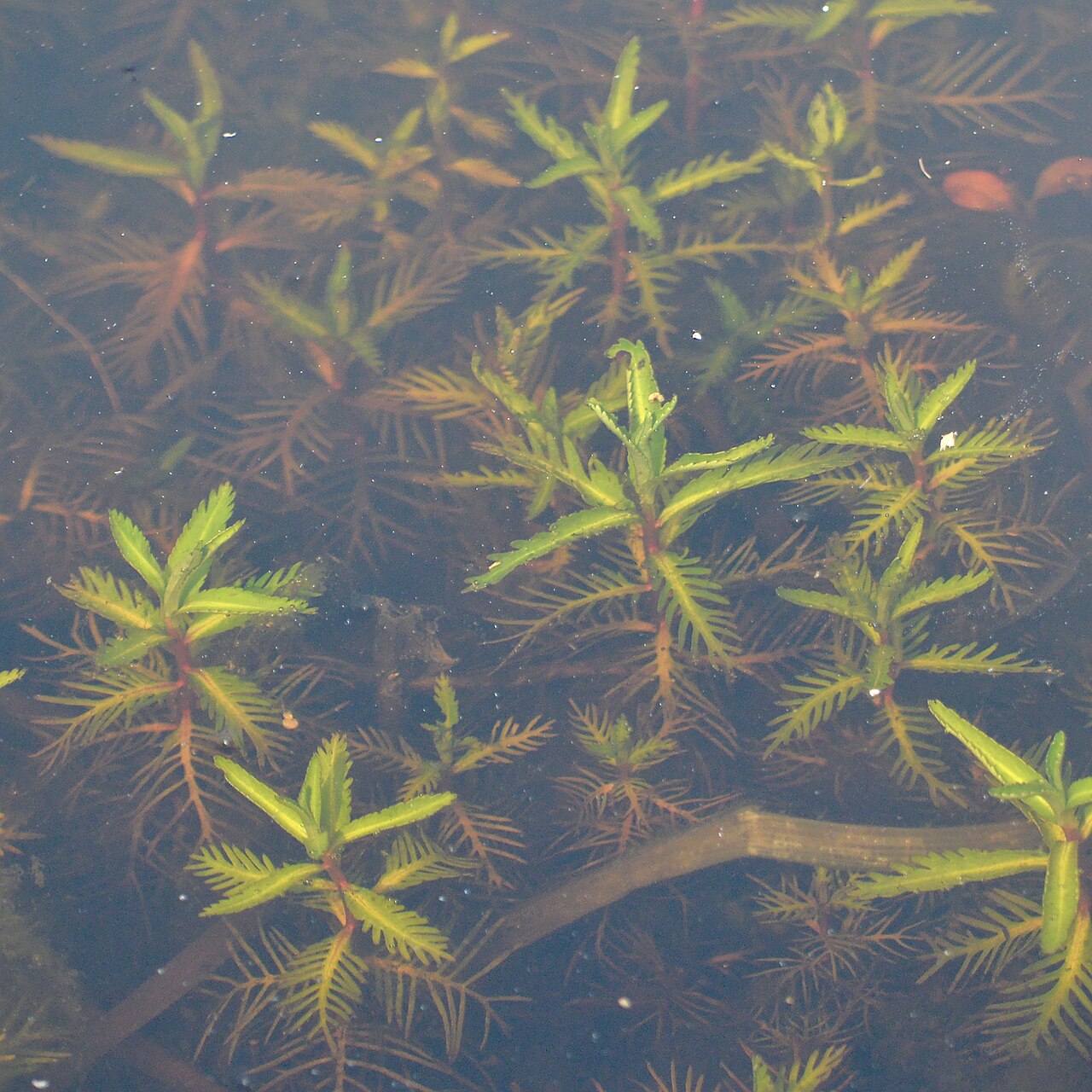
Proserpinaca palustris, Marsh Mermaidweed, is a small native aquatic perennial of shallow water and muddy shores across the eastern half of the United States and southeastern Canada. It is best known for having two completely different kinds of leaves on the same stem: feathery, comb-like leaves underwater and narrow, sawtooth-edged leaves above the surface.
This trait, called heterophylly, makes it a favorite of botany teachers and aquarium hobbyists. The same plant can look like a soft, finely divided water-milfoil when submerged and like a small, toothed willow-leaved herb when the water drops and it grows in the air. Its tiny greenish flowers sit in the leaf axils and are easy to miss, but the three-sided, nutlike fruits are a reliable identification clue.
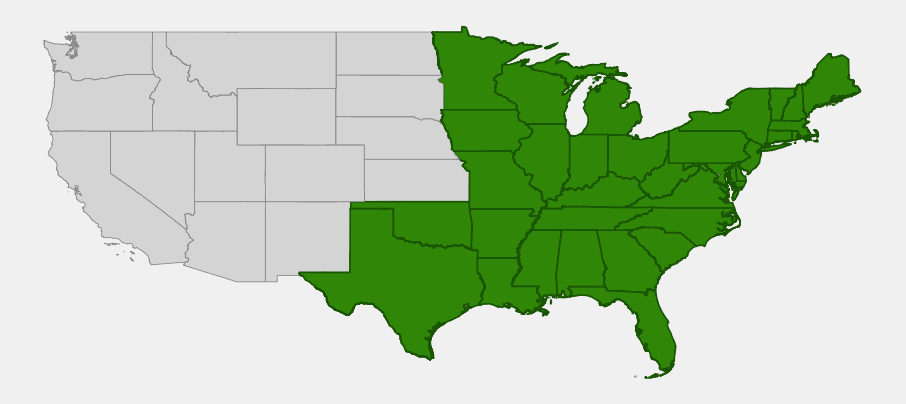
Marsh mermaidweed grows in marshes, swamps, pond edges, ditches and wet meadows, from Maine and Minnesota south to Florida and Texas. This guide covers how to identify it, where it grows, how to grow it in a water garden or aquarium, and its value as cover and food for wetland wildlife.
Identification
Marsh mermaidweed is a low, sprawling perennial with stems that creep and root in mud and then turn upward through the water. The combination of two leaf shapes on one stem and small, three-angled fruits identifies it.
Leaves
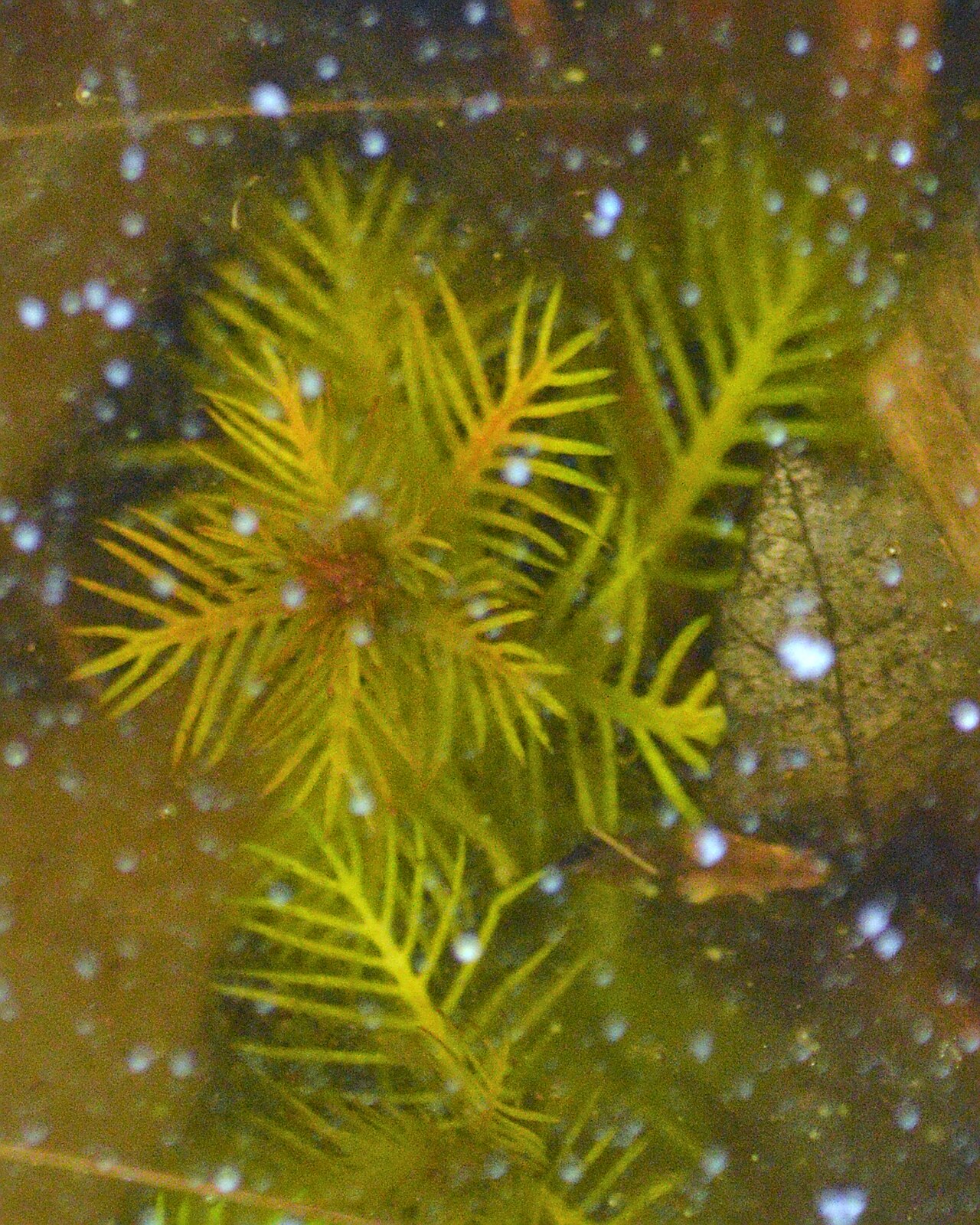
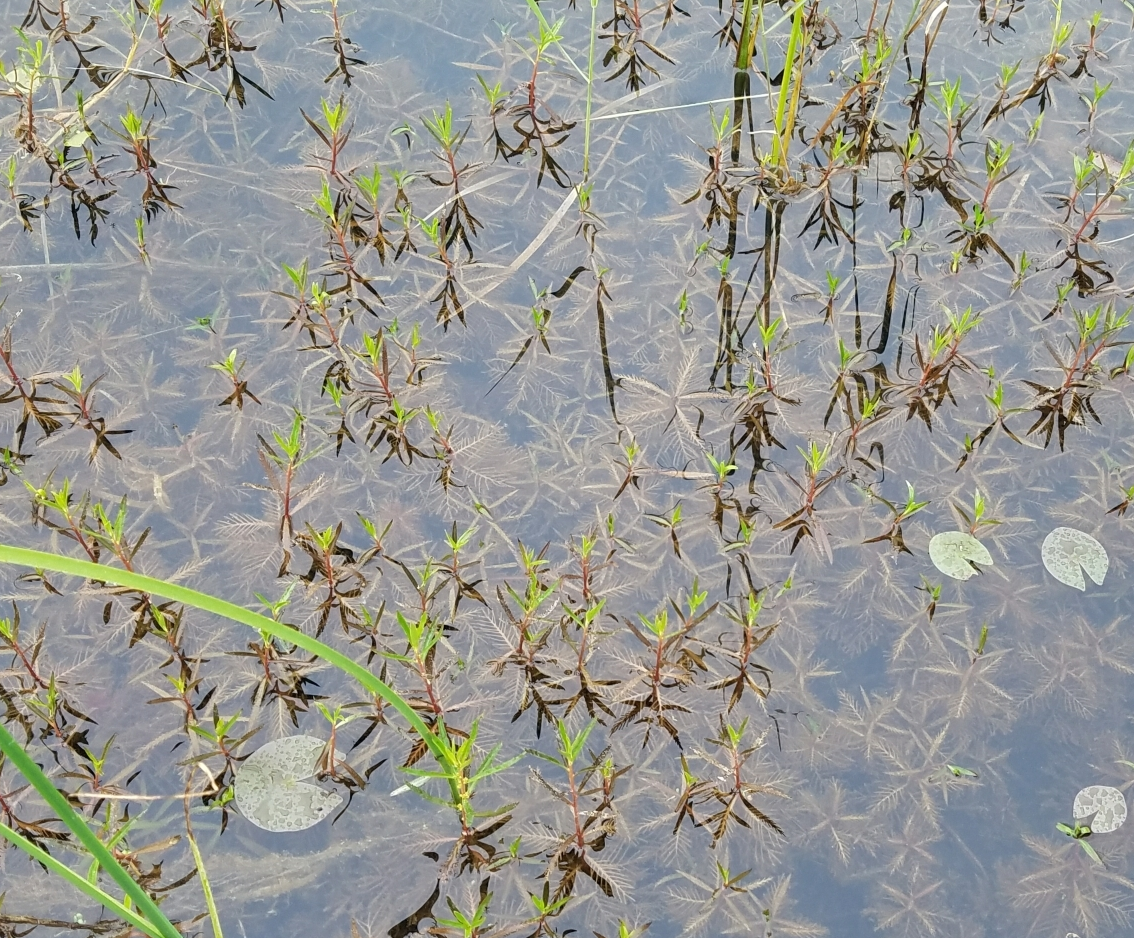
Leaves are alternate. Submerged leaves are 1 to 2 inches long and divided into many fine, comb-like segments. Emergent and aerial leaves are lance-shaped, 1 to 3 inches long and sharply toothed along the edges. Stems that grow from water into air often show a transition from feathery to toothed leaves, with some leaves in between. New growth often has a reddish or bronze tint.
Stems
Stems are 4 to 30 inches long, rooting at the lower nodes in mud and growing up toward the light. In deeper water they stay mostly submerged; on exposed mud they grow upright and short.
Flowers & Fruit
From June to September, tiny greenish to purplish flowers without petals sit singly or in small clusters in the axils of the upper emergent leaves. They are wind-pollinated and very inconspicuous. The fruit is a hard, three-sided nutlet about ⅛ to ¼ inch long, with sharp angles and slightly concave sides; these fruits are useful for identification.
Look-alikes
Comb-leaved mermaidweed (P. pectinata), mainly of the Atlantic and Gulf coastal plain, has all of its leaves, even above water, finely divided. Where the two grow together they can hybridize. Water-milfoils such as Whorled Water-milfoil also have feathery submerged leaves, but their leaves are in whorls of three to five, not alternate.
Quick Facts
| Scientific Name | Proserpinaca palustris L. |
| Family | Haloragaceae (water-milfoil family) |
| Plant Type | Aquatic and emergent herbaceous perennial |
| Mature Height | 4–30 in (stem length) |
| Mature Spread | Spreading by rooting stems |
| Growth Rate | Moderate |
| Sun Exposure | Full sun to partial shade |
| Water Needs | Wet; shallow water up to about 1 ft deep or saturated mud |
| Soil Type | Muck, mud, sand or peat in shallow water |
| Soil pH | Acidic to neutral (about 5.0–7.5) |
| Bloom Time | June–September |
| Flower Color | Greenish to purplish; tiny and inconspicuous |
| Fall Color | Reddish to bronze shoots in cool weather |
| Fruit | Hard, three-sided nutlet |
| Deer Resistant | Not a deer concern in aquatic settings |
| USDA Hardiness Zones | 3–10 |
Native Range
Marsh mermaidweed is native across the eastern and central United States. USDA PLANTS lists it in 33 states, from Maine, Vermont and Minnesota south to Florida, Louisiana and eastern Texas, and west to Iowa, Missouri and Oklahoma. In Canada it grows in Ontario, Quebec, New Brunswick and Nova Scotia. Varieties or closely related populations also occur in the Caribbean, Mexico, Central America and South America.
It grows in shallow, quiet fresh water and on wet, muddy shores: marshes, swamps, pond and lake margins, ditches, wet meadows, sloughs, bogs and the shallow edges of slow streams. It tolerates fluctuating water levels and is often most noticeable when water levels drop and it forms dense mats of upright, toothed shoots on exposed mud.
It is most common on the Atlantic and Gulf coastal plains and in the glaciated Northeast and Great Lakes region, and more scattered in the interior. It is generally secure, though it may be uncommon at the edges of its range.
📋 Regional plant lists featuring Marsh Mermaidweed: North & South Florida · Alabama, Georgia & Mississippi · North & South Carolina · Maryland, Virginia & West Virginia · Kentucky & Tennessee · Arkansas, Louisiana, Eastern Oklahoma & Eastern Texas · Illinois, Iowa & Missouri · Ohio & Indiana · Michigan, Wisconsin & Eastern Minnesota · New York, Pennsylvania & Northern New Jersey · Delaware, Southern New Jersey & Long Island · Connecticut, Massachusetts & Rhode Island · New Hampshire, Maine & Vermont
Growing & Care Guide
Marsh mermaidweed is easy to grow in a sunny water garden, bog garden or the shallow edge of a natural pond, and it is also sold as an aquarium plant, valued for its fine-textured, often reddish leaves. Buy plants from a native aquatic nursery or a reputable aquarium source rather than collecting from the wild.
Light
Full sun to partial shade. More light gives more compact growth and stronger red and bronze colors. In aquariums it needs bright light to keep its color.
Soil & Water
Plant it in mucky, sandy or loamy soil in water from a few inches up to about a foot deep, or in saturated mud at a pond edge. It tolerates water levels that rise and fall through the season. In aquariums it prefers soft to moderately hard water and a nutrient-rich substrate.
Planting Tips
Push stem cuttings or rooted plants into the mud in spring, or set them in a submerged pot of heavy garden soil topped with gravel. Plants in shallower water develop the toothed emergent leaves; plants kept fully submerged keep their feathery leaves.
Pruning & Maintenance
Pull or trim stems that spread beyond where you want them. In aquariums, cut the tops and replant them to keep plants bushy. It is not aggressive and is easy to keep in bounds.
Propagation
Easily propagated from stem cuttings, which root quickly in mud or water. It also spreads by its creeping, rooting stems. Seed can be sown on wet mud, but germination is slow.
Landscape Uses
- Water gardens and ponds: fine-textured cover in shallow margins
- Rain gardens and bog gardens: in the wettest, lowest spots
- Wetland restoration: native cover for shallow marsh and pond edges
- Aquariums: a native plant with feathery, reddish submerged leaves
Wildlife & Ecological Value
Marsh mermaidweed is a small but useful part of shallow-water wetland communities.
For Pollinators
Its flowers are wind-pollinated and provide little for pollinators, but the wetlands it helps stabilize support many insects, including dragonflies and damselflies that lay eggs on submerged plants.
For Birds
Ducks, especially dabbling ducks, and other waterfowl eat the hard nutlets and foliage, and wading birds hunt among the stems for small fish, insects and tadpoles.
For Mammals
Muskrats eat the leafy stems. The plants also provide cover in shallow water for small fish and amphibians.
Ecosystem Role
The fine submerged leaves offer shelter and egg-laying sites for small fish, frogs and aquatic insects, and they carry a film of algae and microorganisms that many small animals feed on. Its rooting stems help hold soft mud along shores.
Cultural & Historical Uses
Carl Linnaeus named Proserpinaca palustris in 1753. The genus name refers to Proserpina, the Roman goddess of the underworld and springtime, and is often said to allude to the plant “creeping forth” from the water. Palustris means “of marshes.”
Botanists have used mermaidweed to study how plants decide what kind of leaves to grow. Experiments showed that the switch between feathery and toothed leaves depends on environmental cues such as day length, temperature and whether the shoot is underwater, which makes it a classic example of heterophylly.
Hobbyists sell it as an aquarium plant, sometimes under the name “mermaid weed,” and some varieties grown in aquariums come from Central or South American populations.
Frequently Asked Questions
Why does marsh mermaidweed have two kinds of leaves?
It produces feathery, finely divided leaves underwater and toothed, lance-shaped leaves in air. The switch is triggered by environmental cues such as day length, temperature and whether the shoot is submerged. Botanists call this heterophylly.
Is marsh mermaidweed native?
Yes. It is native across the eastern and central United States, from Maine and Minnesota south to Florida and eastern Texas, and in southeastern Canada.
Can I grow marsh mermaidweed in an aquarium?
Yes. It is sold as an aquarium plant. Give it bright light, a nutrient-rich substrate and soft to moderately hard water, and trim and replant the tops to keep it bushy.
How is marsh mermaidweed different from comb-leaved mermaidweed?
Marsh mermaidweed has toothed, undivided leaves above water, while comb-leaved mermaidweed has finely divided leaves even above water. The two can hybridize where they grow together.
Is marsh mermaidweed invasive?
No. It is a native plant that stays in shallow water and wet mud and is easy to keep in bounds in a pond.

Looking for a nursery that carries Marsh Mermaidweed?
Browse our native plant nursery directory: Alabama & Arkansas · Connecticut, Delaware, Florida & Georgia · Illinois, Indiana & Iowa · Kentucky, Louisiana, Maine, Maryland, Massachusetts, Michigan, Minnesota, Mississippi & Missouri · New Hampshire, New Jersey, New York, North Carolina, Ohio & Oklahoma · Pennsylvania, Rhode Island, South Carolina, Tennessee, Texas, Vermont & Virginia · West Virginia & Wisconsin

