
Whorled Watermilfoil (Myriophyllum verticillatum)
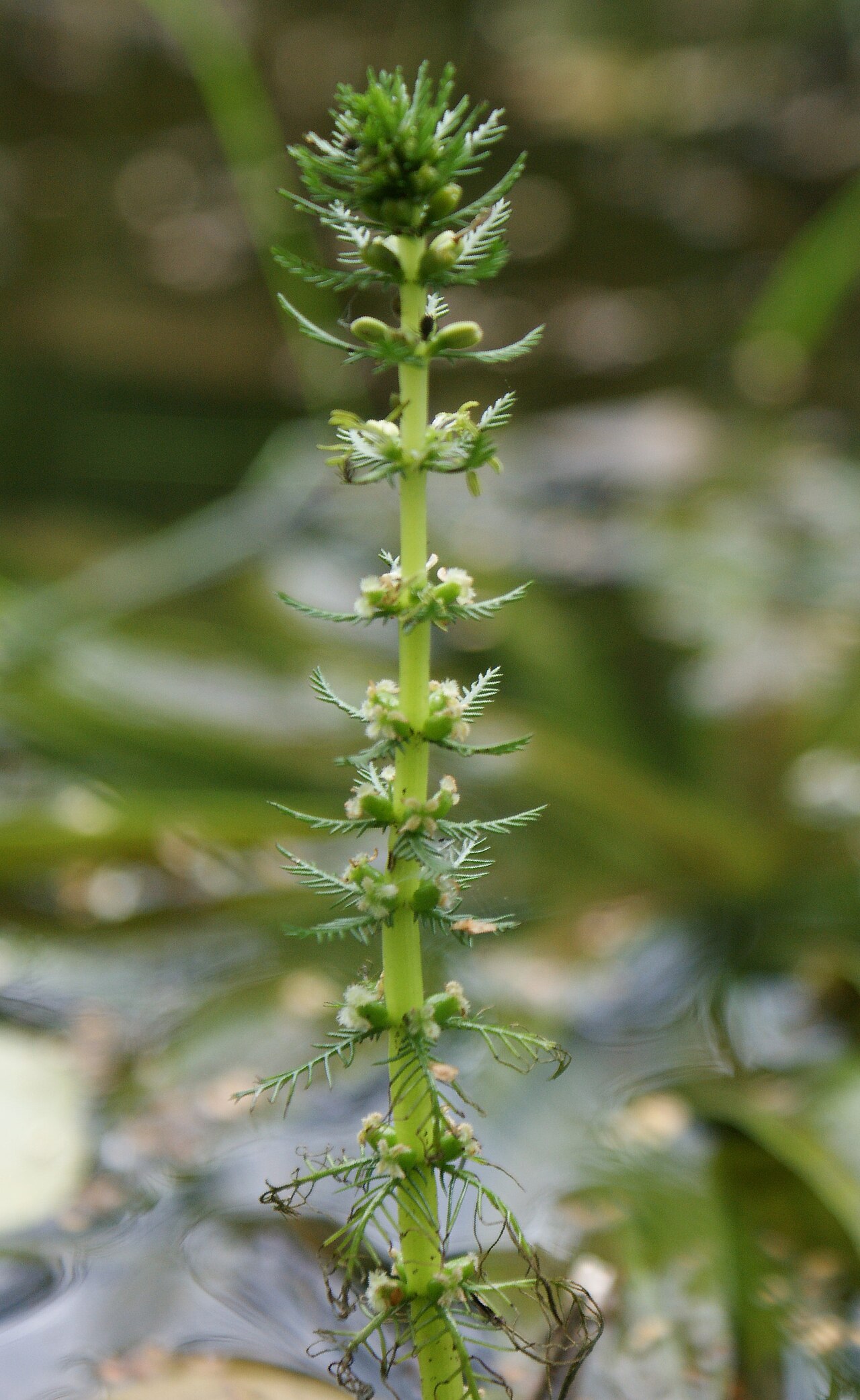
Myriophyllum verticillatum, the Whorled Watermilfoil (USDA: whorl-leaf watermilfoil), is a native submersed aquatic plant of cool lakes, ponds, marshes and slow streams across the northern half of North America, as well as Europe and Asia. Its stems carry whorls of soft, feathery leaves divided into fine, threadlike segments, forming lush underwater beds that are valuable fish and wildlife habitat.
Because its feathery leaves look much like those of the invasive Eurasian watermilfoil (Myriophyllum spicatum), whorled watermilfoil is often mistaken for its troublesome cousin and sometimes treated as a weed by mistake. Telling them apart matters: Eurasian watermilfoil forms dense, canopy-forming mats that choke lakes and is the target of control programs in many states, while whorled watermilfoil is a well-behaved native that belongs in healthy wetlands.
This guide explains how to identify whorled watermilfoil and separate it from Eurasian and other watermilfoils, where it grows, how it can be used in ponds and wetland restoration, and what it does for fish, waterfowl and invertebrates.
Identification
Whorled watermilfoil grows fully underwater for most of the season, with only its flower spikes rising a few inches above the surface in summer. Check the number of leaves per whorl, the number of leaf segments, the bracts on the flower spike and whether the stem tips form winter buds.
Stems & Leaves
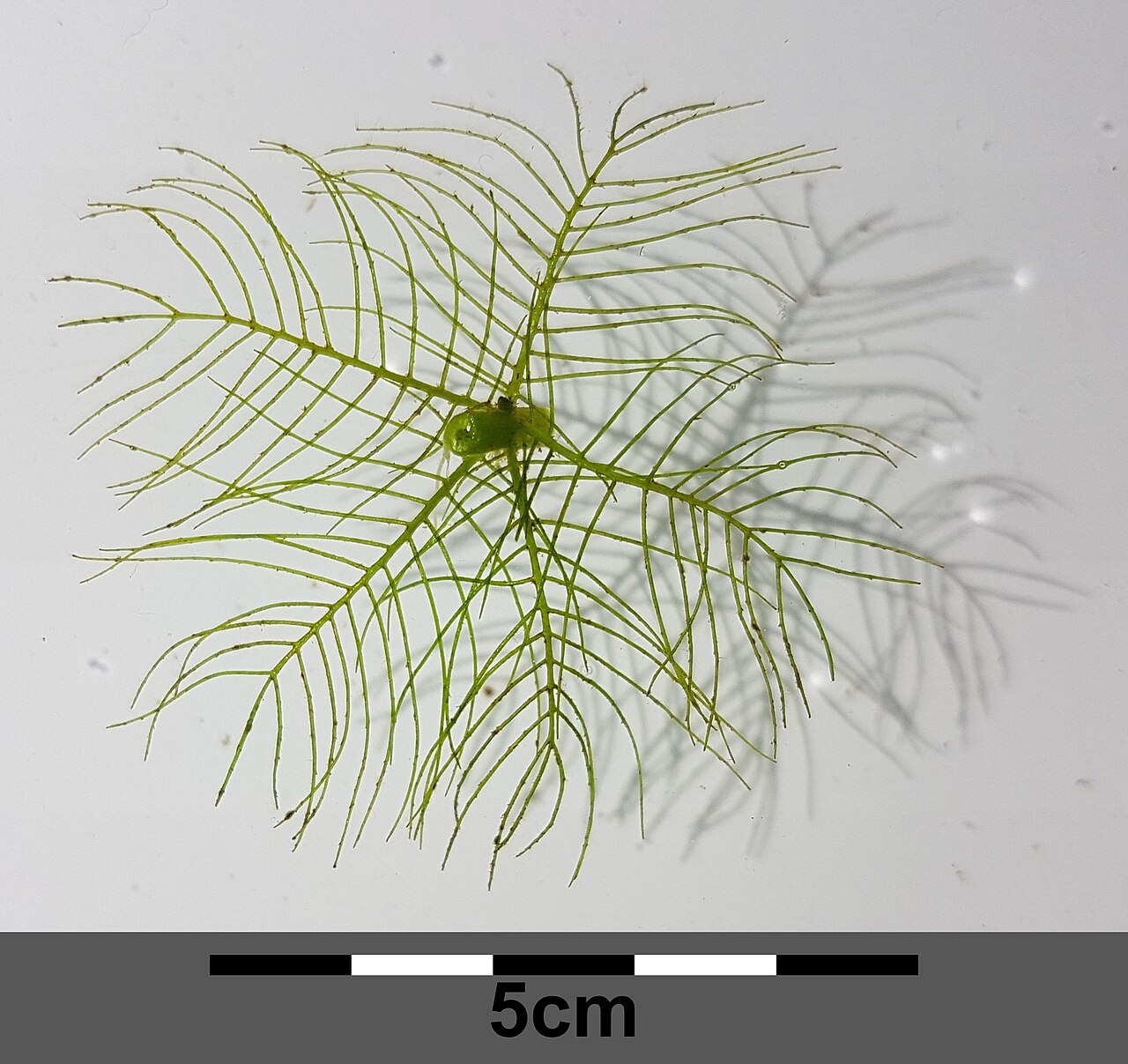
Stems are 1 to 8 feet long, green to brownish, and rooted in soft mud. The underwater leaves are in whorls of usually 4 or 5 (sometimes 3 or 6) and are ½ to 2 inches long. Each leaf is divided like a comb or feather into roughly 9 to 17 pairs of fine, threadlike segments. Plants in shallow water or on drying mud can form short, stiff land forms with small, less divided leaves.
Flowers
From early to late summer, the stem tips rise above the water as a spike 2 to 6 inches long. Tiny flowers sit in the axils of whorled bracts. In whorled watermilfoil these bracts are comb-like (pinnately divided) and clearly longer than the flowers, so the spike looks leafy. The upper flowers are male, with four small petals and eight stamens; the lower ones are female. The flowers are wind-pollinated.
Fruit & Winter Buds
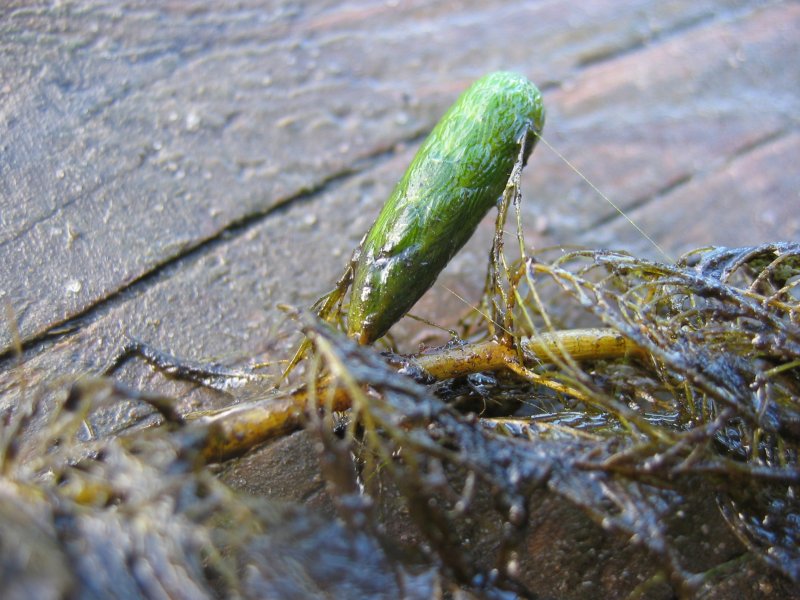
Each female flower ripens into a small, rounded fruit that splits into four nutlets. In late summer and fall, stem tips develop turions: dense, dark green, club-shaped winter buds ¾ to 2½ inches long made of short, thick, stiff leaves. Turions break off, sink and sprout the next spring, and they are one of the easiest ways to confirm the species in fall.
How to Tell It from Eurasian Watermilfoil
Eurasian watermilfoil (Myriophyllum spicatum) is the invasive look-alike. It nearly always has 4 leaves per whorl, each with 12 to 24 pairs of segments (usually 14 or more), so the leaves look densely feathery with squared-off tips. Its emergent flower spikes have small, undivided bracts shorter than the flowers, and it does not form turions; it overwinters as green stems and spreads by fragments. Stem tips are often reddish, and it typically forms a dense canopy at the surface.
Whorled watermilfoil usually has 4 or 5 leaves per whorl with fewer segments (about 9 to 17 pairs), comb-like bracts on the flower spike that are longer than the flowers, and club-shaped turions in fall. Hybrids between Eurasian and native northern watermilfoil also occur and can only be confirmed reliably by DNA testing, so if a milfoil is spreading aggressively in your lake, send a sample to your state aquatic invasive species program before treating it.
Other Native Look-alikes
Northern watermilfoil (M. sibiricum) has 3 or 4 leaves per whorl with only 5 to 12 pairs of segments, whitish stems and undivided bracts. Variable-leaf watermilfoil (M. heterophyllum) has broader, toothed emergent bracts. Coontail (Ceratophyllum demersum) has forked, not feather-like, leaves, and bladderworts such as Common Bladderwort carry small bladders on their leaves.
Quick Facts
| Scientific Name | Myriophyllum verticillatum L. |
| Family | Haloragaceae (watermilfoil family) |
| Plant Type | Submersed aquatic perennial |
| Mature Height | Stems 1–8 ft long underwater; flower spikes 2–6 in above water |
| Mature Spread | Forms loose beds; spreads by turions and fragments |
| Growth Rate | Moderate to fast in summer |
| Sun Exposure | Full sun to partial shade (clear water) |
| Water Needs | Aquatic; still or slow water about 1–10 ft deep |
| Soil Type | Soft mud, muck or silt bottoms |
| Soil pH | About 6.5–9.0 (neutral to alkaline water) |
| Bloom Time | June–September |
| Flower Color | Inconspicuous, greenish to purplish |
| Fall Color | Forms dark green club-shaped turions |
| Fruit | Small four-parted fruit splitting into nutlets |
| Deer Resistant | Not applicable (aquatic) |
| USDA Hardiness Zones | 2–8 |
Native Range
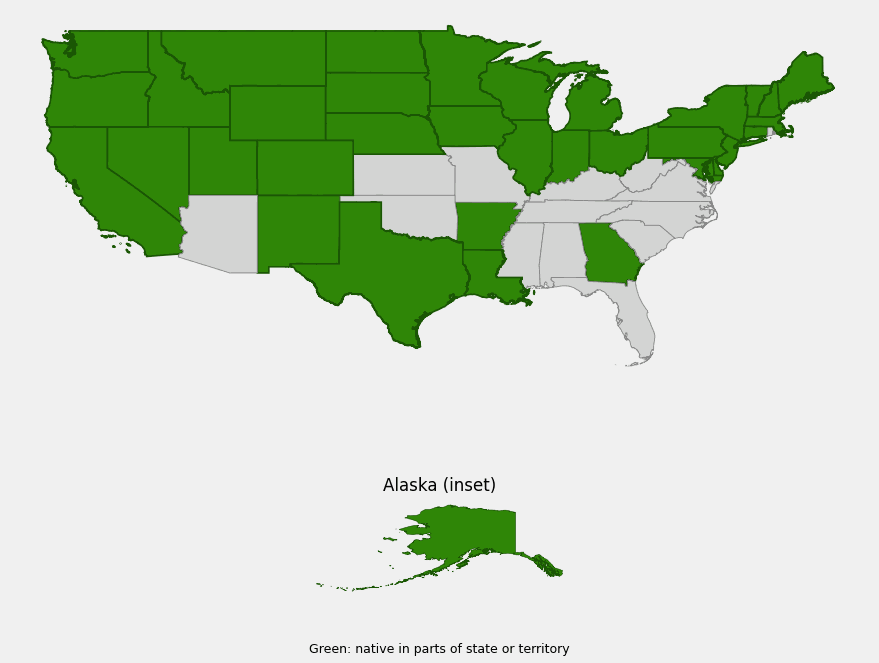
Whorled watermilfoil is circumboreal. In North America it ranges from Alaska and the Yukon across Canada to Newfoundland, and south in the United States through New England, New York, Pennsylvania and New Jersey, the Great Lakes states, the northern Great Plains and the Rocky Mountains to the Pacific states. USDA PLANTS lists it in 36 states. It is most common in the glaciated North, where cool, clear, often alkaline lakes and marshes provide ideal habitat.
Toward the south it becomes rare and scattered. Many northeastern and midwestern states consider it uncommon or rare, including Massachusetts, Maryland, Ohio, Pennsylvania, New Jersey and Iowa. Herbarium specimens from Arkansas, Louisiana, Georgia and Texas (including East Texas and spring-fed streams of the Edwards Plateau) are scattered, outlying records at the southern edge of its range. Florida is not included here: the Atlas of Florida Plants lists M. verticillatum as an excluded name with no vouchered Florida specimens, so older reports from Florida are treated as errors.
In the West it grows in lakes and marshes from the Cascades and Sierra Nevada east to the Rockies, for example in western Oregon and Puget Sound lowlands, the Klamath and Harney basins, northeastern Washington, Utah’s Wasatch Front and Uinta Basin and Nevada’s Elko County, with an isolated record from Catron County, New Mexico.
📋 Regional plant lists featuring Whorled Watermilfoil: Alaska · Western Oregon & Western Washington · Idaho, Eastern Oregon & Eastern Washington · California & Nevada · Utah & Western Colorado · Montana & Wyoming · North Dakota, South Dakota & Western Minnesota · Nebraska, Kansas & Eastern Colorado · Michigan, Wisconsin & Eastern Minnesota · Illinois, Iowa & Missouri · Ohio & Indiana · New York, Pennsylvania & Northern New Jersey · Delaware, Southern New Jersey & Long Island · Maryland, Virginia & West Virginia · Connecticut, Massachusetts & Rhode Island · New Hampshire, Maine & Vermont · Arkansas, Louisiana, Eastern Oklahoma & Eastern Texas
Growing & Care Guide
Whorled watermilfoil can be grown in natural ponds, water gardens and wetland restorations in cool to temperate climates. Buy plants only from aquatic nurseries that sell correctly identified native stock, since Eurasian watermilfoil is sometimes mixed in or mislabeled. Many states prohibit buying, selling or transporting Eurasian watermilfoil, and moving any aquatic plant between water bodies can spread invasive species, so never transplant plants from lakes, and always clean, drain and dry boats and gear.
Light
Full sun to partial shade. It needs reasonably clear water so light can reach the leaves; in murky, nutrient-rich water it is outcompeted by algae and weedy species.
Soil & Water
Plant in still or slowly moving water about 1 to 6 feet deep, over a soft bottom of mud or silt. It prefers neutral to alkaline, moderately fertile water and tolerates cold winters under ice.
Planting Tips
Anchor rooted stem cuttings or turions in a pot of heavy loam topped with gravel, or press them into the pond bottom in spring. In water gardens it works as an oxygenating plant and as cover for small fish.
Pruning & Maintenance
In small ponds, thin the beds in summer if they become too dense by raking out some stems. Compost the removed plants away from the water. Watch for invasive milfoils and check any vigorous milfoil against the ID notes above.
Propagation
Propagate by stem cuttings, which root easily in mud, or by collecting turions from your own plants in fall and planting them in spring. Seed is rarely used.
Landscape Uses
- Natural ponds: a native oxygenating plant that provides fish cover
- Wetland and lake restoration: helps re-establish native submersed plant beds
- Wildlife ponds: food and shelter for waterfowl, fish and aquatic insects
- Shoreline buffers: stabilizes soft bottom sediments in shallow water
Wildlife & Ecological Value
Native submersed plants like whorled watermilfoil are the foundation of the food web in shallow lakes and marshes.
For Pollinators
The flowers are wind-pollinated and do not attract pollinators. Many aquatic insects, such as mayfly and damselfly nymphs, live among the leaves and emerge to feed birds, bats and other wildlife.
For Birds
Ducks, geese, swans and coots eat the leaves, fruits and turions, and diving ducks feed on the abundant invertebrates that live in milfoil beds. Herons, grebes and terns hunt the small fish that shelter there.
For Mammals
Muskrats and beavers eat watermilfoils, and moose feed on submersed plants in northern lakes in summer.
Ecosystem Role
Its beds release oxygen, take up nutrients, reduce wave action and help settle suspended sediment, which keeps water clearer. They provide nursery habitat for young fish such as bluegill, perch and pike and for snails, scuds and insect larvae.
Cultural & Historical Uses
Linnaeus named Myriophyllum verticillatum in 1753. Myriophyllum means “ten thousand leaves” in Greek, for the finely divided foliage, and verticillatum means “whorled.” The plant was described from Europe, where it is still a widespread native of ponds and slow rivers.
Since Eurasian watermilfoil was first recorded in North America in the 1940s, native milfoils have often been confused with it. Lake associations, state agencies and researchers now put a lot of effort into telling the species apart, including DNA testing of suspected hybrids, so that control efforts target only the invasive plants and spare native beds.
Whorled watermilfoil has also been used in aquariums and water gardens as an oxygenating plant. Its turions, tiny packages of stored food that sink to the bottom for winter, are a good example of how northern water plants survive months under ice.
Frequently Asked Questions
Is whorled watermilfoil invasive?
No. Whorled watermilfoil is native to North America and is a valuable part of healthy lake and marsh plant communities. The invasive species is Eurasian watermilfoil, Myriophyllum spicatum, which looks similar.
How can I tell whorled watermilfoil from Eurasian watermilfoil?
Whorled watermilfoil usually has 4 or 5 leaves per whorl with about 9 to 17 pairs of segments, comb-like bracts longer than the flowers on its emergent spikes, and club-shaped winter buds (turions) in fall. Eurasian watermilfoil has 4 leaves per whorl with 12 to 24 pairs of segments, small undivided bracts and no turions.
Does whorled watermilfoil grow in Florida?
No. The Atlas of Florida Plants treats M. verticillatum as an excluded name with no vouchered Florida specimens. In the South it is rare, with scattered records from Arkansas, Louisiana, Georgia and Texas.
Is whorled watermilfoil good for ponds?
Yes, in cool to temperate climates. It oxygenates the water, shelters fish and invertebrates, and feeds waterfowl. Buy correctly identified native stock from an aquatic nursery, never plants taken from lakes.
What should I do if I find watermilfoil in my lake?
Take a sample and compare the leaf whorls, leaf segments and bracts, or send it to your state natural resources or aquatic invasive species program for identification. Don’t treat or remove milfoil until you know whether it is native.

Looking for a nursery that carries Whorled Watermilfoil?
Browse our native plant nursery directory: Alaska & Arkansas · California · Colorado, Connecticut, Delaware & Georgia · Idaho, Illinois, Indiana & Iowa · Louisiana, Maine, Maryland, Massachusetts, Michigan, Minnesota & Montana · Nebraska, Nevada, New Hampshire, New Jersey, New Mexico, New York, North Dakota & Ohio · Oregon · Pennsylvania, South Dakota, Texas, Utah & Vermont · Washington · Wisconsin & Wyoming

