
Perfoliate Pondweed (Potamogeton perfoliatus)
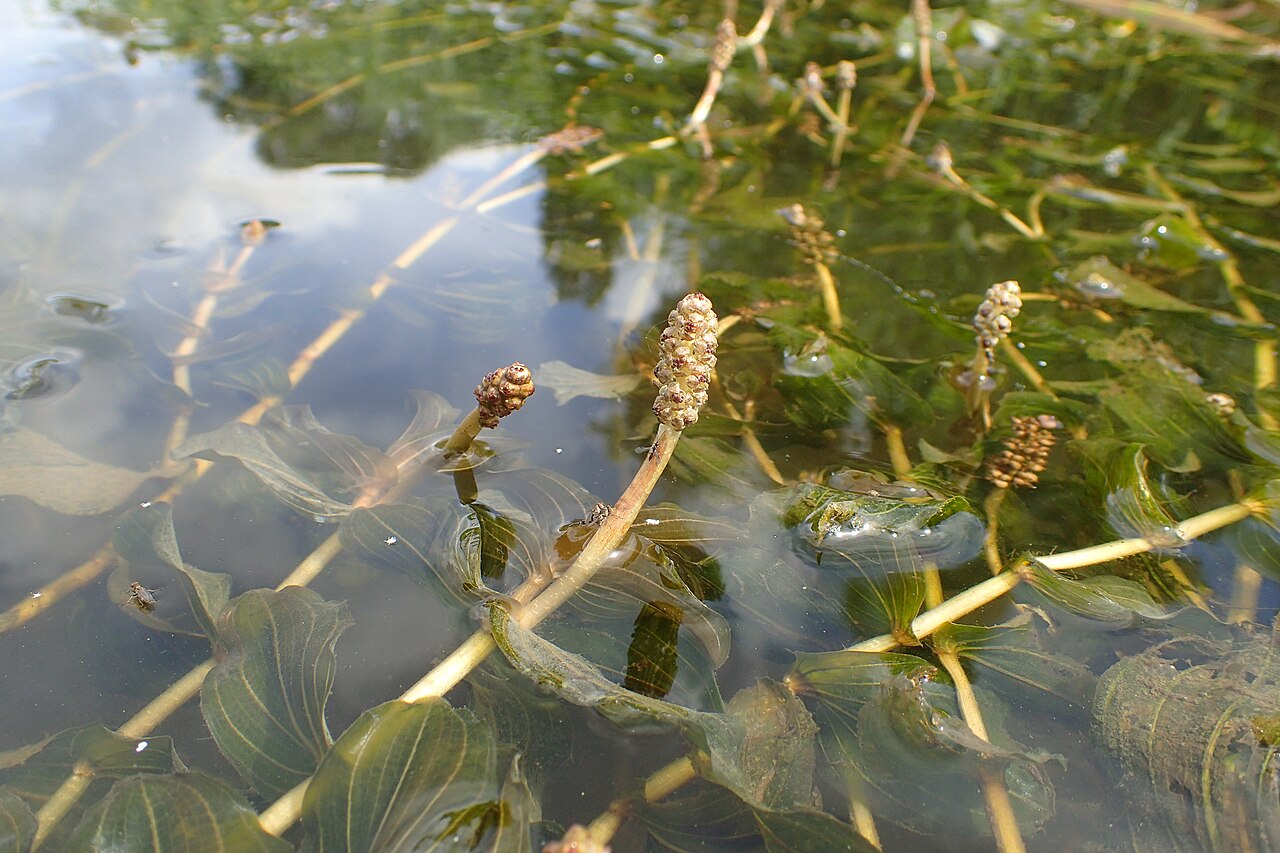
Potamogeton perfoliatus, known as Perfoliate Pondweed, clasping-leaf pondweed (the USDA name is claspingleaf pondweed) or, around Chesapeake Bay, redhead grass, is a submerged aquatic plant of lakes, rivers and tidal waters. Its leafy stems grow entirely underwater, and its oval, wavy leaves wrap around the stem at their base. Only the small flower spikes rise above the surface in summer.
In the United States it is native from Maine and the Great Lakes south along the Atlantic coast to Florida and west along the Gulf Coast to Texas. It grows in fresh water and in slightly brackish water, and it is one of the underwater grasses that biologists monitor and replant in Chesapeake Bay, where it feeds ducks and shelters fish and crabs.
This guide covers how to identify perfoliate pondweed, a naming question (many botanists separate the eastern plant from the very similar Richardson’s pondweed of the North and West), where it grows, its use in ponds and restoration, and its value to waterfowl and fish.
Identification
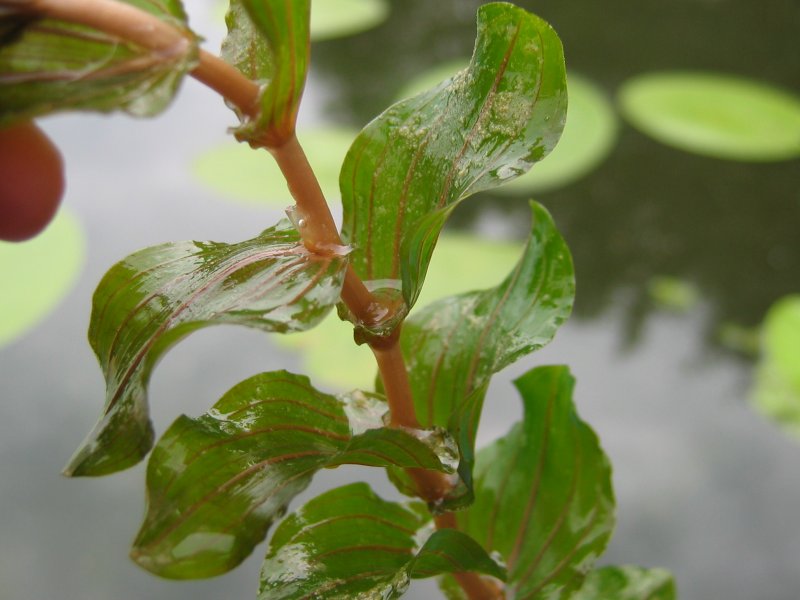
Pondweeds (Potamogeton) are notoriously hard to identify, but perfoliate pondweed is one of the easier ones. Look for an underwater plant with no floating leaves and broad leaves whose bases wrap all the way around the stem.
Stems & Growth Habit
Perfoliate pondweed is a perennial that spreads by creeping rhizomes in the bottom mud. From them rise slender, branched stems that can reach several feet long, depending on the water depth. The plant stays submerged, often forming dense underwater beds, and dies back to rhizomes and winter buds in cold climates.
Leaves
All the leaves are underwater; it never makes floating leaves. They are alternate, oval to nearly round or broadly lance-shaped, about 1/2 to 2 1/2 inches long, thin and translucent, with slightly wavy edges. The base of each leaf is heart-shaped and clasps the stem so completely that the stem seems to pass through the leaf. The small stipules at the leaf bases are delicate and soon fall apart.
Flowers
From early summer into fall, short cylindrical spikes about 1/2 to 1 inch long rise just above the water on stalks. They carry many tiny greenish-brown flowers without showy petals, pollinated mainly by wind at the surface.
Fruit
The flowers develop into small, greenish-brown, beaked seeds (achenes) about 1/8 inch long, packed along the spike. They sink and are eaten by waterfowl.
Perfoliatus or Richardsonii?
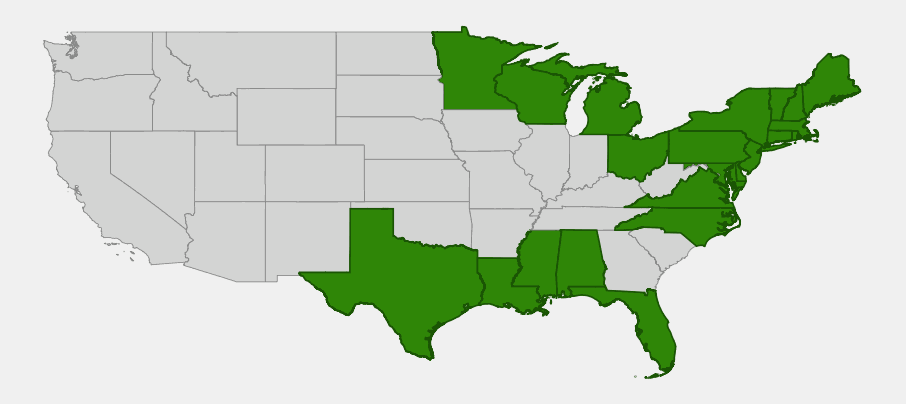
Some botanists treat all North American clasping-leaved plants as one species, Potamogeton perfoliatus. Others, including the Flora of North America, keep two species: P. perfoliatus in the East (mostly the Atlantic and Gulf coastal plain and the Great Lakes region) and Richardson’s pondweed (P. richardsonii), widespread across Canada, the northern states and the West. Richardson’s pondweed has narrower, lance-shaped leaves with more veins and coarse, fibrous stipules that persist on the stem. USDA PLANTS follows the two-species treatment, which is why western states are not on this page’s map. Other look-alikes include large-leaf pondweed (P. amplifolius), which has floating leaves and leaves that do not clasp, and white-stem pondweed (P. praelongus), which has a zigzag whitish stem and leaves with hooded tips.
Quick Facts
| Scientific Name | Potamogeton perfoliatus L. |
| Family | Potamogetonaceae (pondweed family) |
| Plant Type | Submerged aquatic perennial |
| Mature Height | Stems 1–6 ft long, depending on water depth |
| Mature Spread | Spreads by rhizomes into beds several feet across |
| Growth Rate | Fast in summer |
| Sun Exposure | Full sun to part shade (needs clear water) |
| Water Needs | Aquatic; grows fully submerged, about 1–10 ft deep |
| Soil Type | Soft mud, silt or sand on lake, river and bay bottoms |
| Soil pH | Neutral to alkaline water |
| Bloom Time | June–September |
| Flower Color | Greenish-brown (inconspicuous) |
| Fall Color | Not significant |
| Fruit | Small beaked achenes on a short spike |
| Deer Resistant | Not applicable (underwater) |
| USDA Hardiness Zones | 3–9 |
Native Range
USDA PLANTS lists perfoliate pondweed as native in 22 states: Alabama, Connecticut, Delaware, Florida, Louisiana, Maine, Maryland, Massachusetts, Michigan, Minnesota, Mississippi, New Hampshire, New Jersey, New York, North Carolina, Ohio, Pennsylvania, Rhode Island, Texas, Vermont, Virginia and Wisconsin, plus the District of Columbia. Most populations are on the Atlantic coastal plain, in tidal rivers and estuaries, and in lakes of the Northeast and the Great Lakes region. The Gulf Coast states mark the southern edge of its range.
It grows in quiet or slow-moving water: lakes and ponds, slow rivers, tidal freshwater marshes and the low-salinity upper reaches of estuaries such as the Chesapeake Bay. It prefers clear water over soft silt or sand, and it declines where the water becomes muddy or loaded with nutrients and algae.
Beyond the United States, it occurs in eastern Canada, from Ontario and Quebec to the Maritime provinces and Newfoundland, and the species is also widespread in Europe, Asia, Africa and Australia. Western and inland North American clasping-leaved pondweeds are usually treated as Richardson’s pondweed.
📋 Regional plant lists featuring Perfoliate Pondweed: New Hampshire, Maine & Vermont · Connecticut, Massachusetts & Rhode Island · New York, Pennsylvania & Northern New Jersey · Delaware, Southern New Jersey & Long Island · Maryland, Virginia & West Virginia · North & South Carolina · North & South Florida · Alabama, Georgia & Mississippi · Arkansas, Louisiana, Eastern Oklahoma & Eastern Texas · Ohio & Indiana · Michigan, Wisconsin & Eastern Minnesota
Growing & Care Guide
Perfoliate pondweed is not a typical garden plant, but it is a useful native oxygenator for larger natural ponds and is grown by aquatic nurseries for wetland and shoreline restoration. In Chesapeake Bay, redhead grass is one of the species raised and planted to rebuild underwater grass beds.
Light
It needs bright light reaching the bottom, so it grows only in clear water. Full sun is best; a little shade from trees along the edge is fine.
Soil & Water
Plant it in soft mud, silt or sand under about 1 to 6 feet of still or slow-moving water. It tolerates fresh water and slightly brackish water. Murky water, heavy algae, and bottom-feeding fish such as carp that stir up the sediment are its main problems.
Planting Tips
Plant rhizome pieces or young plants in late spring, pressing them into the bottom or into weighted pots or burlap bags of soil lowered into place. In restoration projects, fencing or cages are often used at first to keep geese, ducks and carp from eating or uprooting the young plants.
Pruning & Maintenance
It needs no care in a natural pond. In small ponds it can fill the water by late summer; rake out some of the stems if it becomes too dense. Avoid lawn fertilizers near the water, which feed algae that shade it out.
Propagation
It spreads by rhizomes and can be divided easily. Seeds germinate poorly unless they have been through winter cold in water, so restoration growers mostly use rhizomes, winter buds or nursery-grown transplants. Only buy plants from reputable aquatic nurseries, and never move plants between water bodies, which spreads invasive plants and pests.
Landscape Uses
- Natural ponds: a native underwater plant that oxygenates the water and shelters fish, frogs and insects
- Estuary and lake restoration: one of the native underwater grasses planted in Chesapeake Bay and other estuaries to restore beds
- Wildlife ponds: food for dabbling and diving ducks, and nursery habitat for young fish
- Water quality: its beds trap sediment and take up nutrients, helping keep water clear
- Nature study: an easy-to-recognize pondweed for learning aquatic plants in summer
Wildlife & Ecological Value
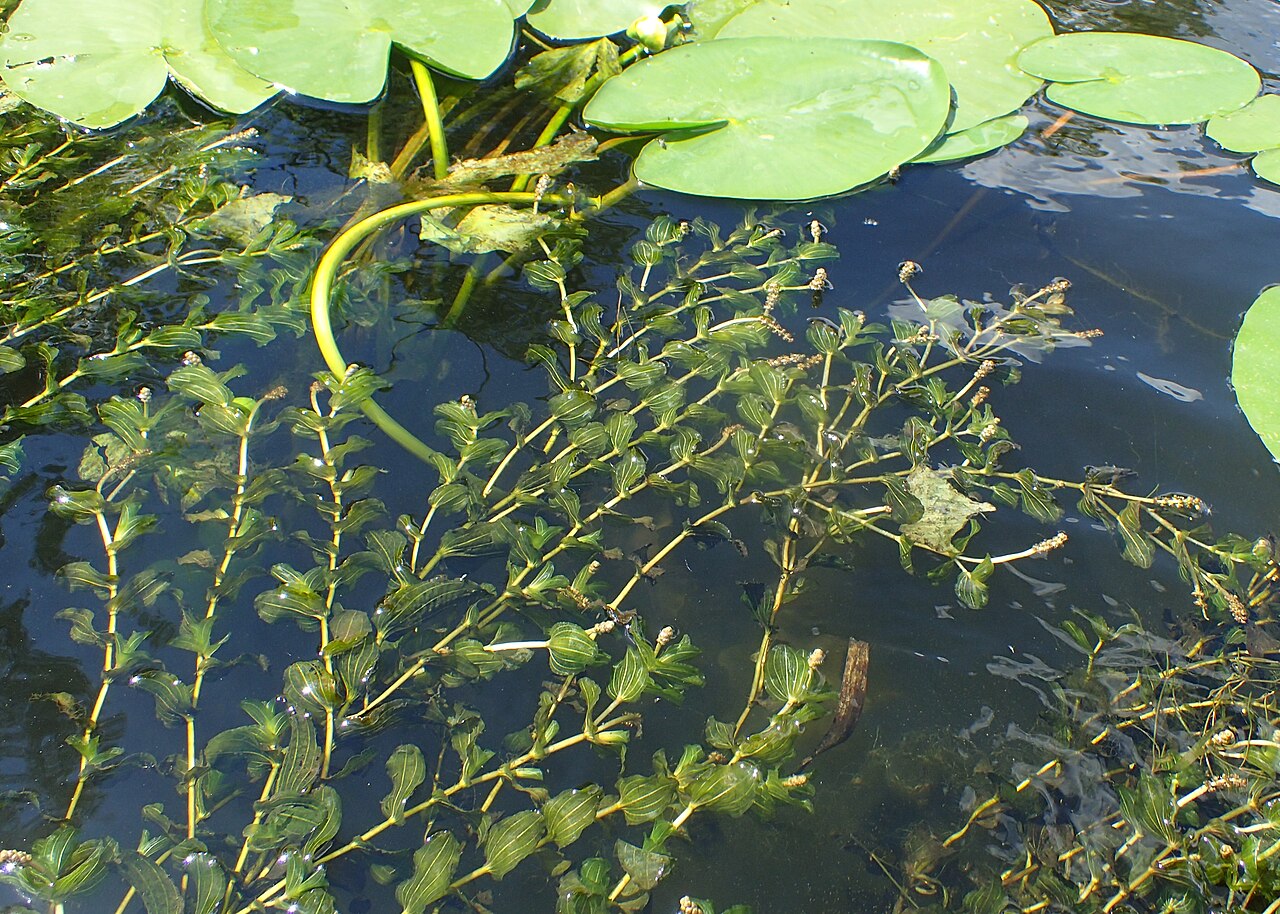
Underwater plant beds are among the richest wildlife habitats in lakes and estuaries, and perfoliate pondweed is a key part of them in the East.
For Pollinators
It is pollinated mostly by wind at the water surface and offers little to bees. Its leaves and stems, however, support a large community of aquatic insects, snails and tiny crustaceans.
For Birds
The seeds, rhizomes and leaves are eaten by many ducks, including redheads, canvasbacks, scaup, wigeon and black ducks, as well as swans and geese. The name redhead grass comes from its value to the redhead duck. Wading birds hunt the fish and crustaceans that shelter in its beds.
For Mammals
Muskrats and beavers eat pondweeds, and moose browse aquatic plants like it in northern lakes.
Ecosystem Role
Its beds slow the water, trap sediment, take up nutrients and add oxygen. They shelter young fish, blue crabs and other invertebrates in estuaries. Redhead grass declined with other underwater grasses in Chesapeake Bay in the 1960s and 1970s as the water became muddier and more polluted, and it is one of the species tracked in the bay’s annual underwater grass surveys.
Cultural & Historical Uses
The genus name Potamogeton comes from Greek words meaning “river neighbor,” a fitting name for plants of rivers and lakes. The species name perfoliatus means “through the leaf,” because the stem appears to pierce each clasping leaf.
Linnaeus described the species in 1753 from European plants. North American botanists have argued ever since about how the native clasping-leaved pondweeds should be divided, which is why older books lump them while newer floras separate P. perfoliatus and P. richardsonii. Eastern plants were also once called P. bupleuroides or P. perfoliatus var. bupleuroides.
Hunters and biologists on Chesapeake Bay have long known it as redhead grass, after the ducks that fed on it in large numbers. Its recovery in some tributaries is used as one sign of improving water quality.
Frequently Asked Questions
Why is it called redhead grass?
Around Chesapeake Bay, perfoliate pondweed is called redhead grass because redhead ducks and other diving ducks feed heavily on it. It is not a true grass but a pondweed.
Is perfoliate pondweed the same as Richardson’s pondweed?
They are very similar and were once combined. Most current floras keep them separate: perfoliate pondweed in the East, with broad oval leaves and stipules that soon disintegrate, and Richardson’s pondweed across the North and West, with narrower leaves and persistent fibrous stipules.
Is perfoliate pondweed invasive?
No, it is native in North America. It can grow thick in shallow nutrient-rich ponds, but it is an important native food plant. Don’t confuse it with curly-leaf pondweed (P. crispus), an invasive Eurasian species with crinkled, finely toothed leaves.
Can I plant perfoliate pondweed in my pond?
Yes, in a natural pond with clear water at least a foot deep. Plant rhizomes or potted plants in the bottom in late spring, and protect them from geese and carp at first.
Does perfoliate pondweed grow in salt water?
It grows in fresh water and in slightly brackish water, such as the upper Chesapeake Bay and tidal rivers. It does not grow in full-strength seawater.

Looking for a nursery that carries Perfoliate Pondweed?
Browse our native plant nursery directory: Alabama · Connecticut, Delaware & Florida · Louisiana, Maine, Maryland, Massachusetts, Michigan, Minnesota & Mississippi · New Hampshire, New Jersey, New York, North Carolina & Ohio · Pennsylvania, Rhode Island, Texas, Vermont & Virginia · Wisconsin

