
Meadow Barley (Hordeum brachyantherum)
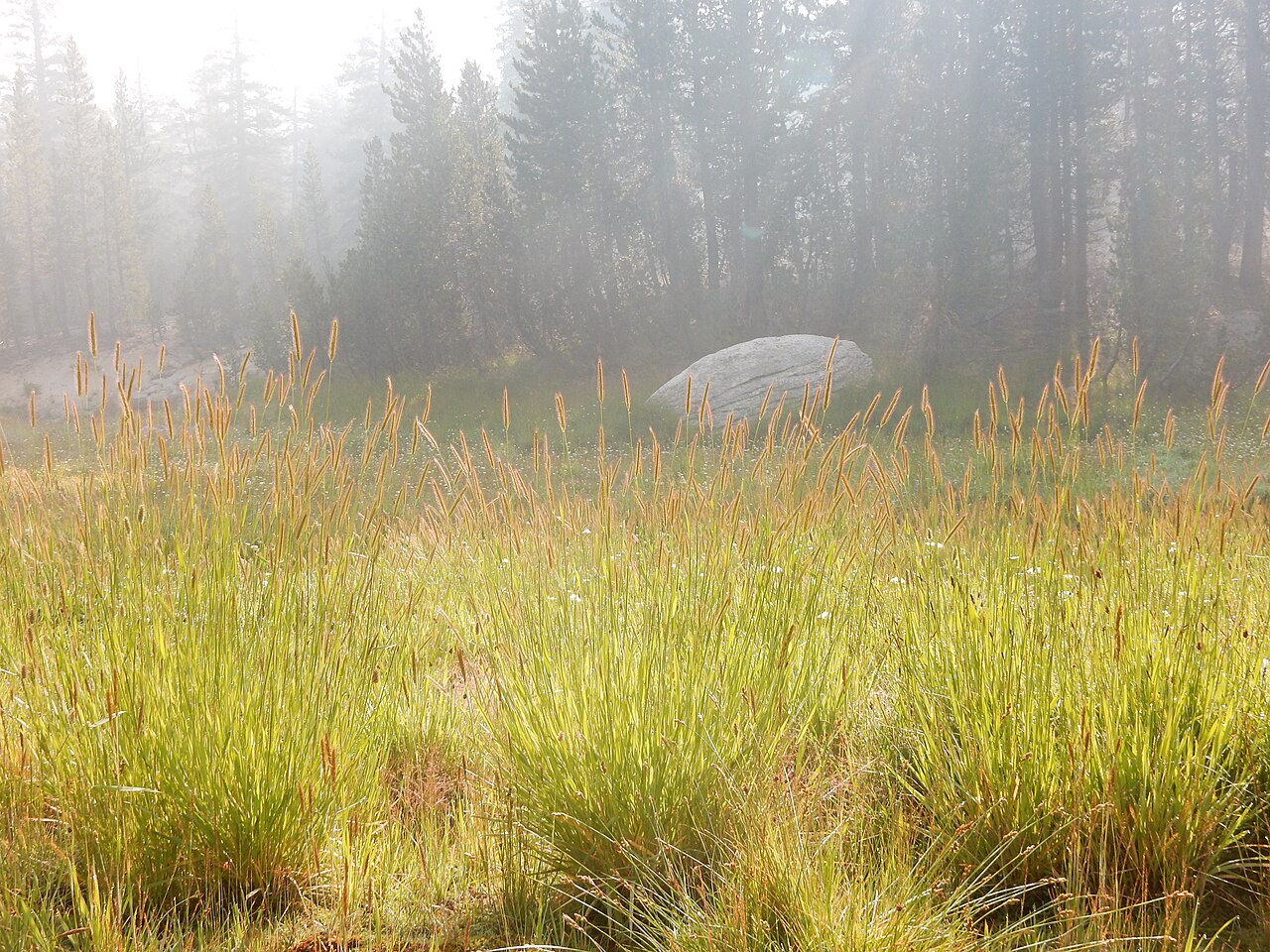
Hordeum brachyantherum, Meadow Barley, is a native perennial bunchgrass of moist meadows, streambanks and marsh edges across western North America. It forms tidy tufts of green leaves and, in late spring and summer, slender stems 1 to 3 feet tall topped with narrow, erect, bristly seed spikes 1½ to 4 inches long. Like all wild barleys, it carries its spikelets in threes at each node, which gives the spikes their dense, bristly look.
Meadow barley grows from Alaska and western Canada south through the Pacific states and the Rocky Mountains to Arizona and New Mexico, and into northern Baja California, from coastal salt marshes to mountain meadows. It is one of the most widely used native grasses in California for restoration, erosion control and wet-meadow plantings, and it is easy to grow from seed.
It is a close relative of the familiar Foxtail Barley, but its awns are much shorter and its spikes stay upright and green. This guide covers how to identify meadow barley, the California subspecies, where it grows and how to use it in gardens and restoration.
Identification
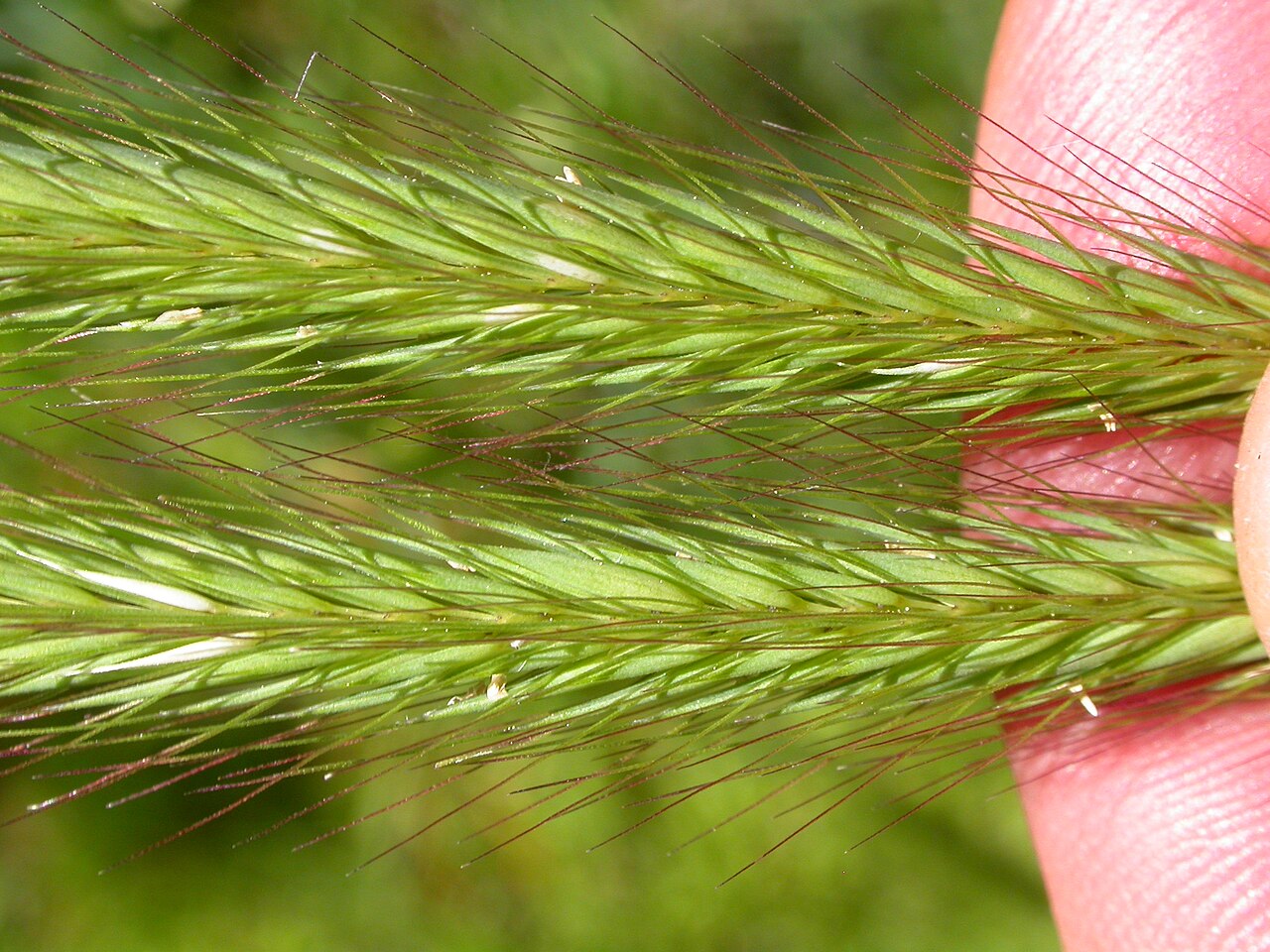
Meadow barley is a cool-season bunchgrass. Its erect, narrow spikes with short awns, its perennial tufts and its moist habitat set it apart from other wild barleys.
Growth Habit
Meadow barley is a tufted perennial bunchgrass, usually 8 inches to 3 feet tall when flowering. It does not spread by runners. It grows actively in cool, moist weather in spring and early summer and often goes partly dormant in late summer if the soil dries.
Leaves
The leaf blades are flat, about ⅛ to ¼ inch wide and 2 to 6 inches long, green to slightly bluish-green, and smooth or a little rough. The leaf sheaths are smooth or sometimes finely hairy, and the auricles (small ear-like lobes at the base of the blade) are absent or tiny.
Seed Heads
The seed head is a dense, narrow spike, usually 1½ to 4 inches long, held erect. Each node has three spikelets: a central, seed-bearing one and two smaller, usually sterile side spikelets on short stalks. The glumes are bristle-like, and the awns on the lemmas and glumes are short, generally well under about 1 inch. The heads are green, sometimes tinged purple, and turn straw-colored as they ripen. When ripe, the spike breaks apart into small, bristly segments that carry the seeds.
Subspecies
Two subspecies are recognized. Subsp. brachyantherum is the widespread form, found from Alaska to the Rocky Mountains and the Southwest; it is tetraploid. Subsp. californicum, California barley, is a smaller, diploid plant with narrower leaves and shorter heads found in California; some botanists treat it as a separate species, Hordeum californicum.
Look-alikes
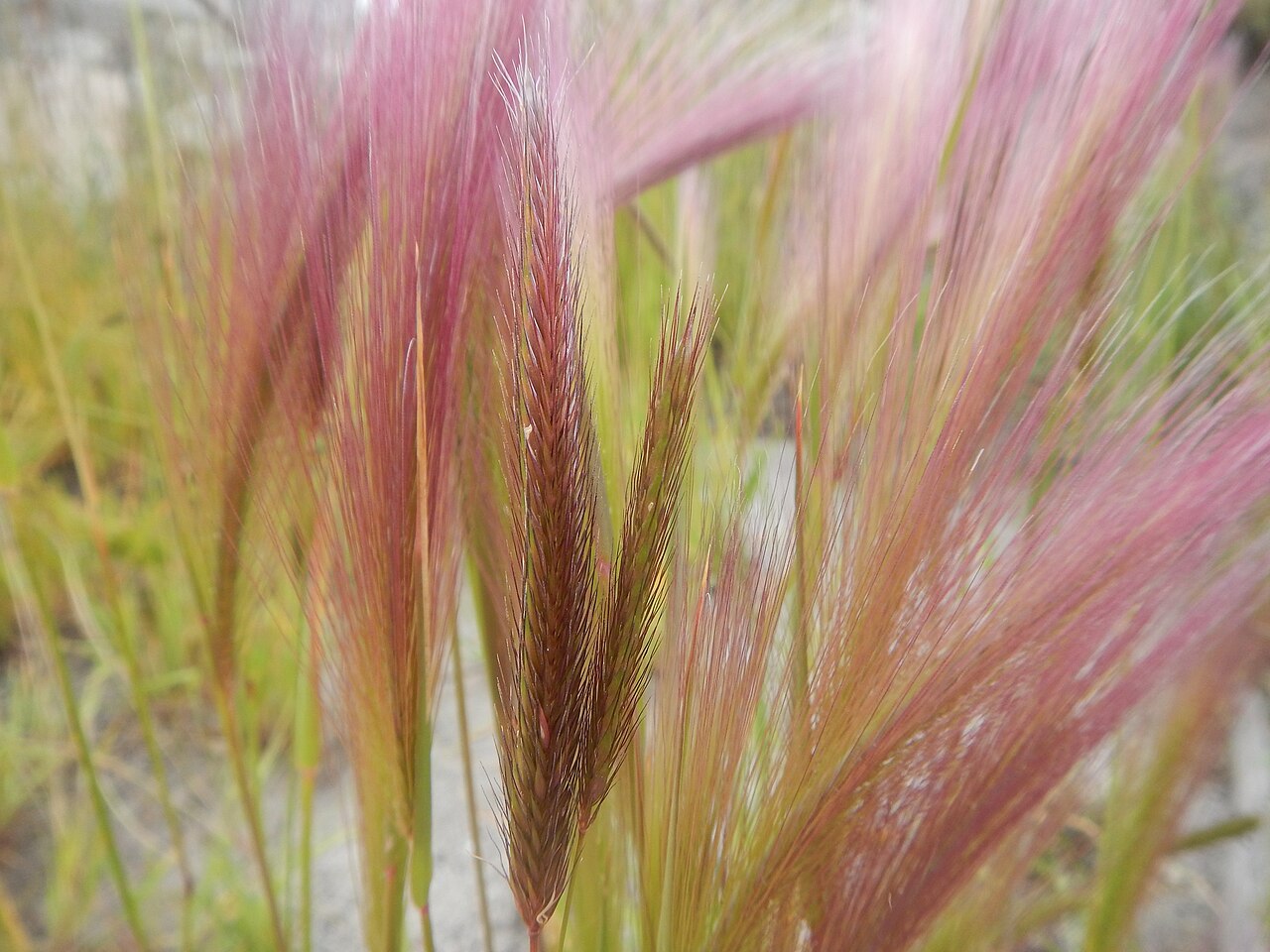
Foxtail Barley is the most similar plant, but its awns are much longer, about 1½ to 3½ inches, silky and spreading, and its heads nod and often turn pink or purple, giving a feathery “foxtail” look. Meadow barley has short awns and stiff, upright, narrow heads. Wild ryes such as Blue Wildrye have taller stems, longer spikes and usually two spikelets per node, not three. Annual barleys such as the non-native wall barley and the native little barley are short-lived, low annuals of dry, disturbed ground.
Quick Facts
| Scientific Name | Hordeum brachyantherum Nevski |
| Family | Poaceae (grass family) |
| Plant Type | Perennial, cool-season bunchgrass |
| Mature Height | 8 in–3 ft in flower (leaves 6–12 in) |
| Mature Spread | 6–12 in |
| Growth Rate | Fast |
| Sun Exposure | Full sun to part shade |
| Water Needs | Medium to high; moist soil, tolerates seasonal flooding |
| Soil Type | Clay, loam or sand; tolerates some salinity and alkalinity |
| Soil pH | About 5.5–8.5 |
| Bloom Time | May–August |
| Flower Color | Green, sometimes purple-tinged; straw-colored when ripe |
| Fall Color | Tan to straw |
| Fruit | Grain carried in bristly, short-awned spike segments |
| Deer Resistant | No; grazed by deer, elk and livestock |
| USDA Hardiness Zones | 3–9 |
Native Range
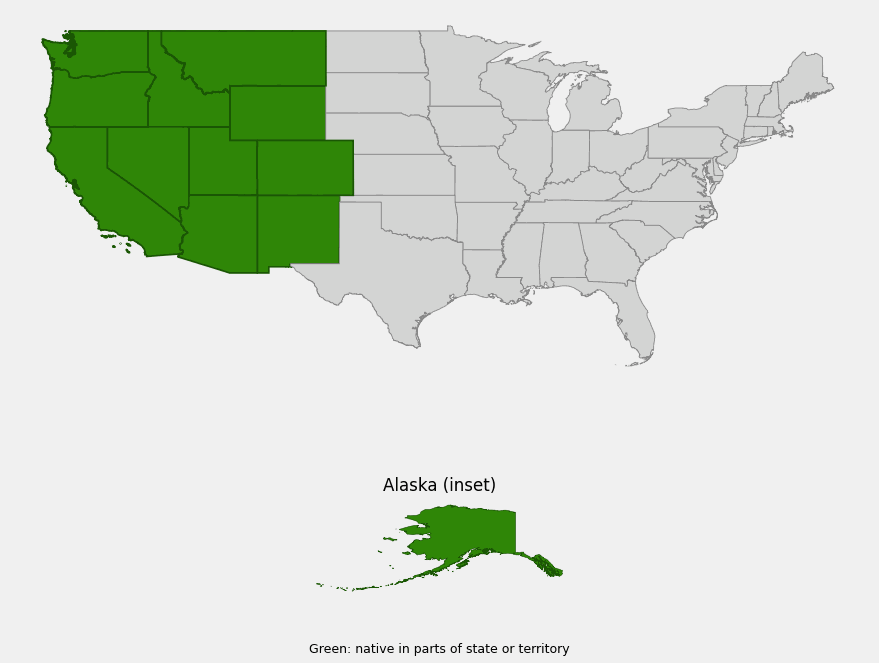
Meadow barley is native across western North America. In the United States it grows in Alaska, Washington, Oregon, California, Idaho, Nevada, Montana, Wyoming, Utah, Colorado, Arizona and New Mexico. In Canada it grows in Yukon, British Columbia, Alberta and Saskatchewan, with an isolated area on the coast of Newfoundland, and it also occurs in northern Baja California and on the Kamchatka coast of easternmost Russia.
USDA PLANTS also lists it from several eastern and midwestern states (including Illinois, Indiana, Maine, Maryland, Mississippi, Missouri, New Hampshire, New Jersey, New York, Ohio and Pennsylvania) and Texas. These are old or occasional collections from railroads, gardens and other disturbed sites, outside the native range; Go Botany treats it as an occasional non-native visitor in New England. We have left those states off the map. USDA lists Hawaii as introduced.
Typical habitats include wet and moist meadows, streambanks, lake and pond margins, seeps, coastal salt-marsh edges, vernal pool margins, moist grasslands and openings in mountain sagebrush and conifer forest. It grows from sea level to over 10,000 feet in the mountains, and in California subsp. californicum is common in moist grasslands and seasonally wet valley soils.
📋 Regional plant lists featuring Meadow Barley: Alaska · Western Oregon & Western Washington · Idaho, Eastern Oregon & Eastern Washington · California & Nevada · Arizona & New Mexico · Utah & Western Colorado · Montana & Wyoming
Growing & Care Guide
Meadow barley is one of the easiest native grasses to establish. It germinates quickly, grows fast in cool weather and is widely sold as seed in the West, especially in California. It is best used in groups or meadow mixes rather than as a single specimen.
Light
Plant in full sun to light shade. It grows densest and flowers best in sun.
Soil & Water
It grows in almost any soil, from heavy clay to sand, as long as it is moist in spring. It tolerates seasonal flooding, poor drainage and mildly saline or alkaline soils, which makes it useful in difficult wet sites. In dry-summer climates it can go partly dormant in late summer; occasional summer water keeps it greener.
Planting Tips
Sow seed in fall in mild-winter areas or in early spring in cold climates, pressing it lightly into a prepared seedbed. It is often used as a quick-establishing part of a native seed mix with slower perennial grasses and wildflowers. Plugs can be planted 12 to 18 inches apart.
Pruning & Maintenance
Cut or mow the old stems once the seed has dropped in summer or in late winter to tidy the planting. Plants are fairly short-lived as individuals but reseed readily in moist sites.
Propagation
Propagate from seed, which needs no special treatment and germinates in one to two weeks in cool, moist conditions. Clumps can also be divided in early spring.
Landscape Uses
- Wet meadows and rain gardens: a fast, tidy bunchgrass for moist and seasonally flooded soil
- Erosion control and restoration: quickly covers bare ground on streambanks, swales and disturbed sites
- Bioswales and roadside ditches: tolerates poor drainage and some salt
- Meadow gardens: a native alternative to lawn grasses in naturalistic plantings
- Wildlife plantings: seed and cover for birds and small mammals
Wildlife & Ecological Value
Meadow barley is a basic part of western wet meadows, providing forage, seed and cover.
For Pollinators
Like other grasses, meadow barley is wind-pollinated and offers little to bees, but grass clumps give shelter to overwintering insects, and grasses are larval host plants for many skipper butterflies and moths.
For Birds
Sparrows, finches, juncos, quail and other seed-eating birds eat the grain. The dense clumps provide nesting and hiding cover for ground-nesting birds in meadows.
For Mammals
Deer, elk and livestock graze the leaves, especially in spring when they are tender. Voles, mice and ground squirrels eat the seeds and use the clumps for cover.
Ecosystem Role
Its fibrous roots hold soil along streambanks and in wet meadows. In California it is a typical grass of vernal pool edges and moist native grasslands, habitats that have largely been lost to development and non-native annual grasses.
Cultural & Historical Uses
The Russian botanist Sergei Nevski named Hordeum brachyantherum in 1941. The name means “short-anthered barley,” from the Greek brachys (short) and anthera (anther). Hordeum is the Latin name for barley.
Meadow barley is a wild relative of cultivated barley (Hordeum vulgare), and plant scientists have studied its genes for traits such as stress tolerance and disease resistance. In California, both diploid and tetraploid forms occur, and a rare hexaploid form found there in 1980 is thought to have arisen from a cross with sea barley (Hordeum marinum).
Unlike Foxtail Barley, whose long, barbed awns can work into the eyes, mouths and skin of grazing animals and pets, meadow barley has short awns and is considered a good forage grass. That difference makes it a much better choice for meadow and pasture plantings.
Frequently Asked Questions
How do I tell meadow barley from foxtail barley?
Look at the awns. Foxtail Barley has long, silky awns about 1½ to 3½ inches long that make a feathery, often pink head that nods. Meadow barley has much shorter awns, generally well under an inch, and its narrow heads stay upright and green until they ripen.
Is meadow barley harmful to dogs like foxtail barley?
Its short awns are much less of a problem than the long, barbed awns of foxtail barley. Still, ripe seed heads of any wild barley can stick in fur, so it is wise to check pets after walks through grassy meadows in late summer.
What is California barley?
California barley is Hordeum brachyantherum subsp. californicum, a smaller, diploid form of meadow barley found in California, sometimes treated as a separate species, Hordeum californicum. Both are used in California restoration plantings.
Where is meadow barley native?
Throughout western North America, from Alaska and western Canada south to Arizona, New Mexico and Baja California, in moist meadows, streambanks and marsh edges. Records in the eastern United States are introduced.
Is meadow barley good for erosion control?
Yes. It establishes quickly from seed, tolerates wet, compacted and mildly salty soils, and its fibrous roots hold soil on streambanks, swales and disturbed ground. It is often used in seed mixes for these purposes in the West.

Looking for a nursery that carries Meadow Barley?
Browse our native plant nursery directory: Alaska & Arizona · California · Colorado · Idaho · Montana · Nevada & New Mexico · Oregon · Utah · Washington · Wyoming

