
Foxtail Barley (Hordeum jubatum)
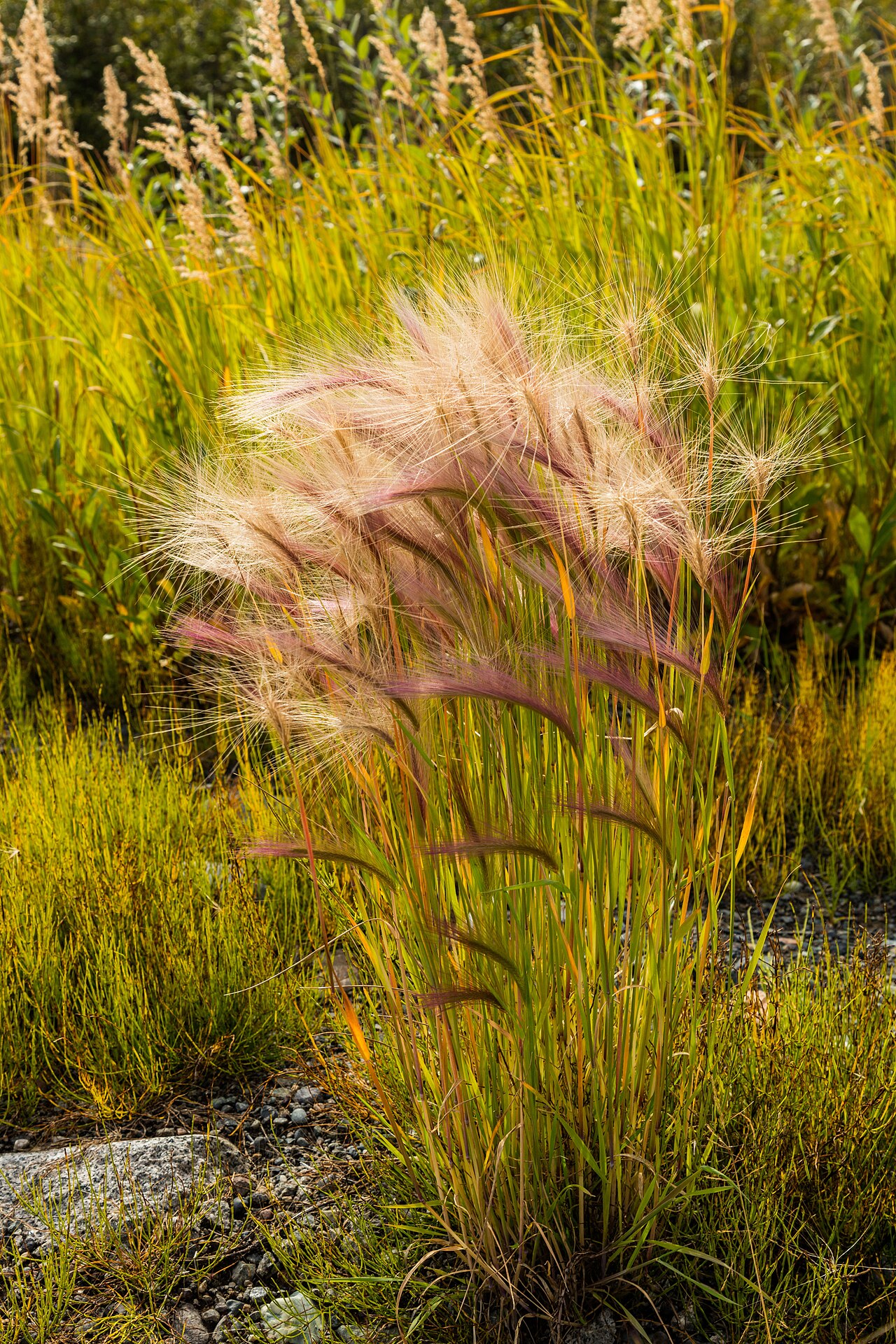
Hordeum jubatum, known as Foxtail Barley (also squirreltail barley or bobtail barley), is a short-lived perennial bunchgrass of the grass family (Poaceae) and a wild relative of cultivated barley. It is native from northeastern Siberia across Alaska and Canada and through most of the United States. It is best known for its striking seed heads: soft, nodding plumes of long, hair-like awns that shimmer pink, purple, silver and gold in the wind.
Foxtail barley is a tough pioneer. It thrives in moist meadows, wet ditches, lake shores and disturbed ground, and it tolerates salty and alkaline soils better than most grasses. It is one of the first grasses to colonize bare, salt-affected or recently exposed soils, which makes it useful for stabilizing difficult sites. Gardeners sometimes grow it as an ornamental for its beautiful, translucent heads.
It has a real downside. When the heads ripen, they break into sharp, barbed pieces that can work into the eyes, ears, noses, mouths and paws of dogs, and the mouths and eyes of livestock, sometimes causing serious injuries. For that reason it should not be planted where dogs play or where livestock graze or eat hay, and many ranchers treat it as a weed. This guide covers how to recognize it, where it grows naturally, and how to use it wisely.
Identification
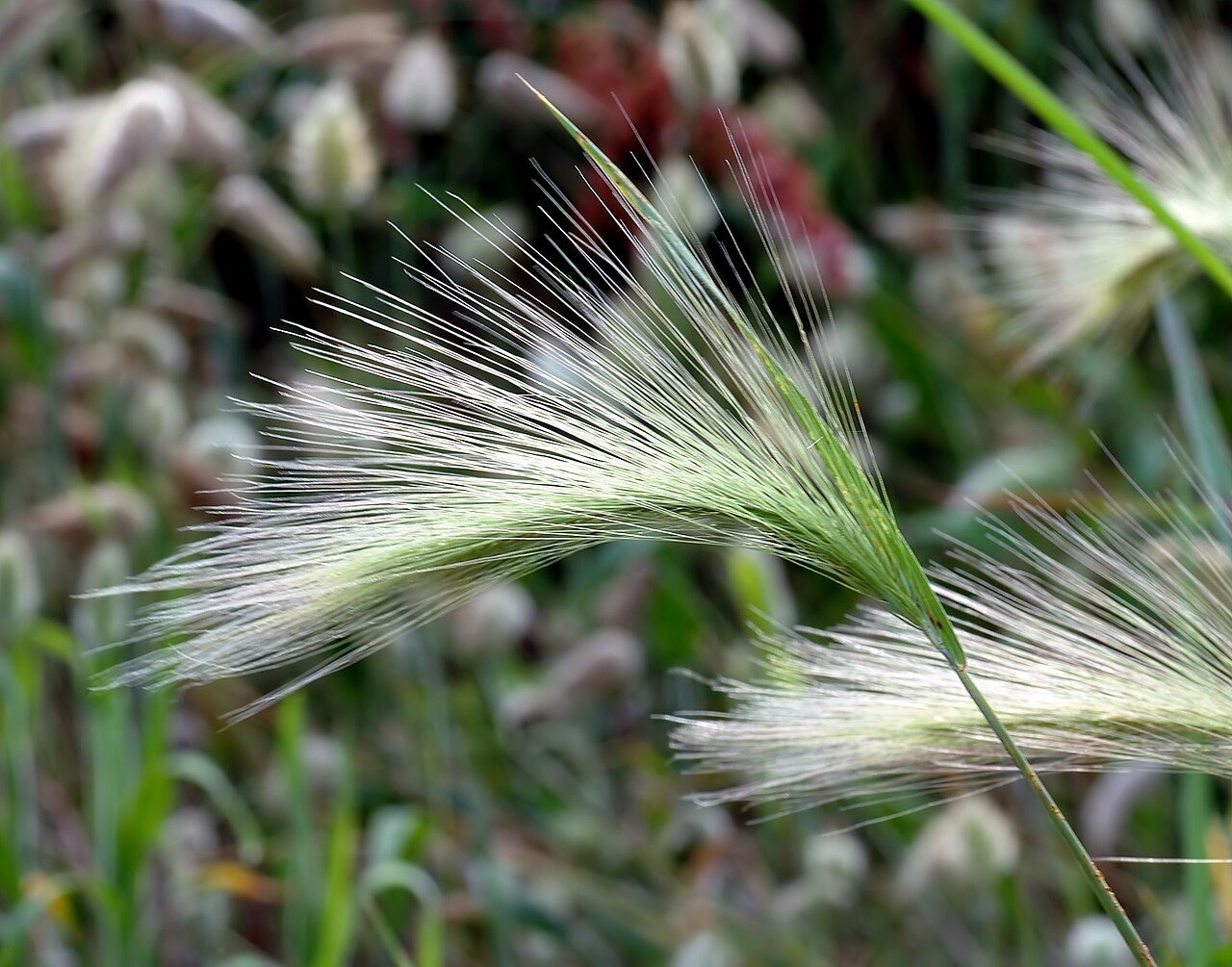
Foxtail barley is easiest to recognize in early to midsummer, when its nodding, brush-like heads with very long, fine awns stand above the leaves.
Growth Form
It grows in dense tufts 1 to 2 feet tall (sometimes taller), with many slender, upright to spreading stems. It is a cool-season grass that greens up early in spring and flowers in late spring and summer. Individual plants are usually short-lived, but they reseed freely.
Leaves
Leaf blades are flat or slightly rolled, about 1/8 to 1/4 inch wide and 2 to 6 inches long, grayish to bluish green and somewhat rough to the touch. The leaf sheaths are often slightly hairy.
Seed Heads
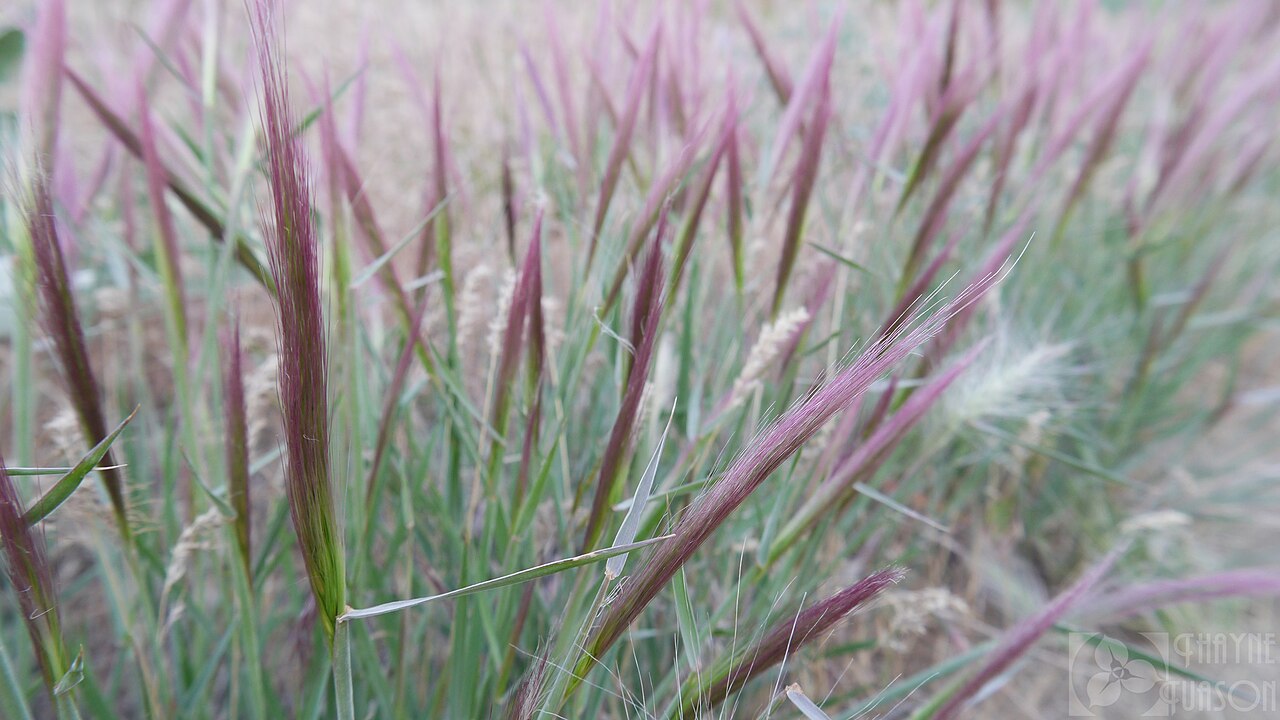
The flower head is a dense, nodding spike 2 to 5 inches long, made of groups of three spikelets at each joint. Only the central spikelet produces a seed; the side spikelets are reduced to bristles. The spikelets bear very slender awns 1 to 3 inches long, giving the head its silky, foxtail look. Young heads are green, pink or purple, and they fade to silvery tan as they ripen in summer.
Seeds & Dispersal
At maturity the spike breaks apart at each joint into small units, each with a seed and a bundle of stiff awns covered in tiny, backward-pointing barbs. These units catch on fur, feathers, clothing and machinery, and they also blow along the ground in the wind. Each plant can produce hundreds of seeds.
Look-alikes
Little barley (Hordeum pusillum) and meadow barley (H. brachyantherum) have much shorter awns, generally under an inch. Bottlebrush Squirreltail (Elymus elymoides) has stiffer, spreading awns on a more upright, bottlebrush-like spike that breaks apart in a similar way. Canada Wild Rye is a much larger grass with thicker, curving awns.
Safety Warning
The barbed seed heads are a known hazard to animals. The Lady Bird Johnson Wildflower Center warns that the awns can cause severe eye injuries in dogs and advises against using this grass where dogs are present. Awns can also lodge between toes and in ears and noses, and can cause sores in the mouths of horses, cattle and sheep that eat mature plants or hay containing them. Check pets after walks through stands of foxtail barley, and see a veterinarian if an animal paws at its eye or ear, sneezes repeatedly or develops a swelling.
Quick Facts
| Scientific Name | Hordeum jubatum |
| Family | Poaceae (grass family) |
| Plant Type | Cool-season, short-lived perennial bunchgrass |
| Mature Height | 1–2 ft |
| Mature Spread | 6–12 in |
| Growth Rate | Fast |
| Sun Exposure | Full sun |
| Water Needs | Medium to high; moist soils, tolerates short dry spells |
| Soil Type | Clay, loam or sandy soils, including saline and alkaline soils |
| Soil pH | About 6.5–9.5 (slightly acidic to strongly alkaline) |
| Bloom Time | May–August |
| Flower Color | Green, pink or purple, aging to silvery tan |
| Fall Color | Tan to straw |
| Fruit | Grain-like seed in a barbed, bristly unit |
| Deer Resistant | Mostly; mature heads are avoided by grazers |
| USDA Hardiness Zones | 2–8 |
Native Range
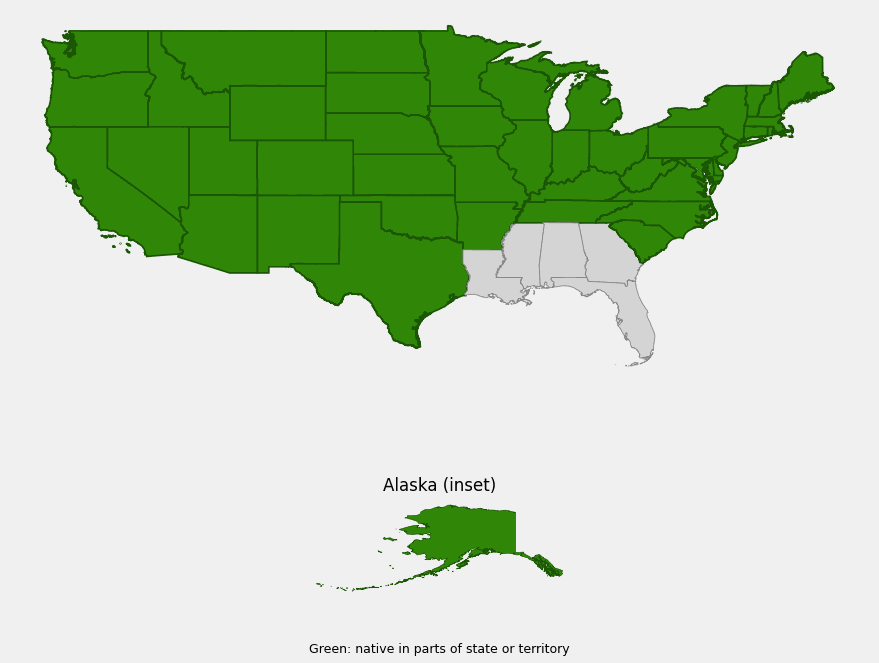
Foxtail barley is native to northeastern Asia and North America. USDA PLANTS lists it as native in Alaska, Canada, Saint Pierre and Miquelon and the lower 48 states, with records from 44 states. In Canada it is found in every province and territory. The Lady Bird Johnson Wildflower Center describes it as native throughout the United States except the Southeast.
It is most abundant in the West and on the Great Plains and prairies, where it can carpet wet meadows, alkaline flats, stock ponds, irrigation ditches and roadsides. It is common across the Great Lakes region and the Northeast as well. In much of the East and South it is mainly a plant of roadsides, rail lines and other disturbed ground, where it may have spread along transportation corridors, and it becomes scattered toward the Southeast. It is absent from Florida, Georgia, Alabama, Mississippi and Louisiana in the USDA records.
Outside North America, foxtail barley has spread widely as an escaped ornamental and contaminant of seed and hay, and it is considered a weed in Europe, Australia and parts of South America. Within its native range it grows from sea level to high mountain meadows.
📋 Regional plant lists featuring Foxtail Barley: New York, Pennsylvania & Northern New Jersey · Idaho, Eastern Oregon & Eastern Washington · Ohio & Indiana · Montana & Wyoming · Michigan, Wisconsin & Eastern Minnesota · Kentucky & Tennessee · Nebraska, Kansas & Eastern Colorado · Utah & Western Colorado · Connecticut, Massachusetts & Rhode Island · New Hampshire, Maine & Vermont · Maryland, Virginia & West Virginia · Delaware, Southern New Jersey & Long Island · Arizona & New Mexico · Illinois, Iowa & Missouri · Alaska · North & South Carolina · Arkansas, Louisiana, Eastern Oklahoma & Eastern Texas · South & West Texas · North Dakota, South Dakota & Western Minnesota · Western Oregon & Western Washington · California & Nevada
Growing & Care Guide
Foxtail barley is very easy to grow, so the main question is where to grow it. It is best used in wild meadows, rain gardens, wet ditches, salt-affected roadside or reclamation plantings and containers, away from dogs, pastures and hay fields. If you grow it as an ornamental, cut the heads before they shatter to prevent injuries and heavy self-seeding.
Light
Plant it in full sun. It tolerates very light shade but becomes floppy and flowers poorly in shade.
Soil & Water
It grows in almost any soil, from sand to heavy clay, and is notable for tolerating salty and alkaline conditions where many plants fail. Moist to seasonally wet soil suits it best, but established plants withstand short droughts.
Planting Tips
Sow seed in fall or early spring on bare, lightly raked soil and press it in; it germinates in cool weather. Space plants 8 to 12 inches apart. In ornamental beds, plant it in drifts or containers where the backlit heads can be seen, and keep it away from paths where people and pets brush against it.
Pruning & Maintenance
Cut back the old foliage in late winter. To prevent seed spread and protect animals, cut or mow the heads as soon as they begin to fade from pink to tan, before they shatter. Because plants are short-lived, let a few seed in naturalized areas, or resow every few years.
Propagation
Grow it from seed; it often blooms in its first or second year. Clumps can also be divided in early spring.
Landscape Uses
- Saline and alkaline sites: one of the few grasses that tolerate salty soils, roadsides and alkali flats
- Reclamation and erosion control: fast cover for bare, disturbed and seasonally wet ground
- Rain gardens and wet ditches: handles periodic flooding and drying
- Ornamental accents: silky, backlit heads in meadows and containers (cut before shattering)
- Dried arrangements: heads picked young hold their color when dried
Wildlife & Ecological Value
Foxtail barley is not a major wildlife plant, but it plays a role in wet meadows, prairies and disturbed sites, especially where few other plants can grow.
For Pollinators
Like other grasses, foxtail barley is wind-pollinated and offers little to bees and butterflies. Its leaves are eaten by the caterpillars of some grass-feeding moths and skippers.
For Birds
Seed-eating birds such as sparrows and ducks eat some of the seeds, and stands in wet meadows and around prairie potholes provide cover for ground-nesting birds and feeding waterfowl.
For Mammals
Young, green plants in spring are grazed by livestock, deer and elk and are reasonably palatable. Once the heads form, grazers avoid it, and the barbed awns can injure the mouths, eyes and skin of animals that eat or brush against it.
Ecosystem Role
Foxtail barley is a pioneer of saline, alkaline and disturbed soils. It quickly covers ground exposed by falling water levels, salting or disturbance, helping to hold soil until other plants arrive. Its abundance in a pasture often indicates overgrazing, salty soils or poor drainage.
Cultural & Historical Uses
The name jubatum means “having a mane,” describing the long, flowing awns of the seed head. Common names such as squirreltail barley and foxtail barley also refer to the soft, bushy heads. It belongs to the same genus as cultivated barley (Hordeum vulgare), but its small seeds were not a significant food crop.
Research has shown that foxtail barley is a polyploid species that arose from hybridization between an East Asian barley species and a relative of the Californian meadow barley. This history helps explain its wide range across the Bering region and North America.
Since the 1800s, foxtail barley has been grown in European gardens for its ornamental heads, and from gardens and contaminated seed it has spread to many countries. In North America it is valued in salt-affected land reclamation but disliked by ranchers and dog owners, a good example of a native plant that is useful in the right place and a problem in the wrong one.
Frequently Asked Questions
Is foxtail barley dangerous to dogs?
It can be. The barbed seed units can enter a dog’s eyes, ears, nose, mouth or paws and cause painful injuries and infections. Avoid planting it where dogs play, and check your dog after walks through stands of foxtail barley.
Is foxtail barley native or a weed?
Both. It is native to most of the United States, Alaska and Canada, but it behaves weedily in pastures, hay fields and disturbed ground, and it is an introduced weed in other parts of the world.
Can I grow it as an ornamental grass?
Yes, in full sun and almost any soil. Plant it away from pets and paths, and cut the heads before they ripen and shatter to prevent injuries and heavy self-seeding.
Does foxtail barley tolerate salt?
Yes. It is one of the most salt- and alkali-tolerant grasses in North America and is often found on saline flats and salted roadsides where few other plants grow.
Is it a perennial?
It is a perennial bunchgrass, but individual plants are usually short-lived. Populations persist by reseeding.

Looking for a nursery that carries Foxtail Barley?
Browse our native plant nursery directory: Alaska, Arizona & Arkansas · California · Colorado, Connecticut & Delaware · Idaho, Illinois, Indiana, Iowa & Kansas · Kentucky, Maine, Maryland, Massachusetts, Michigan, Minnesota, Missouri & Montana · Nebraska, Nevada, New Hampshire, New Jersey, New Mexico, New York, North Carolina, North Dakota, Ohio & Oklahoma · Oregon · Pennsylvania, Rhode Island, South Carolina, South Dakota, Tennessee, Texas, Utah, Vermont & Virginia · Washington · West Virginia, Wisconsin & Wyoming