
Largeleaf Pennywort (Hydrocotyle bonariensis)
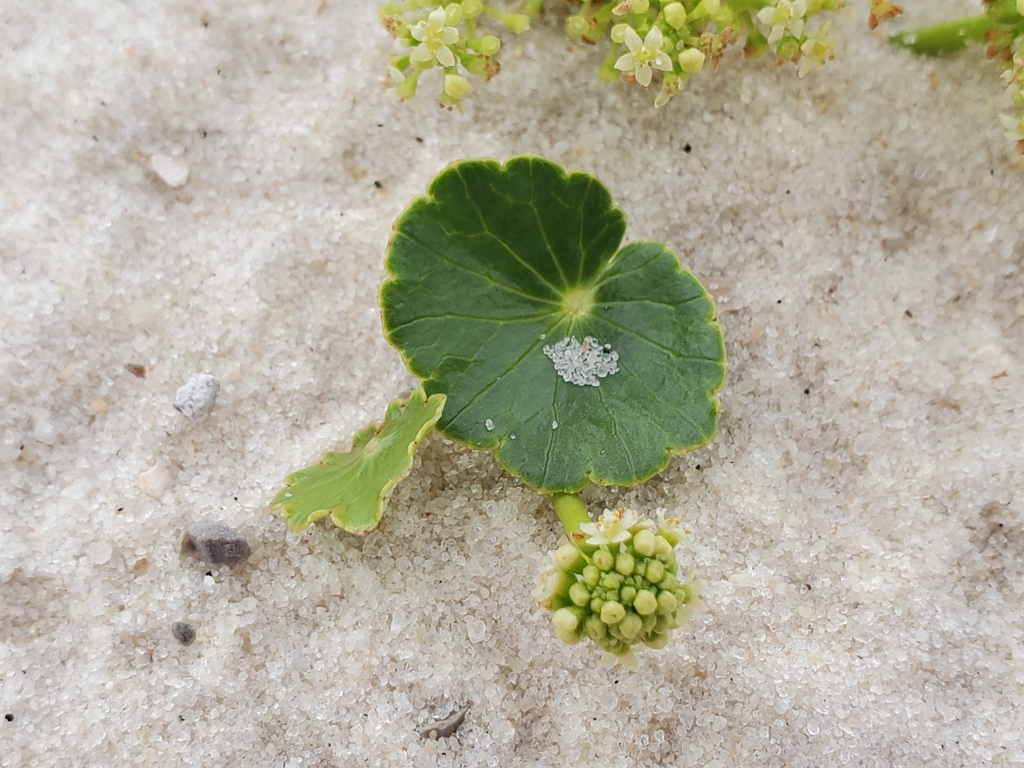
Hydrocotyle bonariensis, known as Largeleaf Pennywort, coastal pennywort or dune pennywort, is a low, creeping perennial of southern coasts. Its round, glossy, bright green leaves, up to about 4 inches across, are attached to their stalks in the center like little umbrellas or lily pads, and they seem to pop straight up out of the sand. From spring into fall, branched clusters of tiny creamy to greenish-white flowers rise on separate stalks among the leaves.
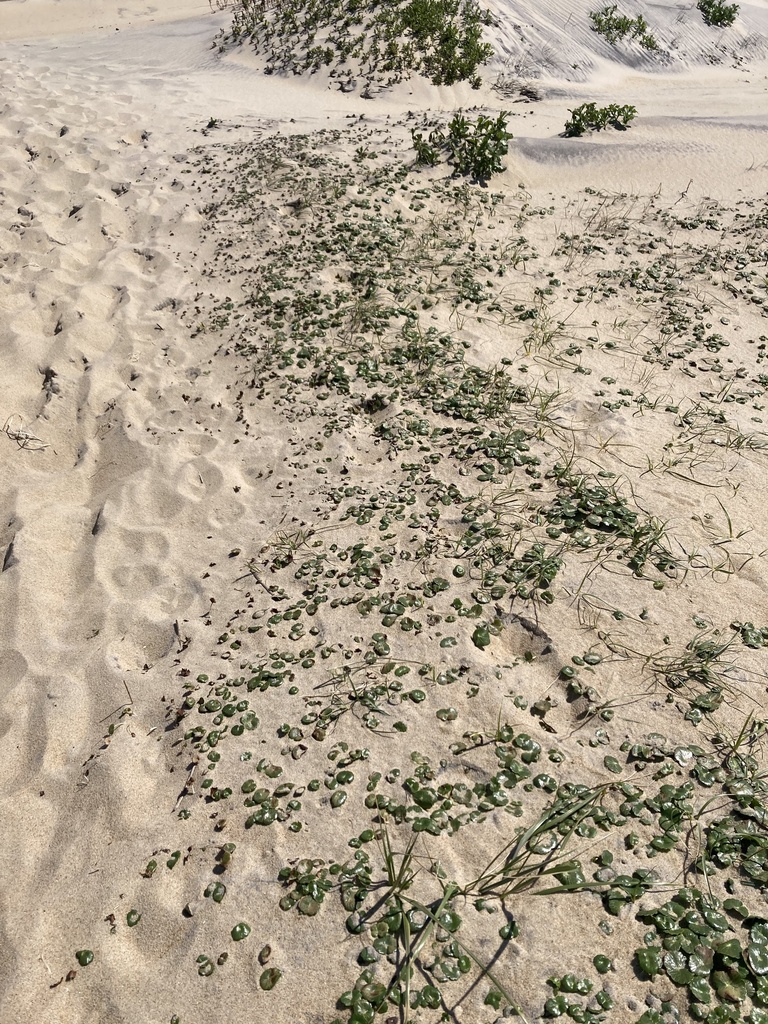
It grows along the Atlantic and Gulf coasts from Virginia to Texas and in Puerto Rico, and its range continues south through Mexico, the Caribbean, Central America and South America. The species name means “of Buenos Aires,” where it was first collected. On barrier islands it is one of the most familiar plants of beaches, dunes and the damp hollows between them, where long underground runners help hold the sand in place.
In gardens it is a tough, salt-tolerant groundcover for sandy coastal sites and wet spots. It also has a reputation as a lawn weed. In irrigated lawns and beds it spreads fast by rhizomes and can be hard to remove, so plant it only where you want a vigorous spreader. Pennyworts are now placed in the ginseng family (Araliaceae), although many older books put them in the carrot family (Apiaceae).
Identification
Several pennyworts grow in the Southeast, and all have round leaves with the stalk attached at or near the center. Largeleaf pennywort is the largest and the one most often found on sand by the sea, and its branched flower clusters are the best way to tell it apart.
Growth Habit
Largeleaf pennywort spreads by long, slender, white or pale rhizomes and runners that travel through sand or wet soil, sending up leaves and flower stalks at intervals. On dunes the runners can extend many feet, so a single plant may look like a scattered colony of separate leaves. In moist, rich soil it forms a dense, low mat.
Leaves
The leaves are round, about 1 to 4 inches across, thick, shiny and bright green, with shallowly scalloped or lobed edges. The leaf stalk joins the blade in the center (peltate), so the leaf looks like a small umbrella, and fine veins radiate out from that point. Stalks are a few inches tall on open sand and can reach 8 inches or more in shaded or wet sites. Leaves in full sun are often cupped and slightly yellowish green.
Flowers
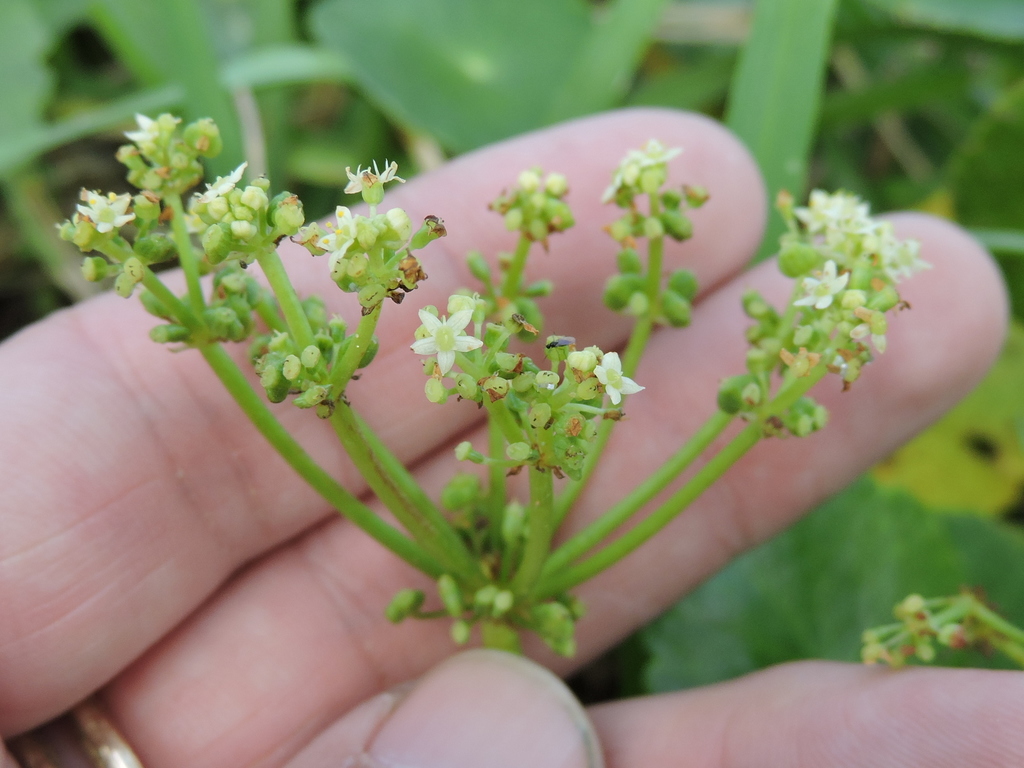
Flowers appear from spring through fall, and nearly year-round in Florida and Puerto Rico. They are tiny, about 1/16 inch across, with five creamy white to greenish-yellow petals, and are packed into small, rounded heads. The heads are carried on a branched, often several-tiered cluster (a compound umbel) that rises on a stalk usually as tall as or taller than the leaves. This branched cluster sets it apart from whorled pennywort (Hydrocotyle verticillata), which has flowers in whorls along a spike, and manyflower pennywort (H. umbellata), which has a single simple umbel.
Fruit
Each flower produces a tiny, flattened, two-parted fruit about 1/8 inch wide with ribbed faces, turning brown as it ripens. Seeds can float and may be carried by water, but most local spread is by runners.
Quick Facts
| Scientific Name | Hydrocotyle bonariensis Lam. |
| Family | Araliaceae (ginseng family); formerly placed in Apiaceae |
| Plant Type | Creeping herbaceous perennial groundcover; rhizomatous |
| Mature Height | 2–8 in (to 12 in in wet shade) |
| Mature Spread | Spreads indefinitely by rhizomes |
| Growth Rate | Fast |
| Sun Exposure | Full sun to partial shade |
| Water Needs | Moderate to high; tolerates dry sand once rooted into moist subsoil |
| Soil Type | Sand, sandy loam or muck; tolerates salt spray |
| Soil pH | Slightly acidic to alkaline (about 5.5–8.0) |
| Bloom Time | March–November; nearly year-round in the far South |
| Flower Color | Creamy white to greenish-yellow |
| Fall Color | Evergreen in mild climates; dies back in hard frost |
| Fruit | Tiny, flattened, ribbed two-parted fruit |
| Deer Resistant | Moderately; occasionally browsed |
| USDA Hardiness Zones | 7b–11 |
Native Range
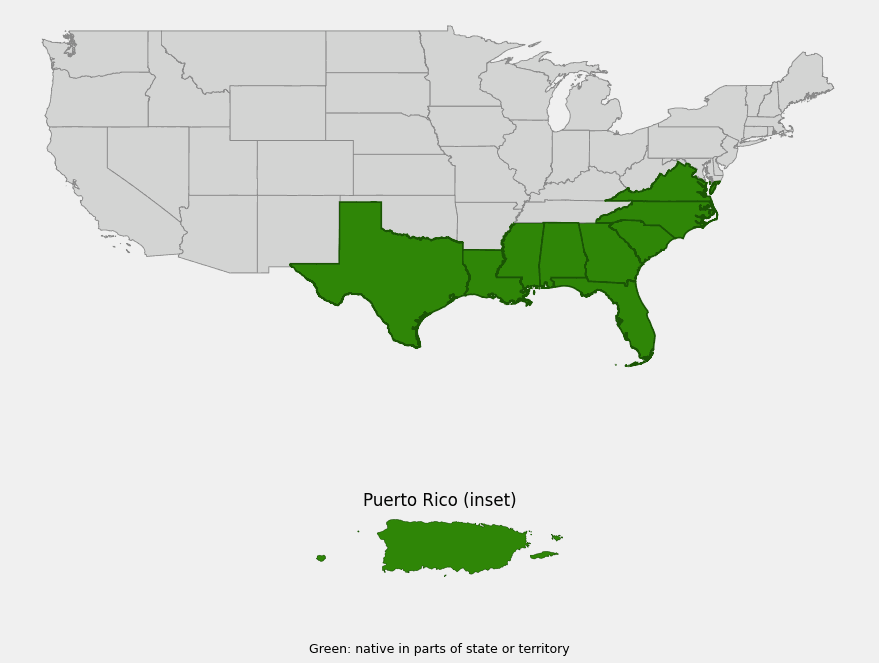
In the United States, USDA PLANTS lists largeleaf pennywort as native in Virginia, North Carolina, South Carolina, Georgia, Florida, Alabama, Mississippi, Louisiana and Texas, as well as Puerto Rico. Beyond the U.S., it ranges through Mexico, the West Indies, Central America and much of South America, including Argentina, Uruguay and Brazil. It has been introduced to Australia and a few other warm regions.
It is above all a coastal plant, common on the barrier islands and mainland shores of the Atlantic coast from southeastern Virginia south, all around the Florida peninsula, and along the Gulf Coast to South Texas, including Padre Island and the Coastal Bend. Inland it is less common, but it occurs in ditches, wet lawns and pond margins in the Coastal Plain, especially in Florida.
Its habitats include beaches, foredunes and backdunes, wet interdune swales, the upper edges of salt and brackish marshes, freshwater marshes, lake shores, ditches and moist disturbed ground. It is also common in lawns, golf courses and road shoulders near the coast, where mowing and irrigation suit it well.
📋 Regional plant lists featuring Largeleaf Pennywort: Maryland, Virginia & West Virginia · Alabama, Georgia & Mississippi · North & South Florida · Puerto Rico · North & South Carolina · Arkansas, Louisiana, Eastern Oklahoma & Eastern Texas · South & West Texas
Growing & Care Guide
Largeleaf pennywort is about as easy as a native plant gets in warm, sandy, coastal gardens, and that is both its strength and its drawback. Give it a spot where a fast-spreading groundcover is welcome, and be ready to edge it where it is not.
Light
Full sun to partial shade. On open dunes it grows in full sun with small, cupped leaves. In partial shade and moist soil the leaves become larger and the stalks taller, making a lush, glossy carpet.
Soil & Water
It grows in pure sand, sandy loam and wet muck, and tolerates salt spray and occasional brackish flooding. It is most vigorous where its roots reach moisture. On dunes it survives dry surface sand because its runners tap damper sand below. In regular garden soil, water during establishment; after that it usually needs no irrigation near the coast. Too much water and fertilizer make it spread faster.
Planting Tips
Plant pieces of rooted runner or small potted plants in spring or early summer, about 12 to 18 inches apart, and they will fill in within a season. Use it to stabilize sand on dune-side properties, in rain gardens and swales, along pond edges, or as a lawn alternative in damp, sunny spots. Be honest with yourself about where it can go: it creeps under edging and into adjoining lawns and beds, and in irrigated lawns it is often treated as a weed. A deep barrier, a hardscape edge or a surrounding area of dry, unirrigated ground helps contain it.
Pruning & Maintenance
It tolerates mowing and foot traffic, so it can be mown along with a lawn. To keep it in bounds, pull or cut runners along the edges a few times a season. Frost may brown the leaves in the northern part of its range, but new growth returns in spring.
Propagation
The easiest way to propagate it is by division: dig a section of runner with a few leaves and roots and replant it. It can also be grown from seed sown on moist soil in warm weather, but division is faster and more reliable. Buy plants from a nursery or take divisions from your own garden; do not dig from protected dunes, where disturbing the sand can harm the dune system.
Landscape Uses
- Coastal and dune gardens: salt-tolerant groundcover that helps stabilize sand
- Rain gardens and wet swales: thrives where water collects and spreads to cover bare soil
- Lawn alternative in damp, sunny areas: takes mowing and light foot traffic
- Pond and lake edges: fills in along shorelines with glossy, round leaves
- Living shoreline and restoration projects: used with sea oats and dune grasses on barrier islands
Wildlife & Ecological Value
Largeleaf pennywort is a small plant with a big role on coastal dunes and wet shorelines, both as a sand-binder and as a nectar source for small insects.
For Pollinators
The tiny flowers are open over a long season and are visited by small native bees, wasps, flies and beetles. Pennywort is not a showy pollinator plant, but its long flowering period provides a steady trickle of nectar and pollen on beaches and marsh edges where few other flowers bloom.
For Birds
Its small fruits and the insects it supports are eaten by ground-feeding birds. Beach-nesting shorebirds and terns often nest near low dune vegetation like pennywort, which gives chicks a little cover from heat and predators.
For Mammals
Rabbits, deer and other herbivores occasionally graze the leaves. On barrier islands, beach mice and other small mammals use the low dune vegetation as cover.
Ecosystem Role
Largeleaf pennywort is an important early colonizer of beaches and dunes. Its rhizomes spread through loose sand, helping to trap and hold it alongside sea oats, panic grass and other dune plants. Studies of this species have shown that connected runners can share water and nutrients across patches, letting the plant spread across the very different conditions of dry dune crests and moist swales. It recovers quickly after storms bury or expose its runners.
Cultural & Historical Uses
The genus name Hydrocotyle comes from Greek words for “water” and “small cup,” a reference to the cupped leaves of these mostly wetland plants. The French naturalist Jean-Baptiste Lamarck named the species bonariensis, “of Buenos Aires,” because it was first described from South America.
Pennywort leaves have been eaten in salads and used in folk medicine in parts of Latin America, and the plant is sometimes confused with Asian pennywort or gotu kola (Centella asiatica), a related plant used in Asian cooking and herbal traditions. Coastal pennywort can grow in polluted ditches and absorb contaminants, so it should not be foraged from roadsides, lawns treated with chemicals, or other questionable places.
For many beach visitors in the Southeast, the round green leaves scattered across the sand are among the first plants they notice, and pennywort has become a symbol of the resilient dune plant communities that protect coastal towns from storms.
Frequently Asked Questions
Is largeleaf pennywort invasive?
It is native to the southeastern U.S. coast, so it is not an invasive species there. It is, however, aggressive. In irrigated lawns and garden beds it spreads quickly by underground runners and can be hard to remove. Plant it only where you want a vigorous groundcover.
How do I get rid of pennywort in my lawn?
Reduce irrigation and fertilizer, which favor it, and improve conditions for your lawn grass. Pull small patches, removing as much of the runner as possible, and repeat as it resprouts. On the coast, consider letting it stay in damp spots where grass struggles.
Is it the same as gotu kola?
No. Gotu kola or Asian pennywort is Centella asiatica. Largeleaf pennywort (Hydrocotyle bonariensis) is a different plant, although the two are related and look somewhat alike.
Does it grow in salt water?
It tolerates salt spray, sandy beaches and occasional flooding with brackish water, but it grows best where there is fresh water in the soil, such as interdune swales and the upper edges of marshes.
Can I use it to stabilize sand?
Yes. Its runners help bind loose sand, and it is a natural part of dune plant communities with sea oats and panic grass. On public dunes, follow local rules; many places prohibit disturbing dune vegetation.

Looking for a nursery that carries Largeleaf Pennywort?
Browse our native plant nursery directory: Alabama · Florida & Georgia · Louisiana & Mississippi · North Carolina · South Carolina, Texas & Virginia