Western Blue Flag (Iris missouriensis)
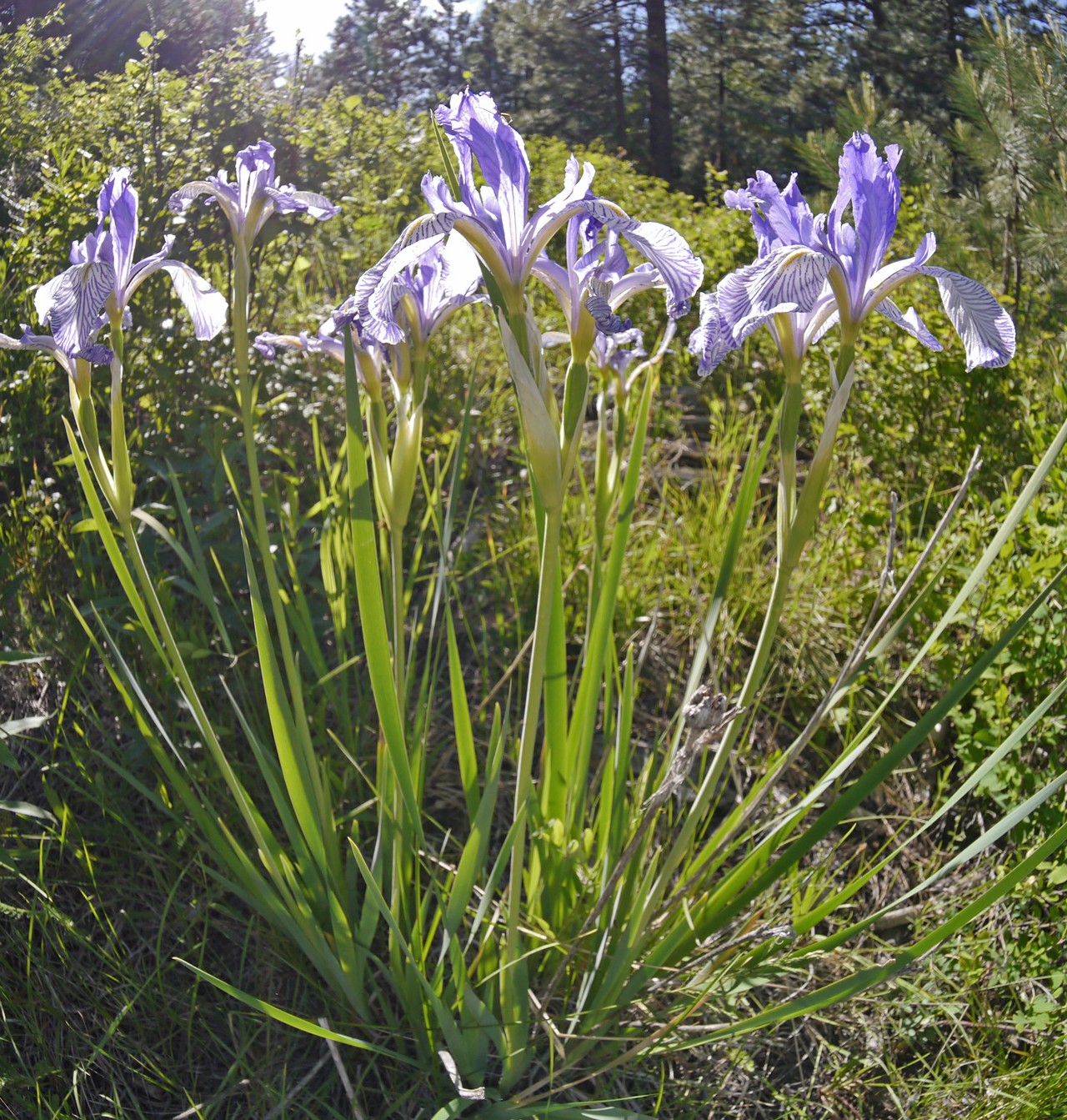
Iris missouriensis, commonly called Western Blue Flag or Rocky Mountain Iris, is the wild iris of the mountain West — a tough, rhizomatous perennial that colors wet meadows, seeps, and stream margins pale blue-lavender from late spring into early summer. It is the most widespread native iris of the interior West, found from the high desert of Nevada and the Great Basin to subalpine meadows in the Rockies, often forming large colonies that are easy to overlook until they bloom.
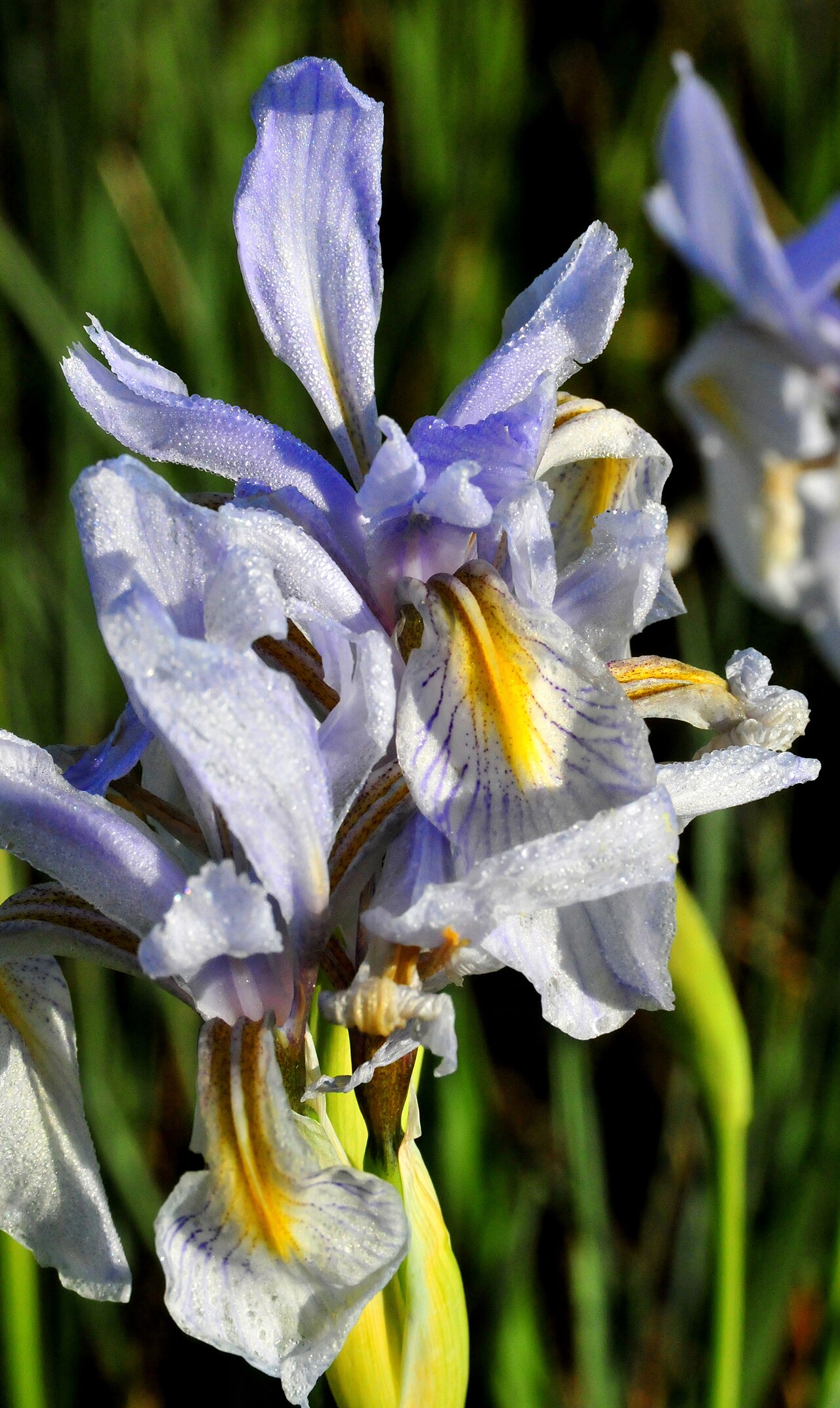
Unlike the showy bearded irises sold at garden centers, Western Blue Flag is an unassuming plant for most of the year: narrow, grayish-green, grass-like leaves rising 12 to 28 inches from a tough rhizome. For a few weeks each year, though, each stem sends up one to three pale blue to lavender-white flowers veined in deep purple, with a small yellow or gold signal patch on the falls that guides pollinators to the nectar. The combination of narrow foliage and short bloom window means it is often mistaken for a sedge or rush until the flowers appear.
Western Blue Flag is an excellent choice for anyone restoring a wet meadow, pond margin, or seasonally moist swale in its native range. It tolerates the boom-and-bust moisture cycle typical of western wetlands — saturated in spring, bone dry by late summer — better than most garden perennials, and it asks for nothing once established. Every part of the plant is toxic if eaten, which is itself a kind of low-maintenance insurance: deer and livestock leave it alone.
Identification
Western Blue Flag grows from a thick, branching rhizome that sits at or just below the soil surface, sending up dense clumps of narrow, sword-shaped leaves. The whole plant has a tidy, grass-like appearance for most of the growing season, with flowering stems only slightly taller than the surrounding foliage.
Leaves
Leaves are linear and flattened, 8 to 24 inches long and typically less than ½ inch wide, gray-green to blue-green in color, and arranged in a fan at the base of the plant. They are tough and somewhat leathery, with parallel veins, and persist through summer even as the plant dries out and goes dormant in late-season drought. New growth emerges from the rhizome each spring, often forming expanding clonal patches over years.
Flowers
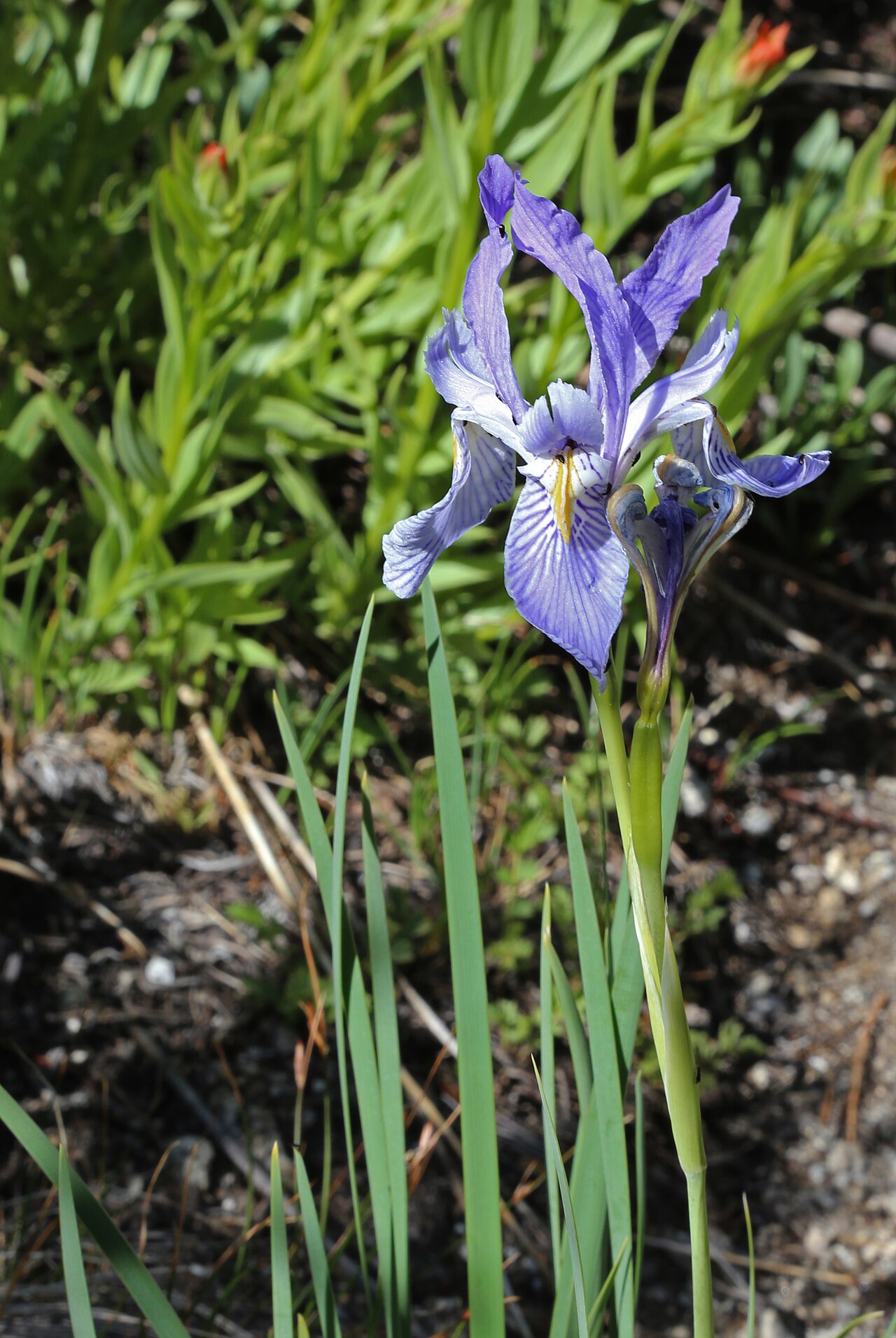
Flowering stems reach 10 to 28 inches tall, usually a bit taller than the leaf fans, each bearing one to three flowers from branched stem tips. The flowers are 2 to 3 inches across, pale blue to blue-violet or nearly white, with three drooping “falls” veined in dark purple and marked with a yellow or greenish-gold signal patch near the base, and three upright, narrower “standards.” Bloom runs from April to July depending on elevation and snowmelt timing — lower desert populations flower earliest, high mountain meadows last, sometimes blooming right at the edge of melting snowbanks.
Fruit & Seeds
After flowering, each stem produces an oblong, three-chambered seed capsule 1½ to 2½ inches long that matures and splits in late summer, releasing flattened, light brown seeds. The capsules are often visible standing above the drying foliage well after the flowers are gone, useful for identifying plants once the colorful bloom window has passed.
Quick Facts
| Scientific Name | Iris missouriensis |
| Family | Iridaceae (Iris) |
| Plant Type | Herbaceous Perennial (rhizomatous) |
| Mature Height | 10–28 in |
| Mature Spread | 12–24 in (clumps expand slowly by rhizome) |
| Growth Rate | Slow to moderate |
| Sun Exposure | Full Sun to Part Shade |
| Water Needs | Wet in spring, tolerates summer drought |
| Soil Type | Clay, loam; moist to seasonally saturated |
| Soil pH | 6.5–8.5 (tolerates alkaline soils) |
| Bloom Time | April – July (varies with elevation) |
| Flower Color | Pale blue to blue-violet, purple-veined |
| Fall Color | None notable; foliage dries tan in late summer |
| Fruit | Oblong seed capsule, not edible |
| Deer Resistant | Yes (foliage and rhizome are toxic) |
| USDA Hardiness Zones | 3–8 |
Native Range
Western Blue Flag is native across the interior mountain West, from the eastern slopes of the Cascades and Sierra Nevada through the Great Basin and Colorado Plateau to the Rocky Mountain front. It is common in Idaho, Utah, Nevada, Arizona, New Mexico, Colorado, Wyoming, and Montana, and reaches the edge of its range in scattered wet meadows and drainages of the western Dakotas and Nebraska panhandle. Within California, Oregon, and Washington it is native mainly to the drier, inland side of the mountains — the Sierra Nevada, Modoc Plateau, and the eastern slopes of the Cascades — rather than the wetter coastal and western valley regions, where plantings of this iris outside gardens are not considered native populations.
Across this huge range, Western Blue Flag is tied to one habitat type: places where the soil is saturated or flooded in spring and dries out by mid-to-late summer. That includes mountain wet meadows fed by snowmelt, stream and spring margins, seasonally flooded alkaline flats, and the edges of stock ponds and irrigation ditches. It grows from valley floors in the Great Basin up to subalpine meadows above 9,000 feet, often as the dominant wildflower in a wet meadow for the few weeks it is in bloom.
Because it tolerates both seasonal flooding and the alkaline soils common in closed desert basins, Western Blue Flag often grows alongside saltgrass and western wheatgrass in situations too harsh or too variable in moisture for less specialized wildflowers. This adaptability is also why it is sometimes planted well outside its native inland range — gardeners in coastal California, Oregon, and Washington should know that while the species will grow there, those populations are not natural and the plant is better suited, ecologically, to its native interior range.
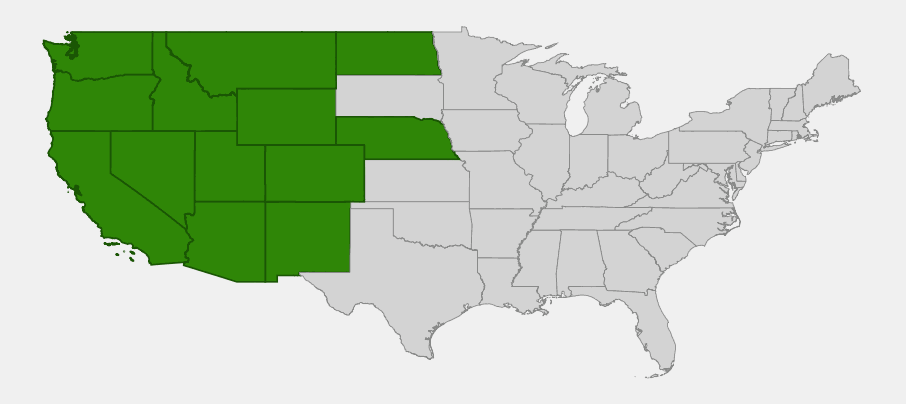
📋 Regional plant lists featuring Western Blue Flag: California & Nevada · Arizona & New Mexico · Utah & Western Colorado · Montana & Wyoming · Nebraska, Kansas & Eastern Colorado · North Dakota, South Dakota & Western Minnesota · Idaho, Eastern Oregon & Eastern Washington
Growing & Care Guide
Western Blue Flag rewards gardeners who can offer it the one thing it truly needs: a spot that is reliably wet in spring. Beyond that, it is one of the most drought- and neglect-tolerant irises available for western gardens, since in the wild it survives a long dry season every single year.
Light
Plant in full sun for the best bloom, though it tolerates light or part shade, especially at lower, hotter elevations where some afternoon shade reduces moisture stress. In its native mountain meadows it typically grows in full sun during the snowmelt season.
Soil & Water
Western Blue Flag wants heavy, moisture-retentive soil — clay or clay-loam that stays saturated through spring. It tolerates neutral to strongly alkaline soils (pH up to 8.5), which makes it a good match for the hard water and alkaline soils common across much of the Intermountain West. Once the spring flush passes, established plants tolerate dry, cracked soil through summer; established clumps need no supplemental water in most of their native range, though young plants benefit from occasional deep watering their first year or two.
Planting Tips
Set out rhizome divisions or container plants in fall or early spring, planting rhizomes shallowly with the top just at or barely below the soil surface — deep planting is a common cause of failure to flower. Choose a low spot, pond margin, or swale that collects spring runoff. Space plants 12 to 18 inches apart; clumps are slow to spread, so closer spacing gives a fuller look sooner.
Pruning & Maintenance
Cut back dried foliage and spent flower stalks in late fall or early spring. Established clumps benefit from division every 4 to 6 years to maintain vigor and bloom — lift and divide in late summer or early fall after the foliage has browned. Wear gloves when handling the rhizomes, since the plant’s toxic compounds can irritate skin.
Propagation
The easiest method is rhizome division: lift an established clump after bloom, cut the rhizome into sections each with a fan of leaves and healthy roots, and replant immediately. Seed propagation is possible but slow — seeds benefit from a cold-moist stratification period over winter and seedlings may take three or more years to flower.
Landscape Uses
- Rain gardens and bioswales designed to flood briefly in spring and dry out in summer
- Pond and stock tank margins where soil stays saturated part of the year
- Wet meadow restoration in its native mountain and high-desert range
- Alkaline or hard-water sites where many garden perennials struggle
- Deer-resistant borders in rural gardens with heavy browse pressure
- Naturalized colonies along irrigation ditches and seasonal drainages
Wildlife & Ecological Value
Though it blooms for only a few weeks a year, Western Blue Flag plays a meaningful role in the wet-meadow ecosystems where it grows, and its dense rhizome mats help stabilize soil that is alternately flooded and parched.
For Pollinators
The flowers are pollinated primarily by native bees, including bumblebees and other large-bodied bees strong enough to push past the landing platform formed by the falls to reach the nectar near the yellow signal patch. Several butterflies, including the Silvery Blue, Rocky Mountain Parnassian, and Western Tiger Swallowtail, visit the flowers for nectar, though they are not effective pollinators.
Birds & Mammals
Because every part of the plant — leaves, rhizome, and seeds — contains irritant glycosides, Western Blue Flag is avoided by deer, elk, and livestock, which makes it one of the few palatable-looking wildflowers that survives heavy grazing pressure in rangeland meadows. This grazing resistance means it can become locally dominant in overgrazed wet meadows where more palatable plants have been eaten down.
Ecosystem Role
The tough, interwoven rhizome mats of Western Blue Flag help stabilize soil along streambanks and meadow margins subject to seasonal flooding, reducing erosion during spring runoff. Its dense clumps also provide cover for small mammals and amphibians using the margins of wet meadows, and its presence is often a useful indicator of a healthy, naturally fluctuating wetland hydrology.
Cultural & Historical Uses
Indigenous peoples across the Great Basin and Rocky Mountain region, including the Shoshone, Paiute, and other groups, historically used the tough fibers of Western Blue Flag leaves for cordage, snares, and nets, valuing the plant’s strong, flexible leaf fibers rather than any edible or medicinal part. The plant’s toxicity was well understood, and it was handled with care during fiber processing.
Some groups used small, carefully prepared amounts of the root as an external treatment, but the species was never regarded as a food plant — every part of Iris missouriensis contains irritant compounds that make it unsafe to eat, and historical accounts consistently describe it as a utility and craft plant rather than a dietary one.
Today, Western Blue Flag has little commercial history compared to showier garden irises, but it has become increasingly valued by restoration ecologists and native-plant gardeners in the Intermountain West for its toughness in seasonally wet, alkaline sites where few other perennials perform reliably.
Frequently Asked Questions
Is Western Blue Flag the same plant as Iris versicolor?
No. Iris versicolor, sometimes called Larger Blue Flag Iris, is a separate species native to the eastern United States and Canada. Western Blue Flag (Iris missouriensis) occupies the interior western mountains and is shorter, with narrower leaves and smaller, paler flowers. See our page on Larger Blue Flag Iris for the eastern counterpart.
Is Western Blue Flag toxic?
Yes. All parts of the plant — leaves, rhizomes, and seeds — contain irritant glycosides that cause nausea, vomiting, and skin irritation if ingested or handled without care. It should never be eaten and should be kept away from children, pets, and livestock.
Can Western Blue Flag grow in a regular garden bed without standing water?
Established plants tolerate ordinary garden conditions and dry summers reasonably well, since that mimics their native boom-and-bust moisture cycle. However, consistent spring moisture is essential for good flowering; a bed that is dry all spring will produce sparse bloom even if the plant survives.
Why do my irises bloom poorly even though the plant looks healthy?
Poor flowering is usually caused by rhizomes planted too deep, overcrowding after several years without division, or insufficient spring moisture. Shallow replanting, periodic division every 4 to 6 years, and ensuring a wet spring period usually restores good bloom.
Is it true this iris is sometimes called Rocky Mountain Iris?
Yes, both common names are used interchangeably. “Rocky Mountain Iris” references its abundance in that range, while “Western Blue Flag” reflects its broader distribution across the interior West, including the Great Basin and Colorado Plateau far from the Rockies themselves.

Looking for a nursery that carries Western Blue Flag?
Browse our native plant nursery directory: California · Arizona · Colorado · Idaho · Montana · Nebraska, Nevada, New Mexico & North Dakota · Oregon · Utah · Washington · Wyoming