
Traveler’s Delight (Apios priceana)
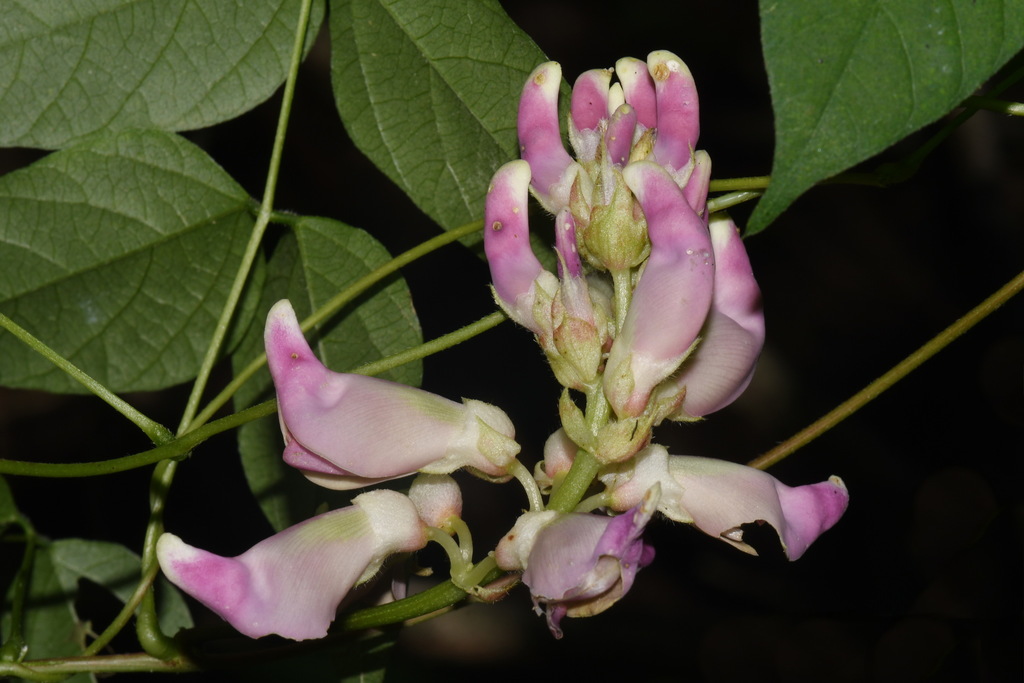
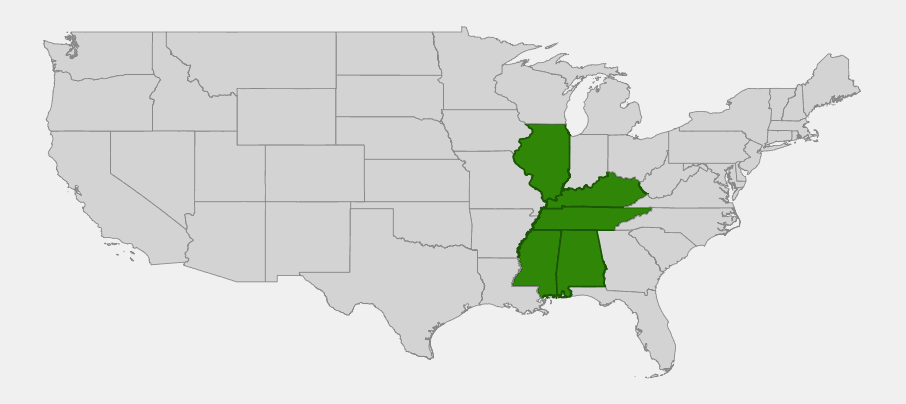
Apios priceana, known as Traveler’s Delight, Price’s potato-bean or Price’s groundnut, is a rare twining vine in the pea family. It grows only in a small part of the southeastern United States: northern and central Alabama, northeastern Mississippi, central Tennessee and south-central Kentucky, with a historic record in southern Illinois.
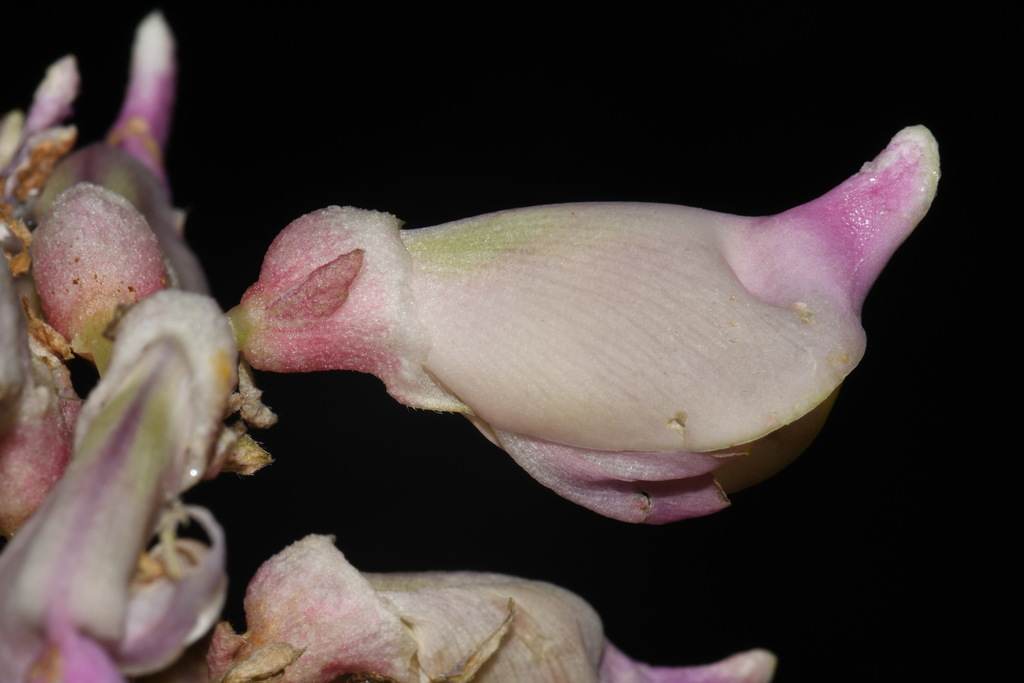
It is a close relative of the common American groundnut but differs in one striking way: instead of a chain of small tubers, each plant grows a single large, potato-like tuber that enlarges year after year. In summer it bears dense clusters of greenish-white to pink pea flowers with a distinctive knob at the tip of the upper petal.
Price’s potato-bean is listed as Threatened under the U.S. Endangered Species Act (since 1990), with only a few dozen known populations. This guide covers how to identify it, where it grows, and why it should never be dug from the wild.
Identification
Traveler’s delight is a herbaceous twining vine with pinnately compound leaves, summer racemes of pale pea flowers with a knob-tipped standard, long slender pods and one big tuber.
Vine & Tuber
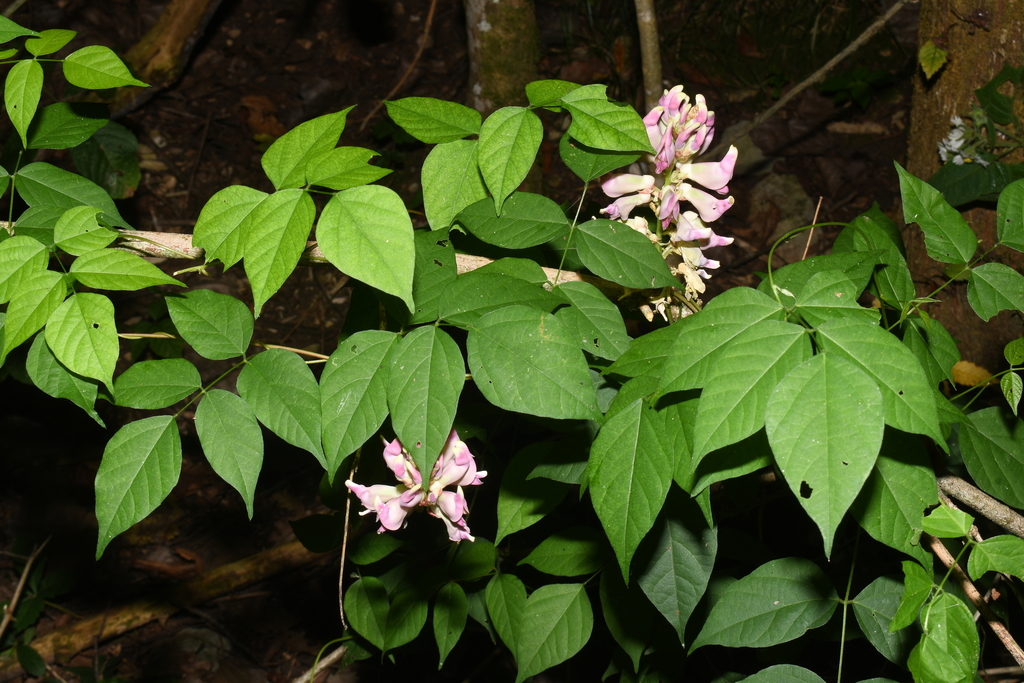
The stems twine around shrubs, saplings and tall herbs, reaching 10 to 16 feet in a good year, and die back to the ground in fall. Underground is one rounded tuber that can grow several inches across over many years. The common groundnut, by contrast, makes a necklace-like chain of small tubers along its roots.
Leaves
The leaves are alternate, about 8 to 12 inches long and pinnately compound, usually with five to seven ovate, pointed leaflets that are smooth and medium green.
Flowers
From about June to August, dense racemes of 20 or more pea-like flowers rise from the leaf axils. The flowers are greenish-white to cream, flushed pink to purplish, and the tip of the upper petal (the standard) bears a thick, spongy, knob-like appendage, the best field mark for the species. They are somewhat fragrant.
Fruit & Look-alikes
The fruit is a long, slender, bean-like pod about 4 to 6 inches long that splits open in fall. American groundnut has smaller, deep maroon-brown and pinkish flowers without the knob and a chain of tubers. American hog peanut is a much smaller vine with three leaflets, and Kentucky wisteria is a woody vine with hanging lilac clusters.
Quick Facts
| Scientific Name | Apios priceana B.L. Rob. |
| Family | Fabaceae (pea or legume family) |
| Plant Type | Herbaceous perennial twining vine from a tuber |
| Mature Height | Vines 10–16 ft long |
| Mature Spread | Climbs over nearby vegetation |
| Growth Rate | Fast each season from the tuber |
| Sun Exposure | Partial shade to light woodland openings |
| Water Needs | Moderate; well-drained soil |
| Soil Type | Fertile, well-drained loam, often over limestone |
| Soil pH | About 6.0–7.5 |
| Bloom Time | June–August |
| Flower Color | Greenish-white to pink and purplish |
| Fall Color | Yellowish before dying back |
| Fruit | Slender pod 4–6 in long |
| Deer Resistant | No; browsed by deer and other animals |
| USDA Hardiness Zones | 6–8 |
Native Range
Traveler’s delight has one of the smallest ranges of any North American legume vine. USDA PLANTS lists it as native to Alabama, Mississippi, Tennessee, Kentucky and Illinois. Most populations are in the Tennessee Valley and Black Belt regions of northern and central Alabama, northeastern Mississippi, the Nashville Basin and Highland Rim of Tennessee, and south-central Kentucky, where it was first found near Bowling Green.
The Illinois record is historic: the species was collected in southern Illinois, but that population is believed to have been lost. In total, the U.S. Fish and Wildlife Service and state heritage programs know of only a few dozen populations, many of them small.
It grows in openings and edges of rich, mixed hardwood forests, often where ravine slopes grade down to creek bottoms, on rocky wooded slopes and on floodplain edges. Soils are well-drained, fertile and often limestone-derived. It needs some light, and some populations persist along road edges and power-line clearings where the canopy is open.
📋 Regional plant lists featuring Traveler’s Delight: Alabama, Georgia & Mississippi · Kentucky & Tennessee · Illinois, Iowa & Missouri
Growing & Care Guide
Traveler’s delight is a federally threatened species and is not a normal garden plant. Never dig wild plants or their tubers: collecting or harming it on federal land, or on any land in violation of state law, is illegal, and removing the single tuber kills the plant. It is grown mainly by botanical gardens and conservation programs. If you ever find it offered for sale, buy only from a reputable nursery that propagates it legally from seed. The notes below describe the conditions it needs, which also guide habitat management where it grows wild.
Light
Partial shade or a woodland opening. It does not tolerate deep shade, and wild populations decline when the forest canopy closes over them.
Soil & Water
Fertile, well-drained loam with steady moisture, often over limestone. Avoid soggy ground, which can rot the tuber.
Planting Tips
Give the vine a shrub, small tree or trellis to climb at the edge of a woodland garden. Mark the spot, since the vine dies back completely in winter and the tuber is easily damaged by digging.
Pruning & Maintenance
No pruning is needed. Keep competing aggressive vines and invasive plants such as crown vetch and Japanese honeysuckle away from it, and protect it from deer browsing.
Propagation
Seeds have a hard coat and need scarification (nicking or sanding) before sowing; they germinate best with warm, fluctuating temperatures. Plants take several years to build a tuber large enough to flower. Propagation of this listed species is done by conservation programs.
Landscape Uses
- Conservation and recovery plantings: by botanical gardens and conservation partners
- Woodland edge habitat: a native legume vine for light gaps
- Pollinator support: summer flowers for bumble bees and skippers
- Education: an example of a rare Interior Low Plateau endemic
Wildlife & Ecological Value
Traveler’s delight feeds summer pollinators and, like other legumes, enriches the soil it grows in.
For Pollinators
Studies in Kentucky and Alabama recorded bumble bees, honey bees, leafcutter bees and the silver-spotted skipper visiting the flowers, and hummingbird clearwing moths have also been seen. Large bees can open the flowers and reach the nectar.
For Birds
The vines add cover to woodland edges. The seeds are not an important bird food.
For Mammals
Deer browse the foliage and small mammals may eat the tubers; browsing and digging can set back small populations.
Ecosystem Role
As a legume it hosts nitrogen-fixing bacteria in root nodules, adding nitrogen to the soil. Its survival depends on periodic openings in the forest canopy, from treefalls, fire or careful management.
Cultural & Historical Uses
The species was discovered by Sadie F. Price, a botanist and artist from Bowling Green, Kentucky, and was named in her honor by Benjamin Lincoln Robinson in 1898. The common name “traveler’s delight” is a folk name for this potato-bean vine.
Its relative, the common groundnut, was an important food for Native Americans and early settlers, and the starchy tuber of Price’s potato-bean is also edible. Historic digging of the tubers for food is thought to have contributed to its decline.
The U.S. Fish and Wildlife Service listed Apios priceana as Threatened in 1990. Recovery work includes protecting known sites, managing canopy cover and invasive plants, and growing plants from seed for reintroduction.
Frequently Asked Questions
Is Price’s potato-bean endangered?
It is federally listed as Threatened, with only a few dozen known populations in Alabama, Mississippi, Tennessee and Kentucky. It is also tracked as rare by each state heritage program.
How is it different from American groundnut?
Traveler’s delight has one large tuber instead of a chain of small ones, paler greenish-white to pink flowers, and a thick knob at the tip of the upper petal.
Can I eat the tuber?
The tuber is edible, but this is a protected rare plant. Never dig it; eat the common groundnut instead if you want to try a native tuber.
Where can I see it?
Some populations grow in protected natural areas and along managed roadsides in Alabama, Mississippi, Tennessee and Kentucky. Look in July and August, when it is in flower, and do not trample or disturb the plants.
Can I grow traveler’s delight in my garden?
Only with legally nursery-propagated stock, which is very rarely available. It needs a partly shaded, fertile, well-drained woodland edge and something to climb.

Looking for a nursery that carries Traveler’s Delight?
Browse our native plant nursery directory: Alabama · Illinois · Kentucky & Mississippi · Tennessee

