
Umbrella-leaf (Diphylleia cymosa)
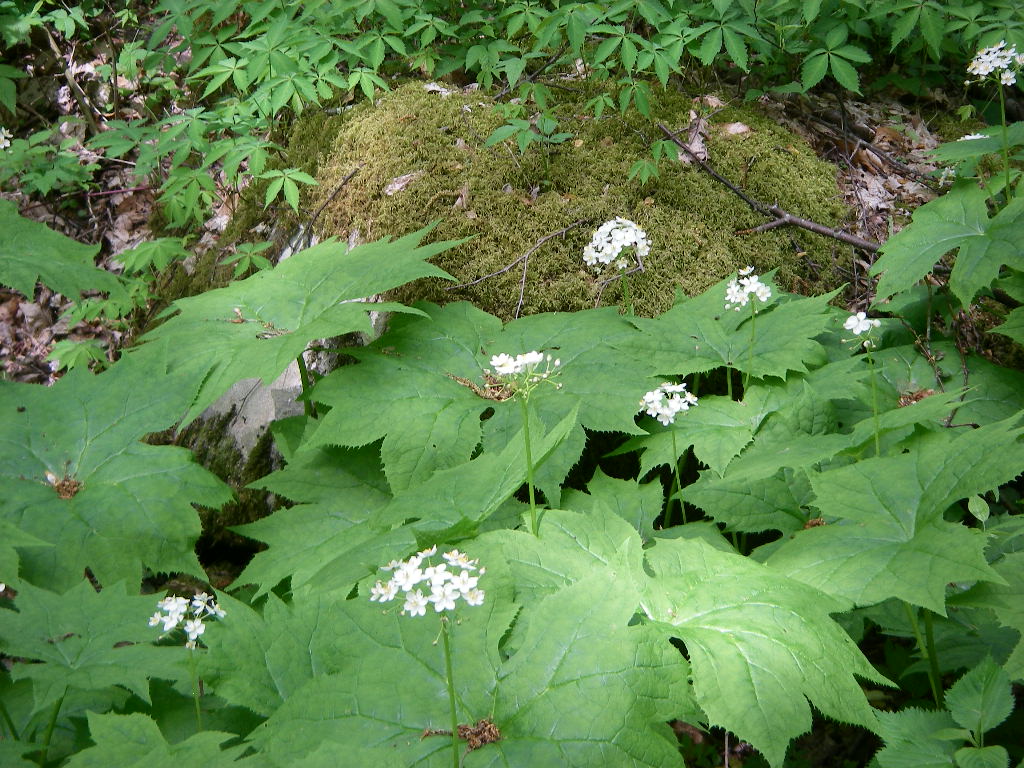
Diphylleia cymosa, known as Umbrella-leaf or American umbrellaleaf, is a bold woodland perennial of the southern Appalachian Mountains. It produces some of the largest leaves of any native wildflower in eastern North America: deeply cleft, umbrella-like blades up to 2 feet across, held on stout stalks above wet ground along streams and seeps in mountain forests.
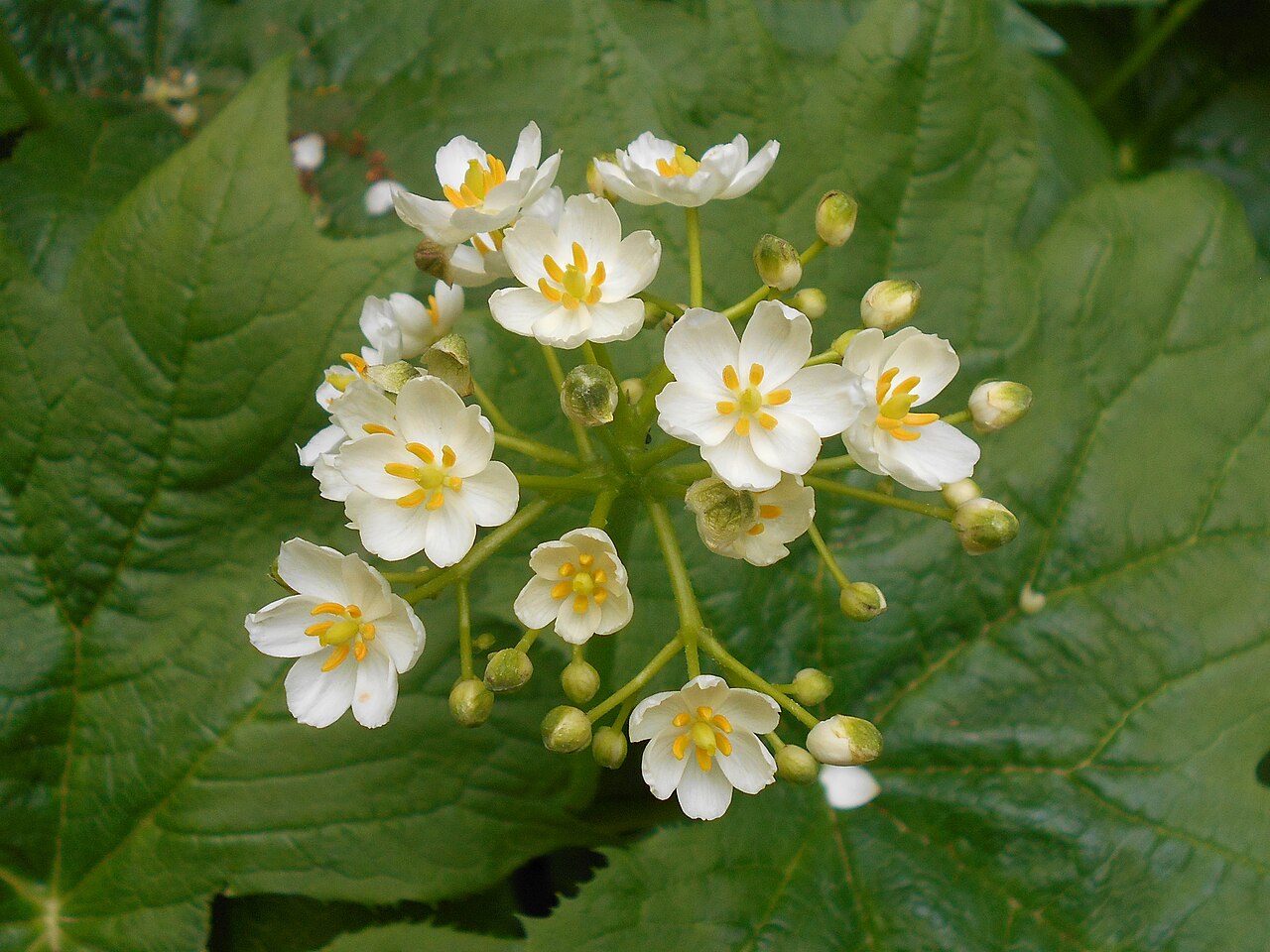
In late spring a flowering stem rises between two smaller leaves (the name Diphylleia means “two leaves”) and carries a rounded cluster of white, six-petaled flowers. These are followed in summer by striking, deep blue berries on bright red stalks, a combination that makes the plant worth seeking out from spring to fall.
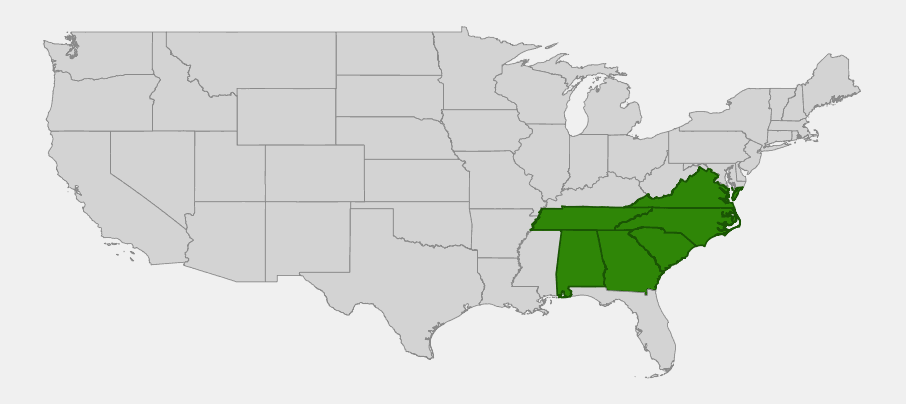
Umbrella-leaf grows in the mountains of Virginia, North Carolina, Tennessee, South Carolina, Georgia and Alabama, and its closest relatives grow in Japan and China, one of the classic links between the floras of eastern North America and eastern Asia. This guide covers how to identify it, where it grows, how to grow it in a moist shade garden, and its role in mountain forests.
Identification
In a wet mountain cove or seep, look for big, deeply notched, round leaves with toothed lobes, held like umbrellas 1 to 3 feet off the ground, often in large patches. In bloom, a cluster of white flowers stands above a pair of smaller leaves on the flowering stem.
Growth Habit
It is a herbaceous perennial growing from a thick, knotted rhizome, spreading slowly to form colonies. Non-flowering plants produce a single large leaf on a long stalk; flowering stems are 1 to 3 feet tall with two alternate leaves.
Leaves
Basal leaves are peltate or nearly so, rounded, up to about 2 feet across, and split by a deep central cleft into two halves, each with several coarsely toothed lobes. The two leaves on the flowering stem are smaller and similarly lobed. The leaves are thin, bright green and somewhat crinkled.
Flowers
Flowers grow in a flat-topped to rounded cluster (cyme) of roughly 10 to 20 at the top of the flowering stem. Each flower is about 1/2 to 3/4 inch across, with six white petals, six stamens and a single pistil. Bloom time is May to June, depending on elevation.
Fruit & Seeds
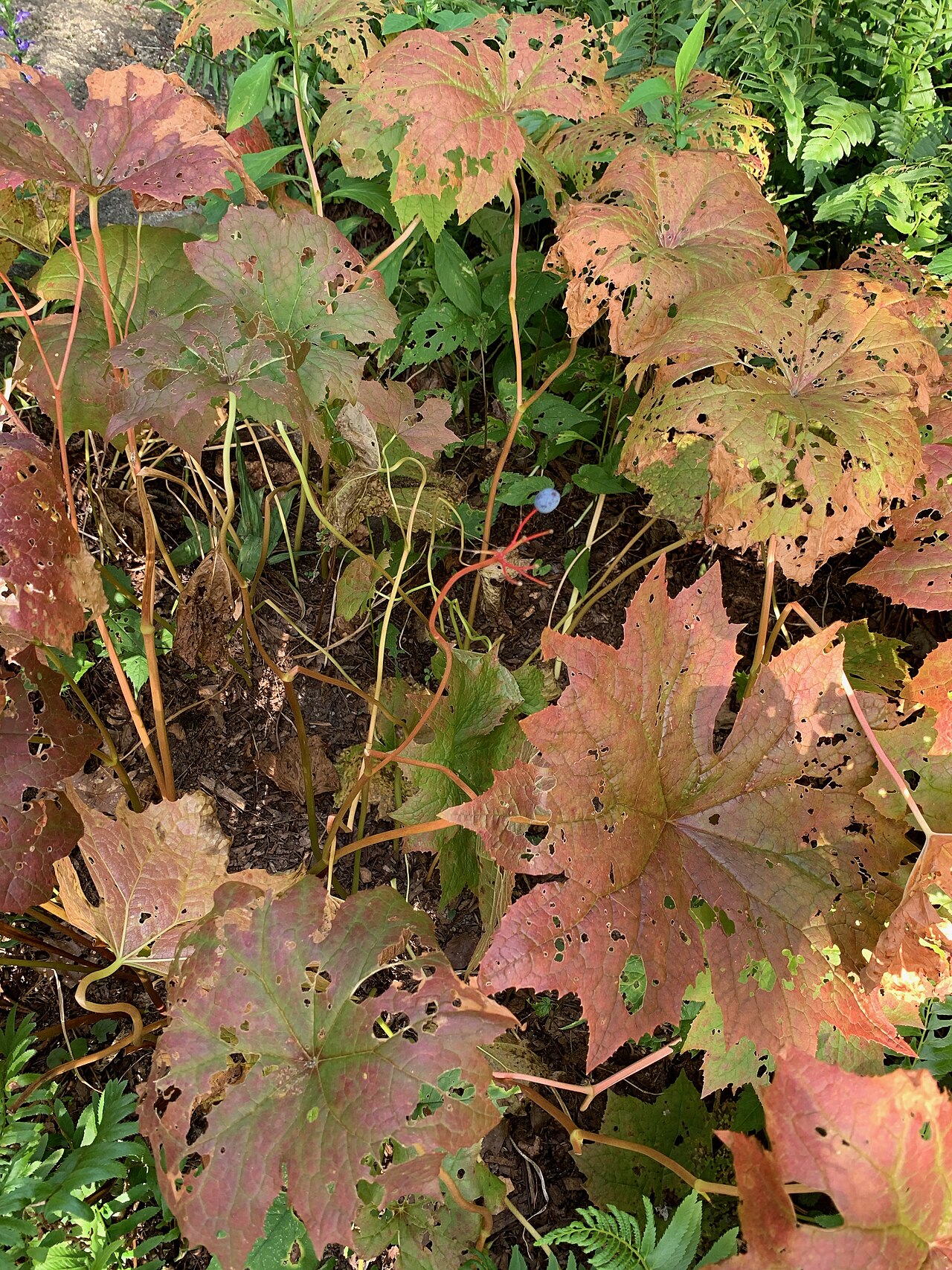
The fruit is a round, deep blue berry about 1/2 inch across, with a waxy bloom, held on stalks that turn bright red. Berries ripen in mid to late summer and contain a few seeds.
Look-alikes
Mayapple, a relative in the same family, has umbrella-like leaves too, but carries a single nodding flower beneath its paired leaves and a yellowish fruit. Blue cohosh, another family member of the same coves, also has blue fruits but finely divided, compound leaves. No other plant in its habitat combines a huge, deeply cleft round leaf with blue berries on red stalks.
Quick Facts
| Scientific Name | Diphylleia cymosa Michx. |
| Family | Berberidaceae (barberry family) |
| Plant Type | Herbaceous perennial from a thick rhizome |
| Mature Height | 1–3 ft |
| Mature Spread | 2–3 ft; slowly forms colonies |
| Growth Rate | Slow to moderate |
| Sun Exposure | Part shade to full shade |
| Water Needs | High; constantly moist to wet soil |
| Soil Type | Moist to wet, humus-rich forest soils; seeps and stream banks |
| Soil pH | About 5.0–6.5 (acidic) |
| Bloom Time | May–June |
| Flower Color | White |
| Fall Color | Leaves turn soft red to bronze in late summer |
| Fruit | Deep blue berry on a red stalk, about 1/2 in across |
| Deer Resistant | Moderately; leaves are rarely browsed heavily |
| USDA Hardiness Zones | 5–8 |
Native Range
Umbrella-leaf is endemic to the southern Appalachian Mountains of the eastern United States. USDA PLANTS lists it in Alabama, Georgia, North Carolina, South Carolina, Tennessee and Virginia. Its stronghold is the Blue Ridge of western North Carolina and eastern Tennessee, including Great Smoky Mountains National Park.
From there it extends north into southwestern Virginia and south into the mountains of northern Georgia and the northwestern corner of South Carolina, with outlying records in northeastern Alabama. Outside the high mountains it is rare and local.
It grows in rich, moist to wet forest: seepage slopes, stream banks, spring heads, wet coves and boulder fields, often under hemlock, birch, buckeye and spruce-fir forest, mostly between about 2,500 and 6,000 feet. It frequently forms large colonies along small mountain streams.
📋 Regional plant lists featuring Umbrella-leaf: Kentucky & Tennessee · Maryland, Virginia & West Virginia · Alabama, Georgia & Mississippi · North & South Carolina
Growing & Care Guide
Umbrella-leaf is a dramatic foliage plant for a moist, shady woodland garden, bog edge or streamside in cool-summer areas. It is available from specialty native and woodland plant nurseries. Buy nursery-propagated plants, and don’t dig it from the wild, where it is uncommon outside the mountains.
Light
Plant it in part to full shade. In the South, deep shade and protection from afternoon sun are essential; leaves scorch quickly in hot sun. Farther north it tolerates a little more light if the soil stays wet.
Soil & Water
It needs rich, acidic, humus-filled soil that stays moist to wet all season, like a seep or stream bank. Never let it dry out; drought causes the leaves to brown and collapse. It struggles in regions with hot, humid nights and does best where summers are relatively cool.
Planting Tips
Plant divisions or container plants in spring or fall, setting the rhizome just below the surface. Space plants about 2 feet apart. Combine it with ferns, blue cohosh, jewelweed, foamflower and other moist-shade natives.
Pruning & Maintenance
Mulch with leaf litter to keep the soil cool and moist. Remove tattered leaves after they die back in fall. Protect young shoots from slugs in spring.
Propagation
Divide the rhizomes in early spring or fall. Seed can be sown fresh from ripe berries in late summer, after cleaning off the pulp; germination is slow and seedlings take several years to flower.
Landscape Uses
- Woodland and shade gardens: huge, bold leaves add tropical-looking texture to moist shade
- Streamsides and bog edges: thrives in constantly wet, shaded soil
- Mountain native gardens: a signature plant of southern Appalachian coves
- Seasonal interest: white spring flowers, blue berries on red stalks in summer and reddish leaves in late summer
- Educational gardens: illustrates the eastern Asia–eastern North America plant connection
Wildlife & Ecological Value
Umbrella-leaf is a characteristic plant of the wet, rich forests of the southern Appalachians, and its flowers and fruits feed insects and birds there.
For Pollinators
The white flowers are visited by bees and flies, including small native bees and syrphid flies, which collect pollen in late spring.
For Birds
The blue berries are eaten by birds, which help disperse the seeds along mountain streams.
For Mammals
Small mammals may eat fallen berries. The leaves are generally not a preferred browse.
Ecosystem Role
Its broad leaves shade and cool the ground in seeps and along streams, and its rhizome colonies help hold wet, mossy soils in place. It is also part of the rich herb layer that makes southern Appalachian coves among the most diverse temperate forests in the world.
Cultural & Historical Uses
The species was described by the French botanist André Michaux, who explored the southern Appalachians in the late 1700s. The genus name Diphylleia refers to the two leaves on the flowering stem, and cymosa to its flowers in a cyme.
Its two close relatives, Diphylleia grayi of Japan and Diphylleia sinensis of China, are famous as “skeleton flowers” because their white petals turn glassy and translucent when wet. The three species together are a textbook example of plants shared between eastern Asia and eastern North America, a link that dates back millions of years.
Safety note: like its relative the mayapple, umbrella-leaf contains bitter, potentially toxic compounds, especially in the rhizome and leaves. Don’t eat any part of the plant, including the berries, and keep it away from children and pets who might chew it.
Frequently Asked Questions
Where does umbrella-leaf grow?
It grows only in the southern Appalachian Mountains of Virginia, North Carolina, Tennessee, South Carolina, Georgia and Alabama, along streams, seeps and wet coves, mostly at 2,500 to 6,000 feet.
Is umbrella-leaf poisonous?
It is in the barberry family and, like mayapple, contains potentially toxic compounds, especially in the rhizome. Don’t eat any part of it, including the berries.
Can I grow umbrella-leaf in my garden?
Yes, if you have a shady spot with rich, acidic soil that stays constantly moist, ideally in a cool-summer area. It does poorly in dry soil or hot sun.
Is umbrella-leaf the same as the skeleton flower?
Not exactly. The skeleton flower is its Asian relative Diphylleia grayi, whose petals become transparent in the rain. American umbrella-leaf is a separate species native to the Appalachians.
When does umbrella-leaf bloom?
It blooms in May and June, and its blue berries on red stalks ripen in mid to late summer.

Looking for a nursery that carries Umbrella-leaf?
Browse our native plant nursery directory: Alabama · Georgia · North Carolina · South Carolina, Tennessee & Virginia

