
Bog White Violet (Viola lanceolata)
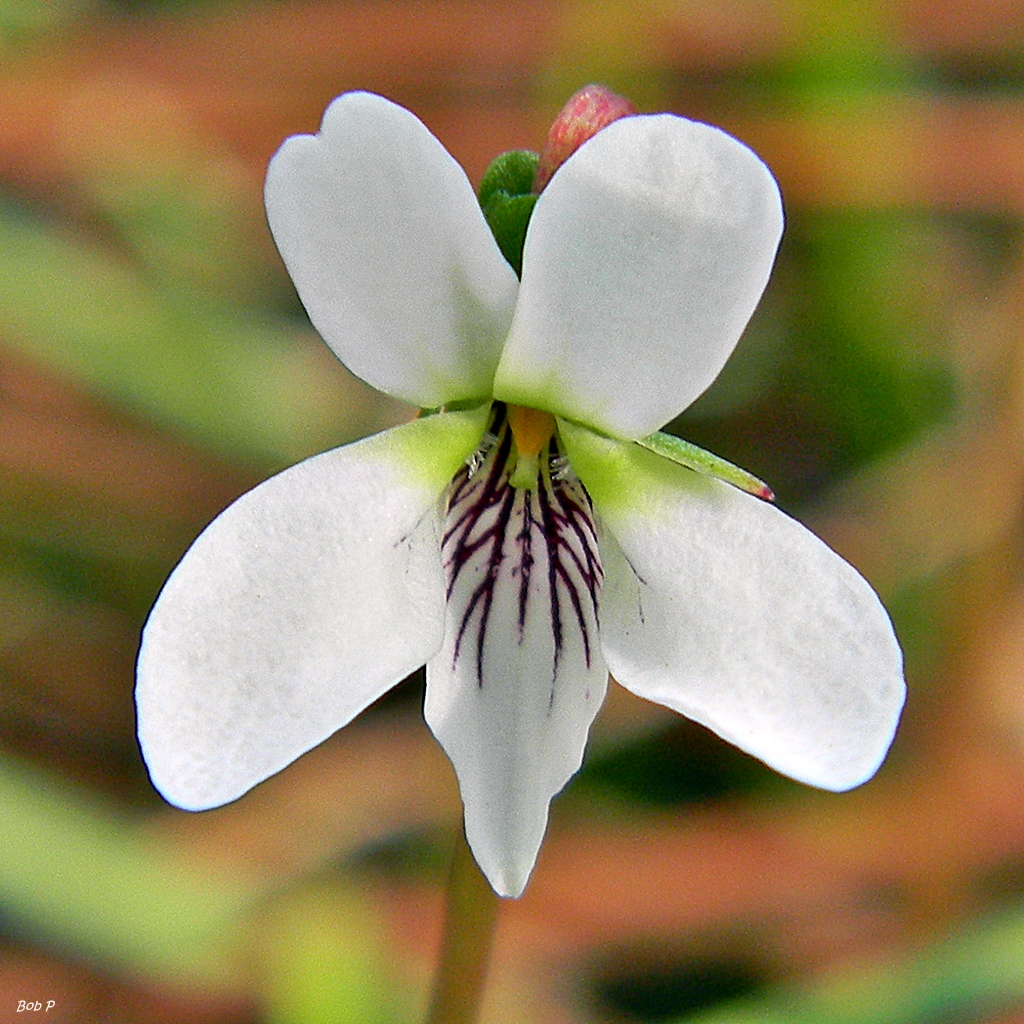
Viola lanceolata, known as Bog White Violet, lance-leaved violet or water violet, is a small white violet of bogs, wet meadows, pond shores and wet pine savannas across eastern North America. It is easy to recognize among violets because its leaves are long and narrow, shaped like a lance blade, instead of the rounded or heart-shaped leaves of most violets.
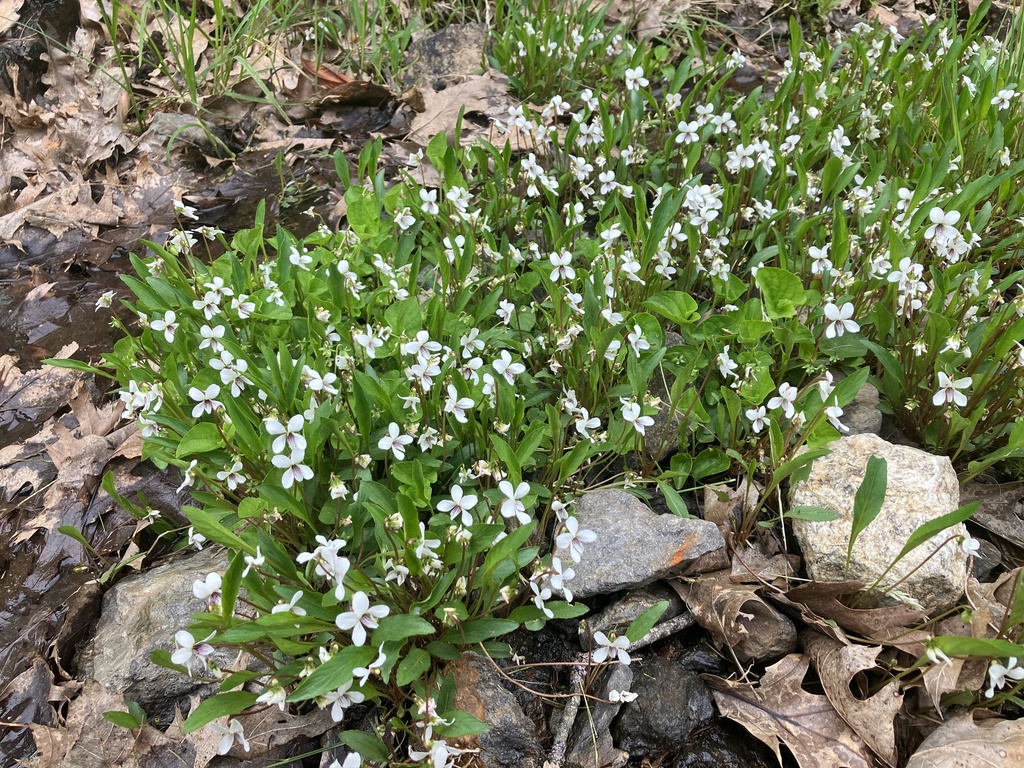
In spring it carries crisp white flowers, each with dark purple veins on the lower three petals, on stalks a few inches tall. It spreads by slender runners that root at the tips, so where conditions suit it, it forms dense carpets on wet, sandy or peaty ground. Later in the season it produces hidden, self-pollinating flowers that set plenty of seed.
Two forms are often recognized. The typical plant, var. lanceolata, has lance-shaped leaves and grows over most of the range. Var. vittata (also treated as Viola lanceolata ssp. vittata or as a separate species, Viola vittata, sometimes called southern water violet) has very narrow, almost grass-like leaves and grows mainly on the southeastern Coastal Plain. This guide covers both and explains how to identify, grow and use this violet in a wet garden.
Identification
Look for a low, stemless violet with upright, long, narrow leaves and small white flowers with purple veins, growing in wet, open, often sandy or peaty ground. The narrow leaves, several times longer than wide, separate it from nearly all other white violets.
Growth Habit
It is a low, stemless perennial, usually 2 to 6 inches tall, with leaves and flower stalks rising directly from the ground. It spreads by thin, above-ground runners (stolons) that root and form new plants, often creating extensive mats.
Leaves
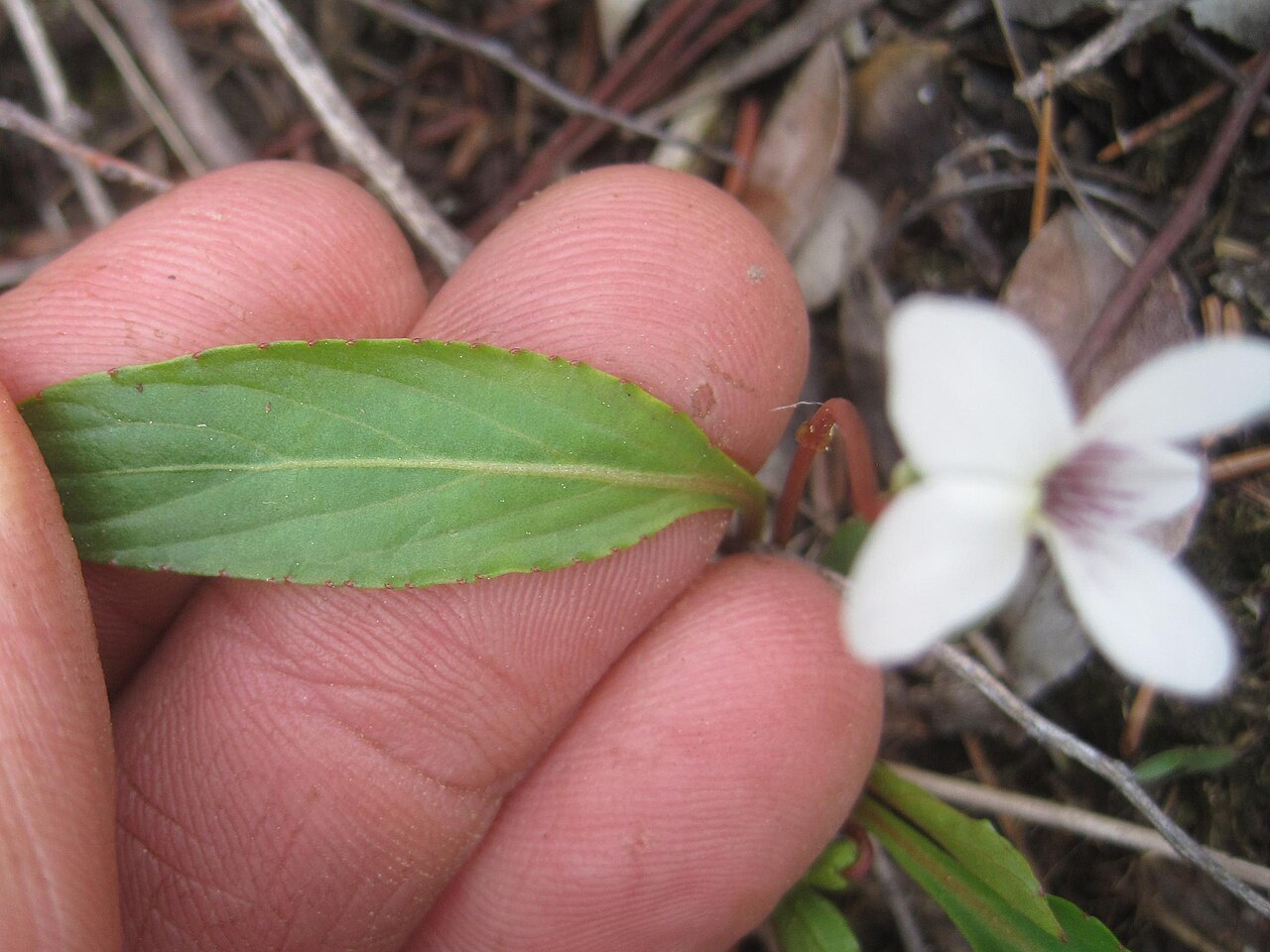
The leaves are lance-shaped, about 2 to 6 inches long and usually 3 or more times as long as wide, tapering gradually into the leaf stalk, with low, shallow teeth along the edges. In var. vittata they are even narrower, linear and strap-like. They are smooth and bright green.
Flowers
Each flower is about 1/2 inch across, with five white petals. The lower three petals have conspicuous dark purple veins that guide insects to the nectar, and the side petals are beardless or nearly so. The flowers sit on stalks about as tall as or taller than the leaves. Bloom is mainly in spring: from late winter in Florida and the Gulf Coast to May and June in the north.
Fruit & Seeds
In summer, inconspicuous, closed flowers that never open (cleistogamous flowers) self-pollinate and produce most of the seed. The green capsules split into three boat-shaped parts that squeeze and shoot out small brown seeds; ants then carry off many seeds, attracted by a small food body on each one.
Look-alikes
Sweet white violet (Viola blanda) and the small northern white violet (Viola macloskeyi) have heart-shaped or rounded leaves. Primrose-leaved violet (Viola primulifolia), which is thought to have arisen as a hybrid between bog white violet and northern white violet, has oblong to oval leaves with a blunt or abruptly narrowed base. Bog white violet’s much longer, narrower, lance-shaped leaves are the key feature.
Quick Facts
| Scientific Name | Viola lanceolata L. |
| Family | Violaceae (violet family) |
| Plant Type | Low, stemless herbaceous perennial spreading by runners |
| Mature Height | 2–6 in |
| Mature Spread | 6–12 in per plant; spreads into mats |
| Growth Rate | Moderate |
| Sun Exposure | Full sun to part shade |
| Water Needs | High; constantly moist to wet soil |
| Soil Type | Wet, acidic sand, peat or muck |
| Soil pH | About 4.5–6.5 |
| Bloom Time | February–June, depending on latitude |
| Flower Color | White with purple veins |
| Fall Color | None; leaves remain green until frost |
| Fruit | Three-part capsule that ejects seeds |
| Deer Resistant | Low; deer and rabbits may eat violets |
| USDA Hardiness Zones | 3–9 |
Native Range
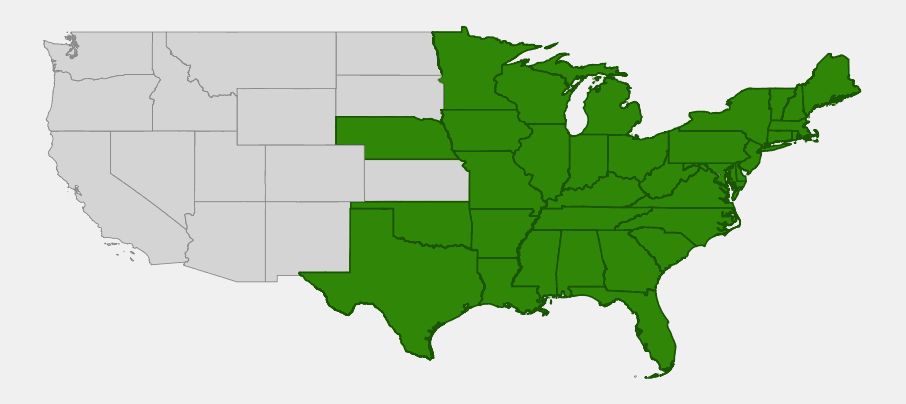
Bog white violet is native to eastern and central North America. Leaving aside introduced Pacific Coast records, USDA PLANTS lists it in 34 states from Maine and Minnesota south to Florida and eastern Texas, including Alabama, Arkansas, Connecticut, Delaware, Georgia, Illinois, Indiana, Iowa, Kentucky, Louisiana, Maryland, Massachusetts, Michigan, Mississippi, Missouri, Nebraska, New Hampshire, New Jersey, New York, North Carolina, Ohio, Oklahoma, Pennsylvania, Rhode Island, South Carolina, Tennessee, Vermont, Virginia, West Virginia and Wisconsin. In Canada it is native in Ontario, Quebec, New Brunswick, Nova Scotia, Prince Edward Island and Newfoundland.
It is most common on the Atlantic and Gulf Coastal Plain and in the sandy and glaciated regions of the Northeast and Great Lakes, and is rarer and more scattered inland, for example in the Appalachian highlands and at the western edge of its range in Oklahoma and Nebraska. Var. vittata is concentrated on the southeastern Coastal Plain from the Carolinas to Florida and west to Texas. USDA also shows records from Washington, Oregon, California and British Columbia, but the Burke Herbarium treats the Pacific Northwest plants, found in bogs, ditches and cranberry beds, as introduced from eastern North America, so those states are not shaded on the map.
It grows in open, wet, usually acidic places: sphagnum bogs and fens, sandy pond and lake shores, wet meadows, seepage slopes, wet pine flatwoods and savannas, ditches and wet roadsides. It is mostly a plant of low elevations, from near sea level to about 2,000 feet, and it often appears after fire or other disturbance opens up its habitat.
📋 Regional plant lists featuring Bog White Violet: North & South Florida · Alabama, Georgia & Mississippi · North & South Carolina · Maryland, Virginia & West Virginia · Kentucky & Tennessee · Arkansas, Louisiana, Eastern Oklahoma & Eastern Texas · Illinois, Iowa & Missouri · Ohio & Indiana · Michigan, Wisconsin & Eastern Minnesota · New York, Pennsylvania & Northern New Jersey · Delaware, Southern New Jersey & Long Island · Connecticut, Massachusetts & Rhode Island · New Hampshire, Maine & Vermont · Nebraska, Kansas & Eastern Colorado
Growing & Care Guide
Bog white violet is a charming groundcover for bog gardens, rain gardens, pond edges and other spots that stay wet. It is occasionally offered by native plant and bog plant nurseries, especially in the Southeast and Northeast. In the right place it spreads steadily by runners into a low mat of narrow leaves dotted with white flowers in spring.
Light
Give it full sun to part shade. It flowers best in sun, as long as the soil never dries out.
Soil & Water
It needs constantly moist to wet, acidic soil: sand, peat or a sand-peat mix, as in a bog garden or at the margin of a pond. It tolerates short periods of shallow flooding. It does poorly in dry soil and in rich, alkaline garden loam.
Planting Tips
Plant divisions or potted plants in spring or fall, about 6 to 12 inches apart. Use it as a groundcover around pitcher plants, sundews, orchids and other bog plants, or along a pond or stream edge where low plants won’t be shaded out by tall grasses and sedges.
Pruning & Maintenance
Little care is needed. Keep taller, aggressive plants from crowding it out, and remove leaf litter that might smother it. Runners can be lifted and replanted if they spread too far.
Propagation
The easiest method is to pot up rooted runners or divide clumps in spring or fall. It can also be grown from seed, which needs a cold-moist period over winter; sow outdoors in fall. Never dig plants from the wild; buy nursery-propagated plants, because many bogs and savannas where it grows are protected or sensitive habitats.
Landscape Uses
- Bog gardens: a low, flowering groundcover between carnivorous plants and orchids
- Rain gardens and pond edges: thrives in saturated, acidic soil
- Wet groundcover: spreads by runners into dense, low mats
- Pollinator gardens: early spring flowers for small native bees
- Butterfly host plant: violet leaves feed fritillary caterpillars
Wildlife & Ecological Value
Like other violets, bog white violet supports early-season pollinators and is a larval host for fritillary butterflies.
For Pollinators
Its spring flowers are visited by small bees, including mason bees and sweat bees, as well as bee flies and small butterflies. The purple veins on the lower petals act as nectar guides. Violets are the caterpillar host plants of fritillary butterflies, such as the meadow fritillary, which uses wet meadow violets.
For Birds
Ground-feeding birds such as sparrows and wild turkeys may eat violet seeds, and mourning doves and quail also take them occasionally.
For Mammals
Rabbits and deer browse violet leaves, and small mammals such as mice eat the seeds.
Ecosystem Role
Its seeds are dispersed in two stages: first shot out by the capsule and then carried by ants, which eat the small food bodies attached to the seeds and discard the seeds in their nests. Its mats help hold wet, sandy soil on pond shores and in savannas, and it often increases after fire, which keeps its open habitats from becoming overgrown.
Cultural & Historical Uses
Bog white violet was named by Carl Linnaeus in 1753 in his Species Plantarum, the starting point for modern plant names. The name lanceolata describes its lance-shaped leaves, which are unusual among violets.
Botanists have long debated how to treat the narrow-leaved southern plants. They have been named Viola vittata, Viola lanceolata var. vittata and Viola lanceolata ssp. vittata, and some recent sources once again treat them as a separate species, the southern water violet. In the field, the two forms intergrade on the Coastal Plain, and both share the same white, purple-veined flowers and wet habitats.
Violet leaves and flowers have long been eaten in salads and used in teas, and the young leaves are a source of vitamins. Bog white violet grows in sensitive wetland habitats, though, so it is best enjoyed in the wild and grown from nursery stock rather than harvested.
Frequently Asked Questions
How do I identify bog white violet?
Look for a low violet with long, narrow, lance-shaped leaves and small white flowers with purple veins on the lower petals, growing in wet, open places such as bogs, pond shores and wet pine savannas.
Where does bog white violet grow?
It is native from Maine and the Great Lakes south to Florida and eastern Texas, and in eastern Canada, mostly in bogs, wet meadows, sandy shores and pine savannas.
What is the difference between bog white violet and southern water violet?
Southern water violet is the name often used for the narrow-leaved southern form, treated as Viola lanceolata var. or ssp. vittata, or as the separate species Viola vittata. It grows mainly on the southeastern Coastal Plain.
Can I grow bog white violet in a garden?
Yes, in a bog garden, rain garden or pond edge where the soil stays wet and acidic. It spreads by runners into a low groundcover.
Is bog white violet edible?
Violet leaves and flowers are generally edible, but this species grows in sensitive wetlands, so harvest only from cultivated plants.

Looking for a nursery that carries Bog White Violet?
Browse our native plant nursery directory: Alabama & Arkansas · Connecticut, Delaware, Florida & Georgia · Illinois, Indiana & Iowa · Kentucky, Louisiana, Maine, Maryland, Massachusetts, Michigan, Minnesota, Mississippi & Missouri · Nebraska, New Hampshire, New Jersey, New York, North Carolina, Ohio & Oklahoma · Pennsylvania, Rhode Island, South Carolina, Tennessee, Texas, Vermont & Virginia · West Virginia & Wisconsin

