Virginia Spiderwort (Tradescantia virginiana)
Tradescantia virginiana, commonly called Virginia Spiderwort, is a clump-forming perennial wildflower prized for its grass-like foliage and vivid three-petaled flowers that open fresh each morning and fade by afternoon. A member of the dayflower family (Commelinaceae), it is one of the most garden-friendly native wildflowers in the eastern United States — easygoing about soil, tolerant of both sun and part shade, and reliable at returning and slowly spreading into a tidy colony year after year.
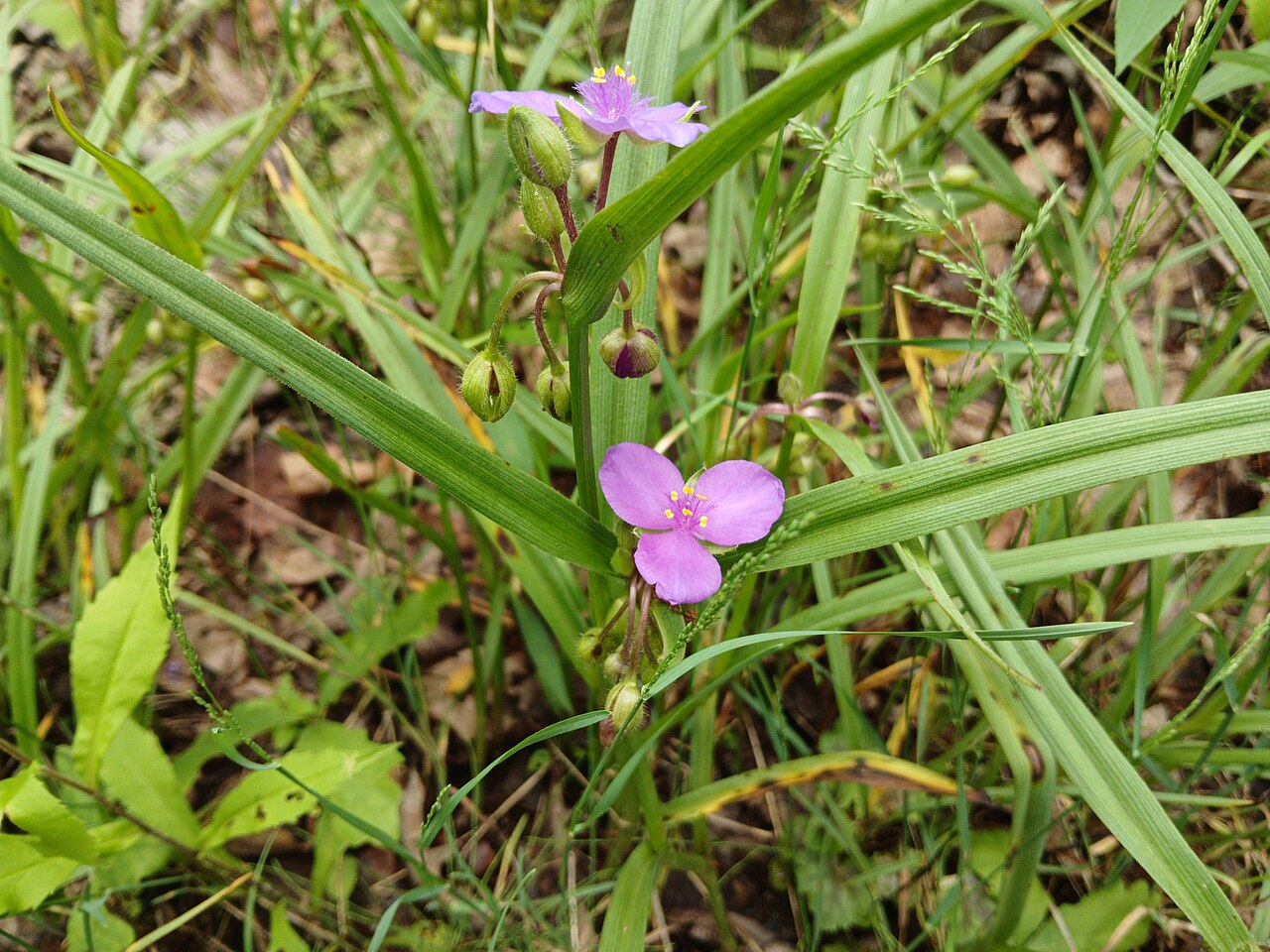
The plant forms arching clumps of long, narrow, lance-shaped leaves that fold at the base like a sheath around the stem, giving the whole plant a loose, grassy texture even before it blooms. From late spring into summer, clusters of three-petaled flowers in shades of violet-blue to rosy purple open atop the stems, each bloom lasting only a single morning before closing — a trait reflected in the related name “dayflower” used for some of its cousins in the genus.
Virginia Spiderwort is an excellent choice for a native perennial border, a cottage-style garden, or the edge of a woodland planting, where its early-summer color and fine texture contrast nicely with bolder-leaved companions. It is low-maintenance once established, attracts a steady stream of native bees, and asks for little beyond occasional division to keep clumps vigorous.
Identification
Virginia Spiderwort grows as an upright to slightly sprawling clump, typically 1 to 2 feet tall and about as wide, with a somewhat floppy habit by midsummer that many gardeners simply accept as part of its character.
Stems & Leaves
Stems are smooth, jointed, and slightly fleshy, often with a faint waxy bloom. Leaves are long and narrow — strap- or grass-like, 8 to 15 inches long but less than an inch wide — arising from a sheathing base that clasps the stem, a characteristic feature of the dayflower family. The foliage is typically a dull blue-green and can look a little untidy after flowering, which is the main reason many gardeners cut plants back hard in midsummer.
Flowers
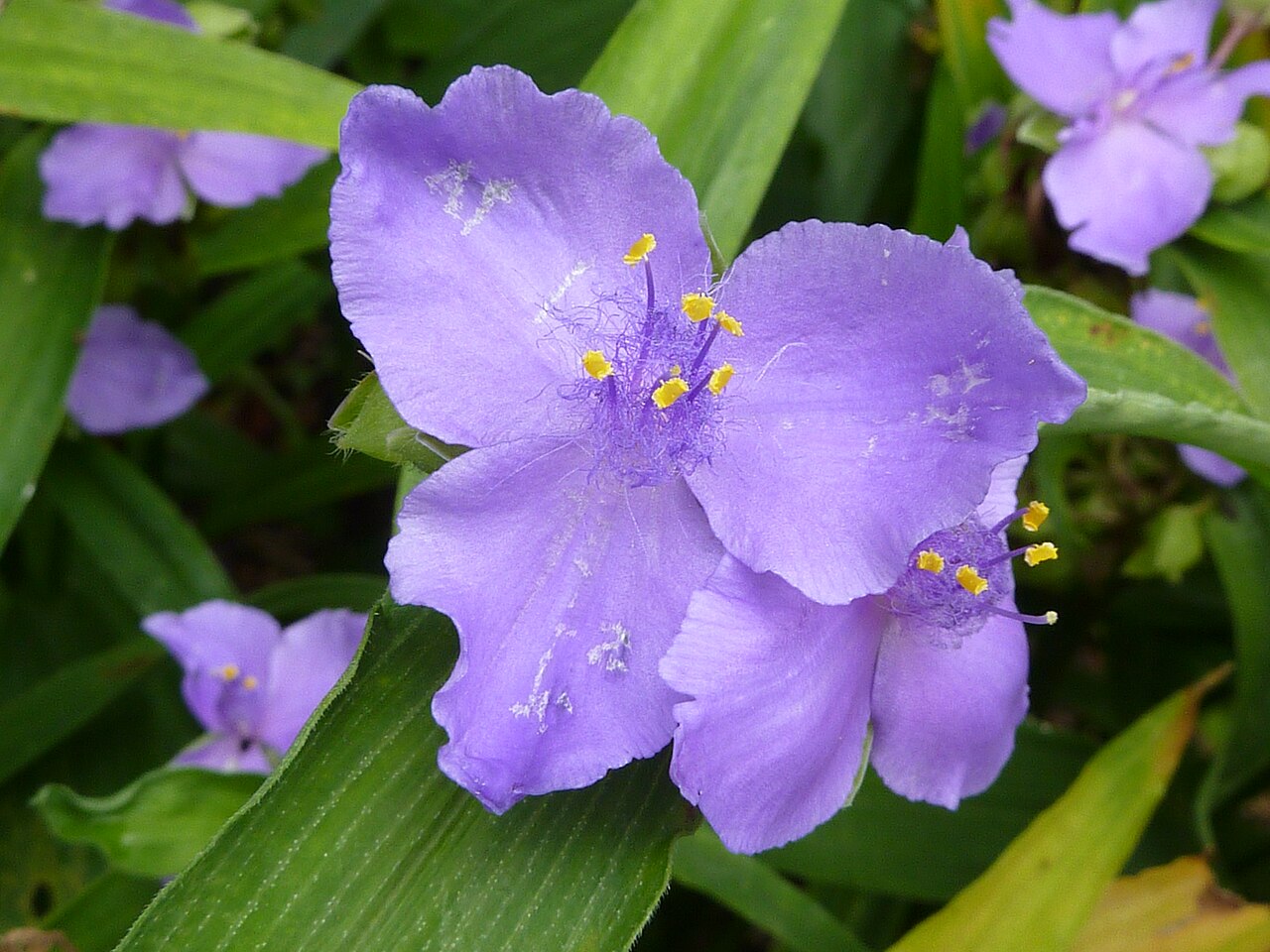
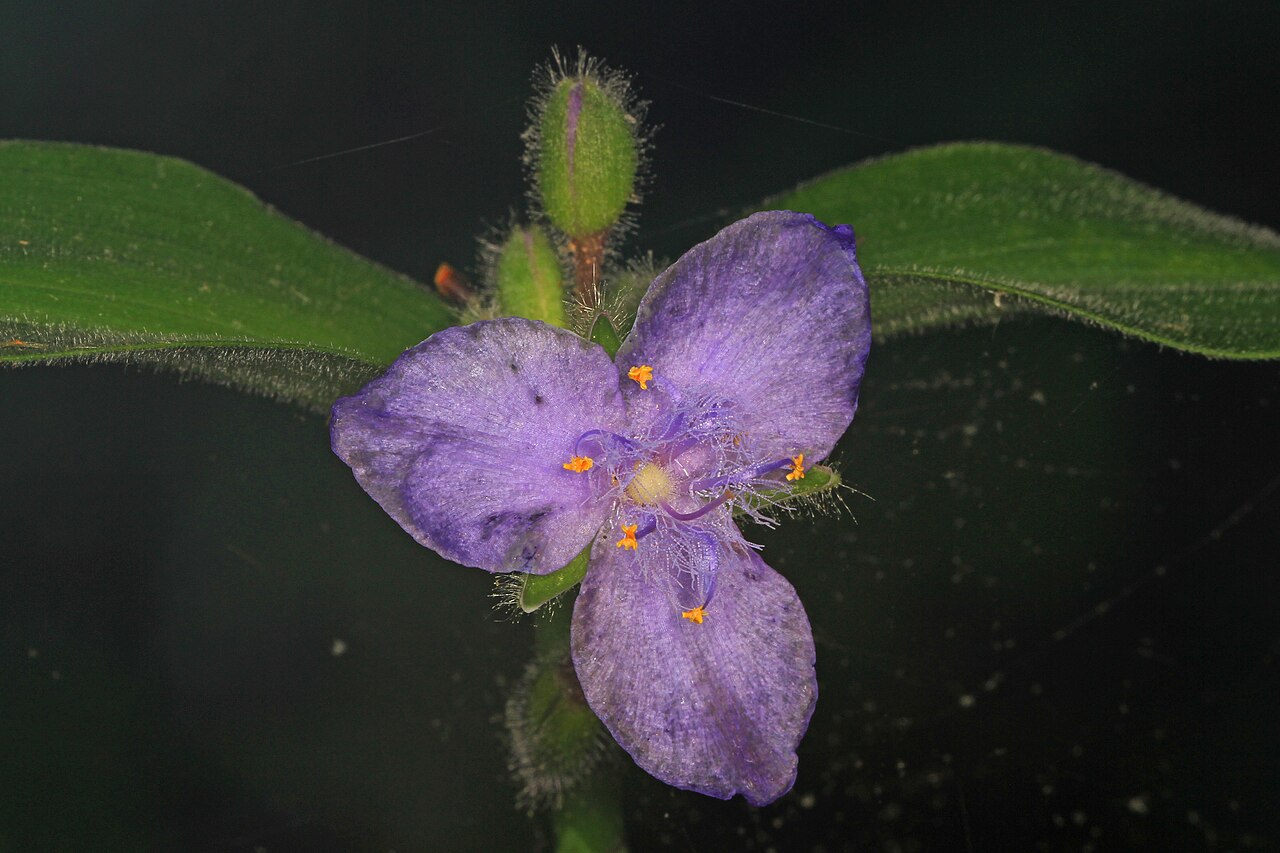
Flowers are borne in loose, umbrella-like clusters (cymes) at the stem tips, each flower about 1 to 1½ inches across with three broad, rounded petals in violet-blue to rose-purple, surrounding a tuft of fuzzy, bright yellow-tipped stamens. Individual flowers open in the morning and typically close by early afternoon, especially on hot, sunny days, but the clusters keep producing new blooms over several weeks from late spring into midsummer.
Fruit & Seed
After flowering, the plant sets small three-chambered seed capsules that dry and split open to release a handful of seeds. Plants also spread readily by short rhizomes, gradually forming wider clumps without becoming aggressive.
Quick Facts
| Scientific Name | Tradescantia virginiana |
| Family | Commelinaceae (Dayflower) |
| Plant Type | Herbaceous Perennial |
| Mature Height | 1–2 ft |
| Mature Spread | 1–1.5 ft, slowly expanding by rhizome |
| Growth Rate | Moderate |
| Sun Exposure | Full Sun to Part Shade |
| Water Needs | Average to Moist |
| Soil Type | Adaptable; loam, clay, or sandy soils |
| Soil pH | 5.5–7.5 (slightly acidic to neutral) |
| Bloom Time | Late spring – midsummer |
| Flower Color | Violet-blue to rose-purple |
| Fall Color | None notable; foliage yellows and dies back |
| Fruit | Small three-chambered seed capsules |
| Deer Resistant | Moderate (occasionally browsed) |
| USDA Hardiness Zones | 4–9 |
Native Range
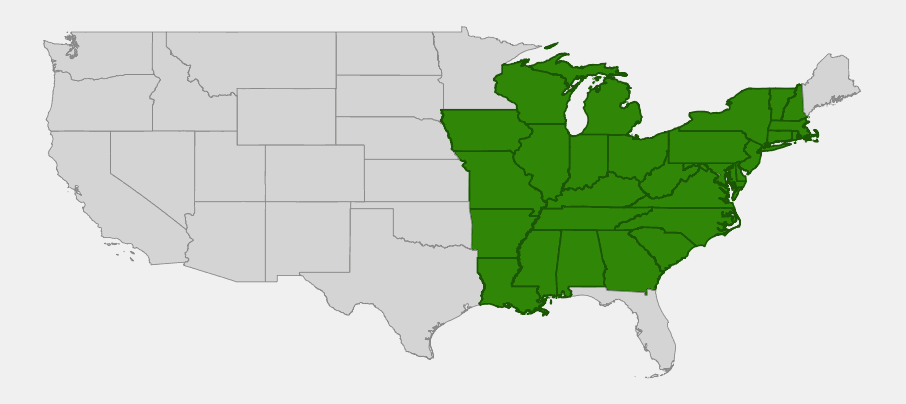
Virginia Spiderwort is native to the eastern and central United States, from New England and New York south through the Mid-Atlantic and Appalachians to Georgia and Alabama, and west through the Ohio Valley and the upper Midwest to Missouri, Iowa, and Arkansas. It is not native to peninsular Florida or to the Great Plains and western states, where it is sometimes grown as a garden plant well outside its natural range.
Within its native range, Virginia Spiderwort typically grows in open woodlands, woodland edges, rocky slopes, meadows, and roadsides, usually in soils that stay moist in spring but can dry out somewhat by summer. It is frequently found alongside other spring- and early-summer-blooming woodland-edge perennials and tolerates the dappled light of an open forest canopy as readily as a sunny meadow.
The species has also been widely planted as an ornamental outside its native range, and some populations outside the core range may represent garden escapes rather than indigenous stands — a distinction worth keeping in mind if you are trying to document truly wild, local-ecotype populations for a restoration project.
📋 Regional plant lists featuring Virginia Spiderwort: New Hampshire, Maine & Vermont · Connecticut, Massachusetts & Rhode Island · New York, Pennsylvania & Northern New Jersey · Delaware, Southern New Jersey & Long Island · Maryland, Virginia & West Virginia · North Carolina & South Carolina · Georgia, Alabama & Mississippi · Arkansas, Louisiana, Eastern Texas & Oklahoma · Kentucky & Tennessee · Ohio & Indiana · Illinois, Iowa & Missouri · Michigan, Wisconsin & Eastern Minnesota
Growing & Care Guide
Virginia Spiderwort is forgiving and adaptable, making it a good choice for gardeners who want reliable early-summer color without fussy maintenance.
Light
Plants thrive in full sun to part shade. In more sun, clumps tend to be more compact and floriferous; in part shade, especially at a woodland edge, plants grow a bit taller and looser but still flower well. Heavy shade reduces bloom.
Soil & Water
Virginia Spiderwort tolerates a wide range of soils, from sandy loam to heavier clay, and isn’t particular about pH within the normal garden range. It performs best with average to consistently moist soil, especially while establishing, but mature clumps handle brief dry spells without serious damage. Good drainage helps avoid root rot in winter.
Planting Tips
Set out container plants in spring or fall, spacing them 12 to 18 inches apart to allow for their spreading habit. The plant is easy to start from divisions taken from an established clump in early spring, and divisions establish quickly. It self-sows modestly where happy, so expect occasional volunteer seedlings nearby.
Pruning & Maintenance
The foliage often turns ragged and yellow by midsummer after the main flowering flush. Cutting the whole clump back to 4 to 6 inches at that point tidies the planting and frequently triggers a smaller rebloom later in summer along with fresh new leaves. Divide congested clumps every 3 to 4 years in spring to maintain vigor.
Landscape Uses
Virginia Spiderwort fits well into several planting styles:
- Native perennial borders paired with columbine, phlox, and coneflowers
- Woodland garden edges where morning sun reaches part-shade beds
- Cottage-style gardens for its old-fashioned, informal texture
- Pollinator gardens as an early-season nectar source for native bees
- Rain garden margins where soil stays moist but not waterlogged
- Mass plantings or drifts for a naturalized meadow look
Wildlife & Ecological Value
Virginia Spiderwort is a dependable early-season nectar and pollen source in the native garden, and its value to pollinators is one of the best reasons to include it.
For Pollinators
The flowers are especially attractive to native bees, including long-horned bees (Melissodes) and bumble bees, many of which are specialist or near-specialist visitors of spiderworts and collect pollen from the fuzzy stamens efficiently. Because flowers close by early afternoon, the plant is particularly valuable to morning-active pollinators. Syrphid flies and other small beneficial insects also visit regularly.
For Birds & Mammals
Seeds are eaten in small amounts by songbirds foraging on the ground near spent flower heads, though the plant is not a major wildlife food source compared with fruiting shrubs or trees. Deer and rabbits browse the foliage occasionally but seldom cause serious damage.
Ecosystem Role
As a clump-forming woodland-edge perennial, Virginia Spiderwort helps fill the early-summer gap between spring ephemerals and the taller midsummer wildflowers, extending the season of nectar availability for pollinators moving through a native planting or natural woodland edge.
Cultural & Historical Uses
The genus Tradescantia commemorates John Tradescant the Younger, a 17th-century English naturalist and gardener who is credited with introducing the plant to cultivation in Europe after collecting it in colonial Virginia — the source of both the genus name and the common name.
Beyond its ornamental history, spiderwort sap has occasionally been used in folk tradition as a topical application for insect bites and stings, though this is a historical practice rather than a modern recommendation, and this page does not suggest it as a treatment. Some Indigenous groups within the plant’s range used related *Tradescantia* species in limited traditional preparations, but specific, verifiable ethnobotanical records for *T. virginiana* are sparse, and any such historical use should not be read as modern medical guidance.
In more recent history, spiderwort species including T. virginiana and related hybrids have been used in scientific research as a bioindicator — certain varieties show detectable color changes in their stamen hairs when exposed to environmental radiation or pollutants, a property researchers have used in simple field-based monitoring studies.
Frequently Asked Questions
Why do spiderwort flowers only last one day?
Each individual bloom is programmed to open for a single morning and then wilt by afternoon, a trait shared across the genus. The plant compensates by producing a long succession of new flowers over several weeks, so the clump as a whole stays in bloom even though no single flower lasts long.
Should I cut Virginia Spiderwort back after it blooms?
Yes, many gardeners cut the whole clump back to a few inches once flowering slows and the foliage starts to look tired. This tidies the planting and often produces fresh leaves and a lighter rebloom later in the season.
Is Virginia Spiderwort aggressive or invasive?
No. It spreads gradually by short rhizomes and modest self-seeding, forming a slowly expanding clump rather than running aggressively. It is easy to keep in bounds with occasional division.
Will Virginia Spiderwort grow in full shade?
It tolerates light to part shade well but blooms best with at least a half day of sun. In deep, continuous shade, plants survive but flower sparsely.
Is Virginia Spiderwort native to Florida or the Great Plains?
No. Its native range runs from New England south to Georgia and Alabama and west to the upper Midwest and Arkansas; it is not native to peninsular Florida, the Great Plains states, or anywhere west of the Mississippi Valley region, even though it is sometimes grown as a garden ornamental in those areas.

Looking for a nursery that carries Virginia Spiderwort?
Browse our native plant nursery directories: CT, DE, GA · KY, LA, ME, MD, MA, MI, MS, MO · NH, NJ, NY, NC · PA, RI, SC, TN, VT, VA · WV, WI · AL, AR · IL, IA