Wild Yam (Dioscorea villosa)
Dioscorea villosa, commonly known as Wild Yam (also called colic root, rheumatism root, or yellow yam), is a slender, herbaceous, twining vine native to woodlands and thickets across most of the eastern United States. It belongs to the Dioscoreaceae, the yam family, a mostly tropical group best known for the starchy tubers of true cultivated yams — though wild yam’s own root is thin, tough, and bitter, nothing like the plump tubers sold in grocery stores. Despite the name, it is not a food crop and should not be confused with sweet potatoes or true yams.
In the wild, Wild Yam climbs by twining counterclockwise over shrubs, fences, and low tree branches in moist, part-shaded woods, thickets, and fencerows, reaching 10 to 20 feet in a season from a perennial underground rhizome. Its heart-shaped leaves, arranged in whorls partway up the stem and alternately higher up, give it a distinctive layered look, and in early summer it produces small, inconspicuous greenish-yellow flowers followed by papery, three-winged seed capsules that dangle in loose chains and persist into winter.
For native plant gardeners in the East, Wild Yam is a useful, low-impact vine for a woodland edge or naturalized fence line where a light, twining cover is wanted rather than a dense screen. It asks for little once established, tolerates a range of light conditions, and its dioecious habit — separate male and female plants — means only female vines produce the ornamental seed capsules that persist into the dormant season.
Identification
Wild Yam is a herbaceous, perennial, twining vine that dies back to the ground each winter and regrows from a woody, horizontal rhizome. Stems are thin, smooth, and reddish to green, climbing by twining rather than by tendrils.
Stems & Roots
The stems are slender, wiry, and largely unbranched, typically reaching 10 to 20 feet in length as they twine over supporting vegetation. The underground rhizome is thin, knotty, and tough, often described as cinnamon-brown and bitter when cut, quite different from the swollen, starchy tubers of cultivated yam species.
Leaves
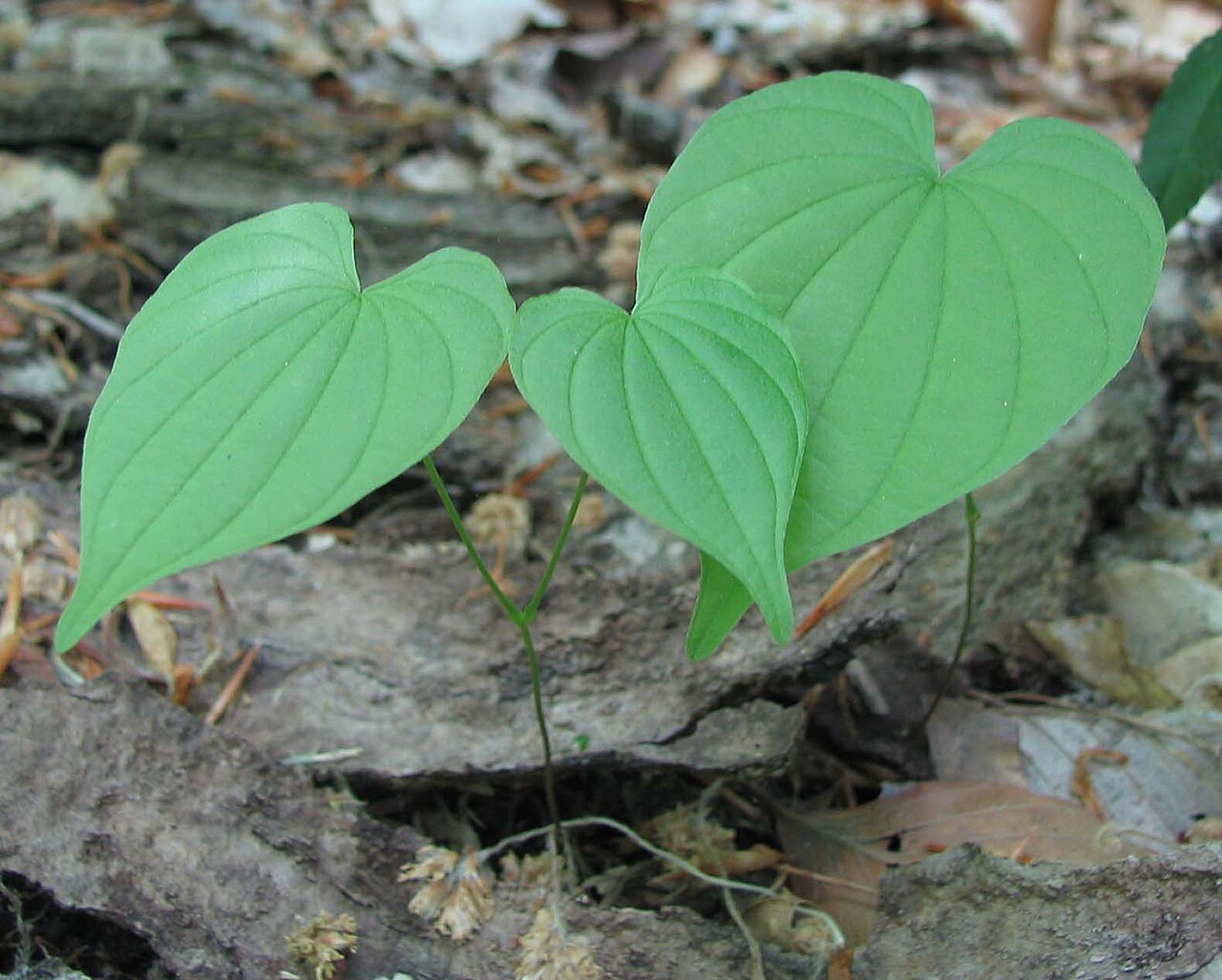
Leaves are simple, heart-shaped (cordate), 2 to 5 inches long, with a pointed tip and prominent, strongly curved parallel veins running from the base to the tip — a reliable field mark for the genus. Lower leaves are often arranged in whorls of three to seven around the stem, while upper leaves become alternate. The leaf surface is smooth and shiny above, paler and sometimes slightly downy beneath.
Flowers & Fruit
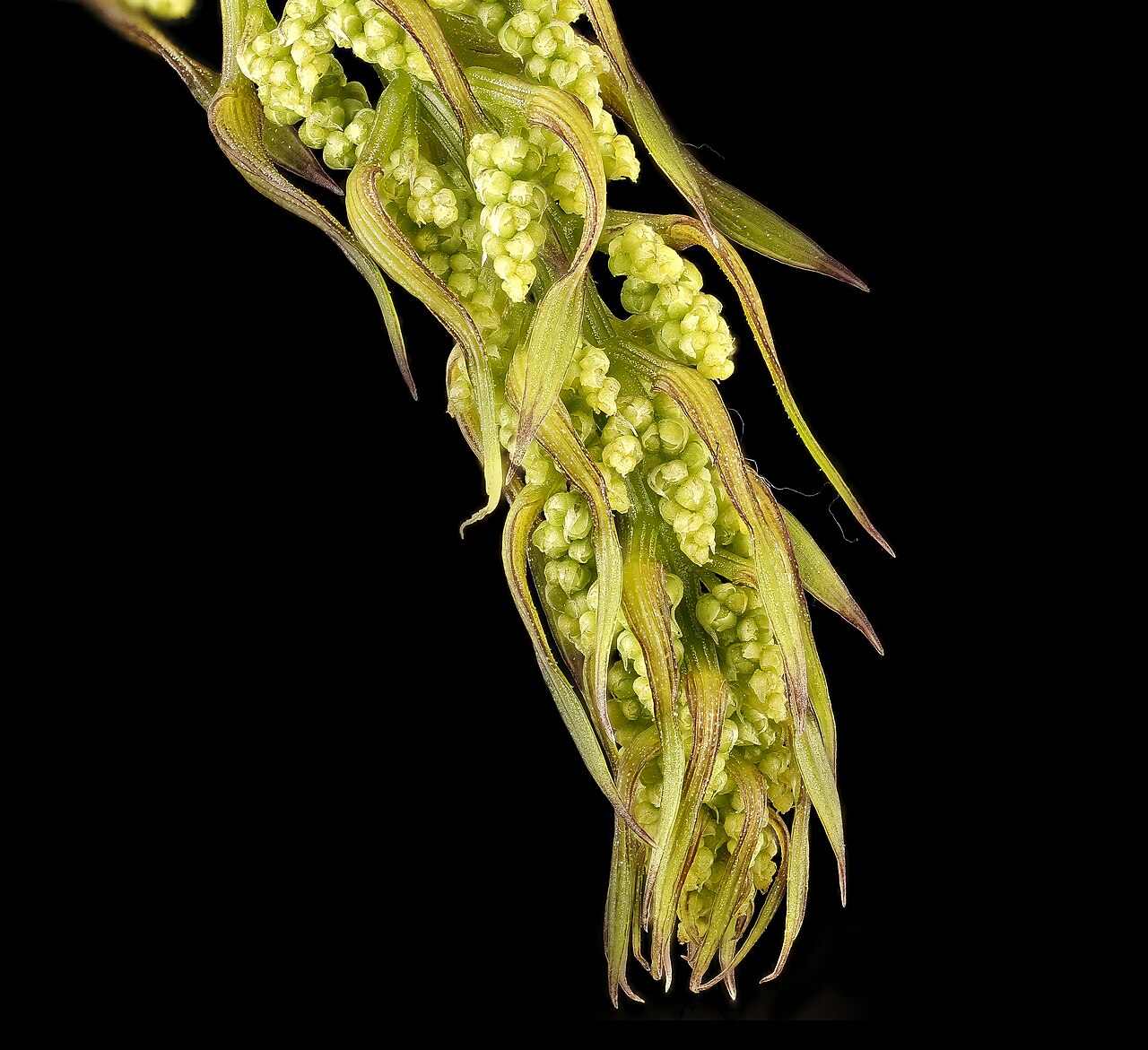
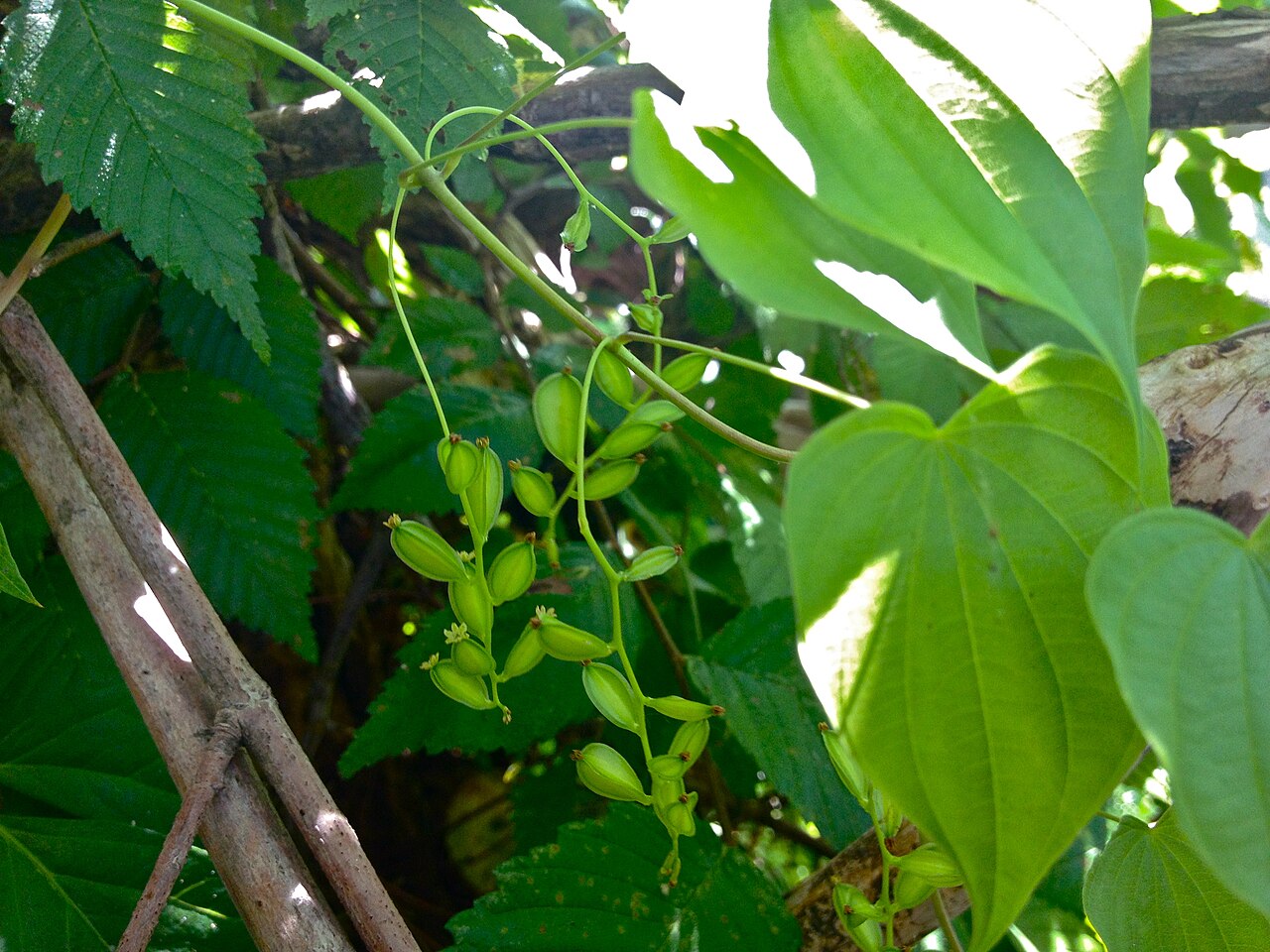
Wild Yam is dioecious, meaning male and female flowers occur on separate plants. Both are small, greenish-yellow, and easy to overlook, blooming from late spring into midsummer. Male flowers are borne in branched, upright to spreading clusters; female flowers hang in simple, drooping spikes from the leaf axils. Pollinated female flowers develop into distinctive three-winged, papery seed capsules about ¾ inch long, hanging in loose chains that ripen tan to brown in fall and often persist on the dried vine well into winter.
Quick Facts
| Scientific Name | Dioscorea villosa |
| Family | Dioscoreaceae (Yam) |
| Plant Type | Herbaceous perennial twining vine |
| Mature Height | Climbs 10–20 ft per season from a perennial root |
| Growth Rate | Moderate; dies back to the ground each winter |
| Sun Exposure | Part Shade (tolerates full sun to fairly deep shade) |
| Water Needs | Average to moist soil |
| Soil Type | Moist, humus-rich woodland soil; adaptable |
| Soil pH | Slightly acidic to neutral |
| Bloom Time | Late spring to midsummer |
| Flower Color | Greenish-yellow (inconspicuous) |
| Fall Color | Yellow before dieback |
| Fruit | Papery three-winged capsules in drooping chains (female plants only) |
| Deer Resistant | Mostly yes; occasional light browsing |
| USDA Hardiness Zones | 4–9 |
Native Range
Wild Yam is native across most of the eastern United States, from southern New England (Connecticut, Massachusetts, and Rhode Island, though it does not reach northern New England) south through the mid-Atlantic and Southeast to Florida, and west through the Ohio Valley, the upper Midwest and the southern Great Plains states to eastern Texas, Oklahoma and Kansas. It is absent from the Rocky Mountain states and the West Coast.
It grows in moist to mesic deciduous woods, thickets, fencerows, streambanks, and the brushy edges between woodland and field, usually in part shade with good soil moisture, though it tolerates drier upland woods and considerably more sun where it can find something to climb. It is a common, unremarkable component of eastern forest-edge vegetation rather than a species of special conservation concern anywhere in its range.
Because it spreads both by seed and by slowly creeping rhizome, Wild Yam often forms loose, scattered colonies along a woodland margin rather than a single discrete plant, twining up through whatever shrubby support is available each growing season before dying back to the rootstock in fall.
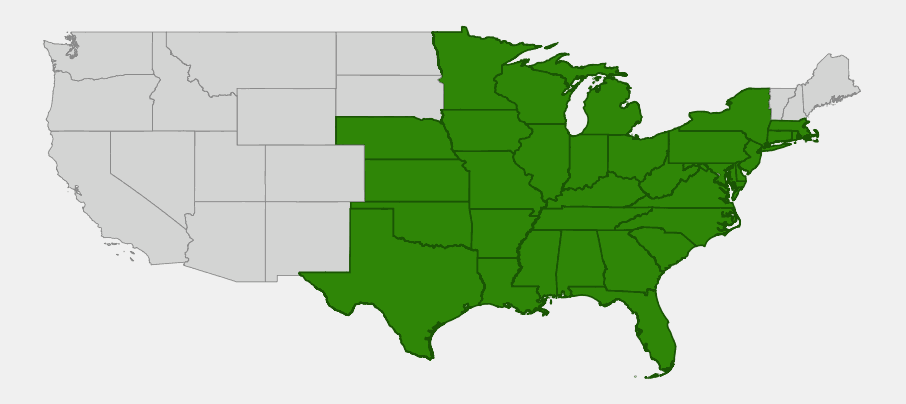
📋 Regional plant lists featuring Wild Yam: Connecticut, Massachusetts & Rhode Island · Delaware, Southern New Jersey & Long Island · New York, Pennsylvania & Northern New Jersey · Maryland, Virginia & West Virginia · North Carolina & South Carolina · Georgia, Alabama & Mississippi · Arkansas, Louisiana, Eastern Oklahoma & Eastern Texas · Kentucky & Tennessee · Ohio & Indiana · Illinois, Iowa & Missouri · Michigan, Wisconsin & Eastern Minnesota · Nebraska, Kansas & Eastern Colorado
Growing & Care Guide
Wild Yam is an easygoing, lightweight vine best suited to a naturalistic woodland edge or fence line rather than a formal trellis, since its twining habit and thin stems need something to wrap around rather than a flat surface to cling to.
Light
It grows best in part shade, mimicking its native woodland-edge habitat, but adapts well to both full sun and fairly deep shade. In shadier spots it tends to produce more foliage and less flower and fruit; in sunnier locations it climbs more vigorously and fruits more heavily on female plants.
Soil & Water
Average to moist, humus-rich soil suits it best, similar to typical deciduous woodland conditions, though established plants handle short dry spells without trouble. It is not fussy about soil type as long as drainage is reasonable.
Planting Tips
Plant in spring near a shrub, fence, or arbor the vine can twine up; it does not attach by tendrils or adhesive pads, so it needs thin, graspable supports rather than a solid wall. Because it is dioecious, a single plant may be male or female — only female vines produce the ornamental winged seed capsules, so gardeners wanting fruit display should plant several to improve the odds of getting both sexes.
Pruning & Maintenance
Essentially no pruning is needed. The top growth dies back naturally each fall; old stems can be cut away or simply left to break down over winter. The plant resprouts reliably from its perennial rootstock each spring.
Landscape Uses
Wild Yam fills a few specific, useful niches in a native garden:
- Woodland edge plantings, twining lightly through shrubs
- Naturalized fence or arbor cover for a loose, informal look
- Restoration plantings in moist eastern deciduous forest margins
- Wildlife gardens, providing cover and minor browse
- Specialty native collections focused on regional forest-edge flora
Wildlife & Ecological Value
Wild Yam is not a showy wildlife magnet, but it plays a quiet supporting role in the eastern woodland-edge ecosystem.
For Pollinators
The small, inconspicuous flowers are visited mainly by flies and small native bees rather than showier pollinators like butterflies, consistent with their pale color and faint fragrance. The bloom period overlaps with many other early-summer woodland flowers, adding modest diversity to the local nectar supply.
For Birds & Small Mammals
The twining growth adds structural cover along woodland edges and fencerows, offering small birds and mammals additional hiding and nesting habitat where it climbs through shrubs. The persistent winter seed capsules provide minor visual interest and occasional food for seed-eating birds.
Ecosystem Role
As a common, unassuming vine of eastern forest margins, Wild Yam adds a layer of structural diversity to the shrub zone without overwhelming its hosts, unlike more aggressive non-native vines. Its perennial rootstock helps hold soil along the shaded banks and fencerows where it typically grows.
Cultural & Historical Uses
Wild Yam has a long documented history in American folk medicine, though that history is recounted here for its cultural interest, not as guidance for use. Nineteenth-century Eclectic and herbal physicians in the United States used the dried rhizome under the names “colic root” and “rheumatism root,” most notably as a remedy for intestinal colic and, as the second name suggests, for joint pain. Indigenous peoples across parts of its range are also recorded as having used preparations of the root for digestive complaints.
In the twentieth century, Wild Yam gained a different kind of fame: its rhizome contains the steroidal saponin diosgenin, which chemists in the mid-1900s used as a starting material to synthesize progesterone and early oral contraceptives and corticosteroids on an industrial scale, before synthetic routes largely replaced plant-derived diosgenin. This chemistry is the origin of persistent but scientifically unsupported folk claims that wild yam itself acts as a natural hormone or “wild yam cream” in the body — the plant’s diosgenin is a laboratory starting material for drug synthesis, not a hormone the human body can use directly, and raw wild yam root is not interchangeable with those manufactured products.
The fresh rhizome is bitter and contains compounds that can cause nausea and digestive upset, and historical household use always involved drying and specific preparation by people experienced with the plant. Wild Yam should not be regarded as a food plant.
Frequently Asked Questions
Is Wild Yam the same as the yams or sweet potatoes sold in grocery stores?
No. Grocery store “yams” in the U.S. are usually sweet potatoes (Ipomoea batatas), a different plant entirely, and true cultivated yams are tropical Dioscorea species with large starchy tubers. Wild Yam’s root is thin, tough, and bitter, and it is not grown or used as a food crop.
Can you eat Wild Yam root?
No. The root is not a food plant — it is bitter, can cause digestive upset, and is historically associated with medicinal rather than culinary use. It should not be eaten.
Does Wild Yam contain natural hormones?
The root contains a compound called diosgenin that was historically used as a laboratory starting material to manufacture steroid hormones industrially, but the plant itself does not supply usable hormones to the human body. This is a common point of confusion in herbal marketing.
How big a support does Wild Yam need?
It is a light, thin-stemmed twining vine, so a shrub, low fence, or slender trellis works well. It cannot climb a flat wall and does not need a heavy-duty structure.
Will Wild Yam take over my garden?
No. It is a well-behaved native vine that dies back each winter and spreads only gradually from its rootstock and by seed, nothing like the aggressive non-native vines that can smother a landscape.

Looking for a nursery that carries Wild Yam?
Browse our native plant nursery directory: CT, DE, GA & FL · MA, MD, MS, KY, MO, MN, MI & LA · RI, PA, VA, SC, TN & TX · NY, NJ, NC, OH, OK & NE · WV & WI · AL & AR · IN, IL, IA & KS