
Water Hemlock (Cicuta maculata)
⚠ DANGER — DO NOT EAT ANY PART OF THIS PLANT. Water Hemlock is widely considered the most acutely toxic native plant in North America. Every part — especially the roots and the lower stem — contains cicutoxin, a convulsant that can kill an adult within an hour of ingestion. There is no safe folk preparation and no historical food or herbal use that makes it safe. This page describes the plant for identification, wetland restoration and wildlife-habitat purposes only. Never handle it around young children, and keep it well away from livestock, grazing animals and vegetable gardens.
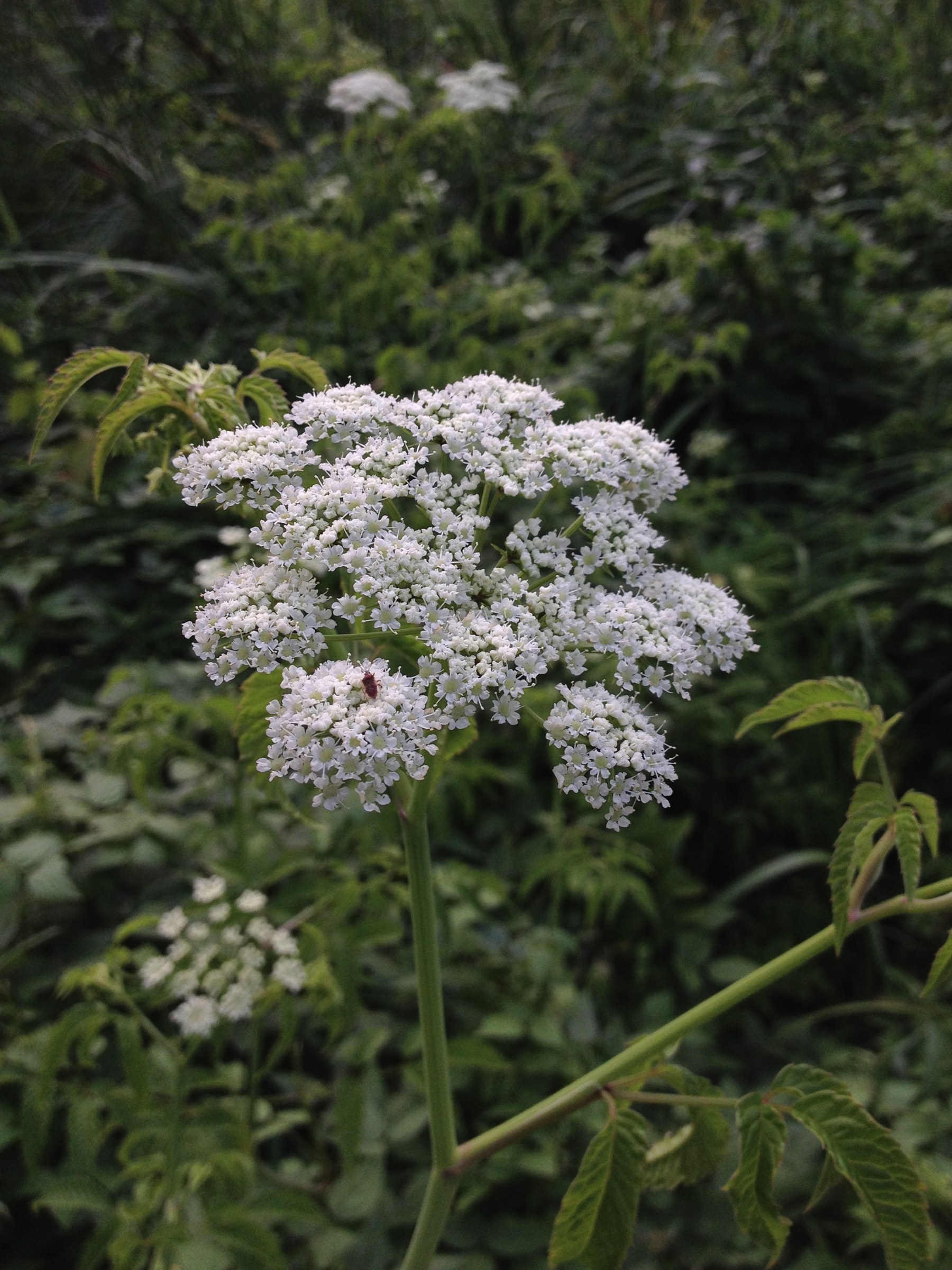
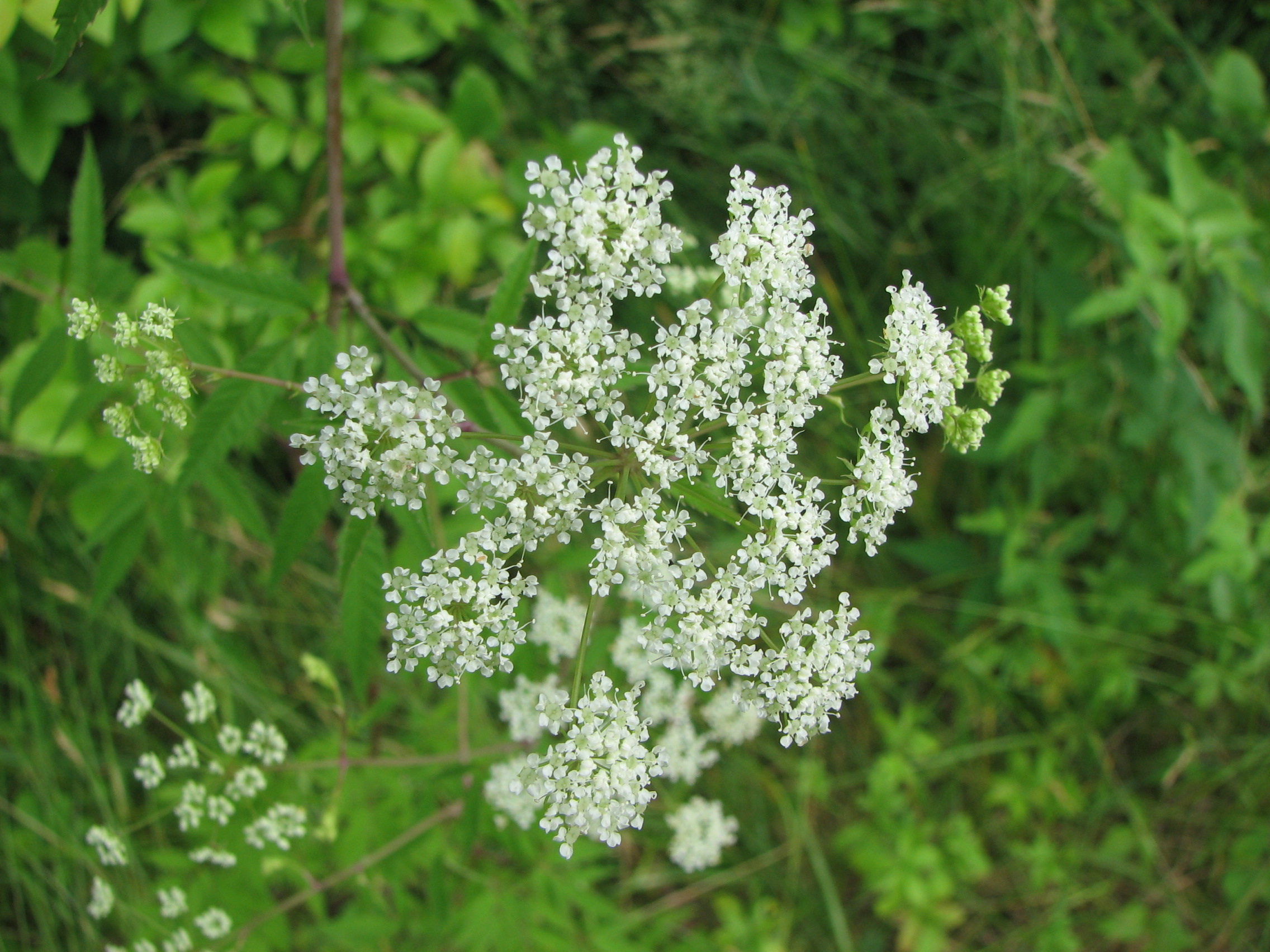
Cicuta maculata, commonly called Water Hemlock (also Spotted Water Hemlock, Spotted Cowbane or Beaver Poison), is a tall perennial wildflower in the carrot family (Apiaceae) that grows in wet meadows, marshes, ditches and streambanks across most of North America. It is instantly recognizable to an experienced eye by its purple-streaked or purple-mottled hollow stems and flat-topped clusters of small white flowers, which closely resemble Queen Anne’s Lace and other members of the carrot family — a resemblance that is part of what makes this plant so dangerous.
Water Hemlock is a genuinely important wetland native: it stabilizes muddy banks with a fibrous root system, flowers through much of the summer when few other wetland plants are blooming, and its open umbels are visited steadily by small native bees, flies, wasps and beetles. Few ornamental or restoration books recommend planting it deliberately because of the poisoning risk, but it already occurs naturally in most wet, undisturbed ground across the continent and plays a legitimate role in marsh and wet-meadow plant communities.
Because confusing Water Hemlock with an edible relative has killed foragers, hikers and livestock, this page exists primarily so gardeners, land managers and parents can confidently identify it, understand where it grows, and know to leave it alone — not as a planting recommendation. If you find it growing in a wet corner of your property, the safest course is usually simply to recognize it, fence off grazing animals, and let it be part of the wetland community it is already part of.
Identification
Water Hemlock is an erect, clump-forming perennial (sometimes behaving as a biennial) that typically reaches 3 to 6 feet tall, occasionally taller in rich wet soil. The whole plant has a coarse, rank, carrot-family look, and crushed foliage gives off a strong, unpleasant parsnip-like odor that is itself a useful warning sign.
Stems & Roots
The stems are stout, hollow, hairless and branching, with a distinctive purple streaking or mottling that is one of the best field marks for the species — plain green, unmarked stems point toward a different (though not necessarily safer) umbellifer. The stems are divided internally by cross-partitions at the nodes, visible when a stem is cut lengthwise. Below ground, Water Hemlock has a cluster of thickened, tuberous roots; if the base of the plant is cut open, it shows hollow chambers and oozes a yellowish, oily liquid that carries the most concentrated dose of toxin in the entire plant. Digging, slicing, or otherwise disturbing the root crown is the single most dangerous thing a person can do around this species.
Leaves
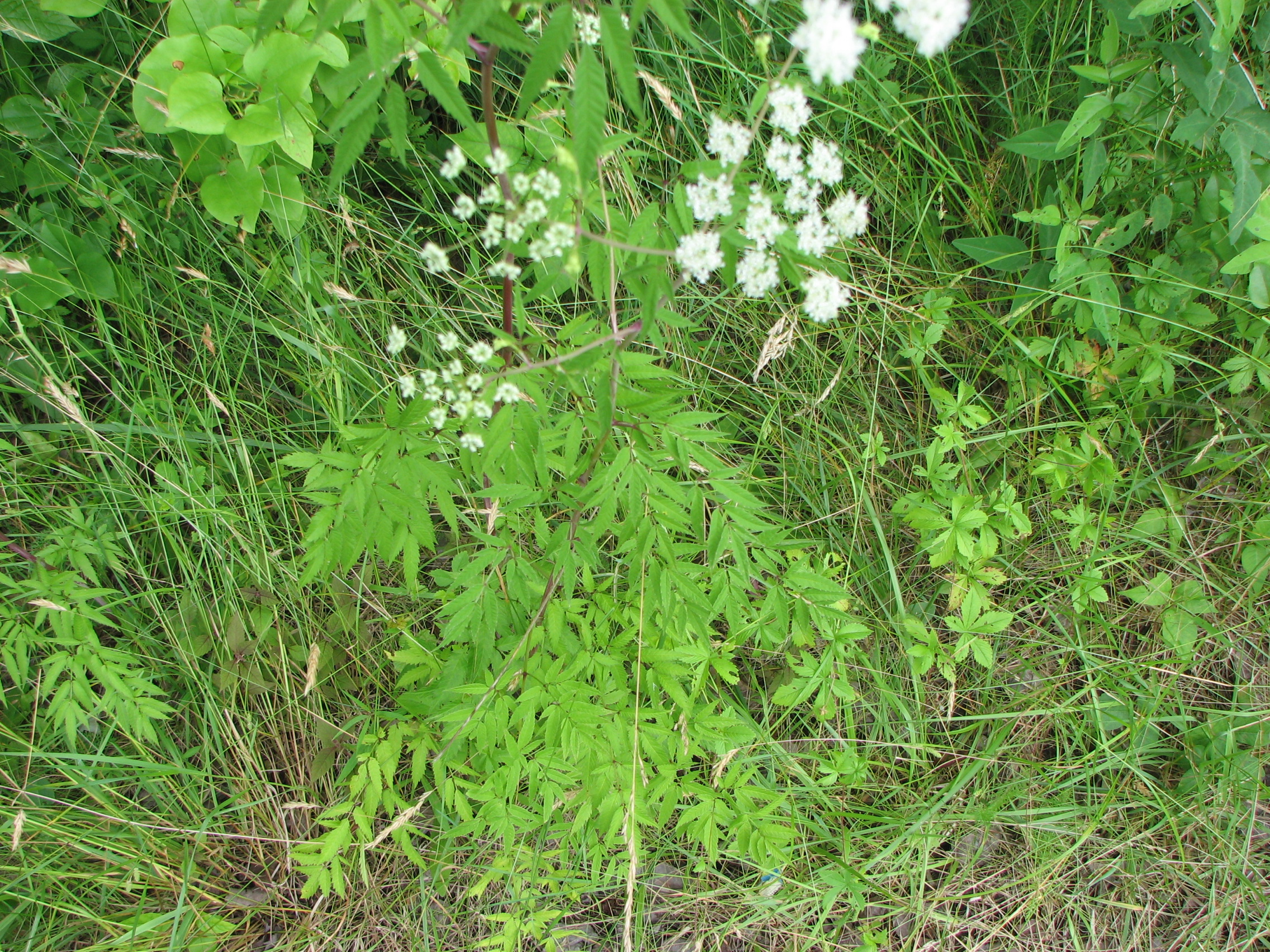
The leaves are large, alternate, and two to three times pinnately compound, giving a lacy, fern-like appearance typical of the carrot family. Leaflets are lance-shaped with sharply toothed margins, 2 to 4 inches long. The best identification detail is the vein pattern: the lateral veins in each leaflet run out to the notches between the marginal teeth, not to the tips of the teeth as in most look-alike umbellifers. This “veins-to-the-notch” pattern is the single most reliable way to separate Water Hemlock from edible relatives in the field.
Flowers & Fruit
From early summer into early fall, Water Hemlock produces flat-topped to slightly rounded compound umbels, 2 to 5 inches across, made up of many small clusters of tiny five-petaled white flowers. The flowers are a typical carrot-family umbel and, on their own, cannot reliably distinguish Water Hemlock from Queen Anne’s Lace, wild parsnip, poison hemlock or several edible umbellifers — identification should always rely on the stem, root and leaf-vein characters together, never on the flowers alone. The fruit is a small, ribbed, egg-shaped schizocarp that splits into two seed-like halves when ripe.
Quick Facts
| Scientific Name | Cicuta maculata L. |
| Family | Apiaceae (Carrot) |
| Plant Type | Herbaceous perennial/biennial wetland forb |
| Mature Height | 3–6 ft (occasionally to 8 ft) |
| Mature Spread | 1–3 ft clump |
| Growth Rate | Fast in wet soil |
| Sun Exposure | Full Sun to Part Shade |
| Water Needs | Wet to consistently saturated; not drought tolerant |
| Soil Type | Wet muck, clay or silt; marsh and streambank soils |
| Soil pH | Neutral to slightly alkaline |
| Bloom Time | June – September, varies by latitude |
| Flower Color | White |
| Fall Color | None notable; foliage yellows and collapses |
| Fruit | Small ribbed brown schizocarps, late summer |
| Deer Resistant | Yes, though livestock and wildlife poisonings still occur |
| Toxicity | Extremely toxic to humans and livestock — never consume any part |
| USDA Hardiness Zones | 3–9 |
Native Range
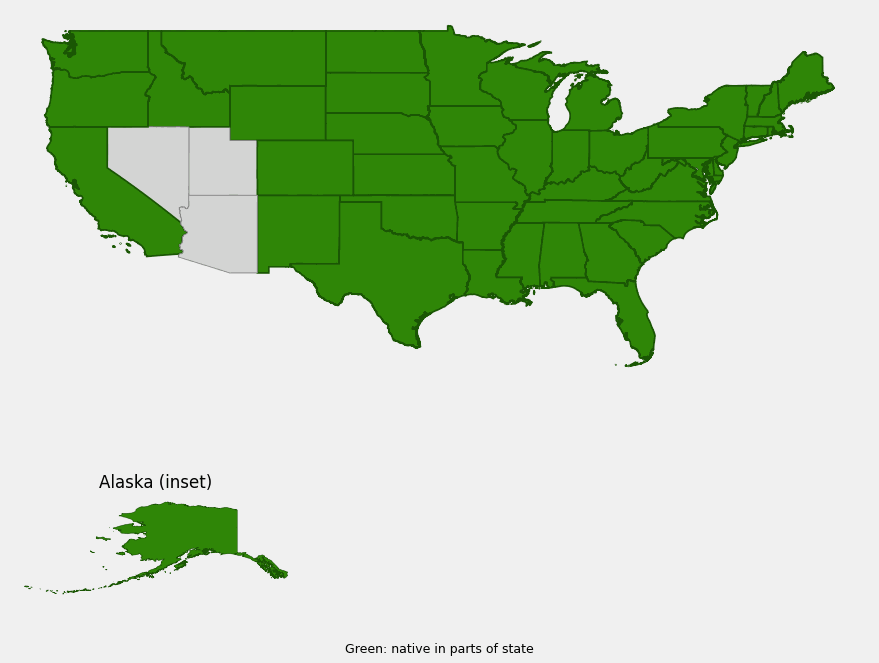
Water Hemlock has one of the broadest native ranges of any North American wetland wildflower, occurring across nearly the entire continent outside the arid Southwest. It is native from Alaska and Canada south through almost every U.S. state in the Lower 48, growing wherever reliably wet, open ground exists — wet prairies, marsh edges, pond and lake margins, stream and river banks, roadside ditches and seasonally flooded meadows.
It is notably absent as a native plant from the driest parts of the interior West. Nevada, Utah and Arizona lack the species; in states on the edge of its range it is restricted to riparian corridors, irrigation ditches and other reliably wet pockets within an otherwise dry landscape. Because it needs saturated or standing water for at least part of the growing season, Water Hemlock is a reliable indicator of a true wetland or seasonally flooded site rather than simply moist upland soil.
Within its wetland habitat, Water Hemlock typically grows alongside other obligate wetland species such as sedges, rushes, cattails, blue flag iris and swamp milkweed. It tolerates a wide range of climates, from subarctic Alaska to subtropical Gulf Coast marshes, as long as its roots stay wet.
📋 Regional plant lists featuring Water Hemlock: Alaska · Georgia, Alabama & Mississippi · Arkansas, Louisiana, Eastern Oklahoma & Eastern Texas · Arizona & New Mexico · North Dakota, South Dakota & Western Minnesota · Delaware, Southern New Jersey & Long Island · Illinois, Iowa & Missouri · Idaho, Eastern Oregon & Eastern Washington · Ohio & Indiana · Kentucky & Tennessee · Maryland, Virginia & West Virginia · Michigan, Wisconsin & Eastern Minnesota · Montana & Wyoming · North Carolina & South Carolina · Nebraska, Kansas & Eastern Colorado · New Hampshire, Maine & Vermont · Connecticut, Massachusetts & Rhode Island · New York, Pennsylvania & Northern New Jersey · Western Oregon & Western Washington · Utah & Western Colorado
Growing & Care Guide
Most gardeners encounter Water Hemlock because it is already growing in a wet corner of their land, not because they planted it on purpose — and for most home landscapes it is not a species worth seeking out. The notes below are for land managers, wetland restoration projects, or anyone who needs to understand how it behaves rather than a general planting recommendation.
Light
Water Hemlock grows best in full sun to part shade. In open marshes and wet meadows with full sun it forms dense, floriferous stands; in shadier streamside settings it grows taller and more open, reaching for light between taller wetland shrubs.
Soil & Water
This species needs consistently wet to saturated soil and does not tolerate drought. It is at home in muck, clay or silty soils that stay wet for most of the growing season, including sites with standing water part of the year. It is not a candidate for ordinary garden beds, rain gardens with intermittent drainage, or any site that dries out in summer — it simply will not persist there.
Siting & Safety
Because of its toxicity, Water Hemlock should never be planted near vegetable or herb gardens, livestock pasture, or anywhere children play. If it is already present in a wet area of a property with grazing animals, fence that area off or remove the plants (wearing gloves, since the sap can irritate skin) before animals have access, since even small amounts of root can be fatal to cattle, horses and sheep.
Maintenance
Where it is allowed to persist as part of a wetland planting, Water Hemlock needs essentially no maintenance — it dies back to the root crown each winter and resprouts in spring. Where removal is the goal, dig out the tuberous roots completely, since fragments can resprout, and dispose of plant material without composting it where animals might later encounter it.
Landscape Uses
Realistic uses are narrow and mostly restoration-oriented:
- Wetland and marsh restoration plantings where the species already occurs regionally
- Naturalized pond or ditch margins as part of a diverse wet-meadow plant community
- Pollinator habitat in wet ground, valued for its long summer bloom period
- Not recommended for home gardens, children’s play areas, or anywhere near livestock or vegetable plots
Wildlife & Ecological Value
Despite its danger to larger animals, Water Hemlock plays a real role in wetland food webs, mostly at the insect level.
For Pollinators
The flat-topped umbels are visited heavily by short-tongued native bees, hoverflies, soldier beetles, and various wasps, which can reach the shallow nectar easily. Because it blooms through mid and late summer, Water Hemlock provides a nectar source during a period when many spring wetland wildflowers have already finished.
For Birds
Seed-eating birds occasionally take the ripe schizocarps in fall, and the dense summer growth offers marsh and wetland birds cover near the water’s edge, though Water Hemlock is not a significant food plant for birds compared with its value to insects.
For Mammals
Here the story is almost entirely cautionary: Water Hemlock is responsible for some of the best-documented livestock poisoning cases of any North American plant, particularly in cattle that graze or trample newly exposed roots along ditch banks and pasture edges in early spring, when the roots are most toxic and most easily pulled up. Deer and other wild herbivores generally avoid it, which is part of why it persists so readily in grazed landscapes.
Ecosystem Role
As an obligate wetland plant, Water Hemlock’s fibrous and tuberous root system helps hold saturated streambank and marsh-edge soils in place, and its presence is itself a useful on-the-ground indicator that a site stays wet through the growing season. It fills a summer-blooming niche in wetland plant communities alongside sedges, rushes and other moisture-loving natives.
Cultural & Historical Uses
Water Hemlock has no safe history of food, herbal or craft use among any culture — its story is instead a long, well-documented history of accidental poisoning. Indigenous peoples across North America generally recognized and avoided the plant, and ethnobotanical records from many tribes note it specifically as a known poison rather than a resource, sometimes used only in the most limited external or ceremonial contexts tied directly to its toxicity rather than any benefit from consuming it.
The species has long been confused with superficially similar carrot-family plants that are genuinely eaten, including wild parsnip roots and the related Water Parsnip, and this confusion has caused fatal poisonings among foragers, hikers and children for as long as records exist. Nineteenth- and twentieth-century agricultural bulletins repeatedly singled out Water Hemlock, alongside its relative Poison Hemlock, as the most dangerous native plant encountered by farmers clearing ditches and streambanks, because the toxin acts within minutes of ingestion and historically had no reliable field remedy.
Today, Water Hemlock’s main relevance to people is as a safety-education topic: foraging guides, extension offices and park naturalist programs use it as the primary cautionary example when teaching how to avoid dangerous look-alikes within the carrot family. Its legitimate modern role is ecological and educational, not culinary, craft or herbal.
Frequently Asked Questions
Is Water Hemlock the same plant as Poison Hemlock?
No. They are different genera in the same family. Poison Hemlock (Conium maculatum) is an introduced biennial with smooth, purple-blotched stems and a mousy odor; Water Hemlock (Cicuta maculata) is a native perennial of wet ground with tuberous roots. Both are extremely toxic, so neither should ever be handled carelessly or ingested.
How poisonous is Water Hemlock really?
It is often called the most acutely toxic native plant in North America. A piece of root the size of a walnut can be fatal to an adult human, and poisoning symptoms — violent convulsions — can begin within 15 minutes of ingestion. There is no antidote; treatment is purely supportive emergency care. If anyone may have ingested any part of this plant, call Poison Control or emergency services immediately.
How can I tell it apart from Queen Anne’s Lace or wild carrot?
Look at the stem and leaf veins, not just the flowers. Water Hemlock has smooth, hollow, purple-streaked stems and compound leaves whose veins run to the notches between leaf-teeth, while Queen Anne’s Lace has hairy, solid green stems and a single dark central floret in the umbel. When in doubt, do not taste or handle the roots to check.
Should I remove Water Hemlock if I find it on my property?
If you have livestock, young children, or grazing animals with access to the area, yes — fence it off or dig it out completely, wearing gloves. If it is growing in an undisturbed wet area away from people and animals, it can be left as part of the native wetland plant community.
Is it safe to touch Water Hemlock?
Simply brushing against the foliage is generally low-risk, but the sap, especially from cut stems or disturbed roots, can be absorbed through skin or mucous membranes and cause irritation. Wear gloves when cutting, digging or removing the plant, wash hands afterward, and never put any part of it in your mouth.

Looking for a nursery that carries native wetland plants for your region?
Browse our native plant nursery directory: Alabama, Alaska & Arkansas · California · Colorado, Connecticut, Delaware, Florida & Georgia · Idaho, Illinois, Indiana, Iowa & Kansas · Kentucky, Louisiana, Maine, Maryland, Massachusetts, Michigan, Minnesota, Mississippi, Missouri & Montana · Nebraska, New Hampshire, New Jersey, New Mexico, New York, North Carolina, North Dakota, Ohio & Oklahoma · Oregon · Pennsylvania, Rhode Island, South Carolina, South Dakota, Tennessee, Texas, Vermont & Virginia · Washington · West Virginia, Wisconsin & Wyoming