
Roundleaf Greenbrier (Smilax rotundifolia)
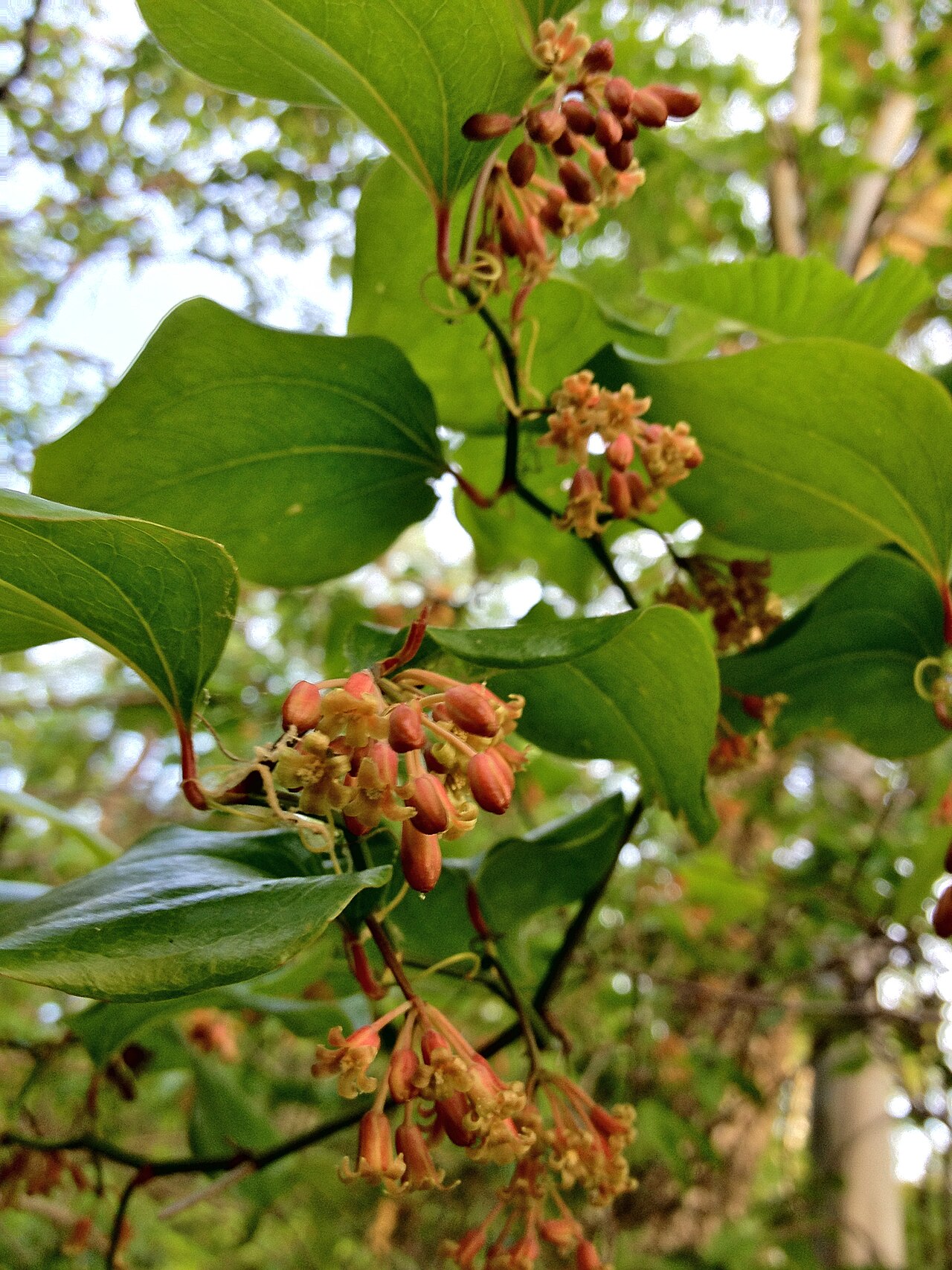
Smilax rotundifolia, commonly called roundleaf greenbrier or simply greenbrier, is a tough, thorny, climbing vine that is one of the most familiar — and least loved — native plants of eastern woodlands. It belongs to the Smilacaceae (catbrier family) and is also known regionally as common greenbrier, bullbrier, horsebrier, and catbrier, names that all point to the same experience: anyone who has pushed through a thicket of it knows the stout, curved prickles that line its stems. Despite the scratches, this vine is an ecological workhorse, forming dense tangles that shelter birds and small mammals while its berries carry many species through the leanest months of winter.
Roundleaf greenbrier is a woody, high-climbing vine that can reach 20 feet or more into the forest canopy, clambering over shrubs and tree trunks with the help of paired tendrils that sprout from the leaf stalks. The stems are green, four-angled, and armed with scattered, stout, straight-to-curved thorns. Its leaves are broadly rounded to heart-shaped, glossy, and leathery, turning the vine into a dense evergreen-to-semievergreen curtain across much of its southern range and a deciduous tangle farther north.
In the garden, greenbrier is rarely planted on purpose — it spreads by both seed and an extensive system of tuberous rhizomes, and once established it is difficult to remove. But where it already grows along a woodland edge or fence line, it is worth leaving in place for the cover and food it provides. This profile covers its identification, true native range, growth habits, and the wildlife that depends on it, so you can recognize it with confidence and decide whether to manage it or let it be.
Identification
Roundleaf greenbrier is best identified by the combination of round, glossy leaves, paired tendrils at the base of each leaf stalk, and stout prickles on green, angled stems. It is one of about a dozen Smilax species native to the eastern United States, and the only common one with consistently round, unlobed leaves and a four-angled stem.
Stems
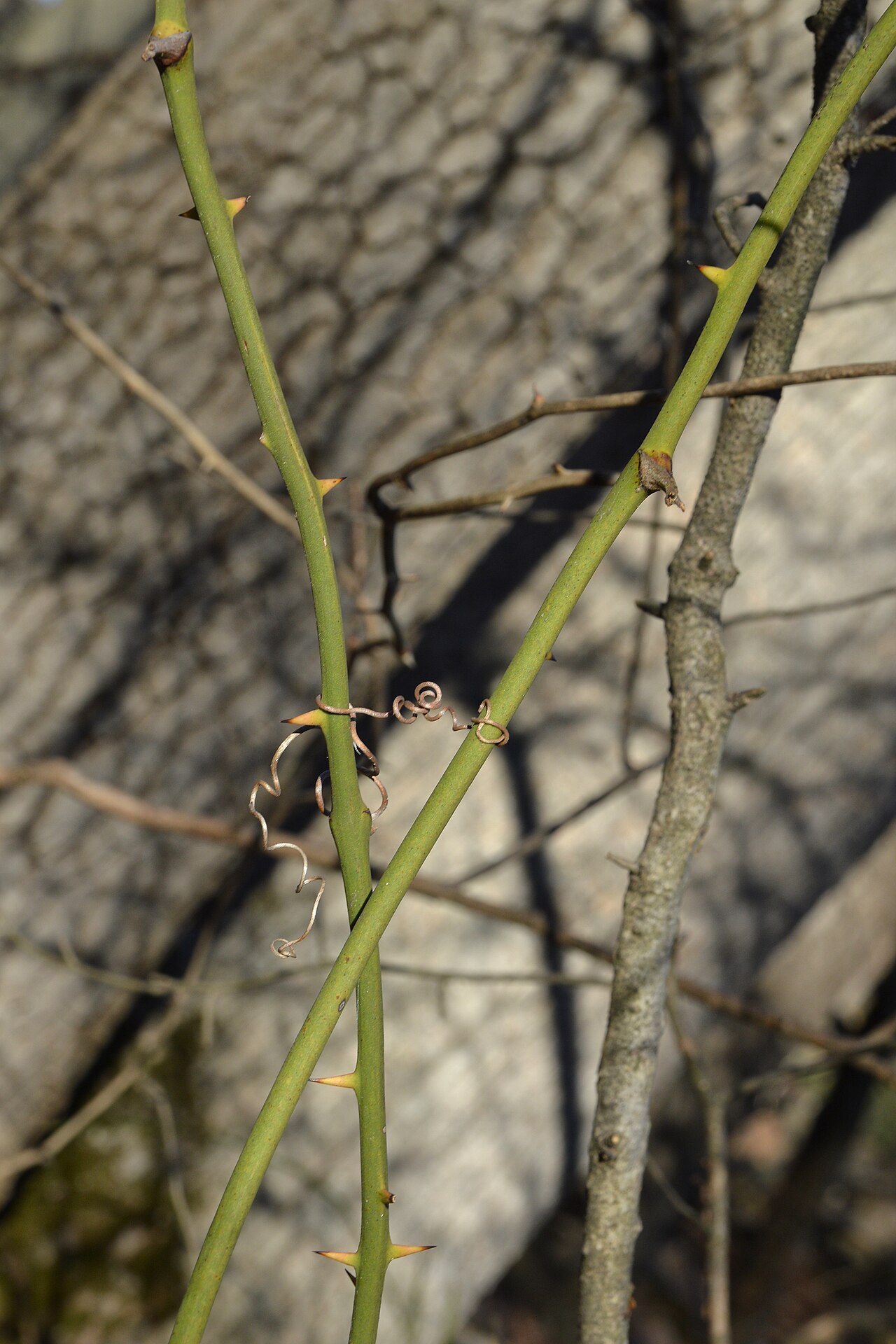
Stems are green (sometimes reddish where exposed to sun), smooth, and distinctly four-angled in cross-section, a feature that separates roundleaf greenbrier from most related species with round stems. Scattered along the stem are stout, straight to slightly curved prickles, usually broad-based and sharp enough to tear skin and clothing easily. Older stems toward the base can thicken and become almost woody and gray-barked, while new growth each year is bright green and flexible. Paired, coiling tendrils arise from the base of the leaf stalks and let the vine grip neighboring branches as it climbs.
Leaves
Leaves are alternate, simple, and broadly oval to nearly round, 2 to 5 inches long, with a short abrupt point at the tip and a rounded to slightly heart-shaped base. They are glossy dark green above, paler beneath, with three to five main veins running from the base to the tip in the typical Smilax pattern. In the Deep South the foliage is evergreen or nearly so; farther north, through New England and the Great Lakes states, the leaves drop in autumn, often turning a dull yellow first.
Flowers
Roundleaf greenbrier is dioecious, meaning individual plants are either male or female. Small, yellow-green flowers appear in rounded umbels on short stalks from the leaf axils in late spring to early summer. They are easy to overlook — each flower is only about 1/8 inch across — but the clusters have a faint, somewhat unpleasant odor that draws flies and small native bees as pollinators.
Fruit & Seeds
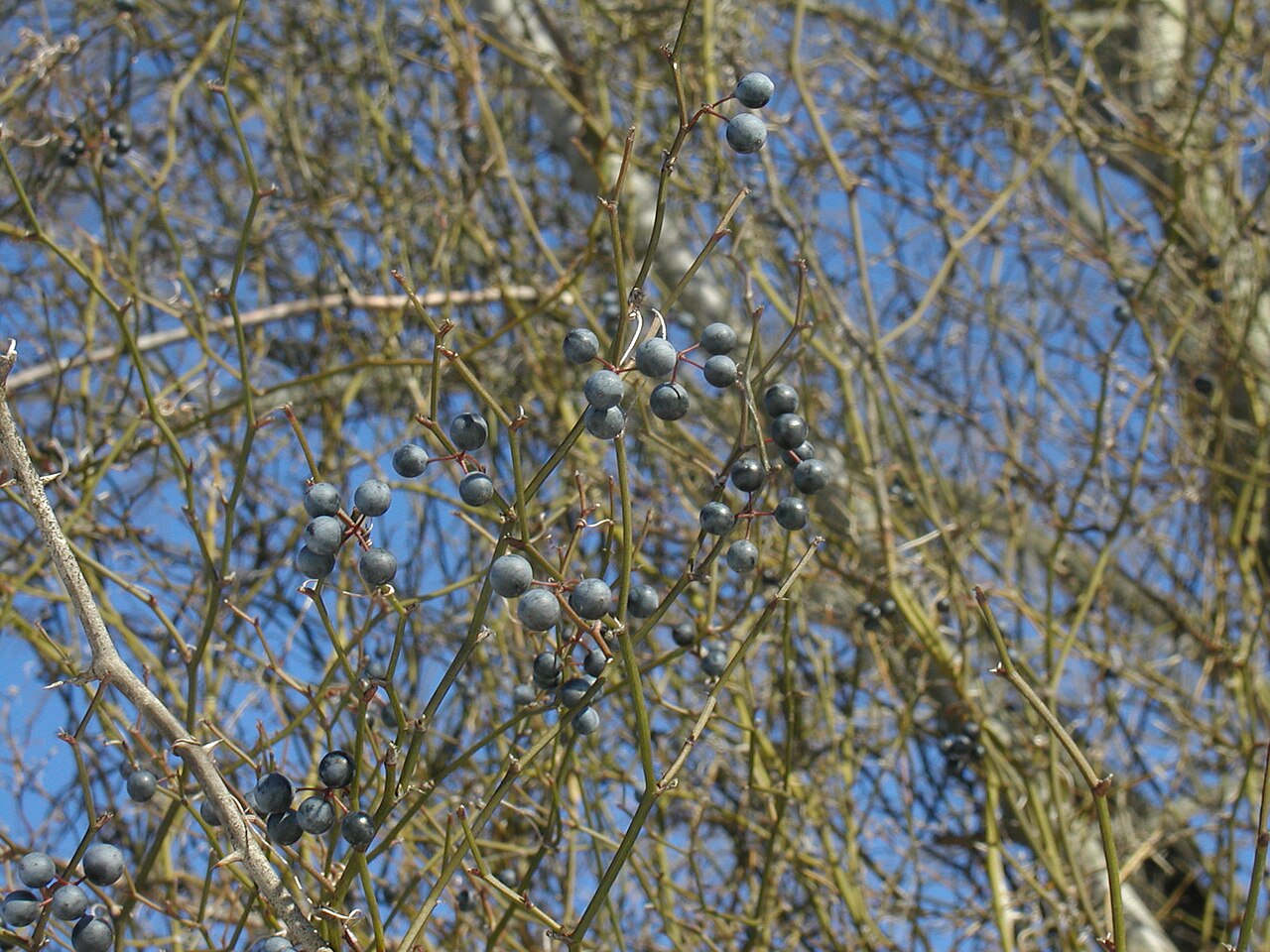
Only female vines produce fruit: round, blue-black berries about 1/4 to 1/3 inch across, borne in loose clusters that ripen in autumn and often persist on the bare stems well into winter. Each berry holds one to a few hard, light brown seeds. The lingering winter fruit is an important late-season food source, visible against the vine’s leafless green-and-thorny tangle long after most other fruit has been eaten or has fallen.
Quick Facts
| Scientific Name | Smilax rotundifolia |
| Family | Smilacaceae (Catbrier) |
| Plant Type | Woody, Climbing Vine |
| Mature Height | 10–20+ ft (climbing) |
| Mature Spread | Spreads indefinitely by rhizome where unchecked |
| Growth Rate | Fast |
| Sun Exposure | Full Sun to Full Shade |
| Water Needs | Average, tolerates wet or dry sites |
| Soil Type | Adaptable; sandy, loamy, or clay |
| Soil pH | Acidic to neutral |
| Bloom Time | May – June |
| Flower Color | Yellow-green |
| Fall Color | Dull yellow (north); evergreen in Deep South |
| Fruit | Blue-black berries, persisting into winter |
| Deer Resistant | Yes (thorns discourage browsing) |
| USDA Hardiness Zones | 5–9 |
Native Range
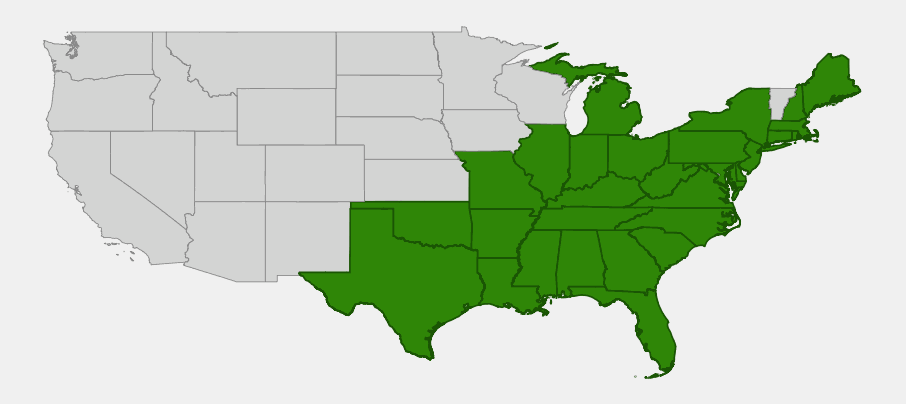
Roundleaf greenbrier is native across the eastern United States, from eastern Texas and Oklahoma north through the Ohio Valley and Great Lakes states to southern New England, and east to the Atlantic coast from Maine to Florida. It also reaches into the southernmost edge of Canada. It does not occur natively in the Upper Midwest prairie states, the Great Plains, or anywhere west of the central prairies — it is strictly an eastern woodland species.
It grows in a wide range of habitats: deciduous and mixed forests, forest edges, fencerows, floodplains, old fields, pine woods, and disturbed ground. It tolerates both wet bottomland soils and dry upland sites, which along with its tolerance of shade and full sun is a large part of why it is so widespread and locally abundant throughout its range.
Because it spreads readily from both seed and rhizome and thrives in disturbed edges, roundleaf greenbrier is often one of the first woody plants to reclaim an abandoned field or clear-cut, forming dense, thorny tangles well before taller trees retake the site. This pioneering habit makes it ecologically valuable in early-succession habitat even though it is rarely the plant a gardener invites in.
📋 Regional plant lists featuring Roundleaf Greenbrier: New Hampshire, Maine & Vermont · Connecticut, Massachusetts & Rhode Island · New York, Pennsylvania & Northern New Jersey · Delaware, Southern New Jersey & Long Island · Maryland, Virginia & West Virginia · North Carolina & South Carolina · Georgia, Alabama & Mississippi · Arkansas, Louisiana, Eastern Oklahoma & Eastern Texas · Kentucky & Tennessee · Ohio & Indiana · Illinois, Iowa & Missouri · Michigan, Wisconsin & Eastern Minnesota
Growing & Care Guide
Few people set out to plant roundleaf greenbrier — it is far more often something a gardener finds already growing along a fence line, in a hedgerow, or at the edge of the woods. Because it establishes so easily and spreads by rhizome as well as seed, it is best managed rather than cultivated. That said, where space and tolerance for thorns allow, it is a genuinely useful wildlife plant.
Light
Roundleaf greenbrier tolerates the full range from open sun to deep forest shade. In sunnier spots it produces more flowers and fruit and grows denser; in shade it stretches toward the canopy with longer, sparser growth, often climbing high into trees in search of light.
Soil & Water
It is remarkably unfussy about soil, growing in everything from heavy clay to sand, and tolerating both seasonally wet bottomland and dry upland sites once established. No supplemental watering is needed outside of the first growing season.
Planting Tips
Because it spreads aggressively from an extensive underground rhizome system, roundleaf greenbrier is rarely a plant to deliberately introduce into a small garden. If you want to encourage it, simply protect existing volunteer vines along a wild edge or fence line rather than mowing them down, and give them a sturdy shrub, fence, or small tree to climb.
Pruning & Maintenance
Where it needs to be contained, cut stems back to the ground; new growth will resprout from the rhizome, so repeated cutting over several seasons, combined with removal of exposed rhizome segments, is usually needed to reduce a stand. Wear heavy gloves and long sleeves — the prickles tear skin and fabric easily. Where it is welcome, little maintenance beyond occasional thinning is required.
Landscape Uses
Roundleaf greenbrier earns its place at the wild edges of a property rather than in formal beds:
- Wildlife thickets — dense, thorny tangles that double as both shelter and food
- Natural living fences along property lines, where its prickles deter foot traffic
- Woodland edge restoration and early-succession habitat plantings
- Erosion control on fencerows and field margins thanks to its spreading rhizomes
- Winter interest — persistent blue-black berries stand out against bare stems
Wildlife & Ecological Value
Few eastern vines do as much for wildlife through the winter months as roundleaf greenbrier, whose tangled, thorny growth and lingering fruit combine shelter and food in a single plant.
For Birds
The persistent winter berries are eaten by a wide range of songbirds, including Northern Cardinals, Eastern Bluebirds, Gray Catbirds, American Robins, and various thrushes, especially in late winter when other fruit has been exhausted. Wild Turkey and Ruffed Grouse browse the leaves and fruit as well. Just as important, the dense, thorny tangles greenbrier forms provide some of the safest nesting and escape cover available in eastern thickets — predators have as hard a time pushing through the prickles as people do.
For Mammals
White-tailed Deer browse the leaves and young stems, and because the plant resprouts vigorously after browsing it can tolerate heavy deer pressure better than most native shrubs — one reason it often becomes locally dominant in areas with high deer populations. Eastern Cottontails and small rodents use greenbrier thickets for cover, and Black Bears will feed on the fruit where it is abundant.
For Pollinators
The small, faintly scented spring flowers are visited by flies, small native bees, and other short-tongued insects, which are the plant’s primary pollinators. As a dioecious species, fruit production depends on both male and female vines growing within pollinator range of each other.
Ecosystem Role
As an aggressive early colonizer of disturbed ground, roundleaf greenbrier helps stabilize soil and shade out competing vegetation while slower-growing trees and shrubs reestablish. Its dense structure adds a layer of habitat complexity that is otherwise scarce in young or heavily browsed forests, and its rhizomes allow it to persist through fire, mowing, and heavy browsing that would eliminate less resilient species.
Cultural & Historical Uses
Indigenous peoples across the plant’s eastern range used various parts of greenbrier for food and craft. The young, tender spring shoots and tendrils were cooked and eaten much like asparagus, a practice still occasionally followed by foragers today. The starchy rhizomes were historically dug, dried, pounded, and used to make a reddish flour or jelly in parts of the Southeast, a labor-intensive process given how deep and extensive the roots grow.
The tough, flexible stems were sometimes used in basketry and cordage by Indigenous peoples, taking advantage of the vine’s strength while working around its thorns. European settlers generally regarded greenbrier as a nuisance in pastures and fields, and clearing it from agricultural land was a recurring chore noted in historical farm accounts across the South.
Today roundleaf greenbrier has little commercial use and is more often the subject of complaints from hikers and hunters who have pushed through a patch of it than of deliberate cultivation. Its persistence through disturbance, however, has long made it a reliable, if thorny, presence in the understory of the eastern forests it has occupied for millennia.
Frequently Asked Questions
Is roundleaf greenbrier the same as catbrier or bullbrier?
Yes. Catbrier, bullbrier, horsebrier, and common greenbrier are all common names used for Smilax rotundifolia in different parts of its range; they all refer to the same thorny, round-leaved vine.
Are greenbrier berries edible?
They are not a food source for people and are best left for birds and wildlife; the young spring shoots and tendrils, by contrast, have a history of being cooked and eaten like asparagus, though anyone foraging should be certain of identification first.
How do I get rid of greenbrier in my yard?
Because it spreads from an extensive rhizome system, mowing or cutting alone will not eliminate it — new shoots resprout quickly. Repeated cutting over multiple seasons, combined with digging out exposed rhizome segments, gradually weakens a stand.
Why does greenbrier have thorns?
The stout prickles deter browsing animals, including deer, and likely help the vine compete for light by discouraging large herbivores from passing through dense stands, leaving its tangled growth largely intact as cover.
Does greenbrier harm the trees it climbs?
It does not parasitize its support plants the way a true parasite does, but a heavy infestation can add significant weight and shade a smaller tree’s foliage, occasionally stressing or bending young trees it has thoroughly overtopped.

Looking for a nursery that carries Roundleaf Greenbrier?
Browse our native plant nursery directory: Alabama & Arkansas · Connecticut, Delaware, Florida & Georgia · Illinois & Indiana · Kentucky, Louisiana, Maine, Maryland, Massachusetts, Michigan, Mississippi & Missouri · New Hampshire, New Jersey, New York, North Carolina, Ohio & Oklahoma · Pennsylvania, Rhode Island, South Carolina, Tennessee, Texas & Virginia · West Virginia