
Tall Blue Lettuce (Lactuca biennis)
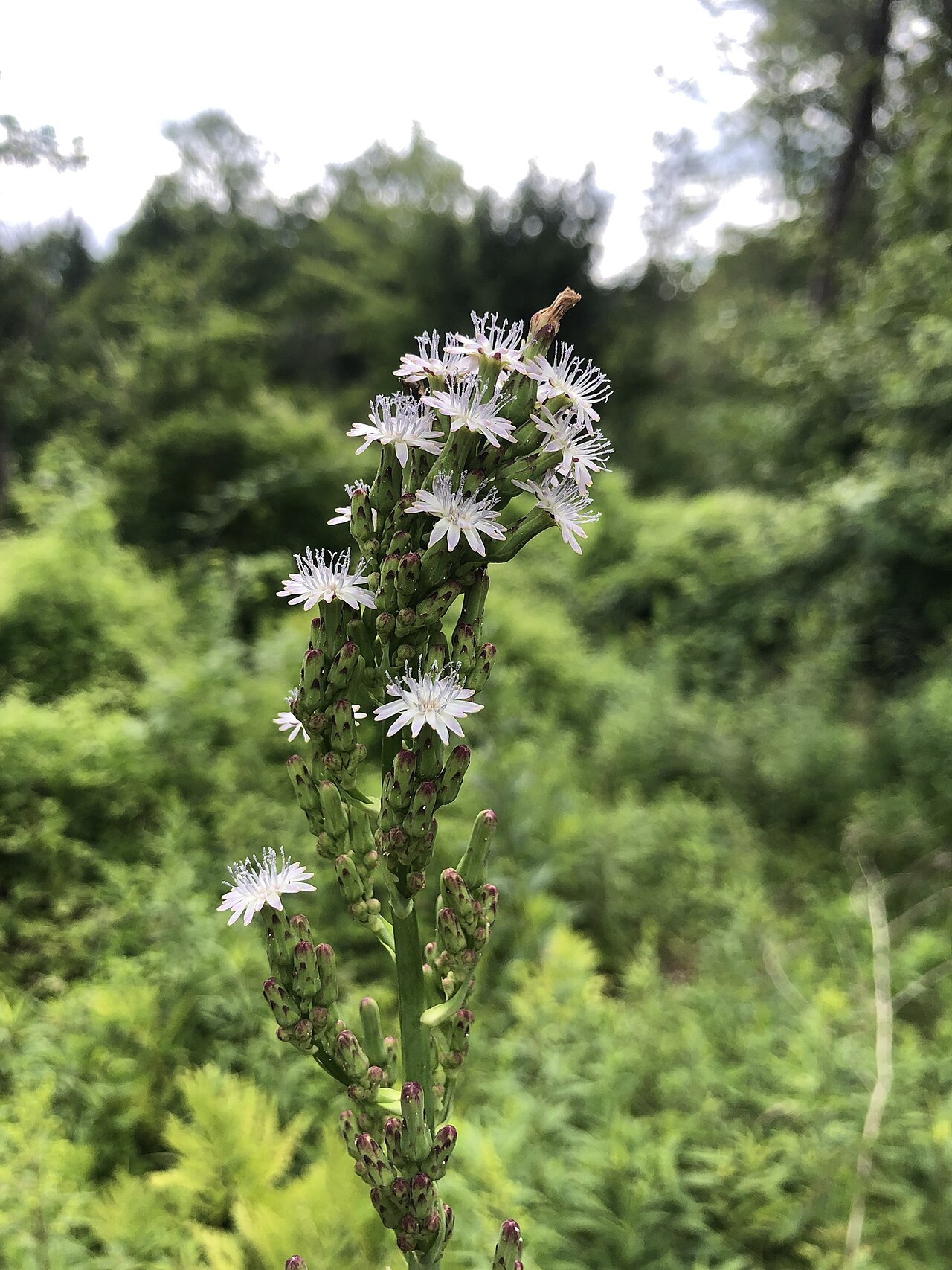
Lactuca biennis, commonly called Tall Blue Lettuce (also Blue Wood Lettuce or Woodland Lettuce), is a tall, fast-growing biennial wildflower in the daisy family (Asteraceae) and a true wild relative of garden lettuce. It is one of the most widespread native “weeds” in North America, found from Alaska and the Yukon across nearly all of Canada and the northern and mountainous United States, reaching south into the Appalachians, the northern Rockies, and even scattered sites in Georgia and California.
True to its lettuce heritage, the whole plant oozes a milky white sap (latex) when cut or broken — the same trait that gives the genus Lactuca its name, from the Latin lac, “milk.” The plant itself is unmistakably tall for a biennial wildflower, often topping 6 feet and occasionally reaching well over that in a single growing season, with a dense, leafy stem topped by a branched spray of small, pale flower heads.
Tall Blue Lettuce is a plant of moist, disturbed, and semi-open ground — streambanks, forest edges, thickets, roadsides, and pastures — rather than deep, undisturbed forest. It is not grown as an edible or medicinal herb: its sap is bitter and can irritate skin, and while the broader lettuce genus has a documented history of being dried into a folk sedative preparation, that practice belongs to history and to other Lactuca species, not to a recommended modern use of this plant.
Identification
Tall Blue Lettuce is a biennial (occasionally behaving as an annual), meaning it spends its first year as a low leafy rosette before sending up a tall flowering stalk in its second year and then dying after setting seed. Mature flowering plants typically stand 3 to 8 feet tall, with exceptional individuals reported up to 13 feet in rich, moist soil.
Stems
The stem is stout, hollow, and unbranched for most of its length except near the top, where it divides into the flowering panicle. All parts of the stem exude a milky white sap when broken or cut.
Leaves
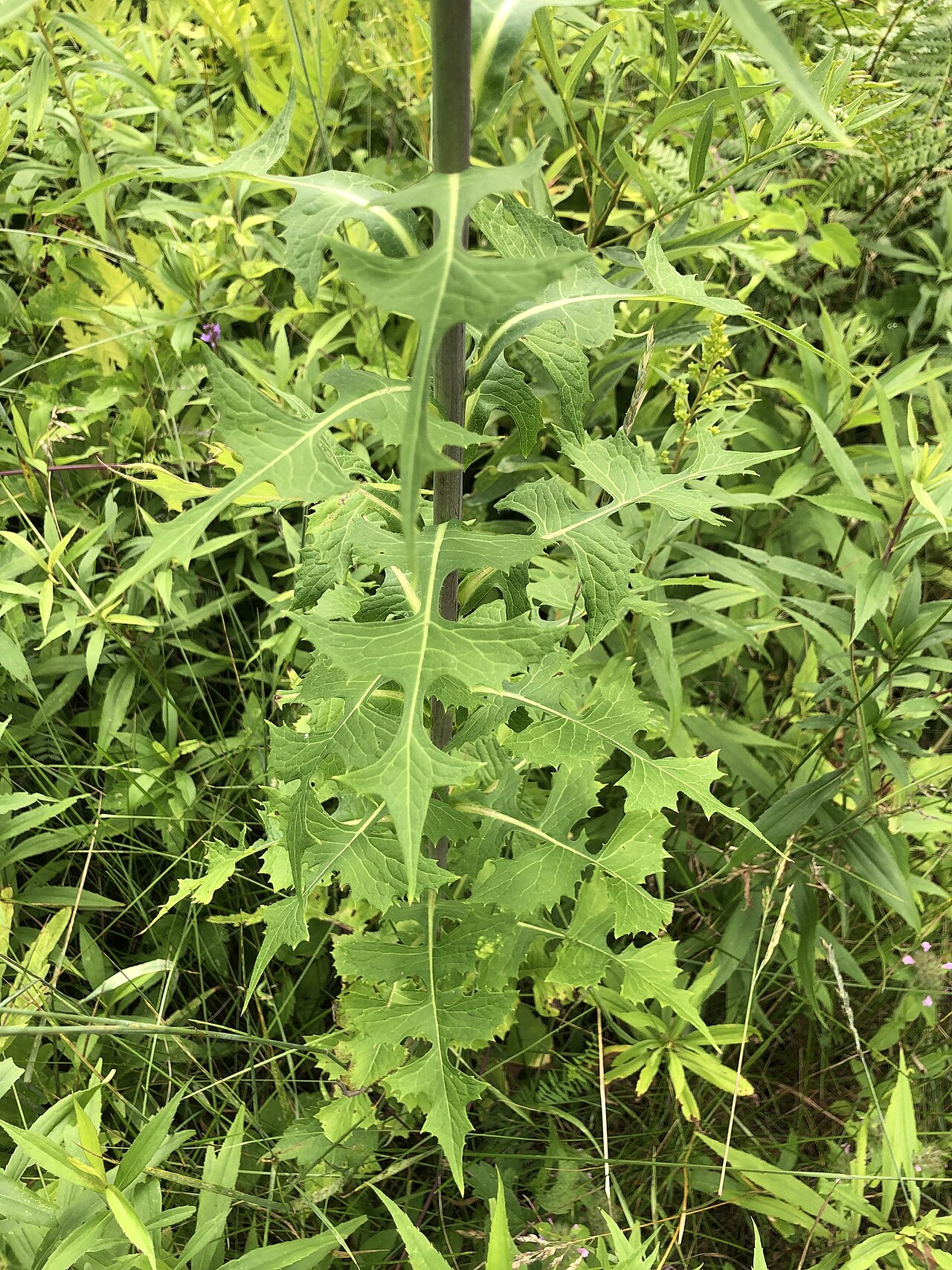
Leaves are large, alternate, and deeply lobed with coarsely toothed margins, somewhat resembling an oversized, ragged dandelion or lettuce leaf. Lower leaves can be a foot or more long and often clasp the stem at their base; leaves become progressively smaller and less lobed higher up the plant.
Flowers
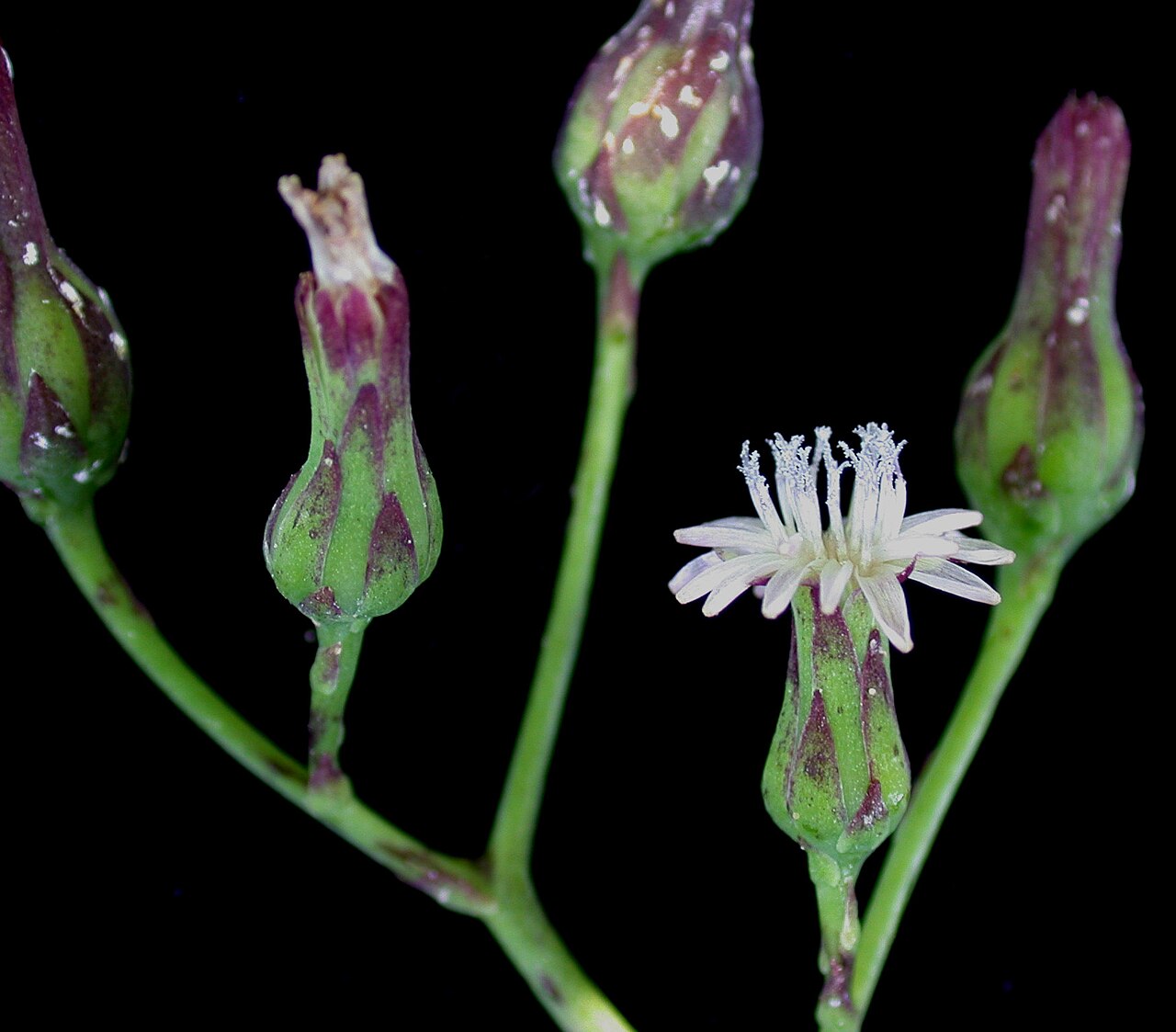
From roughly July through October, the top of the stem opens into a large, multi-branched inflorescence carrying dozens to hundreds of small flower heads, each only about ⅓ to ½ inch across. Every head is made up entirely of ray florets in pale blue, lavender, or near-white — there are no central disc florets, a trait typical of the dandelion tribe within the aster family.
Fruit & Seeds
Each flower head matures into a cluster of small, flattened, mottled achenes, each tipped with a tuft of brownish pappus bristles that carry the seed on the wind, much like a dandelion seed head on a smaller scale.
Quick Facts
| Scientific Name | Lactuca biennis |
| Family | Asteraceae (Aster/Sunflower) |
| Plant Type | Biennial (occasionally annual) Forb/Herb |
| Mature Height | 3–8 ft (1–2.5 m), exceptionally to 13 ft |
| Mature Spread | 1–2 ft |
| Growth Rate | Fast |
| Sun Exposure | Full Sun to Part Shade |
| Water Needs | Moderate to High |
| Soil Type | Moist, rich loam; tolerates disturbed soils |
| Soil pH | Neutral |
| Bloom Time | July – October |
| Flower Color | Pale blue to whitish |
| Fall Color | No notable fall foliage color |
| Fruit | Mottled achene with brownish pappus |
| Deer Resistant | No |
| USDA Hardiness Zones | 2–8 |
Native Range
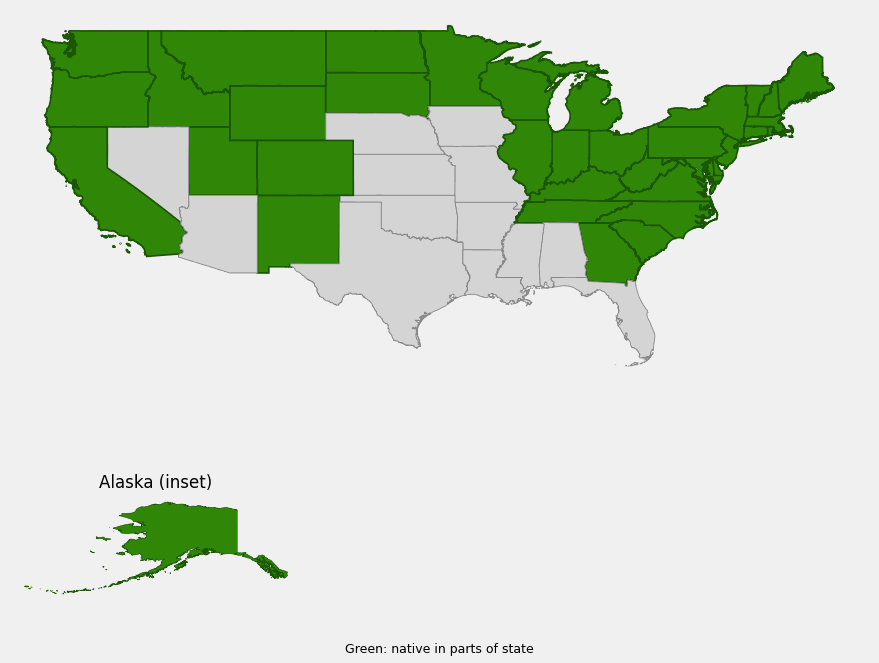
Tall Blue Lettuce has one of the broadest native ranges of any North American wildflower, stretching from Alaska and the Yukon across most of Canada and through the northern and mountainous United States. In the West it runs down the Pacific Northwest interior, the Rockies, and the Intermountain region into Utah, Colorado, New Mexico, and California; across the Midwest and Northeast it covers the Great Lakes states and nearly all of New England and the mid-Atlantic; in the East it follows the Appalachian corridor south through Kentucky, Tennessee, and into the mountains of North Carolina, South Carolina, and Georgia.
It is notably absent from most of the central and southern Great Plains and the Gulf Coast: Oklahoma, Texas, Kansas, Nebraska, Iowa, Missouri, Arkansas, Louisiana, Mississippi, Alabama, and Florida fall outside its native range, as do Arizona and Nevada. Gardeners in those regions should not expect to find it growing wild, and it should not be planted there as a “native” species.
Within its range, Tall Blue Lettuce favors moist, semi-open, and often disturbed ground: stream and river banks, forest edges and openings, thickets, wet meadows, pastures, and roadsides. It behaves as an early-successional pioneer, quick to colonize gaps and disturbed moist soil and just as quick to be shaded out again as surrounding vegetation matures — a natural life history for a short-lived biennial.
📋 Regional plant lists featuring Tall Blue Lettuce: Alaska, Idaho, Eastern Oregon & Eastern Washington, Montana & Wyoming, Utah & Western Colorado, Arizona & New Mexico (New Mexico portion), North Dakota, South Dakota & Western Minnesota, Michigan, Wisconsin & Eastern Minnesota, Illinois, Iowa & Missouri (Illinois portion), Ohio & Indiana, Kentucky & Tennessee, New York, Pennsylvania & Northern New Jersey, New Hampshire, Maine & Vermont, Connecticut, Massachusetts & Rhode Island, Maryland, Virginia & West Virginia, North Carolina & South Carolina, and Georgia, Alabama & Mississippi (Georgia mountains only). It also reaches Delaware, southern New Jersey, and Long Island, New York, covered by the Delaware, Southern New Jersey & Long Island, New York list, though that list has no matching herbaceous-perennial table.
Growing & Care Guide
Tall Blue Lettuce is not a typical garden perennial — it is a vigorous, short-lived biennial best suited to naturalistic plantings, rain gardens, and restoration sites rather than formal flower beds, where its size and self-seeding habit can quickly overwhelm neighbors.
Light
It grows well in full sun to part shade, with the strongest, most compact flowering stalks typically produced in sites with at least a half-day of direct sun. In deeper shade it stretches taller and thinner, chasing available light.
Soil & Water
This species wants consistently moist, fertile soil and performs best along streambanks, in low wet spots, or in rain gardens that stay damp through the growing season. It does not tolerate prolonged drought well and will decline quickly in dry, sandy soils.
Planting Tips
Tall Blue Lettuce is almost always grown from seed sown in fall or early spring, since first-year plants need to establish a rosette before the second-year bolt to flower. Give it room — a mature flowering stalk can reach 6 to 8 feet — and expect it to self-seed readily in favorable, moist soil, so plan for some volunteer seedlings each year if you want it to persist as a patch.
Pruning & Maintenance
Little maintenance is needed beyond removing spent flowering stalks after seed-set if self-seeding is not wanted, or leaving them standing through winter as a seed source for birds. Because plants die after flowering, a self-sustaining patch depends on letting at least some seed mature and disperse each year.
Landscape Uses
Tall Blue Lettuce earns its place in a handful of specific settings rather than as a general-purpose ornamental:
- Rain gardens and streambank plantings in consistently moist soil
- Naturalistic meadow and woodland-edge restorations
- Wildlife and pollinator gardens valued for its late-season seed crop
- Erosion control on moist, disturbed slopes and stream corridors
It is not recommended for small, tidy garden beds, where its height and self-seeding habit can make it feel weedy; it reads best in looser, naturalistic plantings with room to spread.
Wildlife & Ecological Value
Despite its weedy reputation, Tall Blue Lettuce offers real value to wildlife across the many habitats it occupies, from boreal Alaska to Appalachian forest edges.
For Pollinators
The many small flower heads, produced over a long summer-to-fall bloom period, provide nectar and pollen for a range of small native bees, flies, and other insects, particularly valuable in disturbed and edge habitats where floral resources can otherwise be limited.
For Birds
Once the flower heads mature into fluffy seed heads in fall, the small mottled seeds attract seed-eating songbirds, including goldfinches and sparrows, which forage on the abundant, wind-dispersed achenes well into winter where stalks are left standing.
For Mammals
White-tailed deer and other browsers will eat the foliage of young plants, and the lush, leafy growth of first-year rosettes can be a minor forage source in moist meadow and streambank habitats where the species grows in quantity.
Ecosystem Role
As a fast-growing, early-successional pioneer, Tall Blue Lettuce is quick to colonize disturbed, moist ground — stream edges after flooding, forest gaps after treefall, recently cleared or grazed land — helping stabilize bare soil and provide interim cover and forage until longer-lived perennials and shrubs reestablish.
Cultural & Historical Uses
Tall Blue Lettuce does not have a significant documented history of use as food by Indigenous peoples or settlers, unlike some other wild greens of similar habitats; its bitter, latex-rich sap makes it unappealing and potentially irritating raw, and it has not been a staple wild vegetable in the way that many other native plants were.
The broader genus Lactuca, however, carries a well-known historical footnote: several wild lettuce species, most notably the European Lactuca virosa, were dried for their milky latex sap to produce a folk preparation called “lactucarium,” sometimes nicknamed “lettuce opium” for its mild sedative reputation in 19th-century herbal medicine. This practice was centered on other species, not specifically on Lactuca biennis, and its effectiveness was never rigorously established by modern standards. It is a piece of herbal history rather than a verified or recommended use, and the sap of Tall Blue Lettuce can irritate skin, so the plant should not be treated as food or medicine today.
In the present day, Tall Blue Lettuce is mainly of interest to native plant gardeners, pollinator-garden designers, and ecological restorationists who value it as a fast, reliable colonizer of moist disturbed ground across a huge swath of the continent.
Frequently Asked Questions
Can you eat Tall Blue Lettuce?
It is not recommended. While it is a wild relative of garden lettuce, its milky sap is bitter and can irritate the skin, and it has no real history as a food plant. It should not be treated as an edible or medicinal herb.
Is the “lettuce opium” story true for this species?
The historical practice of drying wild lettuce sap into “lactucarium” for its mild sedative folklore mainly involved other Lactuca species, especially Lactuca virosa, not Lactuca biennis specifically, and the practice is a historical curiosity rather than a verified or recommended modern use.
How tall does Tall Blue Lettuce get?
Mature flowering plants typically reach 3 to 8 feet, with exceptional individuals in very rich, moist soil reported up to about 13 feet in a single growing season.
Is Tall Blue Lettuce native to my state?
It has an extremely broad range across Alaska, most of Canada, and the northern, Appalachian, and Rocky Mountain United States, but it is not native to the central and southern Great Plains, the Gulf Coast states, Arizona, or Nevada — check your specific state before assuming it belongs in a local native planting.
Does Tall Blue Lettuce spread aggressively?
As a biennial, individual plants die after flowering and setting seed, but it self-seeds readily in moist, open soil and can form persistent patches over time. It is best planted in naturalistic areas with room to spread rather than tidy formal beds.

Looking for a nursery that carries Tall Blue Lettuce?
Browse our native plant nursery directory: Alaska · Washington · Oregon · Idaho, Illinois & Indiana · Montana, Minnesota, Michigan, Massachusetts, Maine, Maryland & Kentucky · Wyoming, Wisconsin & West Virginia · Colorado, Connecticut, Delaware & Georgia · Utah, South Dakota, Pennsylvania, Rhode Island, Vermont, Virginia, South Carolina & Tennessee · New Mexico, North Dakota, Ohio, New York, New Jersey, New Hampshire & North Carolina · California