
Indian Pipe (Monotropa uniflora)
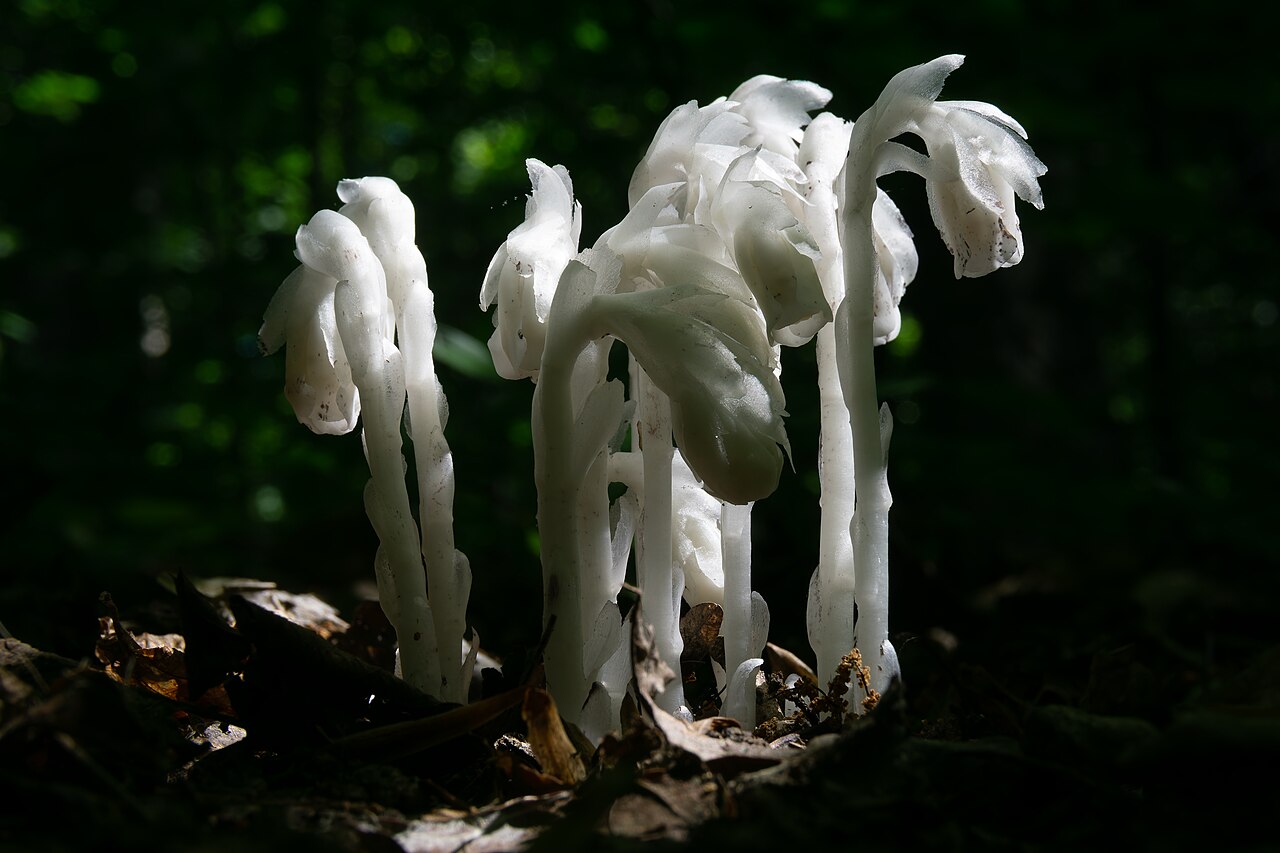
Monotropa uniflora, known as Indian Pipe or Ghost Pipe, is one of the strangest native wildflowers in North American forests — and one of the most important to understand correctly before trying to grow or forage it. Entirely white, waxy, and leafless, it looks more like a cluster of tiny clay pipes pushed up out of the leaf litter than a flowering plant, and that eerie appearance is exactly how it earned its common names.
What makes Indian pipe truly remarkable is not just its ghostly color but how it lives. It contains no chlorophyll and cannot photosynthesize at all. Instead, it is a mycoheterotroph: its roots tap into mycorrhizal fungi that are themselves connected to the roots of nearby trees, drawing sugars that the trees produced through photosynthesis and passed to the fungus. In effect, Indian pipe is a parasite on a fungal network that is itself feeding off living trees — a three-way relationship found in only a handful of plant lineages worldwide.
This biology has a direct, practical consequence for gardeners: Indian pipe cannot be transplanted or cultivated. Because it depends entirely on an intact, mature mycorrhizal network linking it to specific host trees and fungal species, digging up a plant severs that connection instantly and the plant dies — and it will not survive in a garden bed, a container, or anywhere outside that exact underground web. Admire it where it grows, photograph it, and leave it rooted in place.
Identification
Indian pipe is unmistakable once you know what to look for, and it is one of the few native plants where “all white” is itself the identifying feature.
Stems
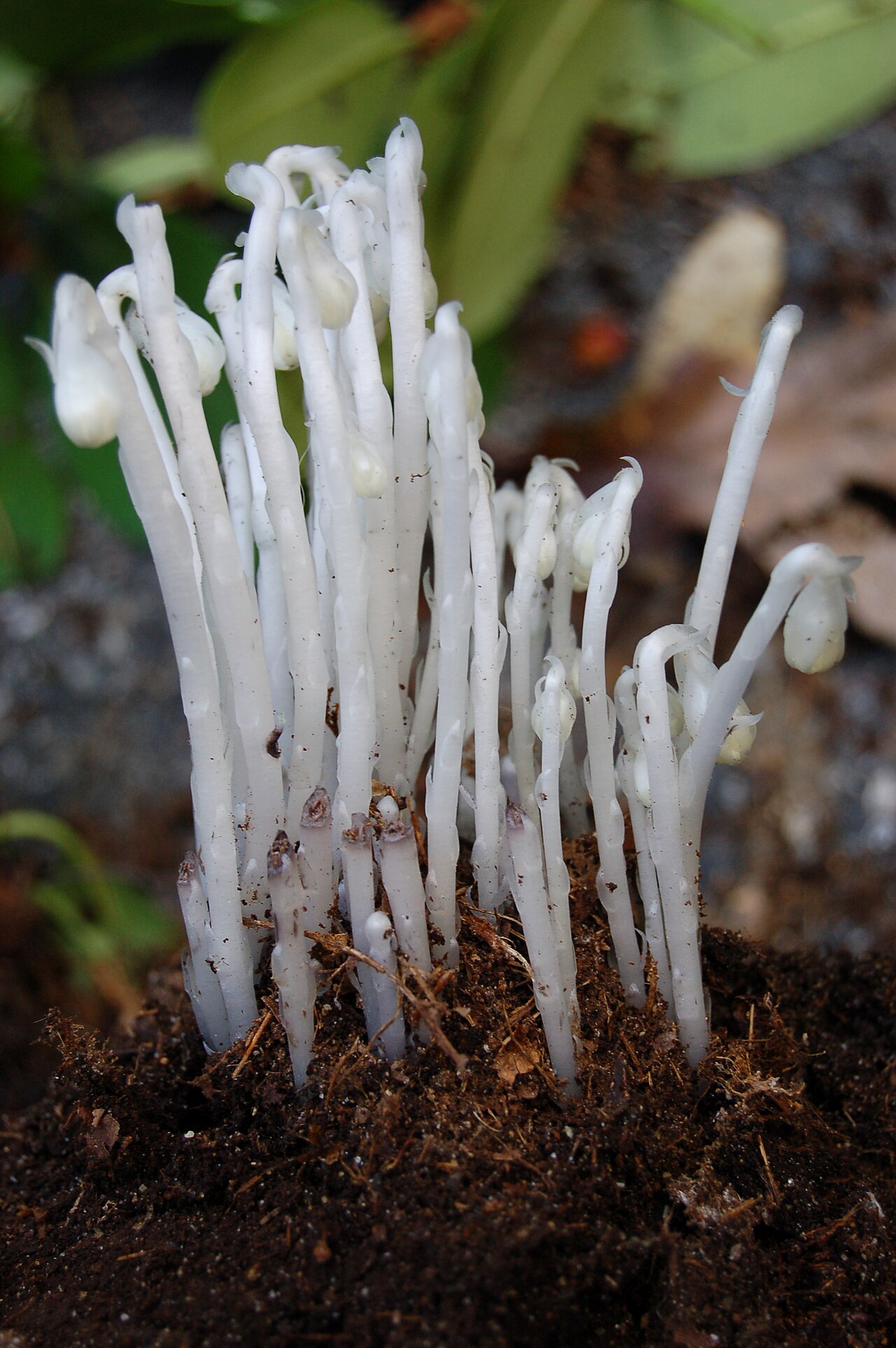
Stems are fleshy, waxy-white to translucent, usually 3 to 10 inches tall, and often tinged pink or black in spots as they age. Several stems typically emerge together in a cluster from a shared mass of brittle roots, each stem unbranched and topped by a single flower.
Leaves
True leaves are absent. In their place, the stem is covered with small, scale-like, translucent white bracts pressed against the stem — a telltale sign that this plant has no need for leaves, since it does not photosynthesize.
Flowers
Each stem bears a single nodding, bell-shaped flower at the tip (the species name uniflora means “one-flowered”), pointed downward like a shepherd’s crook when the plant first emerges. As the flower is pollinated and the seed capsule develops, the entire stem gradually straightens and turns upright. Flowers are waxy white, sometimes with a faint pink blush, and have 4 to 5 petals surrounding a ring of yellow stamens.
Fruit & Seeds
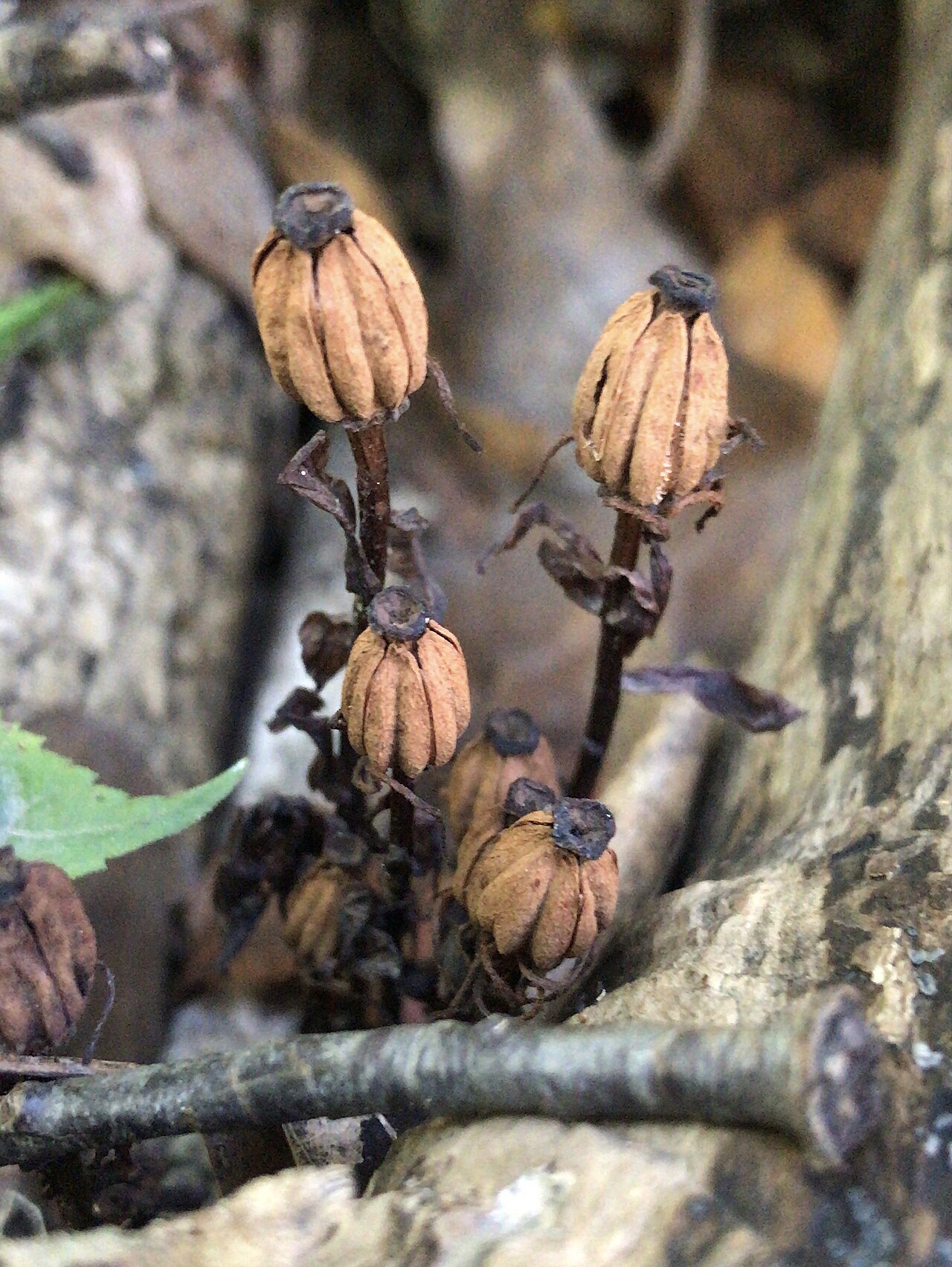
After flowering, the stem becomes upright and the flower develops into a woody, upright seed capsule packed with thousands of dust-fine seeds — so small they have no stored food reserves of their own, which is part of why a germinating seedling must immediately connect to a compatible fungus to survive at all. As the fruit ripens through late summer and fall, the whole plant blackens and dries to a dark brown-black husk that can persist through winter.
Quick Facts
| Scientific Name | Monotropa uniflora |
| Family | Ericaceae (Heath), formerly Monotropaceae |
| Plant Type | Non-photosynthetic, mycoheterotrophic perennial herb |
| Mature Height | 3–10 in |
| Growth Rate | Not applicable — emerges suddenly from an existing fungal connection |
| Sun Exposure | Deep shade (irrelevant to the plant, which does not photosynthesize) |
| Water Needs | Moist, humus-rich forest soil |
| Soil Type | Deep leaf litter and humus over an intact mycorrhizal network |
| Bloom Time | June – September |
| Flower Color | Waxy white, sometimes pink-blushed |
| Fall Color | None — plant blackens as seed capsules mature |
| Fruit | Upright woody capsule with dust-like seeds |
| Deer Resistant | Not applicable — rarely browsed, not a landscape plant |
| USDA Hardiness Zones | 3–8 (wherever its host forest occurs) |
Native Range
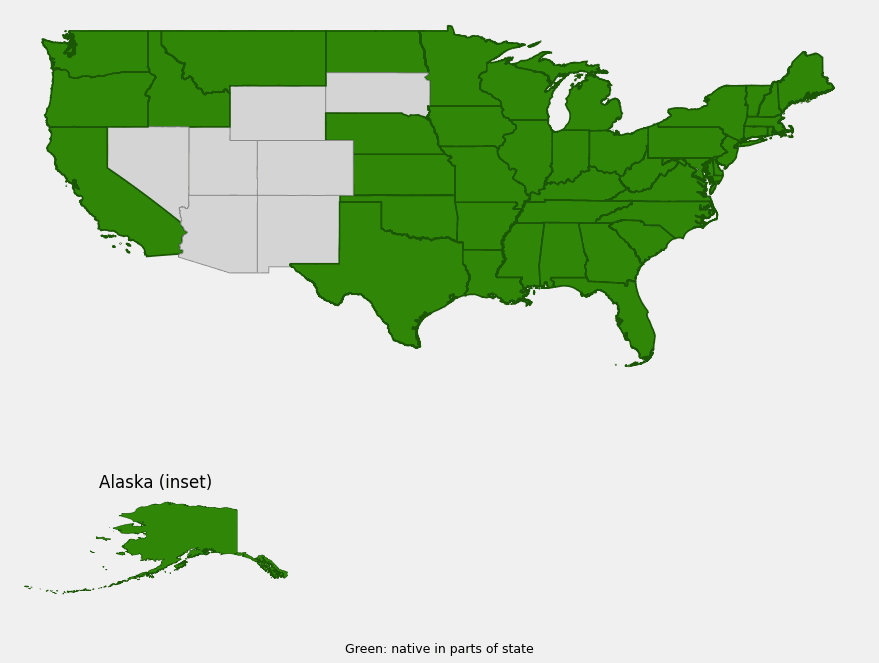
Indian pipe has one of the broadest native ranges of any North American woodland wildflower, occurring across most of the forested United States and Canada: from the Pacific Northwest and northern California east through the northern Rockies, across the upper Midwest and Great Lakes, down through nearly the entire eastern United States to the Gulf Coast and Florida, and north into much of Canada and Alaska. It is conspicuously absent from the arid interior West — Arizona, Nevada, Utah, Colorado, New Mexico, and Wyoming — where the moist, mature forest conditions it depends on simply don’t occur.
Within that enormous range, Indian pipe is tied not to a climate zone but to a very specific below-ground condition: mature forest with an intact mycorrhizal fungal network linking host trees (commonly oaks, beeches, and pines) to the fungi that Indian pipe parasitizes. It is most often found in deeply shaded hardwood and mixed forests with thick leaf litter and undisturbed soil — second-growth woods that have had decades to rebuild a mature fungal web, or old-growth stands where that web was never disrupted.
Because it depends on this hidden infrastructure rather than on sunlight or soil chemistry, Indian pipe can seem to appear and disappear unpredictably from one year to the next in the same patch of woods, flowering heavily after a wet spell and then vanishing for a season or more. Its presence is actually a good sign of forest health — it generally will not persist in recently disturbed, heavily logged, or compacted ground where the fungal network has been broken.
📋 Regional plant lists featuring Indian Pipe: Alaska · Georgia, Alabama & Mississippi · Arkansas, Louisiana, Eastern Oklahoma & Eastern Texas · North Dakota, South Dakota & Western Minnesota · Delaware, Southern New Jersey & Long Island · Illinois, Iowa & Missouri · Idaho, Eastern Oregon & Eastern Washington · Ohio & Indiana · Kentucky & Tennessee · Maryland, Virginia & West Virginia · Michigan, Wisconsin & Eastern Minnesota · Montana & Wyoming · North Carolina & South Carolina · Nebraska, Kansas & Eastern Colorado · New Hampshire, Maine & Vermont · Connecticut, Massachusetts & Rhode Island · New York, Pennsylvania & Northern New Jersey · Western Oregon & Western Washington
Growing & Care Guide
Unlike nearly every other plant profiled on this site, Indian pipe is not a species you can plant, propagate, or landscape with — and it is worth explaining clearly why, so that curiosity about this plant doesn’t lead to disappointment or harm.
Why It Cannot Be Grown
Indian pipe has no chlorophyll and produces none of its own food. Every bit of sugar it uses comes from a living mycorrhizal fungus, which in turn gets that sugar from the roots of a living tree. Nurseries cannot propagate it from seed or division because the dust-like seeds require an exact, compatible fungal partner to germinate at all, and that fungal partner exists only within a mature, undisturbed forest soil web that has had years to develop around specific host trees. There is no commercial source of genuine Indian pipe, and any “Indian pipe” offered for sale is either misidentified or will die shortly after being potted.
Do Not Dig or Transplant
Because the plant’s roots are physically fused to the fungal network feeding it, digging even carefully around a stem severs that connection and kills the plant within hours to days, regardless of how it’s replanted or watered afterward. If you find Indian pipe in your woods or on a hike, the only way to “grow” it is to leave the soil and leaf litter around it undisturbed — admire it in place and let it complete its life cycle where it stands.
Supporting It Indirectly
If Indian pipe already grows on your property, the best thing you can do is protect the conditions that let it persist: avoid tilling, heavy foot traffic, soil compaction, or removing leaf litter in the area, and avoid cutting the mature host trees nearby. Fungicides and heavy fertilizer use can also disrupt the mycorrhizal networks it depends on. Beyond that, there is no planting, watering, or feeding regimen that applies — the plant either has an intact fungal connection or it does not.
Landscape Role
Indian pipe is not a landscaping plant and should never be purchased, transplanted, or encouraged to spread artificially. Its real value in a native-plant landscape is as an indicator: its presence signals an old, undisturbed, fungally rich forest floor, and protecting the broader woodland habitat is the only legitimate way to “cultivate” it.
Wildlife & Ecological Value
Indian pipe’s ecological role is less about feeding wildlife directly and more about what its presence reveals — and supports — underground.
For Pollinators
The nodding, bell-shaped flowers are visited mainly by bumblebees, which are strong and persistent enough to force their way into the tightly closed blossom to reach nectar and pollen, making them the primary pollinator of this species.
For Birds & Mammals
Indian pipe offers little direct food value to birds or mammals; it is neither a significant seed source nor browse. Its ecological importance lies almost entirely below ground, in the fungal networks it taps into, rather than above ground in what it offers foraging wildlife.
Ecosystem Role
Indian pipe is part of a remarkable three-way relationship connecting it to Russulaceae fungi and, through those fungi, to the roots of nearby canopy trees — tapping into the same “wood wide web” that trees use to share resources with each other. Because it can only persist where that underground network is intact and mature, a healthy population of Indian pipe is a strong, visible signal of old, undisturbed forest soil. Its presence (or disappearance after logging, grading, or heavy trail use) is a useful, low-cost indicator of forest-floor health that ecologists and naturalists watch for.
Cultural & Historical Uses
Indian pipe’s strange, corpse-pale appearance made a deep impression on Indigenous peoples and early botanists alike, and it carries a long list of evocative common names across its range, including ghost pipe, corpse plant, and ice plant. Several Indigenous traditions are recorded as using preparations of the plant topically or for specific ceremonial and traditional purposes, and 19th-century American herbalists sometimes included dried Indian pipe root in folk remedies of the period.
Those historical uses are a matter of record, but they are not a basis for use today. Because the plant cannot be commercially cultivated, any dried “Indian pipe” sold currently is typically misidentified material, and because the species is entirely dependent on an intact forest fungal network to survive, wild-harvesting it for any purpose — food, remedy, or otherwise — kills the individual plant and can damage the fungal connections nearby plants rely on as well. This page does not describe Indian pipe as edible or medicinal; its documented historical uses are presented here as history, not as guidance for present-day use.
Beyond its ethnobotanical record, Indian pipe has long fascinated naturalists and nature writers for the way it upends the usual assumptions about what a “plant” has to look like and do, and it remains a favorite discovery for hikers who stumble across its pale, waxy clusters rising from the forest floor.
Frequently Asked Questions
Can I dig up Indian pipe and plant it in my garden?
No. Indian pipe is entirely dependent on a living connection to mycorrhizal fungi and the tree roots those fungi feed from. Digging it up severs that connection immediately, and the plant will die within days no matter how it is replanted or cared for afterward. It should always be left growing where it is found.
Is Indian pipe a fungus or a mushroom?
No — it is a true flowering plant in the heath family (Ericaceae), closely related to blueberries and rhododendrons, despite looking and behaving like a fungus. Its white, leafless appearance comes from having lost the ability to photosynthesize, not from being a fungus itself.
Why is Indian pipe white instead of green?
It contains no chlorophyll because it does not photosynthesize at all. Instead of making its own food from sunlight, it draws sugars indirectly from nearby trees through a shared mycorrhizal fungus, so it has no biological need for green, light-capturing leaves.
Is it true that Indian pipe turns black?
Yes. As the flower is pollinated and the seed capsule matures through summer into fall, the whole plant gradually turns black and dries out, a natural part of its life cycle rather than a sign of disease or damage.
Can Indian pipe be eaten or used medicinally?
This page does not recommend eating or using Indian pipe for any medicinal purpose. Historical accounts describe traditional uses, but the plant cannot be safely or sustainably harvested today — removing it kills the individual plant and risks damaging the shared fungal network nearby plants depend on, and there is no reliable modern safety information to support present-day use.

Looking for a nursery that carries native woodland wildflowers?
Indian pipe itself is never sold or planted — it cannot survive outside an intact forest fungal network. For other shade-loving natives to grow instead, browse our nursery directory: Oregon · Kentucky, Missouri & Montana · New York, Ohio & North Carolina