Bay Forget-me-not (Myosotis laxa)
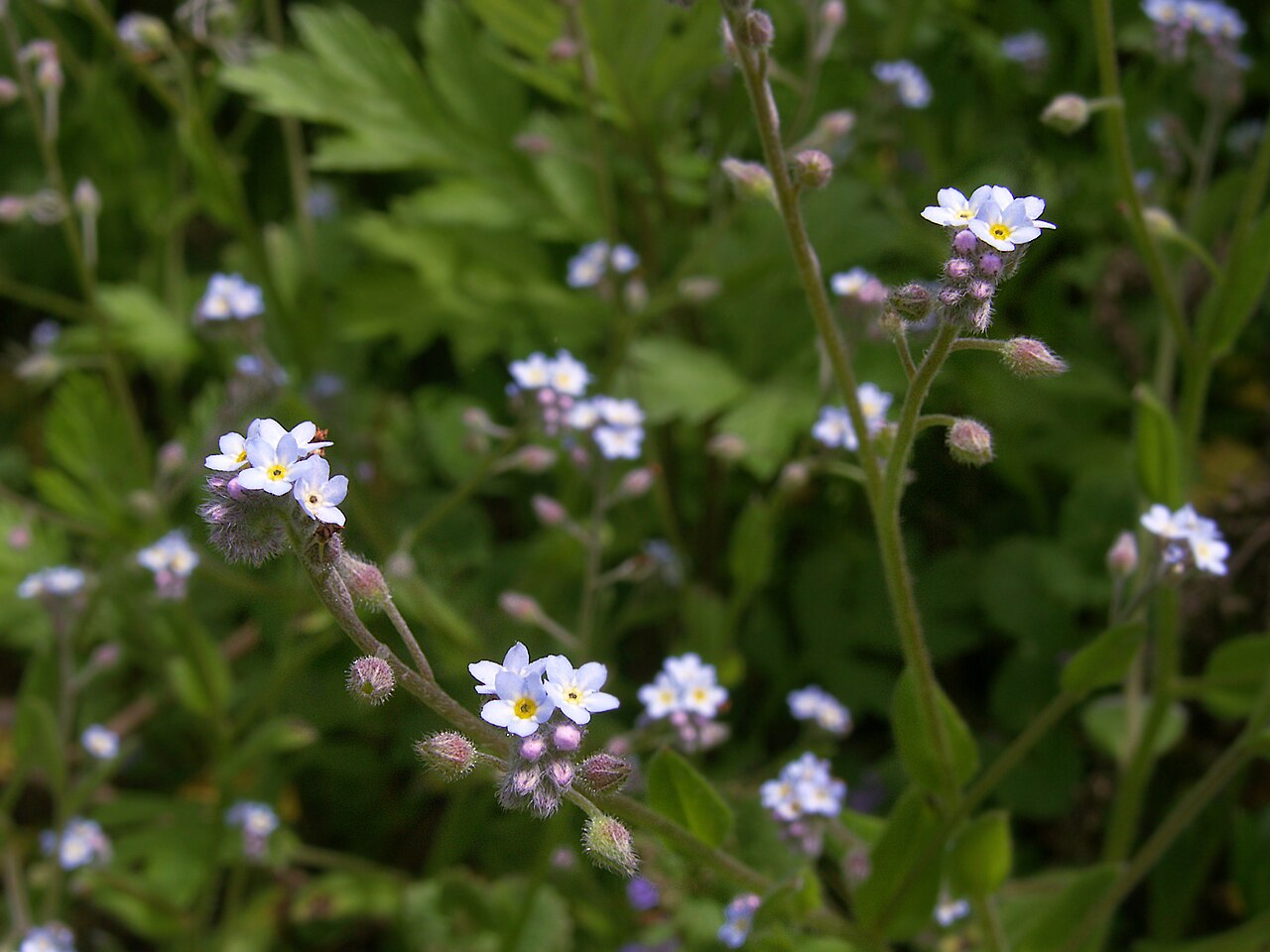
Myosotis laxa, commonly called Bay Forget-me-not (also known as Smaller Forget-me-not or Tufted Forget-me-not), is a small, true native wildflower of wet ground in two very different parts of the country: the cool stream banks and bogs of the Northeast and Upper Midwest, and the seeps and pond margins of the Pacific Northwest and northern California. Unlike the familiar garden forget-me-nots sold at nurseries, Bay Forget-me-not is a genuine North American native, a member of the borage family (Boraginaceae) that has grown along our waterways since long before European settlement.
It is an unassuming plant — thin, weak, often sprawling stems only 4 to 16 inches tall, topped with tiny five-petaled blue flowers barely a quarter-inch across. What it lacks in size it makes up for in persistence, spreading into loose, carpeting colonies wherever soil stays consistently wet: stream banks, pond edges, sedge meadows, floodplain forests, and seepy spots at the base of slopes. It blooms over a long stretch, typically from May into September, offering a small but steady splash of blue through much of the growing season.
Gardeners searching for “forget-me-not” online most often land on the European garden species — Wood Forget-me-not (Myosotis sylvatica) and True Forget-me-not (Myosotis scorpioides) — both of which are widely sold, have escaped cultivation across much of North America, and are considered invasive in wetlands in some states. Bay Forget-me-not offers native gardeners and restoration planters a true regional alternative: a similar look and bloom, but a plant that belongs in the local ecosystem rather than one that can crowd out native sedges and rushes in wet meadows.
Identification
Bay Forget-me-not is easy to overlook until it blooms, and even then it rewards a close look rather than a glance from a distance. Learning its few diagnostic features also helps separate it from the European garden escapees it is often confused with.
Stems
Stems are slender, round to slightly angled in cross-section, and arise in multiple weak, often sprawling or ascending clusters from the base of the plant — they do not root where they touch the ground, unlike the stoloniferous stems of True Forget-me-not. The stems and flower stalks carry sparse to moderate short, straight, appressed (flattened against the surface) hairs, never the hooked or spreading hairs found on some related species.
Leaves
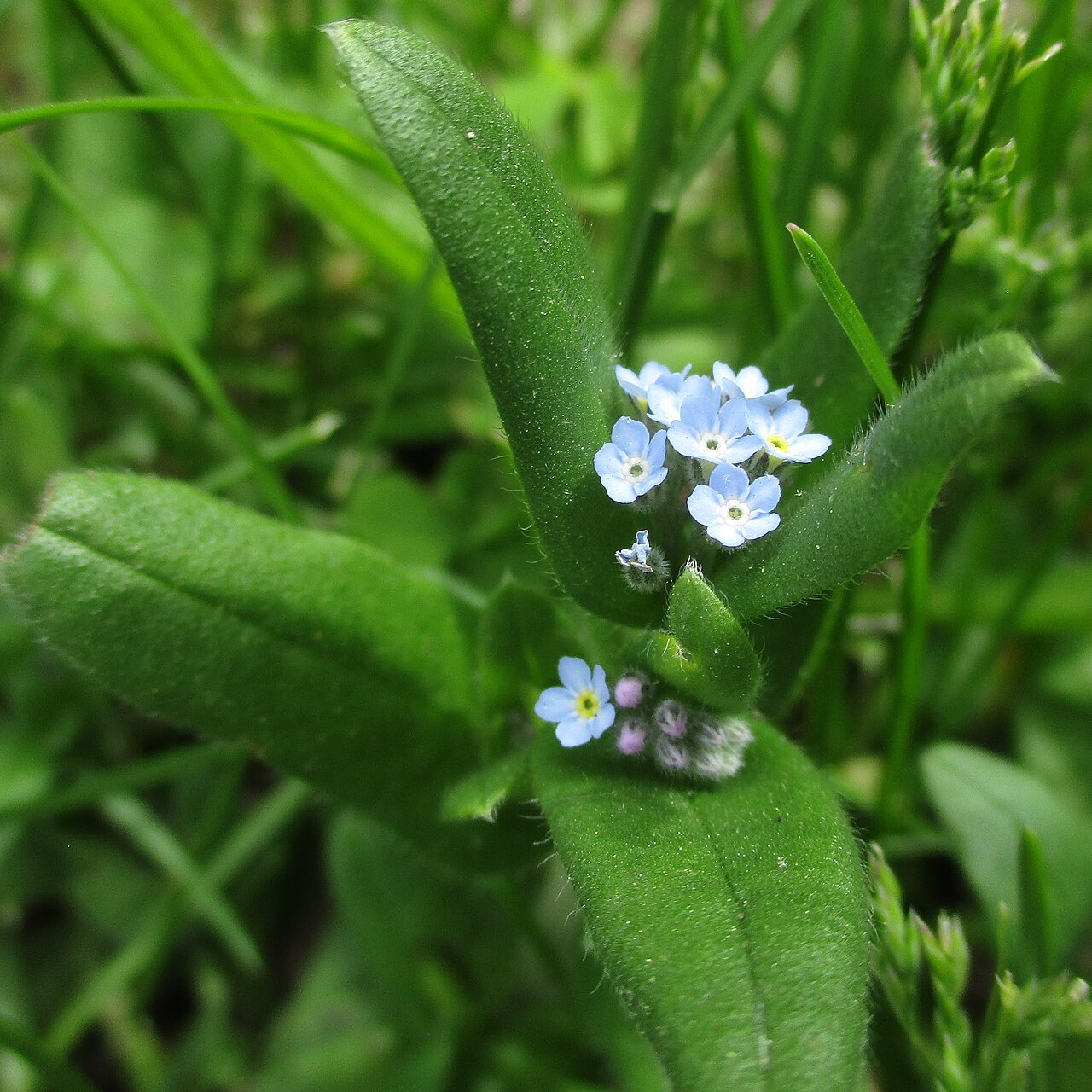
Leaves are simple, alternate, and stalkless or nearly so along most of the stem. Lower leaves are broadest above the middle and short-stalked, 1 to 2½ inches long and ¼ to ⅔ inch wide; upper leaves become smaller and more lance-shaped as they ascend the stem. Leaf edges are smooth (entire), without teeth, and both surfaces carry sparse appressed hairs that give the foliage a slightly fuzzy, grayish-green cast.
Flowers
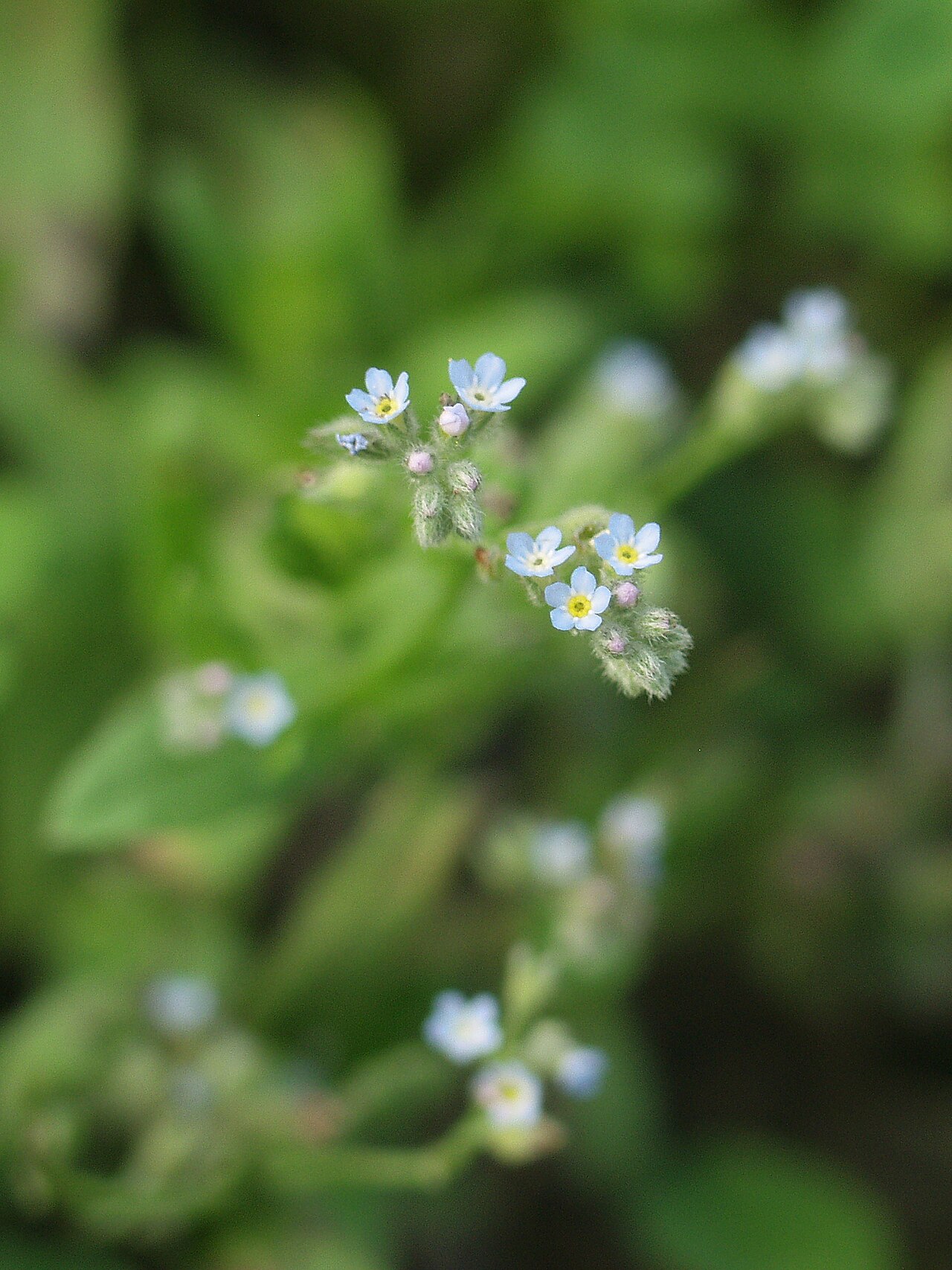
The flowers are the plant’s calling card: tiny, bright to pale blue, tubular blooms about ⅛ to ¼ inch across with five spreading, rounded petal lobes and a small yellow “eye” at the throat. They open in succession along a coiled, uncurling cluster (a scorpioid cyme) at the branch tips, so a single stem may show open flowers, swelling buds, and spent blooms all at once. The narrow calyx behind each flower is covered in short, straight, appressed hairs — not the hooked hairs of Wood Forget-me-not or the wider, flatter corolla of True Forget-me-not — which is the most reliable field mark for telling Bay Forget-me-not apart from its garden relatives.
Fruit & Seeds
After pollination, each flower produces four small, shiny, black nutlets (technically a schizocarp that splits into four one-seeded sections) cupped inside the persistent, hairy calyx. The nutlets are taller than the flower’s style, another detail that separates this species from True Forget-me-not. Seeds ripen through summer and scatter close to the parent plant, helping the species form the loose colonies typical of streamside seeps.
Quick Facts
| Scientific Name | Myosotis laxa |
| Family | Boraginaceae (Borage) |
| Plant Type | Annual, biennial, or short-lived perennial wildflower |
| Mature Height | 4–16 in (10–40 cm) |
| Mature Spread | 8–14 in, spreading into loose colonies by self-seeding |
| Growth Rate | Fast (reseeds readily in wet soil) |
| Sun Exposure | Full Sun to Part Shade |
| Water Needs | Wet to consistently moist; poor drought tolerance |
| Soil Type | Saturated to moist muck, sand, or loam |
| Soil pH | 5.5–7.0 (slightly acidic to neutral) |
| Bloom Time | May – September |
| Flower Color | Bright to pale blue with a yellow eye |
| Fall Color | None notable; foliage dies back |
| Fruit | Tiny black nutlets, not showy |
| Deer Resistant | Mostly yes (low palatability) |
| USDA Hardiness Zones | 3–8 |
Native Range
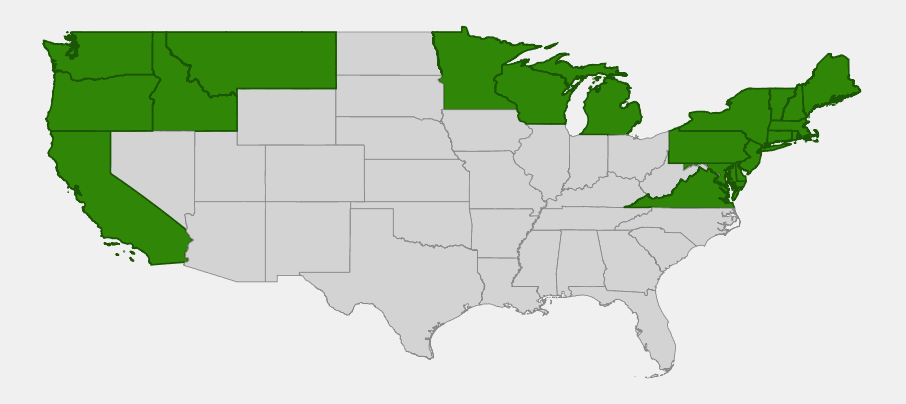
Bay Forget-me-not has a disjunct native range, meaning it occurs as two separate native regions rather than one continuous band. In the East, it is native from Maine, New Hampshire, and Vermont south through Massachusetts, Connecticut, and Rhode Island, and through New York, Pennsylvania, New Jersey, Delaware, Maryland, and Virginia, with another native pocket around the Great Lakes in Michigan, Wisconsin, and eastern Minnesota. In the West, it is native along the Pacific Coast and northern Rockies, from Washington and western Oregon east through the Idaho panhandle and into western Montana, and south along the coast into northern California.
Within that range it is confined to wetland habitats: the USDA wetland indicator rating for Bay Forget-me-not is Obligate (OBL) in every region it is assessed, meaning it is found almost exclusively in wetlands — stream banks and channels, pond and lake shores, seepage areas, sedge meadows, swamps, and floodplain forest. It tolerates everything from full sun along open shorelines to the part shade of a streamside alder thicket, but it does not persist in average garden soil that dries out between rains.
Despite the frequent confusion with garden forget-me-nots, Bay Forget-me-not is not native to, and is generally absent from, the Great Plains, the Rocky Mountain states outside this range (including Wyoming), the Southwest, and most of the Southeast — gardeners in those regions should not assume local native status for any Myosotis species and should check their state’s native plant resources before planting.
📋 Regional plant lists featuring Bay Forget-me-not: New Hampshire, Maine & Vermont · Connecticut, Massachusetts & Rhode Island · New York, Pennsylvania & Northern New Jersey · Delaware, Southern New Jersey & Long Island · Maryland, Virginia & West Virginia · Michigan, Wisconsin & Eastern Minnesota · Idaho, Eastern Oregon & Eastern Washington · Western Oregon & Western Washington · Montana & Wyoming · California & Nevada
Growing & Care Guide
Bay Forget-me-not is a plant for the wet corner of the garden that most other flowers struggle in — the downspout outlet, the rain garden low point, the edge of a pond, or the damp shade under a streamside tree. Give it the moisture it needs and it largely takes care of itself.
Light
Plants grow well anywhere from full sun to part shade. In cooler, consistently wet sites it tolerates more sun; in warmer regions or drier microclimates within a wet garden, afternoon shade helps keep foliage from wilting on hot days and extends the bloom season.
Soil & Water
This is a true wetland obligate — it needs saturated to consistently moist soil and will not persist where the ground dries out for extended periods in summer. It grows in muck, sand, or loam as long as moisture is reliable, and tolerates occasional standing water at the pond or stream edge. It has essentially no drought tolerance, so it is not a candidate for a typical dry perennial border.
Planting Tips
Set out nursery plants or sow seed in spring directly at the water’s edge, in a rain garden basin, or along a stream bank where soil stays wet. Space plants about 8 to 12 inches apart; they will fill in and self-sow into gaps within a season or two in favorable conditions. Because the seed needs consistently damp soil to germinate, mulch lightly and keep new plantings watered through their first summer.
Propagation
Bay Forget-me-not is easiest to propagate from seed collected after the nutlets ripen and darken in mid to late summer; sow immediately or cold-stratify over winter for spring germination. Established clumps can also be divided in early spring. Expect volunteer seedlings to appear nearby each year once a colony is established — this is normal and part of how the species maintains itself in the wild.
Landscape Uses
- Rain gardens and bioswales where soil cycles between saturated and moist
- Pond and stream margins as a low, spreading groundcover
- Native wet meadow and sedge meadow restorations
- Shaded wetland edges beneath alders, willows, or red maple
- Naturalized plantings where a native, well-behaved alternative to garden forget-me-nots is wanted
Gardeners comparing it to the plants typically covered in general forget-me-not seed-growing guides and forget-me-not seedling care guides should note that most of that mainstream advice is written for the European garden species, not for Bay Forget-me-not; those plants tolerate average garden soil, while Bay Forget-me-not strictly needs wet ground. Gardeners in the Rockies and points west looking for a native forget-me-not for drier, rocky, higher-elevation sites should instead consider Alpine Forget-me-not (Myosotis asiatica), a native alpine species adapted to very different growing conditions.
Wildlife & Ecological Value
As a small, early- and long-blooming wetland wildflower, Bay Forget-me-not plays a modest but genuine supporting role in the wet habitats where it grows, alongside larger and showier wetland natives.
For Pollinators
The small tubular flowers are visited by short-tongued native bees, hoverflies, and other small flies and beetles that work the exposed yellow throat. Because bloom continues over many weeks from late spring through summer, it offers a low but steady nectar and pollen source in wetland habitats, complementing larger-flowered neighbors like Cardinal Flower and Marsh Marigold that bloom in shorter, showier bursts. In the Pacific Northwest, it often shares seep habitat with Monkeyflower, another small native that draws similar pollinators.
For Birds
The tiny nutlets are eaten incidentally by small seed-eating songbirds foraging low in wet meadow and streamside vegetation, though the plant is not a primary food source for any species. Its greater value to birds is structural: dense colonies add low ground cover near water that shelters insects, which in turn feed insectivorous birds working the wetland edge.
Mammals
Bay Forget-me-not is browsed lightly, if at all, by deer and other herbivores, making it a reasonably deer-resistant option for wet garden areas. Historically, the Makah people of the Olympic Peninsula rubbed the plant into their hair, using it much as a hair dressing — one of the few documented traditional uses of this otherwise unassuming species.
Ecosystem Role
In streamside and pond-margin plant communities, Bay Forget-me-not helps hold damp soil in place with its mat of fine roots, filling small gaps between larger sedges such as Tussock Sedge, rushes, and wetland forbs like Jewelweed. In shaded seeps it is sometimes found growing near Skunk Cabbage. Because it thrives in the fluctuating wet-to-saturated conditions typical of seasonal seeps and flood-prone banks, it is one of relatively few native flowering plants able to persist through repeated wetting and drying cycles in these habitats.
Cultural & Historical Uses
Documented traditional use of Bay Forget-me-not is limited, but one record stands out: the Makah people of Washington’s Olympic Peninsula rubbed the plant on their hair, using it in a manner similar to a hair treatment or scent. Beyond this, the species does not appear prominently in the ethnobotanical record compared to showier wetland natives like Cardinal Flower or Skunk Cabbage, likely owing to its small size and modest appearance.
Much of the public familiarity with “forget-me-not” as a name and a flower comes instead from European garden species and the European folklore surrounding them — the well-known legend of a knight who fell into a river while picking the flowers for his lady, calling out “forget me not!” as he was swept away. That story, and the ornamental garden forget-me-nots it is attached to, refers to the Old World species Myosotis sylvatica and Myosotis scorpioides, not to Bay Forget-me-not.
Today, Bay Forget-me-not’s main value is quiet and ecological rather than ornamental or culinary: it is simply part of the native plant palette of healthy wetlands, a plant worth including in restoration seed mixes and rain gardens precisely because it does not carry the invasive baggage of its more famous European cousins.
Frequently Asked Questions
Is Bay Forget-me-not the same as the forget-me-not sold at garden centers?
No. Most forget-me-nots sold as garden plants are Wood Forget-me-not (Myosotis sylvatica) or True Forget-me-not (Myosotis scorpioides), both native to Europe. Bay Forget-me-not (Myosotis laxa) is a separate, North American native species with a similar look but a very different native and garden role.
Are garden forget-me-nots invasive?
Wood Forget-me-not and True Forget-me-not have escaped cultivation across much of North America and are considered invasive in wetlands and moist woodlands in a number of states, where they can crowd out natives including Bay Forget-me-not. Gardeners near wetlands who want a forget-me-not look without that risk should choose the native Bay Forget-me-not instead.
How wet does the soil need to be for Bay Forget-me-not?
Very wet. It is rated an obligate wetland species, meaning it is found almost exclusively in wetlands. It needs consistently moist to saturated soil and has essentially no drought tolerance, so it will not thrive in an average flower bed that dries out between waterings.
Will Bay Forget-me-not spread aggressively in my garden?
It self-seeds readily in consistently wet soil and will form loose colonies over a few seasons, but it is not documented as weedy or aggressive within its native range and stays confined to areas that remain wet — it will not spread into drier parts of a yard.
Does Bay Forget-me-not grow in my state?
It is native to a disjunct set of states in the Northeast, Great Lakes, and Pacific Northwest (see the Native Range section above). It is not native to the Great Plains, most of the Rocky Mountain states, the Southwest, or most of the Southeast, so gardeners outside its native range should choose a locally native wetland wildflower instead.

Looking for a nursery that carries Bay Forget-me-not?
Browse our native plant nursery directory: ME, MD, MA, MI, MN, MT · NH, NY, NJ · VT, RI, PA, VA · CT, DE · WI · ID · WA · OR · CA