
Pumpkin Ash (Fraxinus profunda)
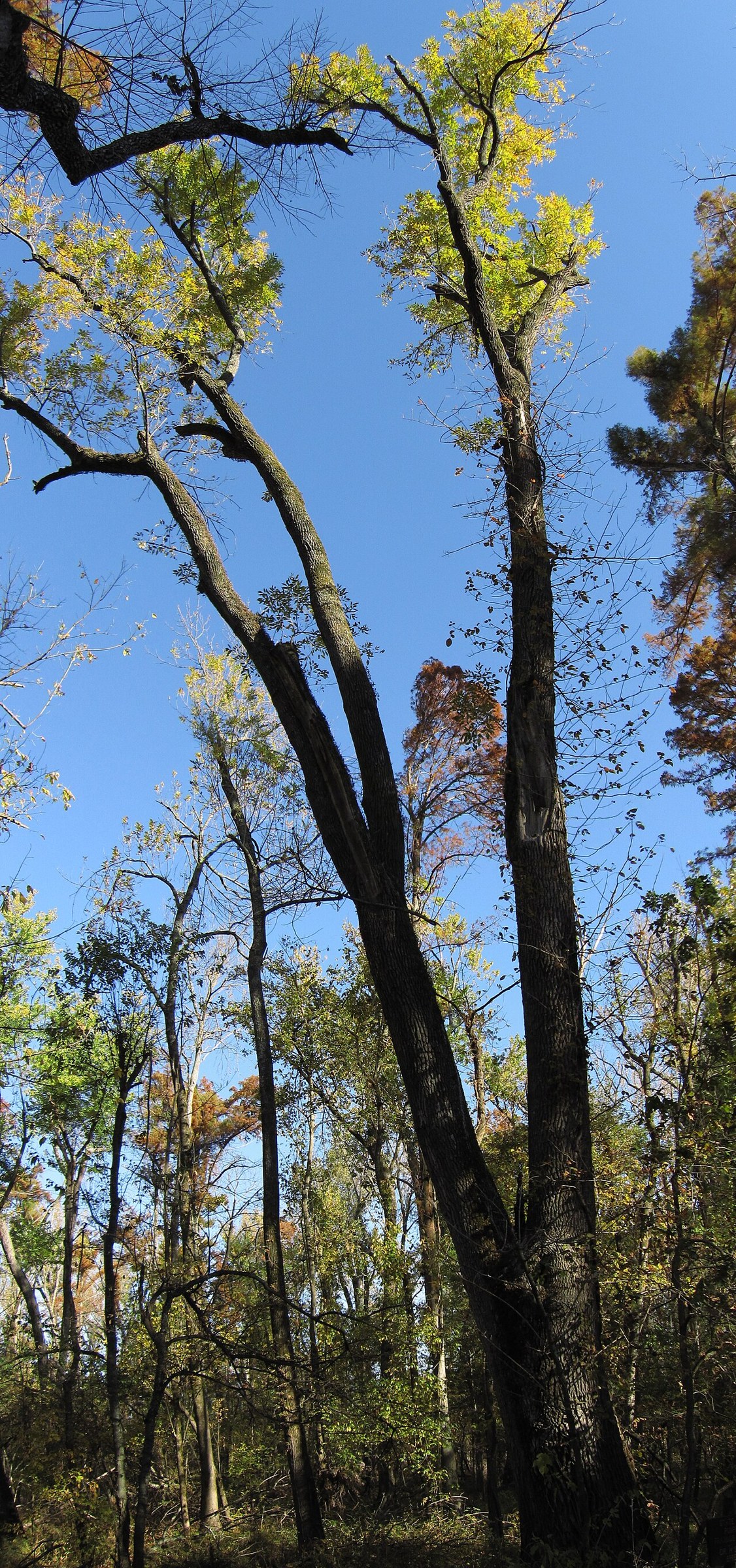
Fraxinus profunda, commonly known as Pumpkin Ash, is the largest of North America’s swamp-dwelling ashes — a towering bottomland tree named for the dramatically swollen, pumpkin-shaped buttress that forms at its base in permanently flooded sites. Reaching 80 to 100 feet or more at maturity, it is an impressive, if increasingly scarce, canopy tree of the eastern floodplain forest.
Pumpkin Ash shares its swamp habitat with Carolina Ash, Water Locust, Bald Cypress, and Water Tupelo, but is easily told apart by its sheer size and, up close, by its large leaflets and densely velvety young twigs and leaf undersides — a soft, hairy texture rare among the ashes. Its scattered, locally uncommon populations stretch from the Great Lakes basin south through the Mississippi and Ohio river valleys to the Gulf Coast and east along the Atlantic coastal plain.
Like other American ash species, Pumpkin Ash now faces a serious new threat from the invasive emerald ash borer, which has killed ash trees by the millions across its range. Conservation-minded plantings in appropriate wet bottomland sites are increasingly valuable for maintaining genetic diversity in this already uncommon species.
Identification
Pumpkin Ash is a large deciduous tree, typically 80 to 100 feet tall (exceptional trees reach well over 100 feet) with a straight, tall trunk 2 to 4 feet in diameter. In permanently or seasonally flooded sites, the trunk develops a pronounced swollen, buttressed base — often dramatically wider than the trunk above it — an adaptation to anchor the tree and aid gas exchange in saturated soils. Like all ashes, branching is opposite.
Bark & Stems
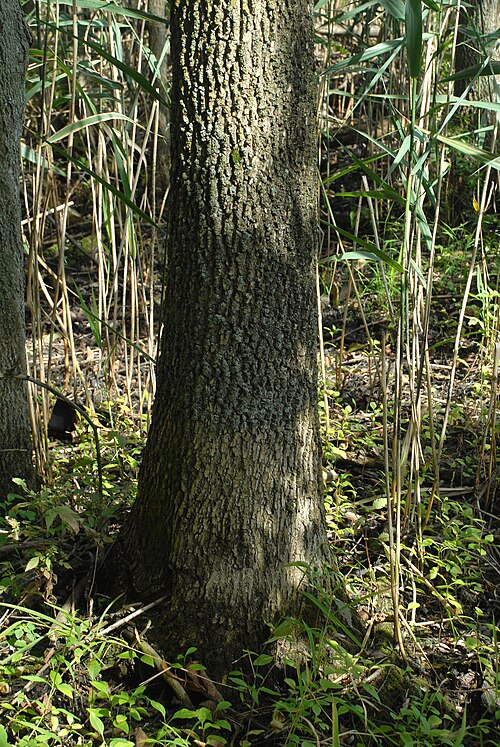
Bark is gray-brown with a tight, diamond-shaped furrowed pattern similar to other ashes, becoming thicker and more deeply ridged with age. Young twigs, leaf stalks, and leaflet undersides are notably velvety-hairy — a soft, downy texture that is one of the most reliable ways to distinguish Pumpkin Ash from the similar but smooth-twigged Green Ash.
Leaves
Leaves are pinnately compound, 10 to 18 inches long — notably large for a native ash — with 7 (occasionally 5 to 9) stalked leaflets 3 to 6 inches long. Leaflets are broadly lance-shaped to elliptic, with margins ranging from entire to obscurely toothed, dark green above and pale, often velvety-hairy beneath. Fall color is an unremarkable pale yellow.
Flowers
Pumpkin Ash is dioecious. Small, petal-less, purplish flowers emerge in dense clusters in early spring before the leaves, wind-pollinated and easily overlooked.
Fruit & Seeds
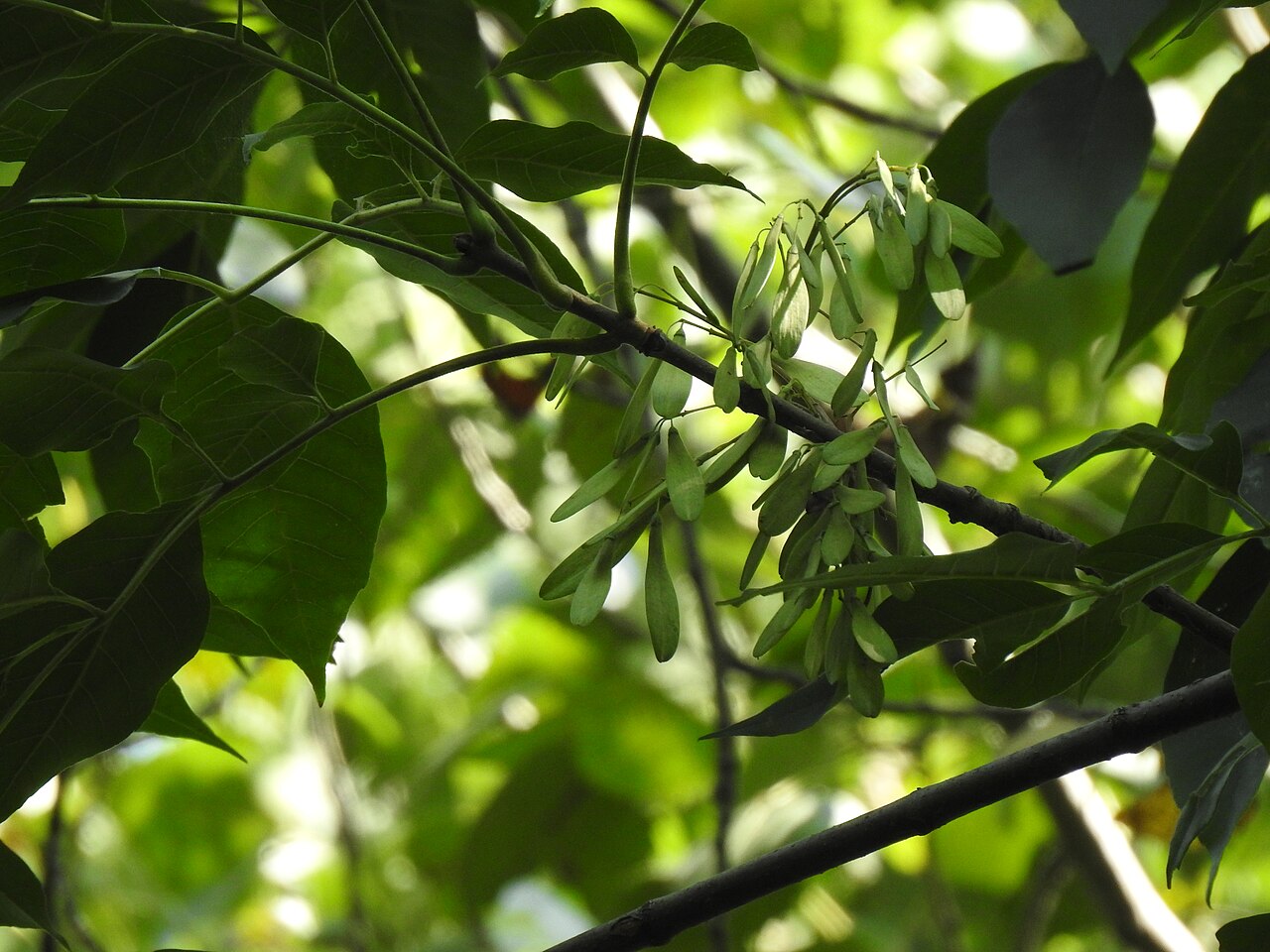
The winged samara is large for an ash, 2 to 3 inches long, narrow and strap-shaped, with the wing extending only partway down the flattened seed body. Samaras hang in dense clusters and mature in late summer to fall, dispersing by wind and, in flooded sites, by water.
Quick Facts
| Scientific Name | Fraxinus profunda |
| Family | Oleaceae (Olive) |
| Plant Type | Deciduous Tree |
| Mature Height | 80–100 ft |
| Mature Spread | 30–45 ft |
| Growth Rate | Moderate |
| Sun Exposure | Full Sun to Part Shade |
| Water Needs | Wet; tolerates seasonal to prolonged flooding |
| Soil Type | Wet clay, muck, or silty bottomland alluvium |
| Soil pH | 5.0–7.0 |
| Bloom Time | March – April |
| Flower Color | Purplish (inconspicuous) |
| Fall Color | Pale yellow |
| Fruit | Narrow winged samara, 2–3 in |
| Deer Resistant | No (deer browse seedlings and low growth) |
| USDA Hardiness Zones | 5–9 |
Native Range
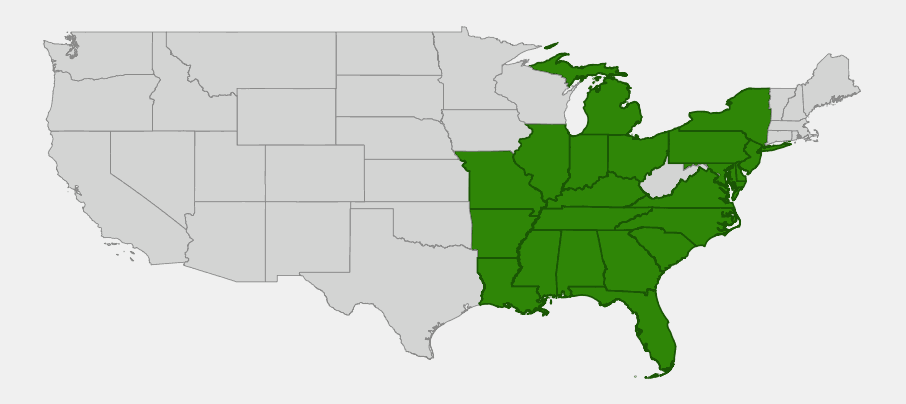
Pumpkin Ash has a scattered, discontinuous range across the eastern United States. It occurs along the Atlantic coastal plain from southern New York and New Jersey south through Delaware, Maryland, Virginia, and the Carolinas to Georgia and northern Florida, and west along the Gulf Coast through Alabama, Mississippi, and Louisiana. A second, inland population follows the Mississippi and Ohio River valleys through Missouri, Arkansas, Illinois, Indiana, Kentucky, Tennessee, and into southern Michigan and Ohio, with Pennsylvania also within its range.
Throughout this range, Pumpkin Ash is confined to the wettest bottomland sites: swamp forests, river floodplains, and backwater sloughs that flood seasonally or stand in water for much of the growing season. It is typically uncommon even within suitable habitat, occurring as scattered individuals or small groups rather than dense stands, which makes it a conservation priority in several states.
Because confirmed populations are scattered and sometimes very local, always verify suitability with a county-level source such as BONAP or a state natural heritage program before planting outside a documented local population.
📋 Regional plant lists featuring Pumpkin Ash: Georgia, Alabama & Mississippi · Arkansas, Louisiana, Eastern Oklahoma & Eastern Texas (Arkansas and Louisiana only) · North Carolina & South Carolina · Maryland, Virginia & West Virginia (not native in West Virginia) · Kentucky & Tennessee · Ohio & Indiana · Illinois, Iowa & Missouri (not native in Iowa) · Michigan, Wisconsin & Eastern Minnesota (Michigan only) · Delaware, Southern New Jersey & Long Island, New York · New York, Pennsylvania & Northern New Jersey (no dedicated Florida list exists on this site; Pumpkin Ash is also native in the Florida panhandle)
Growing & Care Guide
Pumpkin Ash is a large tree for a large, consistently wet site — a bottomland restoration planting, a pond or wetland margin with room to grow, or a floodplain reforestation project. It is not suited to typical residential lots given its mature size and strict wet-soil requirement.
Light
Grows best in full sun to light shade. Seedlings tolerate the partial shade of an open swamp canopy, but mature trees need good light to reach their full height and produce seed well.
Soil & Water
Pumpkin Ash requires consistently wet soil and tolerates seasonal to prolonged flooding better than almost any other ash. It grows in heavy wet clay, muck, and silty bottomland alluvium, and performs poorly on dry or average upland soils — a site that floods for weeks at a time during the growing season is well within its tolerance.
Planting Tips
Plant container or bare-root stock in late winter to early spring on a site with documented seasonal flooding. Because of its eventual large size, allow 30 to 40 feet between trees in a restoration planting, and keep it well away from structures or utility lines. Protect young trees from deer browse with tree shelters until well established.
Pruning & Maintenance
Minimal pruning is needed beyond removing dead or storm-damaged wood. Monitor closely for signs of emerald ash borer — thinning canopy, D-shaped exit holes, woodpecker damage, and epicormic sprouting on the trunk — and report suspected infestations to local extension or forestry services, since Pumpkin Ash populations are already uncommon in many states.
Propagation
Propagated from seed, which requires cold-moist stratification to break dormancy. Because wild populations are scattered and often small, seed collection for restoration work should prioritize genetic diversity across as many source trees as possible.
Landscape Uses
Pumpkin Ash is appropriate for a narrow set of large-scale plantings:
- Bottomland hardwood forest restoration on seasonally to permanently flooded sites
- Floodplain and riparian reforestation along rivers and backwaters
- Large wetland or constructed-wetland plantings with room for a canopy tree
- Conservation plantings aimed at preserving genetic diversity in an uncommon species
Wildlife & Ecological Value
As a canopy-forming tree of eastern bottomland swamp forests, Pumpkin Ash contributes significant habitat structure wherever it still occurs in numbers.
For Pollinators
The early, wind-pollinated spring flowers are not a major nectar resource, but Pumpkin Ash hosts a range of native insects that depend on ash species generally, including several moth larvae.
For Birds
Cavity-nesting birds and woodpeckers use mature trunks, and the large canopy provides nesting and foraging habitat for songbirds within the bottomland forest; the abundant samaras are eaten by some seed-eating birds in fall and winter.
For Mammals
Deer browse seedlings and low branches, which can be a significant establishment challenge in restoration plantings; squirrels and other small mammals feed on the samaras when accessible.
Ecosystem Role
As one of the largest trees able to tolerate prolonged flooding, Pumpkin Ash is an important structural component of bottomland hardwood forests, contributing to the canopy layer alongside Bald Cypress, Water Tupelo, and Overcup Oak in the wettest forest zones. Its swollen trunk base helps stabilize soil in flood-prone sites, and the tree’s decline from emerald ash borer in parts of its range is a significant concern for bottomland forest ecologists tracking cascading effects on swamp forest structure.
Cultural & Historical Uses
Pumpkin Ash wood has seen limited commercial use, historically harvested alongside Green Ash and other commercial ashes for tool handles, furniture, and baseball bats where accessible stands existed, though its scattered distribution in difficult-to-access swamp terrain has always limited large-scale harvest compared to upland ash species.
The common name references the distinctive swollen, “pumpkin-shaped” buttress that forms at the base of mature trees in flooded sites — a feature that has long attracted the attention of foresters and naturalists documenting unusual tree forms in southern swamp forests.
Today, Pumpkin Ash draws the most attention from conservation biologists and foresters concerned about the spread of emerald ash borer, which threatens to further reduce an already uncommon and scattered species. Several states track Pumpkin Ash populations as a conservation priority, and seed-banking efforts are underway in parts of its range to preserve genetic diversity.
Frequently Asked Questions
How can you tell Pumpkin Ash from Green Ash?
Pumpkin Ash has notably larger leaves and leaflets, densely velvety-hairy young twigs and leaf undersides, and — in flooded sites — a dramatically swollen, buttressed trunk base. Green Ash (Fraxinus pennsylvanica) has smaller leaves, generally hairless or only sparsely hairy twigs, and tolerates much drier soils.
Is Pumpkin Ash endangered?
It is not federally listed, but it is uncommon and scattered throughout its range, and several states track it as a species of conservation concern. The spread of emerald ash borer has added new pressure on an already uncommon tree.
How big does Pumpkin Ash get?
It is the largest native swamp ash, typically reaching 80 to 100 feet, with exceptional champion trees recorded well over 100 feet tall and with trunk circumferences exceeding 15 feet at the swollen base.
Can Pumpkin Ash be planted outside a swamp?
Not successfully in most cases. It is a strict wetland species that needs consistently wet to seasonally flooded soil; planting it in average upland garden conditions is unlikely to succeed long-term.
Is Pumpkin Ash affected by emerald ash borer?
Yes — like other native Fraxinus species, it is highly susceptible. Given its already scattered populations, monitoring and conservation plantings are especially important for this species.

Looking for a nursery that carries Pumpkin Ash?
Browse our native plant nursery directory: Alabama & Arkansas · Delaware, Florida & Georgia · Illinois & Indiana · Kentucky, Louisiana, Maryland, Michigan, Mississippi & Missouri · New Jersey, New York, North Carolina & Ohio · Pennsylvania, South Carolina, Tennessee & Virginia
For other bottomland swamp associates, see our pages on Black Gum, Overcup Oak, and Water Hickory. For more on native tree planting, see our overview of the benefits of planting native trees and our guide to planting native trees for wildlife.

