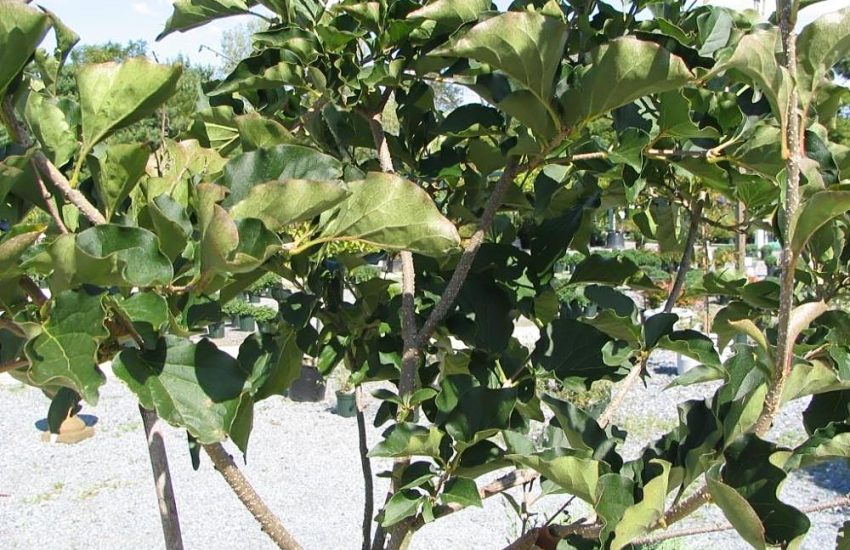
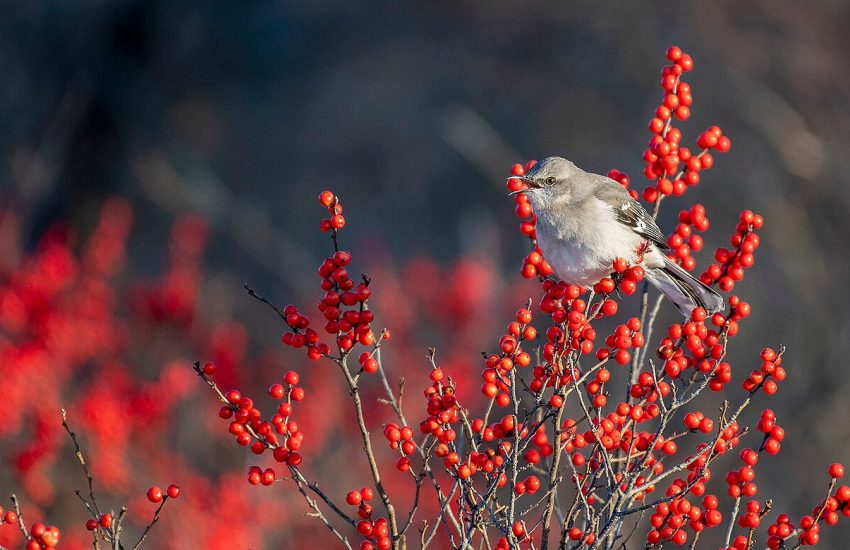
Winterberry Holly With No Berries: Matching Flowering and Pollination
Last updated: November 6, 2026
Your winterberry holly leafed out, grew well, and maybe even flowered. Now the leaves are dropping, and the red berries you planted it for never showed up.
With winterberry, the cause is usually not a disease or a feeding problem. It is a matchmaking problem. This shrub needs the right partner, blooming at the right time, close enough for bees to carry pollen between them.
This guide works through the pollination side first, because it explains most bare winterberries. Then it covers the site and care issues that can stop a well-pollinated plant from holding its crop.
The Short Answer
Winterberry (Ilex verticillata) has separate male and female plants. Only females make berries, and only when a male of the same species blooms nearby at the same time. A shrub with no berries usually has one of these problems:
- It’s a male plant. Males never fruit, no matter how healthy they are.
- There’s no male nearby, or the only one is too far away.
- The male blooms at a different time than the female (early and late cultivars don’t overlap well).
- Too much shade or dry soil during bloom, which cuts flowering or causes young fruit to drop.
- Pruning that removed flowering shoots.
- Berries that formed and were eaten before you looked.
How Winterberry Sets Fruit
Like most hollies, winterberry is dioecious: each plant carries either male or female flowers. Both sexes bloom, and the flowers look similar from a distance. They are small, white, and easy to miss among the leaves.
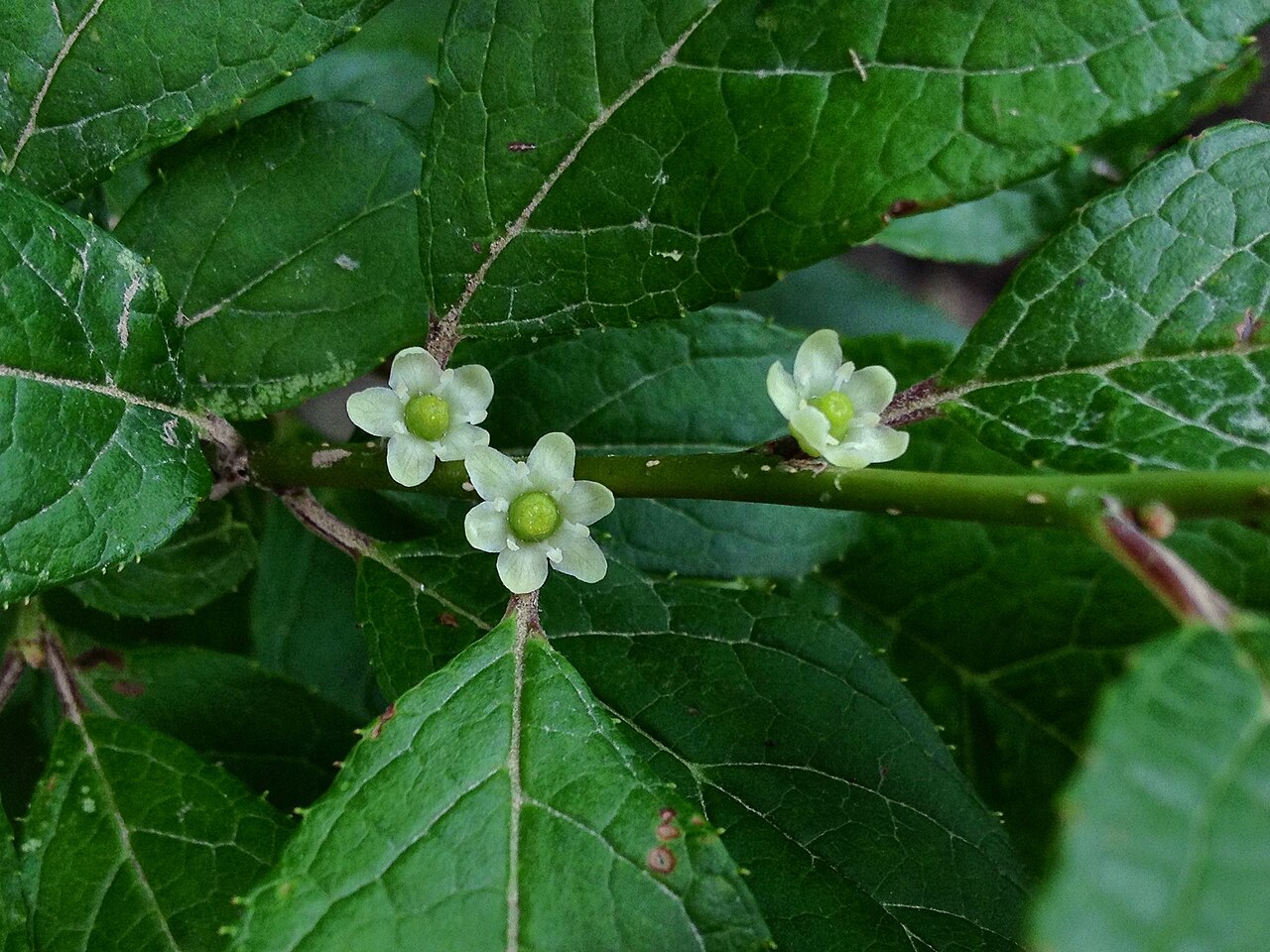
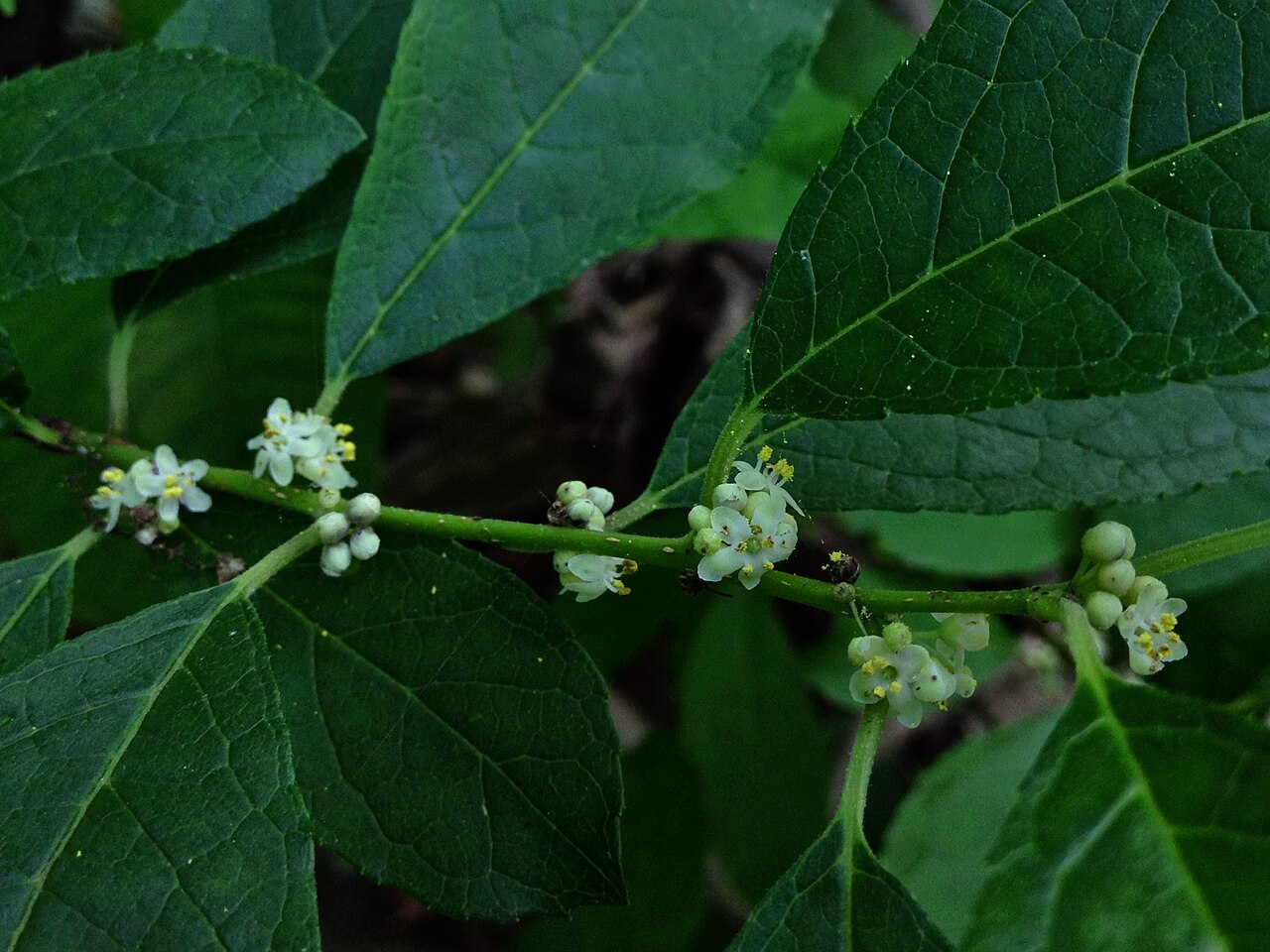
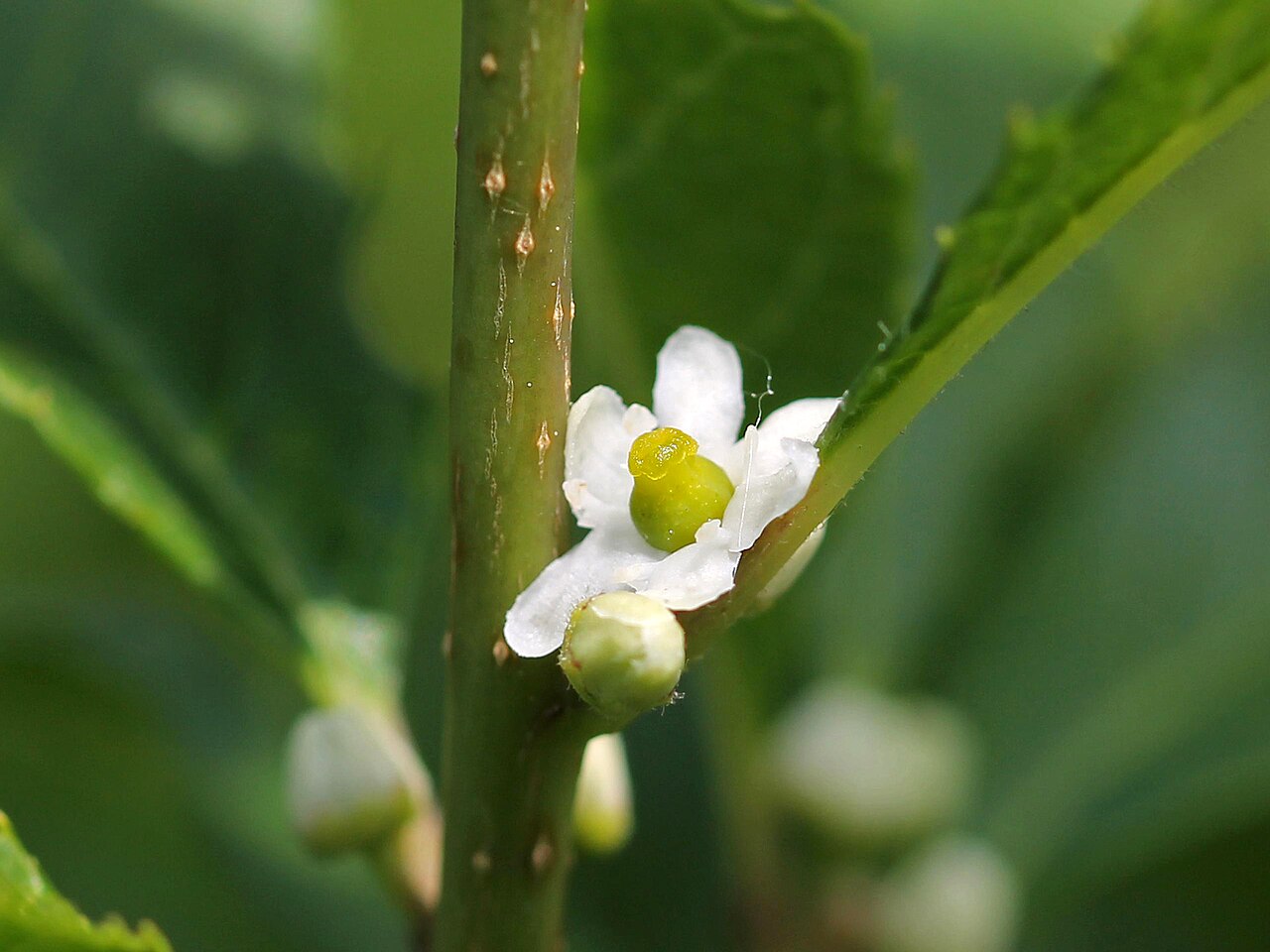
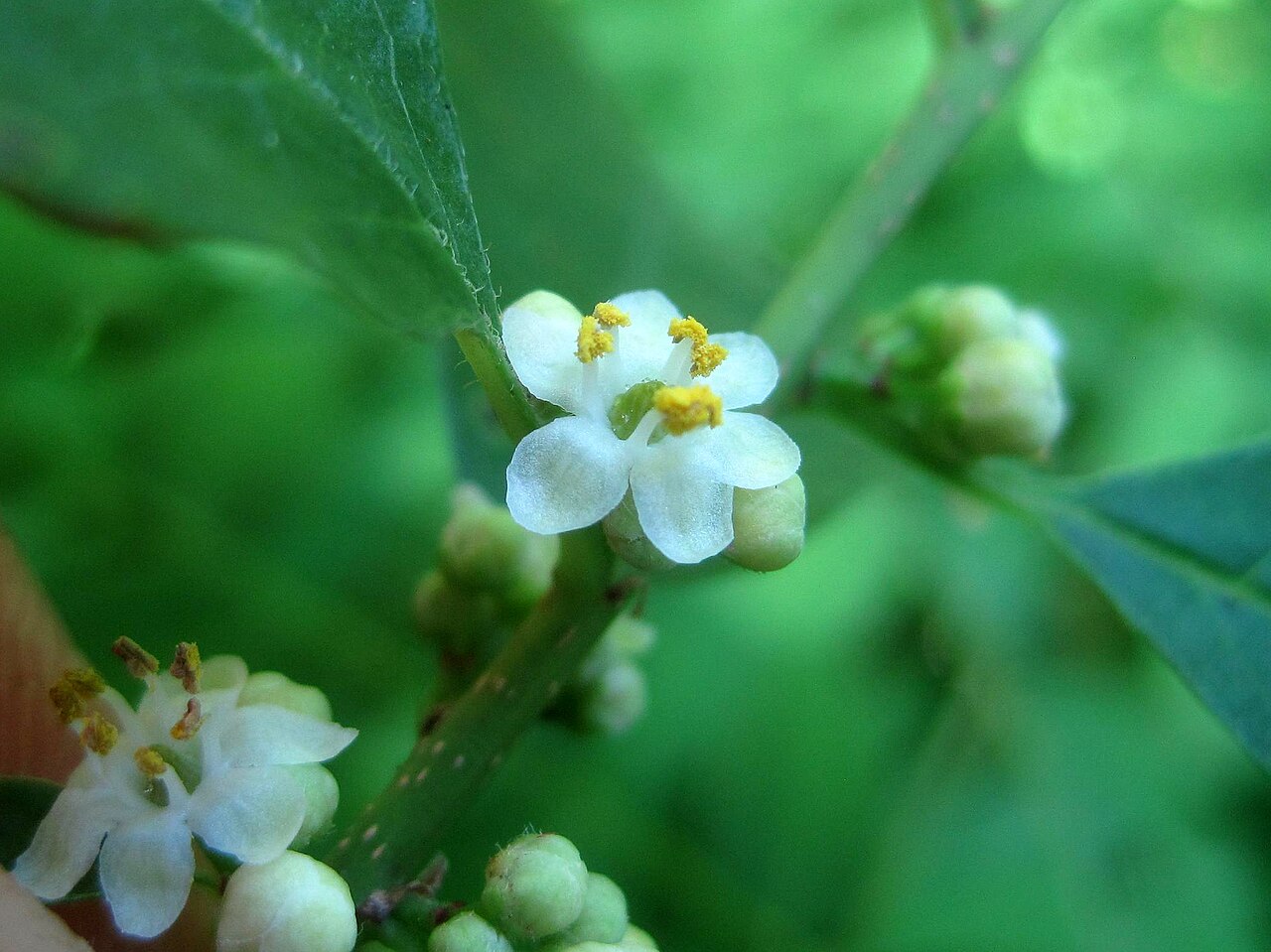
Up close they differ. Female flowers sit singly or in twos and threes along the stem, each with a plump green ovary in the center. Male flowers come in crowded clusters, with yellow-tipped stamens sticking out of each one.
Pollen has to travel from a male flower to a female flower, and bees do that work. Bumble bees, mining bees, sweat bees, and small carpenter bees have been recorded at the flowers. Each pollinated female flower can then swell into a single berry that stays green all summer and colors up in fall.
The Winterberry Fruiting Year
| Spring | New shoots and leaves expand. Flower buds develop along the young growth. |
| Late spring – midsummer | Bloom. Sources give windows from April to July depending on region and cultivar. Each plant flowers over a few weeks. |
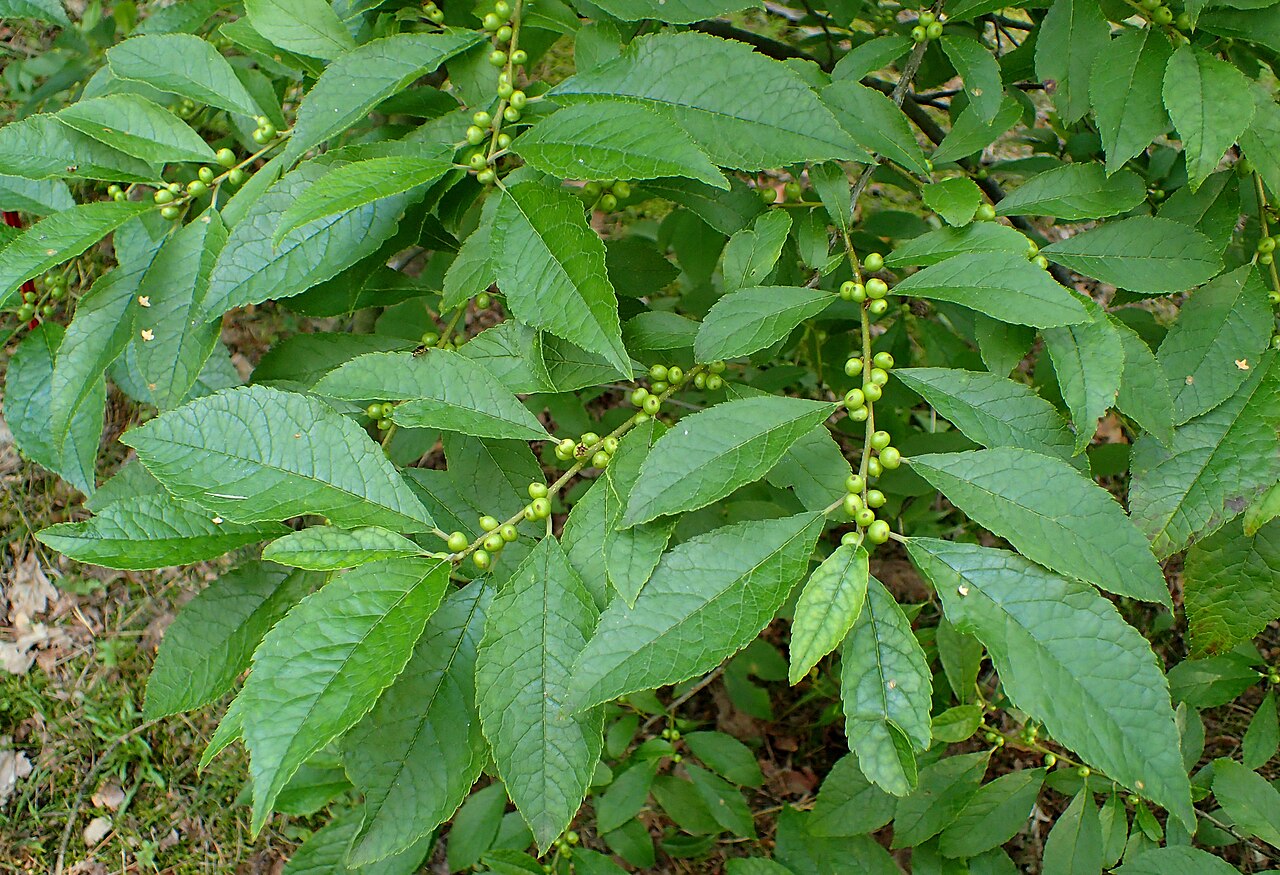
| Summer | Pollinated female flowers become small green berries in the leaf axils. |
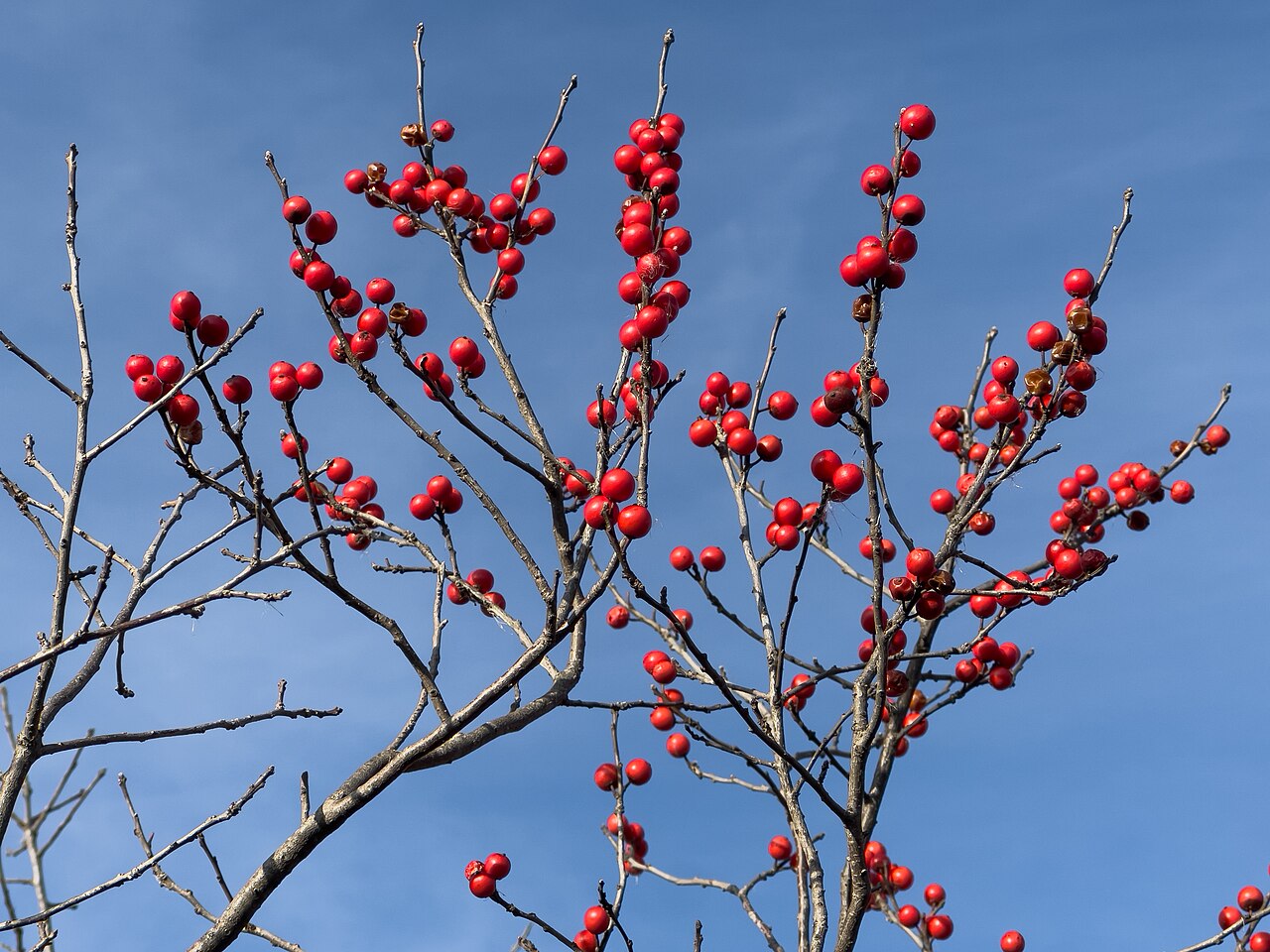
| Early – mid fall | Berries turn red (orange or yellow in some cultivars). Leaves yellow and drop. |
| Winter | Berries hang on bare stems until birds eat them or weather damages them. |
Check 1: Is Your Plant Male or Female?
This is the first thing to rule out. Garden centers sell males as pollinators, and unlabeled seedling plants can be either sex. A healthy shrub that has never fruited in several years may simply be a male.
The only reliable test is to look at the flowers while they’re open. Use a hand lens or your phone camera’s zoom.
- Female: a green, rounded ovary in the middle of the flower, topped by a flat stigma. Flowers are scattered singly or in small groups.
- Male: no swollen green center. Instead, stamens with yellow pollen-bearing tips reach out from each flower. Flowers are packed into dense bunches.
Female flowers do carry small, sterile stamen-like structures between the petals, so look for the green ovary rather than just “something in the middle.”
If you missed bloom this year, check the old nursery tag. Common male cultivars include ‘Jim Dandy’, ‘Southern Gentleman’, ‘Apollo’, and ‘Raritan Chief’. Female cultivars include ‘Red Sprite’, ‘Winter Red’, ‘Sparkleberry’, ‘Berry Heavy’, and many others.
Check 2: Is There a Male Close Enough?
A female winterberry with no male nearby will flower and then drop its unfertilized flowers. Nothing else will fix that.
Look for males in your own yard first, then around the neighborhood. Wild winterberry in a nearby wetland may also be doing the job. The Lady Bird Johnson Wildflower Center notes that some gardeners plant a single female and rely on a male somewhere nearby, though that’s a gamble.
How close is close enough? Sources vary, so treat these as guidelines rather than hard limits:
- University of Minnesota Extension: one male within 40 feet can pollinate about 20 females. Beyond 40 feet, about four to five.
- University of Maryland Extension: at least one male for up to 10 females, within 50 feet.
- NC State Extension: one male per 10 to 20 females, within 50 feet.
- Piedmont Master Gardeners (Virginia): one male for three to six or more females, within 40 to 50 feet.
The practical takeaway: if your only male is across the yard, behind the house, or more than about 50 feet away, move it closer or add another one. Closer is better, and a male in the same bed is the safest arrangement.
The male also has to be winterberry. The Wildflower Center notes that the pollinator must be the same species as the female. A nearby evergreen holly, or even the similar southern deciduous holly, isn’t a substitute you can count on.
Check 3: Do the Bloom Times Overlap?
This is the most common hidden cause in planted landscapes. You bought a female and a male together, they’re 10 feet apart, and you still get few berries.
Winterberry cultivars fall roughly into early-blooming and late-blooming groups. An early male may finish shedding pollen before a late female opens. The University of Maryland Extension puts it simply: the more overlap between male and female bloom, the better the berry production.
Here are the pairings that extension sources and the University of Connecticut Plant Database give most often:
Common Male–Female Pairings
| ‘Jim Dandy’ (early male) | ‘Red Sprite’, ‘Afterglow’, ‘Aurantiaca’, Berry Heavy®, Berry Nice®, and other early females |
| ‘Southern Gentleman’ (late male) | Winter Red®, ‘Winter Gold’, and other late females; Maryland and Minnesota Extension also pair it with ‘Sparkleberry’ |
| ‘Apollo’ (late male, hybrid) | ‘Sparkleberry’ and ‘Bonfire’ (both I. verticillata × I. serrata hybrids); also listed for Winter Red® and ‘Red Sprite’ |
| ‘Raritan Chief’ (long bloom) | Listed for ‘Harvest Red’ and many deciduous holly hybrids because it flowers over a long period |
Sources don’t always agree. ‘Cacapon’, for example, appears with ‘Jim Dandy’ in some lists and ‘Southern Gentleman’ in others. If you’re unsure, plant one early male and one late male.
To check your own plants, note the dates when each one opens its first flowers and when the last flowers fade. If the male is done before the female starts, or the reverse, that’s your answer.
Check 4: Did It Get Enough Sun?
Winterberry tolerates shade, but it doesn’t fruit well there. The UConn Plant Database says it plainly: more sun means more fruit on females. Piedmont Master Gardeners also report that full sun gives better berry production.
Shade often creeps in over the years as nearby trees grow, so a shrub that fruited well when it was planted may taper off later.
If your shrub sits under a growing canopy, consider limbing up the trees or moving the winterberry. Young plants can be moved in early spring or fall.
Check 5: Was the Soil Dry During Bloom or Early Fruit?
In the wild, winterberry grows in swamps, along streams, and around ponds. It handles average garden soil, but it doesn’t like drying out while it’s flowering and setting fruit.
NC State Extension notes that winterberry may abort fruit set in dry soil. A University of Maryland Extension answer goes further. It reports winterberries shedding foliage, flowers, or unripe berries when they get a bit too dry between waterings, even before they wilt.
If green berries formed and then vanished in midsummer, especially during a dry spell, drought is the likely cause. That Maryland answer suggests checking the soil about five inches down next to the roots. If it’s dry at that depth, water thoroughly.
Very alkaline soil can also stress the plant. Minnesota Extension notes yellowing leaves when soil pH is above 6.5. A soil test is worth doing if leaves stay pale and growth is weak.
Check 6: Was It Pruned at the Wrong Time?
Flowers appear along the young shoots in late spring. Shearing in spring or early summer removes those shoots, and the flowers go with them.
Sources disagree on one detail. Some describe winterberry as flowering on new growth; others say the buds form the year before. Either way, the safe approach is the same: do any structural pruning in late winter, before growth starts, and thin whole stems rather than shearing the tips. Our guide to pruning an overgrown winterberry lays out a staged plan.
Cutting berried branches for holiday decorations counts as pruning too. Take them from different parts of the shrub, not all from one side.
Check 7: Were There Berries You Didn’t See?
Before you give up on this year, rule out a crop that was eaten. Birds often pass winterberry over in fall and eat it later in winter. But a flock of hungry American robins or cedar waxwings can strip a shrub in a matter of hours.
Look closely at the twigs. Tiny leftover fruit stalks in the leaf axils mean berries were there. If you see them, the shrub did its job, and the issue is timing and wildlife, not pollination.
Troubleshooting at a Glance
| Flowers with no green center, in dense clusters | Male plant. Keep it as a pollinator and add a female. |
| Female flowers, but no green berries by midsummer | No male nearby, or bloom times don’t overlap. Add a matching male within about 40–50 feet. |
| Few flowers at all | Too much shade, recent spring pruning, or a stressed plant. |
| Green berries that dropped in summer | Drought stress during fruit set. Check soil moisture a few inches down. |
| Berries formed and colored, then vanished | Wildlife or weather. See why winterberry berries disappear. |
| Pale yellow leaves and weak growth | Check soil pH; winterberry wants acidic soil. |
What to Do Now
If it’s a male: keep it. It’s pollinating something, maybe your neighbor’s shrub. Add one or more females of a matching bloom period within a few dozen feet.
If it’s a female with no partner: buy a male with matching timing and plant it as close as practical. Ask the nursery which females it’s meant for.
If you have both and still get few berries: compare bloom dates next year. If they don’t overlap, add a second male of the other timing. If they do overlap, look at sun and summer water.
If you don’t know what you have: wait for flowers and look closely. The pollination problem looks a lot like the flower-but-no-fruit problem on other dioecious and cross-pollinated shrubs. Our spicebush pollination troubleshooting guide uses the same male-or-female check.
A Season-by-Season Plan for Next Year
- Late winter: make any thinning cuts now, at the base. Note whether nearby trees have grown and cut into the shrub’s sun.
- Spring: plant a new male or female if needed, close to its partner. Mulch and keep the soil evenly moist.
- Bloom (late spring – midsummer): check flowers to confirm each plant’s sex. Write down when the male and female each start and finish blooming. Avoid insecticide sprays on blooming plants.
- Summer: water deeply in dry spells. Look for green berries in the leaf axils by midsummer.
- Fall – winter: enjoy the color. Watch for flocks of fruit-eating birds, and cut decorative branches evenly from around the shrub.
📋 More on this plant: read the full Winterberry Holly (Ilex verticillata) profile, or find it in our native plant lists for New Hampshire, Maine & Vermont, Connecticut, Massachusetts & Rhode Island, New York, Pennsylvania & Northern New Jersey, Delaware, Southern New Jersey & Long Island, Maryland, Virginia & West Virginia, North Carolina & South Carolina, Georgia, Alabama & Mississippi, Kentucky & Tennessee, Ohio & Indiana, Michigan, Wisconsin & Eastern Minnesota, and Arkansas, Louisiana, Eastern Oklahoma & Eastern Texas.
Frequently Asked Questions
Do you need a male and female winterberry to get berries?
Yes. Winterberry is dioecious, so female plants fruit only when pollen from a male winterberry reaches them. The male must bloom at the same time and be reasonably close; extension guidelines range from about 40 to 50 feet.
How can I tell if my winterberry is male or female?
Look at open flowers. Females have a green, rounded ovary in the center and grow singly or in small groups. Males grow in crowded clusters and show yellow-tipped stamens instead of a green center.
Will any holly pollinate my winterberry?
Don’t count on it. The Lady Bird Johnson Wildflower Center says the male must be the same species as the female and bloom at the same time. Choose a winterberry male whose bloom period matches your female cultivar.
Why did my winterberry have berries last year but not this year?
Compare what changed: a male removed or damaged, spring pruning, a dry spell during bloom, more shade, or birds eating the crop early. A one-year gap with a healthy plant often traces back to weather or wildlife rather than pollination.
Can one male winterberry pollinate several females?
Yes. Minnesota Extension estimates one male can pollinate about 20 females within 40 feet. Farther away, it may cover only four or five. Other sources give lower ratios, so plant extra males if your females are spread out.
Sources
- University of Minnesota Extension, Winterberry: male-to-female ratios and distances, cultivar pairings, pH above 6.5 and leaf yellowing.
- University of Maryland Extension, Winterberry Holly: bloom overlap, one male per up to 10 females within 50 feet, early and late pairings.
- North Carolina Extension Gardener Plant Toolbox, Ilex verticillata: one male per 10 to 20 females within 50 feet, fruit aborted in dry soil, flowers on new growth.
- University of Connecticut Plant Database, Ilex verticillata, Common Winterberry: male and female flower arrangement, more sun means more fruit, cultivar pollinators.
- Piedmont Master Gardeners (Virginia), Winterberry Holly: flower differences between sexes, pollination ratios, full sun for better berries, cultivar pairings.
- Lady Bird Johnson Wildflower Center, Ilex verticillata: same-species male blooming at the same time, bloom months, native range.
- Ask Extension (University of Maryland Extension answer), Winterberry holly disease: drought-related shedding of flowers and unripe berries, checking soil moisture about five inches down, conflicting bud-timing references.
- The Natural Web, Where do Winterberries Come From?: female flower structure, sterile stamens, bee visitors, and birds stripping shrubs.