
Grass Pink (Calopogon tuberosus)
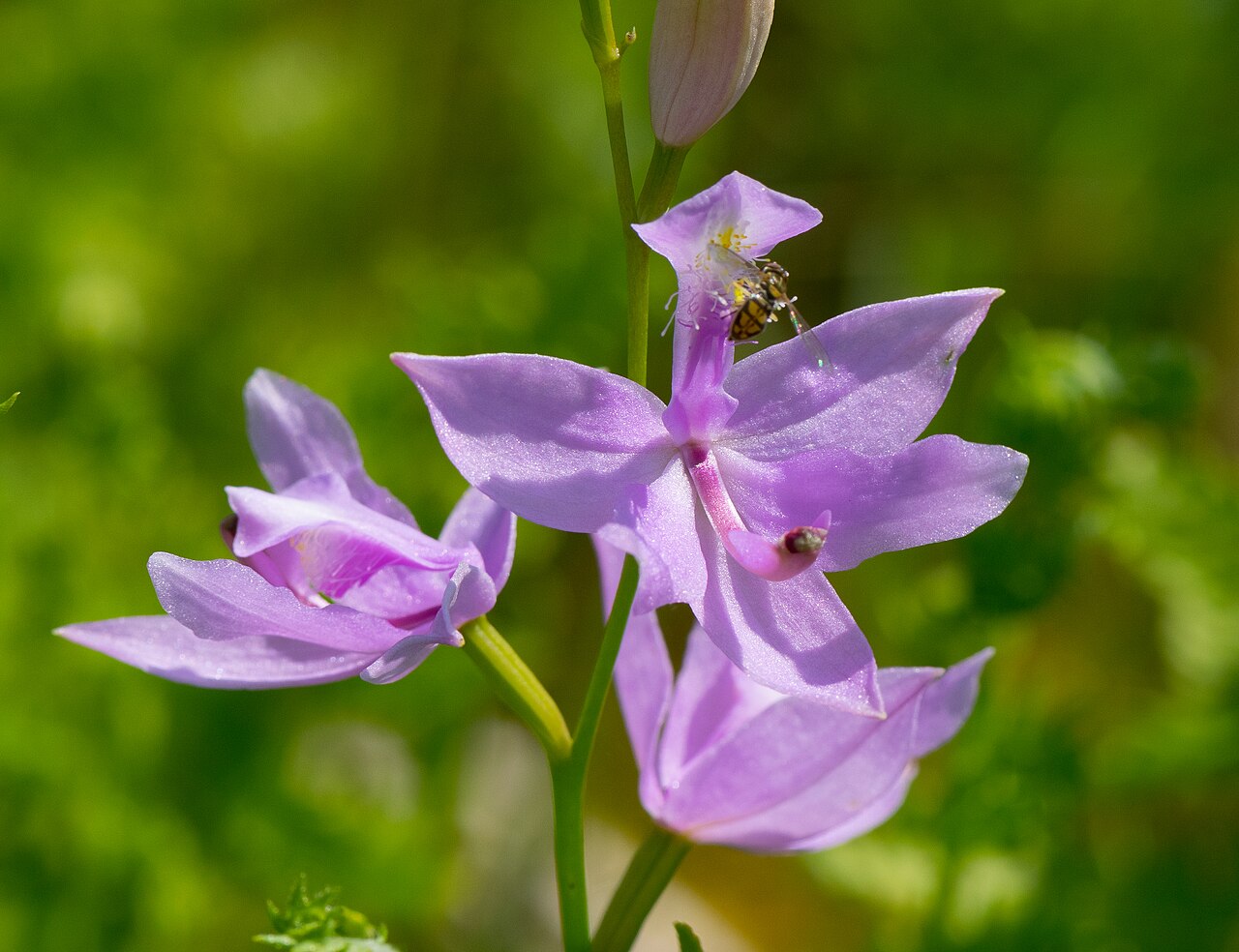
Calopogon tuberosus, known as Grass Pink or tuberous grass-pink, is one of the showiest native orchids of eastern North America. A single grass-like leaf and a slender stalk rise from a small underground corm, and in late spring or early summer the stalk opens a loose spike of magenta-pink flowers, each about 1 to 1½ inches across. It belongs to the orchid family (Orchidaceae) and grows in sunny, wet, open places: sphagnum bogs, fens, wet pine savannas and flatwoods, seepage slopes and the edges of ponds.
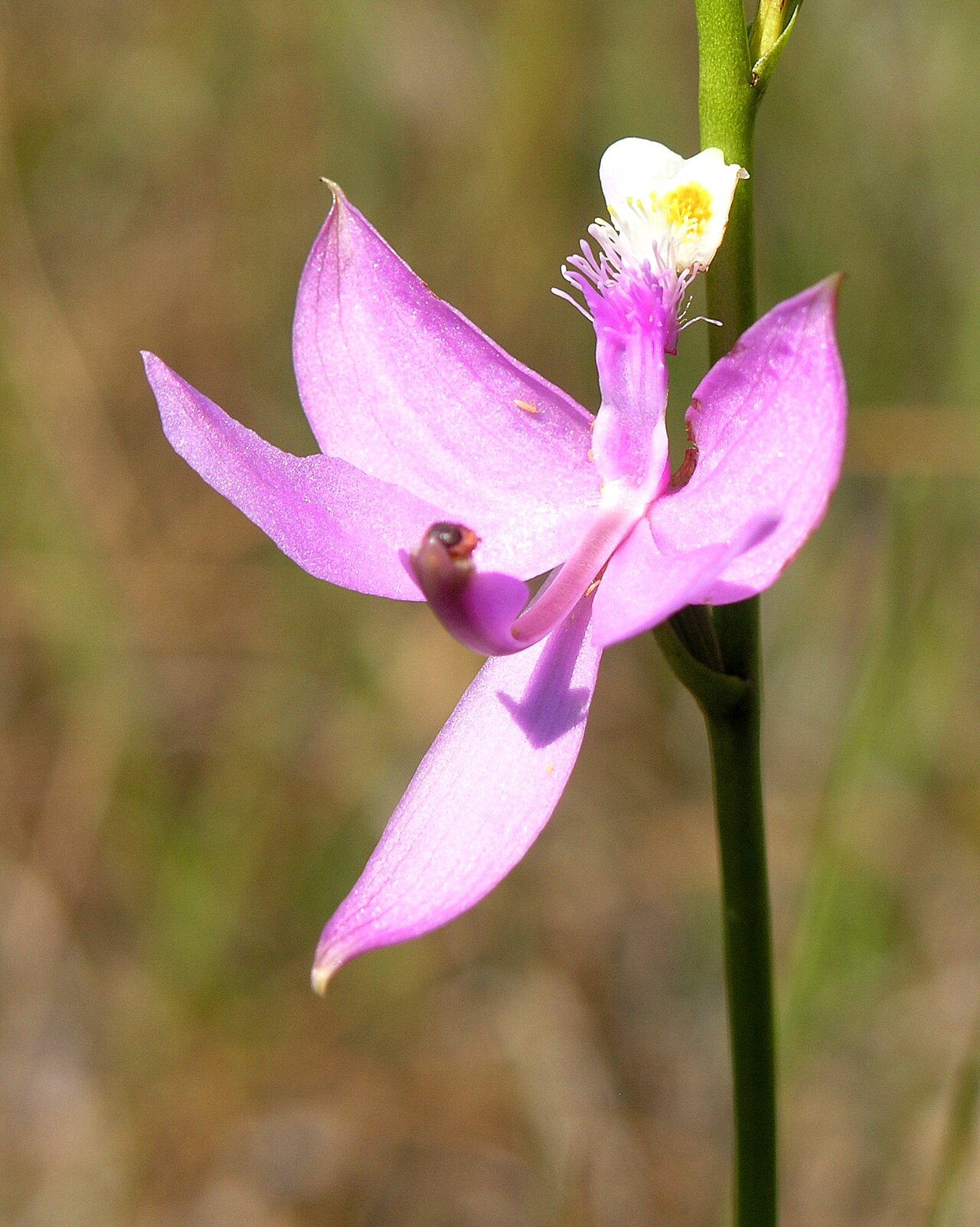
What makes grass pink easy to recognize is that its flowers are upside down compared with most orchids. The lip, which in most orchids hangs at the bottom as a landing platform, sits at the top of the grass pink flower. It is decorated with a brush of club-shaped hairs tipped in yellow, the “beautiful beard” behind the genus name Calopogon (Greek kalos, beautiful, and pogon, beard). Those hairs look like a cluster of pollen-rich stamens. In fact the flower offers no nectar or loose pollen at all, and it relies on deceiving young bees.
Grass pink ranges from Newfoundland and Manitoba south to Florida and eastern Texas, so it is one of the most widespread native orchids in the East. It is still a plant of shrinking habitats, though. Bogs and wet savannas have been drained, paved, and shaded out by woody plants after decades without fire. This guide covers how to identify it, where it grows, how gardeners can grow it responsibly from nursery-propagated stock, and how it fits into the ecology of fire-maintained wetlands.
Identification
Grass pink is a small plant when not in flower, and it is easy to overlook among sedges and grasses. In bloom it is unmistakable. Only a handful of other Calopogon species grow in the Southeast, and they differ mainly in flower size, bloom time, and the order in which the flowers open.
Corm & Stems
Each plant grows from a small, rounded corm (the “tuber” of the species name) buried a few inches deep in wet peat or sand. Every year the corm produces a new one beside it, and old corms wither, so a single plant can slowly form a small clump. The flowering stalk is slender, smooth, green to purplish, and usually 12 to 30 inches tall. On vigorous plants in rich bogs it can reach 3 feet or more.
Leaves
Usually there is a single leaf, sometimes two. It is narrow and grass-like, keeled, up to about 12 to 20 inches long and generally less than an inch wide. It sheathes the base of the flowering stem and appears in spring before flowering. Without flowers the plant looks almost exactly like a blade of grass or a young sedge, hence the common name. In south Florida, plants with very narrow leaves are often separated as var. simpsonii.
Flowers
The spike carries 2 to about 15 flowers (rarely more). They open from the bottom upward over several weeks, so a plant is usually in bloom with buds above and fading flowers below. Each flower is magenta-pink to lilac, occasionally pale pink or white, with three spreading sepals and two petals that form a loose star 1 to 1½ inches wide. The lip is on top: a narrow claw that widens into a triangular blade covered in hairs, with white and pink bases and bright yellow or orange tips. The column, which holds the pollen, curves downward from the center of the flower and has a broad, winged tip.
Grass pink flowers have only a slight fragrance. In Florida they open from late winter into spring, and in the Northeast, Great Lakes and Canada mostly in June and July.
Fruit & Seeds
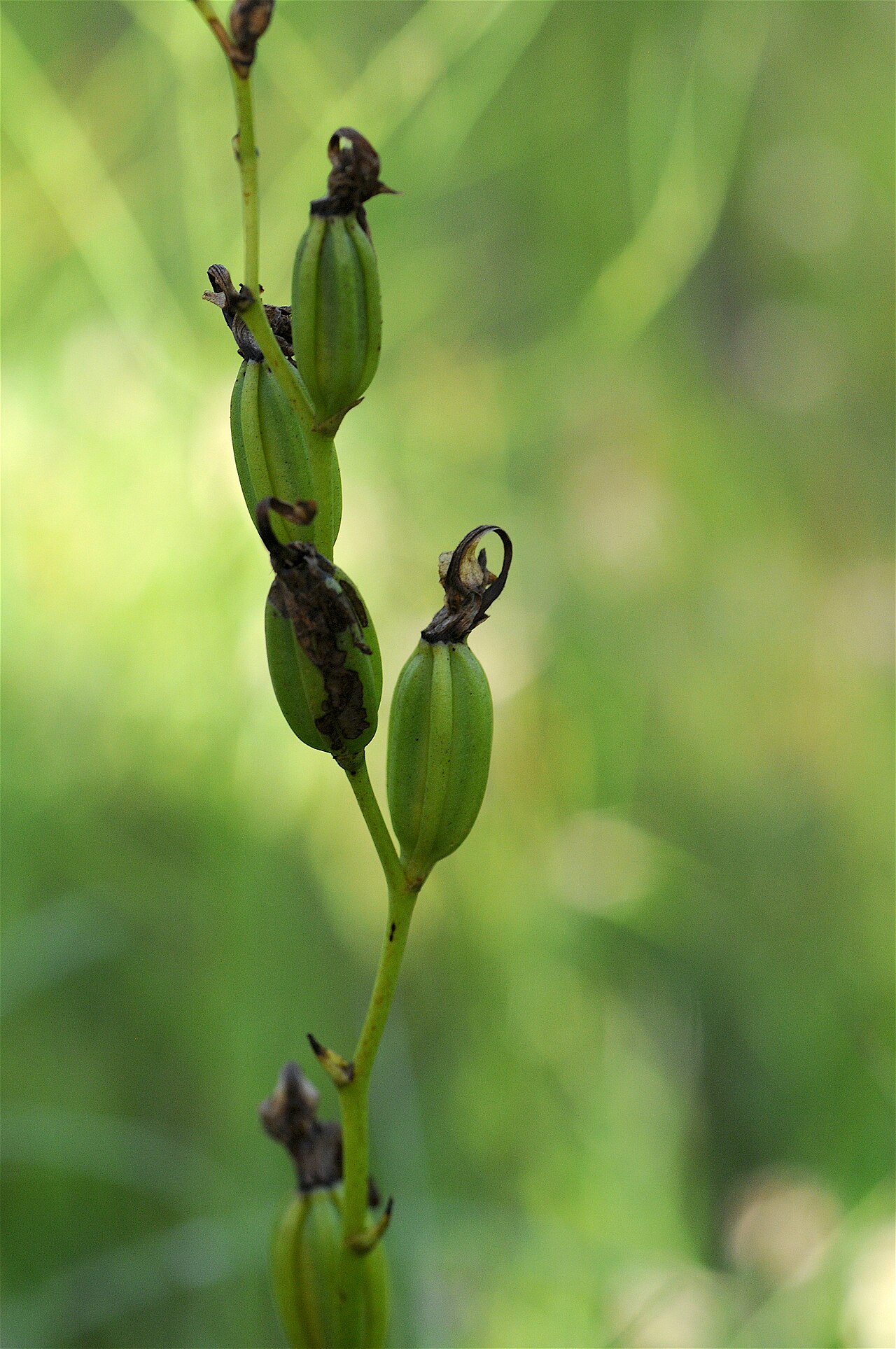
Pollinated flowers ripen into upright, ribbed, cylindrical capsules about an inch long. When dry they split along their ribs and release thousands of dust-fine seeds, which drift on the wind. Like all orchid seeds they have almost no stored food, and they can only germinate after a compatible soil fungus colonizes them and supplies sugars. This is why grass pink appears unpredictably in new sites and why it cannot be raised from seed in an ordinary seed tray.
Quick Facts
| Scientific Name | Calopogon tuberosus (syn. C. pulchellus, Limodorum tuberosum) |
| Family | Orchidaceae (orchid family) |
| Plant Type | Terrestrial orchid; herbaceous perennial from a corm |
| Mature Height | 12–30 in in flower (occasionally to about 3 ft or more in rich bogs) |
| Mature Spread | 3–6 in per plant; slowly forms small clumps |
| Growth Rate | Slow |
| Sun Exposure | Full sun to light shade |
| Water Needs | High; soil must stay wet to saturated during the growing season |
| Soil Type | Sphagnum peat, wet sand or peaty sand; also marl and fen soils |
| Soil pH | About 4.5–7.0 (acid bogs to near-neutral fens) |
| Bloom Time | March–May in Florida; May–July farther north |
| Flower Color | Magenta-pink to lilac; rarely pale pink or white |
| Fall Color | None; the leaf withers and the corm goes dormant |
| Fruit | Upright ribbed capsule with dust-like seeds |
| Deer Resistant | No; deer and rabbits sometimes eat the flowering stalks |
| USDA Hardiness Zones | 3–10 |
Native Range
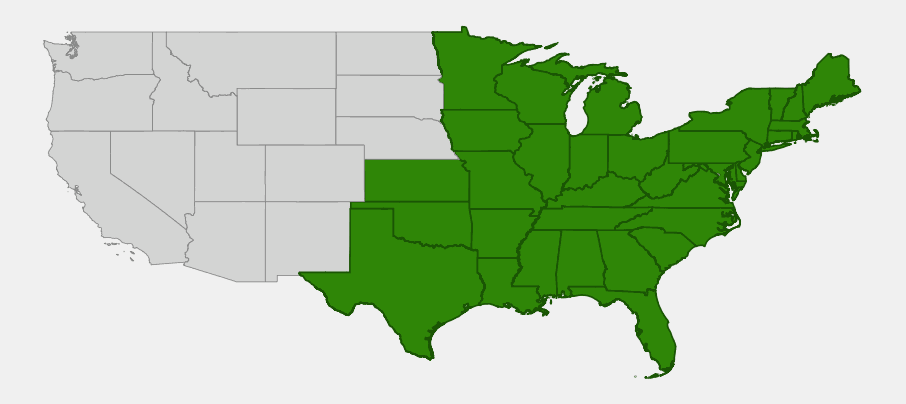
Grass pink has a broad eastern North American range. USDA PLANTS and the Lady Bird Johnson Wildflower Center record it from 34 states and the District of Columbia, from Maine and the Great Lakes south to Florida and west to Minnesota, Iowa, Kansas, Oklahoma and eastern Texas. In Canada it grows from Manitoba and Ontario east through Quebec to the Maritime provinces and Newfoundland, and it reaches the French islands of Saint Pierre and Miquelon. Beyond North America it extends to the Bahamas and Cuba.
Within this range it is truly common only where suitable wetlands are common. The richest populations are on the Atlantic and Gulf Coastal Plain, in pine savannas, flatwoods and seepage bogs from New Jersey’s Pine Barrens to Florida and eastern Texas, and in the glaciated bog and fen country of the Great Lakes states and southern Canada. In the interior South and lower Midwest it is patchy, limited to scattered fens, seeps and acid barrens, and it is rare at the western edge of its range in Kansas, Oklahoma and Iowa.
Two varieties are often recognized. The widespread var. tuberosus covers almost the whole range. Var. simpsonii, with very narrow leaves and often paler flowers, grows in the marl prairies and wet pinelands of south Florida, including the Everglades, and in the Bahamas and Cuba. Some botanists treat it as a separate species.
📋 Regional plant lists featuring Grass Pink: North & South Florida · Alabama, Georgia & Mississippi · North & South Carolina · Maryland, Virginia & West Virginia · Kentucky & Tennessee · Arkansas, Louisiana, Eastern Oklahoma & Eastern Texas · Illinois, Iowa & Missouri · Ohio & Indiana · Nebraska, Kansas & Eastern Colorado · Michigan, Wisconsin & Eastern Minnesota · New York, Pennsylvania & Northern New Jersey · Delaware, Southern New Jersey & Long Island · Connecticut, Massachusetts & Rhode Island · New Hampshire, Maine & Vermont
Growing & Care Guide
Grass pink is one of the few native orchids that ordinary gardeners can grow, but only in a properly built bog garden and only from nursery-propagated plants. Wild plants almost never survive being dug, and taking them damages populations that are already declining. Several specialist nurseries now raise grass pink from seed in sterile lab culture, and these plants adapt to garden bogs far better than collected corms.
Light
Give grass pink full sun or, at most, a few hours of light shade. In the wild it disappears once shrubs and trees close over a bog or savanna. Plants in too much shade make leaves but stop flowering.
Soil & Water
The growing medium should be low in nutrients and constantly wet: a mix of about two parts sphagnum peat to one part coarse, lime-free sand works well in a lined bog garden or a large container without drainage holes. The water table should stay within an inch or two of the surface from spring through fall. Use rainwater or other water low in dissolved minerals where possible, since hard, mineral-rich tap water slowly raises pH and salts. Never fertilize. Rich soil favors weeds and fungal rot, not orchids.
Planting Tips
Plant dormant corms in fall or early spring about 1 to 2 inches deep, with the pointed growing tip upward. Potted plants can go in during spring. Set them among low companions such as pitcher plants, sundews and small sedges rather than in bare peat, which dries and crusts at the surface. Mark their locations, because the plants vanish completely in late summer and are easy to dig into by mistake.
Pruning & Maintenance
Grass pink needs little care beyond keeping the bog wet and open. Pull out aggressive grasses, sedges and seedlings of red maple, wax myrtle and other shrubs that would shade it. In the wild, periodic fire does this work. Leave flowering stalks to ripen seed if you want volunteers. Otherwise cut them back after bloom. Mulch is unnecessary; a living carpet of sphagnum is the ideal cover.
Propagation
Established plants slowly increase by producing extra corms, which can be separated while dormant. Growing from seed requires sterile lab culture (asymbiotic flasking) or careful sowing with a compatible fungus, and it is best left to specialist nurseries. Seed scattered on a mature, moss-covered bog garden sometimes produces surprise seedlings after a few years.
Landscape Uses
- Bog gardens: the classic companion for pitcher plants, sundews and other carnivorous plants
- Wet savanna and wetland restoration: in fire-managed pine savannas and seepage bogs within its native range, using propagated stock
- Container bogs: a large tub or lined half-barrel kept wet makes a small but effective orchid display
- Pond and lake margins: in sunny, wet, nutrient-poor shoreline peat
- Native orchid collections: one of the most forgiving hardy terrestrial orchids for beginners
Wildlife & Ecological Value
Grass pink is a small plant, but it tells a lot about the health of a wetland. Where it flowers abundantly, the bog or savanna usually still has its natural water levels, low nutrients and open, sunny conditions.
For Pollinators
The flower is a well-studied example of deceptive pollination. It produces no nectar, and its yellow-tipped hairs imitate pollen. Young bumblebees, carpenter bees and other bees that have not yet learned the trick land on the lip, which is hinged at its base. Under the weight of a bee large enough to be an effective pollinator, the lip swings down and drops the insect onto the column, where pollen masses stick to its back. Small bees and flies are often too light to trip it. Because bees soon learn that the flower offers no reward, grass pink depends on a steady supply of naive insects and often flowers alongside rewarding plants such as meadow beauties and milkworts.
For Birds
Grass pink has no direct food value for birds. It grows in habitats that matter to wetland and savanna birds, though, including Bachman’s sparrows and Henslow’s sparrows in pine savannas and sedge wrens in northern fens and wet meadows.
For Mammals
Deer and rabbits sometimes nip off flowering stalks, and voles may eat corms. The plant is otherwise of little importance to mammals.
Ecosystem Role
Like all orchids, grass pink depends on soil fungi for germination, and young plants grow underground for a year or more, fed by fungal partners, before producing a leaf. In the Southeast it is adapted to frequent fire. Corms survive underground while fires burn off competing vegetation, and plants often flower heavily in the season after a burn. Its decline across much of its range is mostly due to drainage, fire suppression, and the woody growth that follows.
Cultural & Historical Uses
Linnaeus described grass pink in 1753 as Limodorum tuberosum from specimens sent from North America. Robert Brown later created the genus Calopogon for it in 1813, choosing a name that celebrates the bearded lip. For much of the twentieth century it was known as Calopogon pulchellus, and that name still appears in older field guides and state floras.
There is little record of Native American use of this orchid, which is not surprising for a plant with a tiny corm and scattered populations. Its cultural importance is mainly as a symbol of wild bogs. For generations of naturalists in New England, the Great Lakes and the Coastal Plain, finding the first grass pinks in a sphagnum bog has marked early summer. The New Jersey Pinelands Commission lists it among the 27 native orchids that grow in the Pine Barrens.
Today grass pink is a favorite of native orchid growers and conservation programs. Because it germinates readily in sterile culture and flowers within a few years, it is used to teach orchid propagation and is one of the few native orchids widely available as legally propagated plants. Buying those plants, rather than collected ones, is one of the simplest ways gardeners can help protect wild populations.
Frequently Asked Questions
Is grass pink hard to grow?
It is easy if you can provide a permanently wet, sunny, nutrient-poor bog, and nearly impossible in ordinary garden soil. Start with nursery-propagated plants, use a peat and sand mix kept saturated with low-mineral water, and keep taller plants from shading it.
Why are grass pink flowers “upside down”?
Most orchid flower buds twist 180 degrees as they open, which puts the lip at the bottom. Grass pink buds do not twist, so the lip stays on top. The arrangement is part of its pollination trick: a bee lands on the lip at the top, and its weight swings the lip down onto the column.
Can I dig grass pink from the wild?
No. Collected plants rarely survive transplanting, and digging harms wild populations, some of which are protected by state law. Buy plants raised from seed in lab culture by reputable native orchid nurseries.
Is grass pink the same as swamp pink?
Not usually. “Swamp pink” is sometimes used as a local name for grass pink, but it more often refers to Helonias bullata, a federally threatened lily relative of Atlantic Coast bogs. Using the scientific name avoids confusion.
When does grass pink bloom?
In Florida it can bloom from late winter into spring, and along the Gulf Coast mainly in April and May. In the Northeast, Great Lakes states and southern Canada it flowers mostly in June and July. Each plant blooms for several weeks as its flowers open one after another.

Looking for a nursery that carries Grass Pink?
Browse our native plant nursery directory: Alabama & Arkansas · Connecticut, Delaware, Florida & Georgia · Illinois, Indiana, Iowa & Kansas · Kentucky, Louisiana, Maine, Maryland, Massachusetts, Michigan, Minnesota, Mississippi & Missouri · New Hampshire, New Jersey, New York, North Carolina, Ohio & Oklahoma · Pennsylvania, Rhode Island, South Carolina, Tennessee, Texas, Vermont & Virginia · West Virginia & Wisconsin